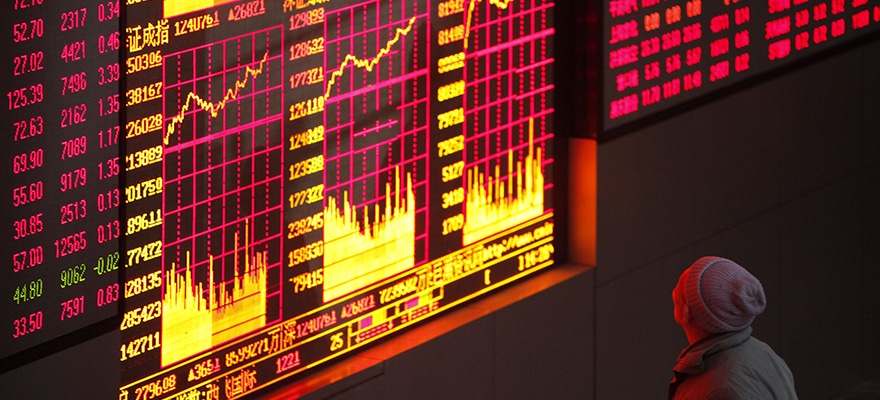
Chinese brokers have received a substantial lifeline to help temper a market free-fall that has roiled Chinese stock markets over the past month, according to a recent FT report.
The timeline of Chinese equities’ tumble has caused great concern amongst investors, given such a meteoric rise and staunch decline some weeks later. As a result, the Chinese government is attempting to alleviate the decline, buttressing the market in a bid to foster confidence from investors as questions of sustainability abound.
In particular, China’s biggest state-owned banks have managed to put together an aid package worth $209 billion (RMB1.3 trillion) to the country’s margin finance agency, China Securities Finance Corp (CSF). Established in 2011 to help lend to securities brokerages, the CSF has maintained a critical position in supporting margin lending to investors.
Markets on Life Support?
A stock market bubble is not a new phenomenon to any national Stock Exchange
Stock Exchange
A stock exchange, also known as a securities exchange or bourse represents is a facility where stockbrokers and traders can buy and sell securities.This includes shares of stock, bonds, exchange-traded funds (ETFs), or other financial instruments. By extension, stock exchanges can also provide facilities for the issue and redemption of such securities and instruments and capital events including the payment of income and dividendsStock exchanges have developed into a permanent fixture in the fin
Read this Term, however the schizophrenic behavior of the Chinese markets, namely the Shanghai Composite Index, has called into question the level of state support behind subsequent rallies. Indeed, following an Exchange
Exchange
An exchange is known as a marketplace that supports the trading of derivatives, commodities, securities, and other financial instruments.Generally, an exchange is accessible through a digital platform or sometimes at a tangible address where investors organize to perform trading. Among the chief responsibilities of an exchange would be to uphold honest and fair-trading practices. These are instrumental in making sure that the distribution of supported security rates on that exchange are effectiv
Read this Term-wide plunge of 32%, the Shanghai Index has since rallied nearly 15% in subsequent weeks, suggesting a false dawn of sorts, fueled exclusively by state-injected support.
Behind the scenes, CSF has extended emergency financing to brokerages to support their investment in shares, whilst also purchasing mutual funds directly. In addition, China’s Caijing has loaned RMB186 billion, with five of the country’s largest banks extending another RMB100 billion in loans in a concerted effort to help assist the CSF.
According to Larry Hu, China economist at Macquarie Securities, in a recent statement on the lending, “I think what the PBoC wants to achieve is like ‘do whatever it takes’, as said by European Central Bank President Mario Draghi to boost confidence, but no need to really print money to buy stocks. They want to do easing, but not this way."
In any scenario, the central bank lends on a regular basis to commercial banks via an assortment of mechanisms, such that the People’s Bank of China (PBoC) could have provided extra funds to support commercial banks’ loans to the CSF.
However, by extension, burden of national service put on China’s commercial banks is not too extensive, namely as loans to the CSF carry little inherent risk. At the time of writing, the Shanghai Composite closed at 3,957.35, up 3.51% Friday after bottoming out below 3,700 earlier this week.
Chinese brokers have received a substantial lifeline to help temper a market free-fall that has roiled Chinese stock markets over the past month, according to a recent FT report.
The timeline of Chinese equities’ tumble has caused great concern amongst investors, given such a meteoric rise and staunch decline some weeks later. As a result, the Chinese government is attempting to alleviate the decline, buttressing the market in a bid to foster confidence from investors as questions of sustainability abound.
In particular, China’s biggest state-owned banks have managed to put together an aid package worth $209 billion (RMB1.3 trillion) to the country’s margin finance agency, China Securities Finance Corp (CSF). Established in 2011 to help lend to securities brokerages, the CSF has maintained a critical position in supporting margin lending to investors.
Markets on Life Support?
A stock market bubble is not a new phenomenon to any national Stock Exchange
Stock Exchange
A stock exchange, also known as a securities exchange or bourse represents is a facility where stockbrokers and traders can buy and sell securities.This includes shares of stock, bonds, exchange-traded funds (ETFs), or other financial instruments. By extension, stock exchanges can also provide facilities for the issue and redemption of such securities and instruments and capital events including the payment of income and dividendsStock exchanges have developed into a permanent fixture in the fin
Read this Term, however the schizophrenic behavior of the Chinese markets, namely the Shanghai Composite Index, has called into question the level of state support behind subsequent rallies. Indeed, following an Exchange
Exchange
An exchange is known as a marketplace that supports the trading of derivatives, commodities, securities, and other financial instruments.Generally, an exchange is accessible through a digital platform or sometimes at a tangible address where investors organize to perform trading. Among the chief responsibilities of an exchange would be to uphold honest and fair-trading practices. These are instrumental in making sure that the distribution of supported security rates on that exchange are effectiv
Read this Term-wide plunge of 32%, the Shanghai Index has since rallied nearly 15% in subsequent weeks, suggesting a false dawn of sorts, fueled exclusively by state-injected support.
Behind the scenes, CSF has extended emergency financing to brokerages to support their investment in shares, whilst also purchasing mutual funds directly. In addition, China’s Caijing has loaned RMB186 billion, with five of the country’s largest banks extending another RMB100 billion in loans in a concerted effort to help assist the CSF.
According to Larry Hu, China economist at Macquarie Securities, in a recent statement on the lending, “I think what the PBoC wants to achieve is like ‘do whatever it takes’, as said by European Central Bank President Mario Draghi to boost confidence, but no need to really print money to buy stocks. They want to do easing, but not this way."
In any scenario, the central bank lends on a regular basis to commercial banks via an assortment of mechanisms, such that the People’s Bank of China (PBoC) could have provided extra funds to support commercial banks’ loans to the CSF.
However, by extension, burden of national service put on China’s commercial banks is not too extensive, namely as loans to the CSF carry little inherent risk. At the time of writing, the Shanghai Composite closed at 3,957.35, up 3.51% Friday after bottoming out below 3,700 earlier this week.