White label tech helps prop firms launch fast, but it often comes at a high cost and reduced control over risk, branding, and infrastructure.
Building in-house tech gives flexibility and control, but many prop firms underestimate the complexity, cost, and staffing required.
White label solution providers are quick to point out the challenges of building a prop trading platform, but leading firms tell FinanceMagnates.com that this approach still comes with limitations in terms of flexibility, cost and risk management.
As we recently reported, growth in prop trading is enabling non-bank liquidity providers to compete effectively with banks despite the latter’s dominance of market making activities.
According to broker solutions vendors, using a ready-made system enables prop firms to tap into this lucrative market much more quickly and without the hassle of finding and retaining in-house development teams.
Most of the entrepreneurs who want to be prop firm operators have a background in brokerage, sales, marketing and/or social influence rather than technology, says Justin Hertzberg, CEO FPFX Tech.
Justin Hertzberg, CEO of FPFX Tech, Source: LinkedIn
“The pattern we are seeing is very similar to what has happened in the brokerage space over the past decade,” he adds. “Most brokers are licensing their foundational technologies and focusing more of their efforts on client acquisition, marketing differentiation and brand value. They aren't spending time or money developing their own trading platforms, liquidity bridges or CRM/client areas.”
Given that he comes from a technology and consulting background, Blueberry Funded managing director, Marcus Fetherston, says he has seen many firms jump into building their own technology to save costs only to find out that it is far from easy.
Marcus Fetherston, Blueberry Funded’s General Manager (photo: LinkedIn)
“Prop CRMs—unlike brokerage CRMs—require intricate, near real-time data handling and automation and any bugs during development can seriously impact the business,” he observes. “Most firms still lean heavily on white label solutions for CRMs, trading platforms and bridges. That said, more established firms often partially own or heavily customise their tech stacks to maintain flexibility, margins and branding control.”
E8 Markets believes that owning and continuously improving its in-house technology allows it to deliver a tailored, stable and scalable experience that evolves with traders' needs without being held back by vendor limitations, says Chief Growth Officer, Yavuz Karadeniz.
Yavuz Karadeniz, Director of Community Development at E8 Markets
“That said, we recognise the value of third party solutions in areas where trader preference matters, such as widely adopted trading platforms,” he adds. “While our core infrastructure is built in-house, we selectively integrate external tools that enhance the overall experience without compromising control.”
Upside Funding also operates a mix of white label and in-house development explains CEO and founder, Charles Finkelstein.
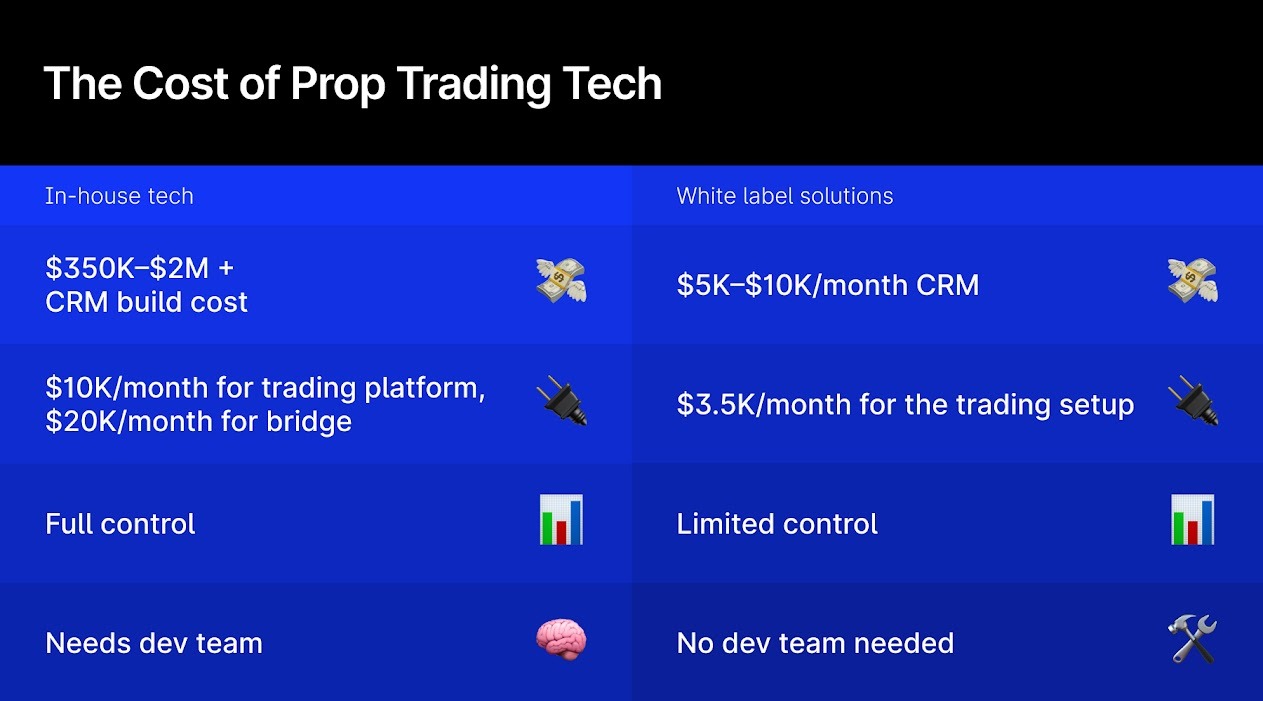
“A trade execution platform licence like MetaTrader 5 typically costs around $10,000 a month and (the events of) last year taught the industry that you probably want to be diversified,” he says. “You then need a bridge—the best provider in the market costs $20,000 a month, or you can white label, give up some control but pay around $3,500 a month.”
Charles Finkelstein, CEO and founder of Upside Funding
On the CRM/trader dashboard, Finkelstein suggests it could cost between $350,000 and $2 million to build a platform before taking into account staffing costs compared to between $5,000 and $10,000 a month for a white label solution.
“Payment solutions are another headache for prop firm owners,” he adds. “We have more than a dozen different solutions and some firms have more. We felt it was best to outsource this rather than manage each provider ourselves, finding a payment orchestrator that packages it for us.”
Simone Nateri, Chief Operating Officer at City Traders Imperium acknowledges that as the industry has evolved, companies have emerged offering robust white label solutions.
Simone Nateri, Chief Operating Officer at City Traders Imperium (Photo: LinkedIn)
“However, it is important to acknowledge a significant trade-off,” he says. “Relying on external providers means white labelled prop firms have less control over their technological infrastructure. This can pose risks, particularly in areas like risk management where the control often resides with the technology provider rather than the trading firm itself. For traders, this could mean adjustments in terms and conditions that are not always aligned with their expectations.”
“Exorbitant” Profit Sharing Models
David Dombrowsky, CEO & founder of FX2 Funding is even more critical, suggesting that white label technology providers have been demanding “exorbitant” profit sharing models that he says make it increasingly difficult for prop firms to succeed under that structure.
David Dombrowsky, CEO and Founder of FX2 Funding
He is also sceptical that the profile of the typical prop trader has changed significantly following recent new platform launches.
“What I have seen is a growing portion of the market attempting to hedge, cheat or game the system,” says Dombrowsky. “If a firm doesn’t place strong emphasis on risk management, these groups will exploit it and they can quickly overwhelm a poorly protected model.”
Hertzberg refers to significant growth in overall awareness of prop trading and client acquisition, as well as the increasing tension that exists with prop firms and brokerages competing for the same customer and the finite amount of investable dollars those customers have to spend on their trading activity.
“But the profile of prop traders hasn't changed too much over the past five years,” he says. “The demographics are similar to those seen at brokerages, although the average age is skewed a bit younger as the newer generation of traders are enamoured by the lower barriers to entry in prop trading and the greater upside it has to offer over self-funded trading accounts.”
Karadeniz reckons traders are becoming more disciplined and risk-aware, adapting their strategies to align with structured rules and long term sustainability rather than aggressive gains, while Fetherston references an influx of traders from underserved regions like Asia, Africa and South America, driven by platform, pricing and payment options that offer region-specific accessibility.
“We have also seen an increase in average trader profitability in the industry,” he says. “Prop trading often gives traders the chance to improve their trading since the downside risk is limited compared to trading their own funds, along with having risk parameters that they need to trade around. This aligns with the educational focus we strongly emphasise and means the business model for the prop industry needs to continue developing.”
White label solution providers are quick to point out the challenges of building a prop trading platform, but leading firms tell FinanceMagnates.com that this approach still comes with limitations in terms of flexibility, cost and risk management.
As we recently reported, growth in prop trading is enabling non-bank liquidity providers to compete effectively with banks despite the latter’s dominance of market making activities.
According to broker solutions vendors, using a ready-made system enables prop firms to tap into this lucrative market much more quickly and without the hassle of finding and retaining in-house development teams.
Most of the entrepreneurs who want to be prop firm operators have a background in brokerage, sales, marketing and/or social influence rather than technology, says Justin Hertzberg, CEO FPFX Tech.
Justin Hertzberg, CEO of FPFX Tech, Source: LinkedIn
“The pattern we are seeing is very similar to what has happened in the brokerage space over the past decade,” he adds. “Most brokers are licensing their foundational technologies and focusing more of their efforts on client acquisition, marketing differentiation and brand value. They aren't spending time or money developing their own trading platforms, liquidity bridges or CRM/client areas.”
Given that he comes from a technology and consulting background, Blueberry Funded managing director, Marcus Fetherston, says he has seen many firms jump into building their own technology to save costs only to find out that it is far from easy.
Marcus Fetherston, Blueberry Funded’s General Manager (photo: LinkedIn)
“Prop CRMs—unlike brokerage CRMs—require intricate, near real-time data handling and automation and any bugs during development can seriously impact the business,” he observes. “Most firms still lean heavily on white label solutions for CRMs, trading platforms and bridges. That said, more established firms often partially own or heavily customise their tech stacks to maintain flexibility, margins and branding control.”
E8 Markets believes that owning and continuously improving its in-house technology allows it to deliver a tailored, stable and scalable experience that evolves with traders' needs without being held back by vendor limitations, says Chief Growth Officer, Yavuz Karadeniz.
Yavuz Karadeniz, Director of Community Development at E8 Markets
“That said, we recognise the value of third party solutions in areas where trader preference matters, such as widely adopted trading platforms,” he adds. “While our core infrastructure is built in-house, we selectively integrate external tools that enhance the overall experience without compromising control.”
Upside Funding also operates a mix of white label and in-house development explains CEO and founder, Charles Finkelstein.
“A trade execution platform licence like MetaTrader 5 typically costs around $10,000 a month and (the events of) last year taught the industry that you probably want to be diversified,” he says. “You then need a bridge—the best provider in the market costs $20,000 a month, or you can white label, give up some control but pay around $3,500 a month.”
Charles Finkelstein, CEO and founder of Upside Funding
On the CRM/trader dashboard, Finkelstein suggests it could cost between $350,000 and $2 million to build a platform before taking into account staffing costs compared to between $5,000 and $10,000 a month for a white label solution.
“Payment solutions are another headache for prop firm owners,” he adds. “We have more than a dozen different solutions and some firms have more. We felt it was best to outsource this rather than manage each provider ourselves, finding a payment orchestrator that packages it for us.”
Simone Nateri, Chief Operating Officer at City Traders Imperium acknowledges that as the industry has evolved, companies have emerged offering robust white label solutions.
Simone Nateri, Chief Operating Officer at City Traders Imperium (Photo: LinkedIn)
“However, it is important to acknowledge a significant trade-off,” he says. “Relying on external providers means white labelled prop firms have less control over their technological infrastructure. This can pose risks, particularly in areas like risk management where the control often resides with the technology provider rather than the trading firm itself. For traders, this could mean adjustments in terms and conditions that are not always aligned with their expectations.”
“Exorbitant” Profit Sharing Models
David Dombrowsky, CEO & founder of FX2 Funding is even more critical, suggesting that white label technology providers have been demanding “exorbitant” profit sharing models that he says make it increasingly difficult for prop firms to succeed under that structure.
David Dombrowsky, CEO and Founder of FX2 Funding
He is also sceptical that the profile of the typical prop trader has changed significantly following recent new platform launches.
“What I have seen is a growing portion of the market attempting to hedge, cheat or game the system,” says Dombrowsky. “If a firm doesn’t place strong emphasis on risk management, these groups will exploit it and they can quickly overwhelm a poorly protected model.”
Hertzberg refers to significant growth in overall awareness of prop trading and client acquisition, as well as the increasing tension that exists with prop firms and brokerages competing for the same customer and the finite amount of investable dollars those customers have to spend on their trading activity.
“But the profile of prop traders hasn't changed too much over the past five years,” he says. “The demographics are similar to those seen at brokerages, although the average age is skewed a bit younger as the newer generation of traders are enamoured by the lower barriers to entry in prop trading and the greater upside it has to offer over self-funded trading accounts.”
Karadeniz reckons traders are becoming more disciplined and risk-aware, adapting their strategies to align with structured rules and long term sustainability rather than aggressive gains, while Fetherston references an influx of traders from underserved regions like Asia, Africa and South America, driven by platform, pricing and payment options that offer region-specific accessibility.
“We have also seen an increase in average trader profitability in the industry,” he says. “Prop trading often gives traders the chance to improve their trading since the downside risk is limited compared to trading their own funds, along with having risk parameters that they need to trade around. This aligns with the educational focus we strongly emphasise and means the business model for the prop industry needs to continue developing.”
Paul Golden is an experienced freelance financial journalist with a strong institutional background. Over the past two decades, he has written for globally recognised financial publications, covering topics such as market structure, regulation, trading behaviour, and economic policy.
Webull Spent Big to Hit Record Revenue, and the Bill Is in the Fine Print
FP Markets Winner Spotlight 🏆 | Global Broker of the Year 2025 #Trading #Broker #Innovation #Shorts
FP Markets Winner Spotlight 🏆 | Global Broker of the Year 2025 #Trading #Broker #Innovation #Shorts
FP Markets takes the spotlight as Global Broker of the Year 2025 at the Finance Magnates Awards.
Martin Stoilov, Head of Client Experience, shares that trust, innovation, and people played a key role in the company’s success, supported by a strong foundation of integrity and client-centricity.
Following this milestone, FP Markets continues to focus on growth, technology investment, and its core values of transparency and excellence.
👉 Be part of FM Awards 2026: https://awards.financemagnates.com/#nominate
FP Markets takes the spotlight as Global Broker of the Year 2025 at the Finance Magnates Awards.
Martin Stoilov, Head of Client Experience, shares that trust, innovation, and people played a key role in the company’s success, supported by a strong foundation of integrity and client-centricity.
Following this milestone, FP Markets continues to focus on growth, technology investment, and its core values of transparency and excellence.
👉 Be part of FM Awards 2026: https://awards.financemagnates.com/#nominate
In this video, we review @HolaPrimeMarketsOfficial, a multi-asset forex and CFDs broker offering different account types, trading platforms, and flexible trading conditions.
We cover the broker’s overall offering, including account options, trading environment, platforms like MT4 and MT5, and additional services such as managed accounts and fast withdrawals.
Watch the full video to see if Hola Prime Markets fits your trading needs.
📣 Stay up to date with the latest in finance and trading. Follow Finance Magnates for industry news, insights, and global event coverage.
Connect with us:
🔗 LinkedIn: /financemagnates
👍 Facebook: /financemagnates
📸 Instagram: https://www.instagram.com/financemagnates
🐦 X: https://x.com/financemagnates
🎥 TikTok: https://www.tiktok.com/tag/financemagnates
▶️ YouTube: /@financemagnates_official
#HolaPrime #ForexBroker #CFDTrading #FinanceMagnates #Trading #Forex #BrokerReview
In this video, we review @HolaPrimeMarketsOfficial, a multi-asset forex and CFDs broker offering different account types, trading platforms, and flexible trading conditions.
We cover the broker’s overall offering, including account options, trading environment, platforms like MT4 and MT5, and additional services such as managed accounts and fast withdrawals.
Watch the full video to see if Hola Prime Markets fits your trading needs.
📣 Stay up to date with the latest in finance and trading. Follow Finance Magnates for industry news, insights, and global event coverage.
Connect with us:
🔗 LinkedIn: /financemagnates
👍 Facebook: /financemagnates
📸 Instagram: https://www.instagram.com/financemagnates
🐦 X: https://x.com/financemagnates
🎥 TikTok: https://www.tiktok.com/tag/financemagnates
▶️ YouTube: /@financemagnates_official
#HolaPrime #ForexBroker #CFDTrading #FinanceMagnates #Trading #Forex #BrokerReview
Hola Prime Review: What You Need to Know | Full Breakdown by Finance Magnates
Hola Prime Review: What You Need to Know | Full Breakdown by Finance Magnates
In this video, we review @HolaPrime_Global, a proprietary trading firm offering evaluation programs and performance-based payouts in simulated market environments.
We cover how the challenge model works, including account types, profit splits (up to 95%), trading rules, and what it takes to reach a funded account. You’ll also learn about available platforms like MT4, MT5, cTrader, and more, along with insights into payouts, support, and trading conditions.
Watch the full video to see if Hola Prime fits your trading style.
📣 Stay up to date with the latest in finance and trading. Follow Finance Magnates for industry news, insights, and global event coverage.
Connect with us:
🔗 LinkedIn: /financemagnates
👍 Facebook: /financemagnates
📸 Instagram: https://www.instagram.com/financemagnates
🐦 X: https://x.com/financemagnates
🎥 TikTok: https://www.tiktok.com/tag/financemagnates
▶️ YouTube: /@financemagnates_official
#HolaPrime #PropFirm #Trading #FinanceMagnates #Forex #FuturesTrading #TradingReview #PropFirmReview
In this video, we review @HolaPrime_Global, a proprietary trading firm offering evaluation programs and performance-based payouts in simulated market environments.
We cover how the challenge model works, including account types, profit splits (up to 95%), trading rules, and what it takes to reach a funded account. You’ll also learn about available platforms like MT4, MT5, cTrader, and more, along with insights into payouts, support, and trading conditions.
Watch the full video to see if Hola Prime fits your trading style.
📣 Stay up to date with the latest in finance and trading. Follow Finance Magnates for industry news, insights, and global event coverage.
Connect with us:
🔗 LinkedIn: /financemagnates
👍 Facebook: /financemagnates
📸 Instagram: https://www.instagram.com/financemagnates
🐦 X: https://x.com/financemagnates
🎥 TikTok: https://www.tiktok.com/tag/financemagnates
▶️ YouTube: /@financemagnates_official
#HolaPrime #PropFirm #Trading #FinanceMagnates #Forex #FuturesTrading #TradingReview #PropFirmReview
Axi Winner Spotlight 🏆 | Global Most Innovative Broker 2025 #Innovation #Trading #Fintech #Broker
Axi Winner Spotlight 🏆 | Global Most Innovative Broker 2025 #Innovation #Trading #Fintech #Broker
Axi takes the spotlight at the Finance Magnates Awards, winning Global Most Innovative Broker 2025.
Olivia Xenofontos and Ivanna Openko share how the team will feel: proud, motivated, and ready to keep delivering.
They also describe the night as well-organized, focused, and enjoyable for all.
👉 Be part of FM Awards 2026.
Axi takes the spotlight at the Finance Magnates Awards, winning Global Most Innovative Broker 2025.
Olivia Xenofontos and Ivanna Openko share how the team will feel: proud, motivated, and ready to keep delivering.
They also describe the night as well-organized, focused, and enjoyable for all.
👉 Be part of FM Awards 2026.
Recognition that matters.
Built on transparency.
Driven by the industry.
The Finance Magnates Awards 2026.
Nominations are now open.
🔗 https://awards.financemagnates.com/?utm_source=SM&utm_medium=social&utm_campaign=recognition-matters
Recognition that matters.
Built on transparency.
Driven by the industry.
The Finance Magnates Awards 2026.
Nominations are now open.
🔗 https://awards.financemagnates.com/?utm_source=SM&utm_medium=social&utm_campaign=recognition-matters