CFI secured preliminary VARA approval for its Dubai crypto brokerage subsidiary, CFIX, pending a full licence.
Former iS Prime founders launched JT Prime, a new liquidity provider targeting brokers, funds and prop trading firms.
The futures prop trading sector faced renewed
questions over its business model, with exchange data costs and low-priced
challenges putting pressure on firms operating without recurring subscriptions.
Meanwhile, established industry figures returned with new businesses, while
brokers continued to expand their regulatory and corporate structures.
The week also brought developments in brokerage technology,
corporate governance and retail trading activity. IG Group advanced its planned
move to Jersey, CFI secured preliminary approval for a crypto brokerage
operation in Dubai, and eToro reported weaker crypto trading activity despite
account growth.
Artificial intelligence, prediction markets and technology
disruptions also featured among the week’s developments.
Futures Prop Firms Face Rising CME Data Costs Under
One-Time Pricing Models
Manuel Sonnleithner, Co-founder and CEO of TradersYard
Several futures proprietary
trading firms have moved away from monthly subscriptions towards one-time
challenge fees, raising questions about the sustainability of their pricing
models. Apex, Tradeify, Bulenox and My Funded Futures made the shift in 2026,
while exchange data costs continue to recur monthly for active users.
CME’s
real-time annual licence fee is $29,280 per exchange, although many firms
access data through platform vendors rather than licensing it directly.
TradersYard’s co-founder Manuel Sonnleithner said a prop-specific simulation
licence requires all four exchanges, bringing the base fee to $117,120
annually, before additional monthly data charges.
The mismatch between
recurring operating costs and one-off customer payments remains a central
challenge.
Futures Prop Firms See Margins Squeezed by $49 Challenges
and Rising Costs
Ruben Abitbol, Founder at RUBIK
The pressure on futures prop firms extends
beyond exchange data fees, with lower challenge prices and higher operating
costs reducing profitability. TradersYard CEO Manuel Sonnleithner, citing
internal industry data, estimated that net margins have fallen from 25-30% to
10-15%. Platform expenses, including monthly charges per user, make low-priced
challenges harder to sustain.
Ruben Abitbol of RUBIK said futures firms
generally face higher operating costs than CFD prop firms, partly because of
platform and market-data expenses. Payout ratios also differ, with futures
firms typically paying out 70-80% compared with 40-50% for CFD firms, according
to Abitbol’s broad benchmark.
Several operators, including FundingTicks, Rev
One and FundedSeat, closed during 2026, and Alpha closed its Premium Plan.
Former iS Prime Founders Launch New Liquidity Business
for Brokers
Raj Sitlani and Jonathan Brewer, who co-founded iS Prime in
2014, established the business alongside Jeff Wilkins, who previously led iS
Prime’s risk analytics operation.
JT Prime will offer aggregated Tier 1 bank
and non-bank liquidity across foreign exchange, precious metals and index CFDs,
with FIX API connectivity.
Jonathan Brewer
The business operates as the institutional arm of
retail broker JT Markets. JT Markets currently holds a Seychelles licence,
while an application in an unnamed Western market remains pending. The founders
also plan to expand into digital assets.
CFI Receives Preliminary VARA Approval for Dubai Crypto
Brokerage
CFI Financial Group has received in-principle
approval from Dubai’s Virtual Assets Regulatory Authority, known as VARA,
for its crypto brokerage subsidiary, CFIX. The approval covers broker-dealer
services, but the company cannot begin offering virtual asset services until it
receives a full licence.
Ziad Melhem, CEO at CFI Financial Group (Source: CFI)
According to CFI, VARA requires the subsidiary to
finalise its leadership appointments, operational infrastructure, governance
arrangements and regulatory controls before granting final authorisation. CFI
said CFIX would operate as a separate legal entity with its own governance
structure.
The development adds another regulatory step to the group’s
international expansion. CFI also holds authorisations in several
jurisdictions, including Brazil, where it received approval for a securities
brokerage earlier this year.
IG Group Advances Jersey Redomiciliation Ahead of
November Listing Switch
The move is scheduled to take effect on 13 November, subject to
delivery of the court order to the Registrar of Companies. Existing shares will
be cancelled, with new shares issued through the Jersey entity.
The current
shares are scheduled to be delisted from the London Stock Exchange on 16
November, when the new shares are expected to begin trading. The group expects
restructuring costs of £30 million in 2026.
CFI Chairman Says Independent Board Must Challenge
Management Decisions
Hisham Mansour, Co-Founder at CFI Financial Group; Source: CFI
CFI Financial Group’s independent chairman, Federico Cirulli, outlined
how the board oversees management as the broker expands its operations and
regulatory footprint. Cirulli said independent directors should pressure-test
management proposals rather than routinely block decisions.
The board sets
strategic direction, establishes risk appetite and holds executives
accountable, while Chief Executive Ziad Melhem manages daily operations.
Cirulli also said founder-led structures are effective in the early stages, but
that more stakeholders, a more complex offering and heavier regulation can call
for a different structure.
CFI reported $3.45 trillion in trading volume during
the third quarter, up 123% year-on-year, while nine-month volume reached $8.8
trillion, figures that are company-reported. Cirulli said governance and
internal controls must keep pace with that expansion.
eToro Reports 62% Drop in Crypto Trades Despite Funded
Account Growth
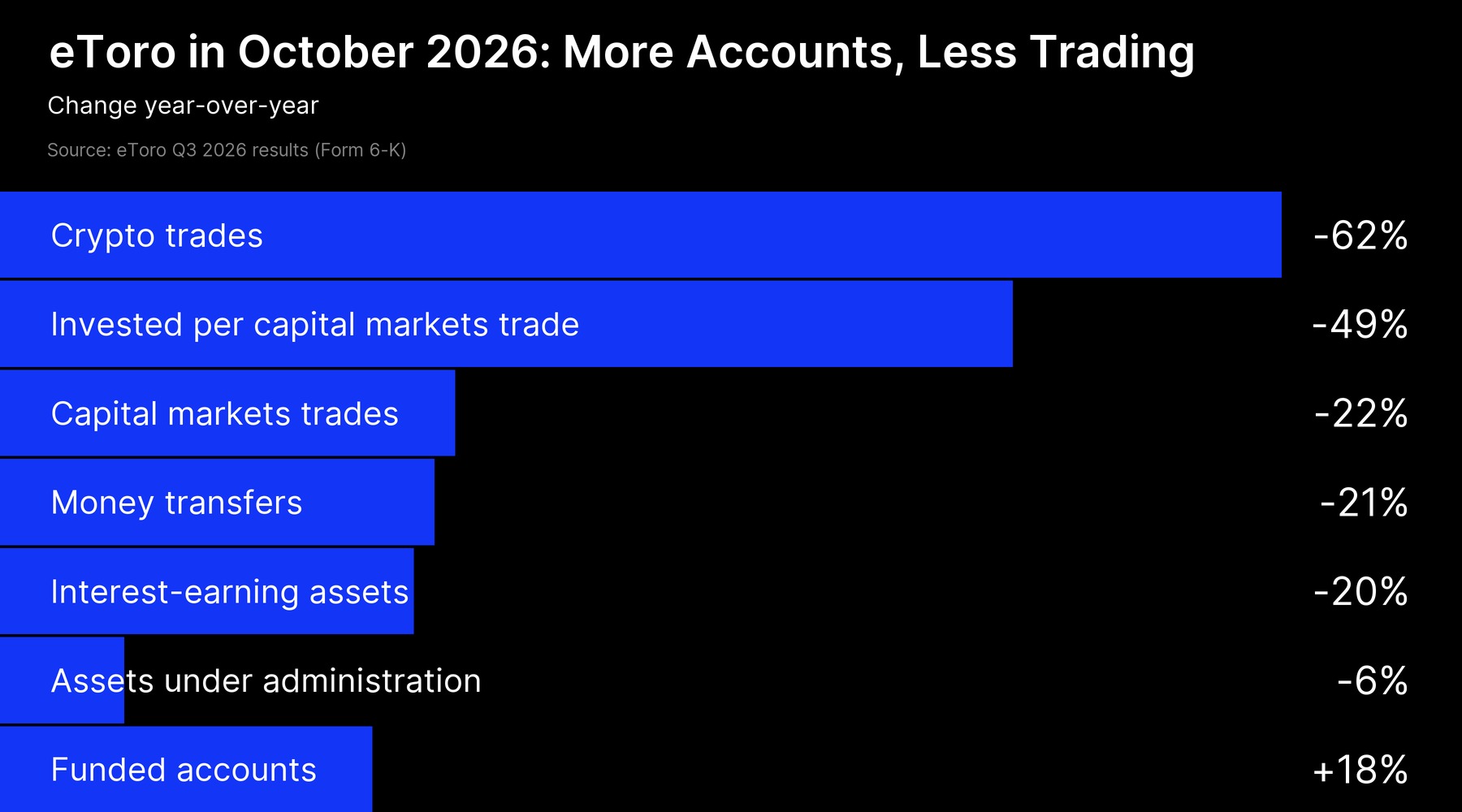
eToro’s clients placed 2
million cryptocurrency trades in October, down 62% from a year earlier,
despite an 18% increase in funded accounts to 4.42 million. The average amount
invested per crypto trade fell 29% to $228.
The figures followed a weaker third
quarter, when net income dropped 74% year-on-year to $15 million and net
contribution declined 13% to $186 million. Adjusted EBITDA fell 56% to $34.2
million.
Net trading income from equities, commodities and currencies increased
21% to $88.5 million, although it declined from the previous quarter. Chief
Financial Officer Meron Shani said crypto activity had recovered sequentially
compared with the second quarter.
eToro Targets $100 Million Latin American Revenue After
Argentine Acquisition
Yoni Assia, the CEO of eToro
eToro plans to generate $100
million in Latin American revenue within two to three years, using its
proposed acquisition of Argentine fintech LB Finanzas as a regional base. The
company agreed to acquire the investing and payments app for less than $20
million.
Chief Executive Yoni Assia gave analysts the target, and the article
noted that eToro already has a larger online audience in the region than most
retail brokers, according to FM Intelligence data.
The acquisition marks the
company’s fourth deal announced in 2026, following purchases involving Zengo
and Bit2C and an agreement to acquire US broker TradeZero. Assia said eToro
would slow its acquisition activity to focus on integrating the businesses.
AI Trading Agents Create New Monitoring Challenges for
Forex Brokers
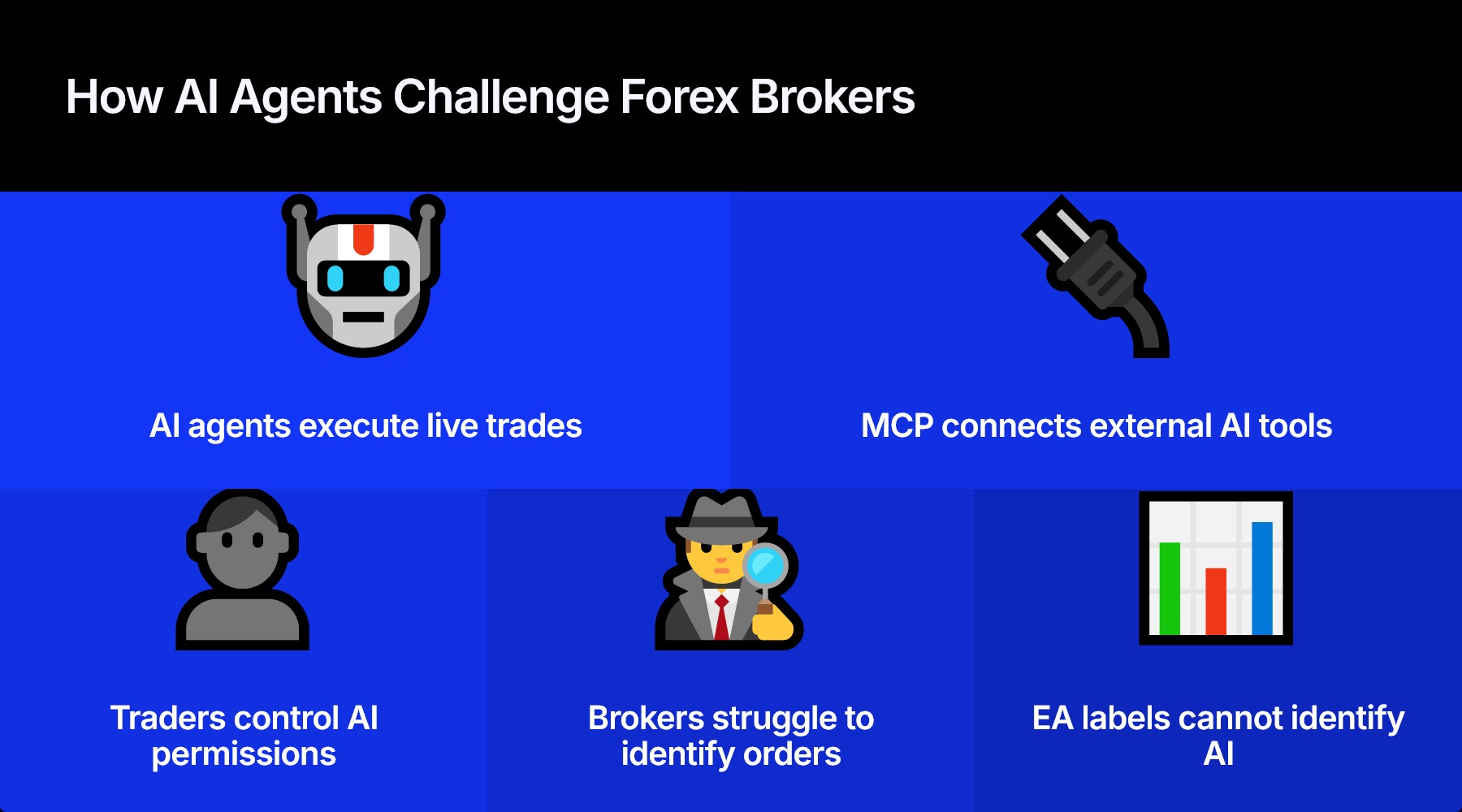
Artificial intelligence agents are increasingly able to interact
directly with retail trading accounts, creating new monitoring challenges
for forex and CFD brokers, according to an op-ed by Marios Kyriakou, Head of FX
Dealer Academy by Your Bourse.
Connections through platforms such as MetaTrader
and cTrader allow AI tools to access trading functions through Model Context
Protocol, or MCP, servers. These integrations can make it difficult for dealing
desks to distinguish automated orders from trades placed manually by clients.
Remote setups may also involve access tokens held by third-party AI tools,
limiting brokers’ visibility. While some official integrations offer read-only
access and approval requirements before trades are executed, open-source and
custom-built alternatives may lack similar safeguards. The development raises
questions about client profiling, exposure management and operational risk.
AI Voice Agents Raise Questions About Client Trust in Forex
Brokerage
Forex
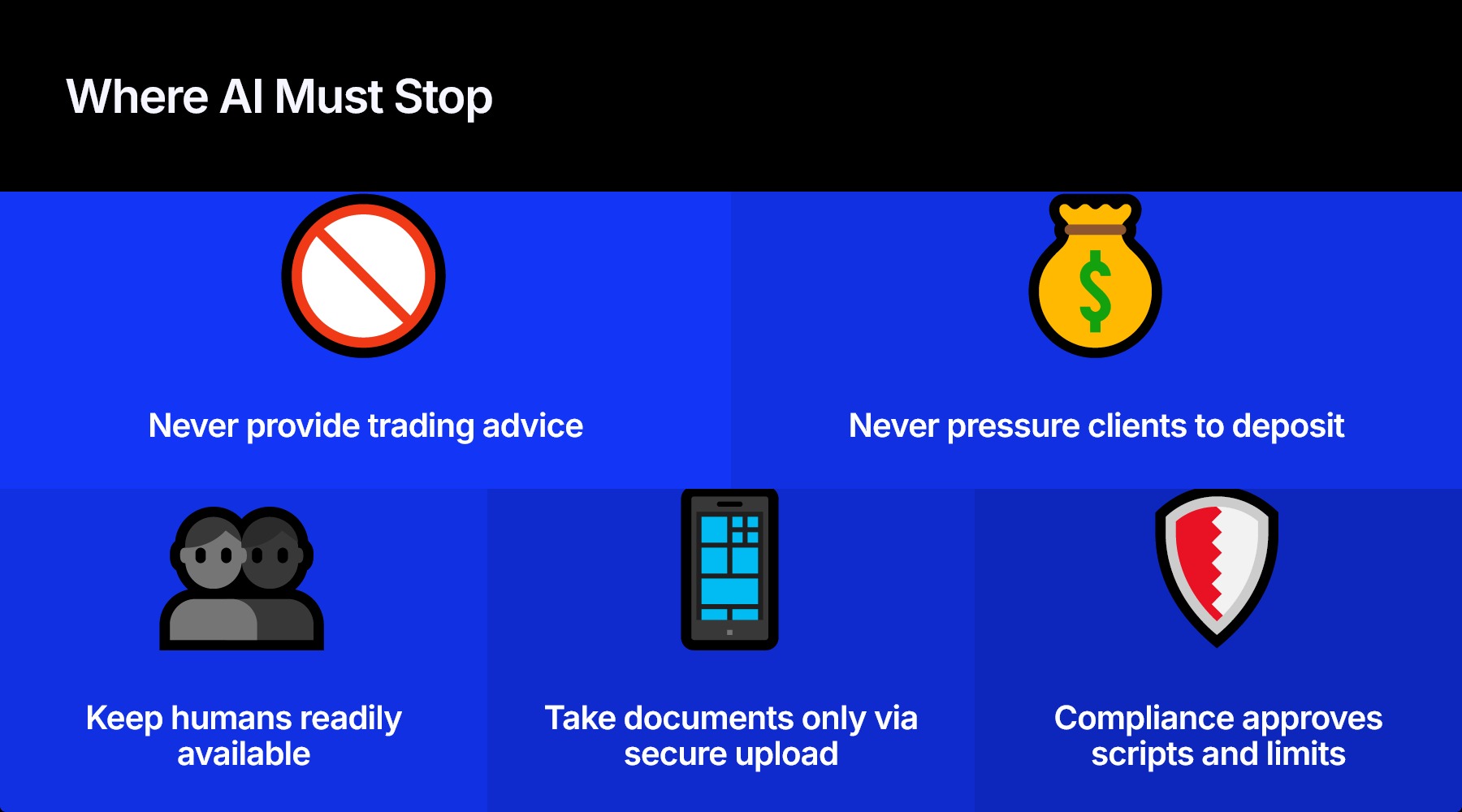
brokers are increasingly considering AI voice agents to handle customer
acquisition and routine communications. The technology can contact prospective
clients, chase account-opening documents through a secure upload link, follow
up on incomplete applications and schedule calls with human representatives.
However,
its use in client-facing conversations raises concerns about mis-selling and
the boundaries of automated communication. Anish Lal, Chief Business
Development Officer at BlackBull Markets, argued that voice agents should
support administrative tasks rather than provide trading advice or encourage
additional deposits, and that documents and card details should never be taken
over the phone.
He also highlighted the importance of transparency, including
informing customers when they are speaking to AI. Brokers must balance
efficiency gains with appropriate controls and maintain human involvement where
financial decisions and client trust are concerned.
Prediction Markets Seek Broker Partnerships to Sustain
Trading Activity
Prediction market operators are increasingly turning to brokerage
partnerships and wider product offerings to attract customers beyond major
sporting and political events, according to a column by Paul Golden. The World
Cup generated a significant increase in activity, but platforms now face the
challenge of maintaining user engagement between major events.
Women are less than 25% of the user base on prediction markets like Kalshi and Polymarket… but are the largest consumers on Instagram and Facebook.
I think Meta’s prediction market product will actually be a huge hit due to this untapped audience and the social/cultural topics they are interested in.
Count me in for predicting who gets voted out next on Love Island. 🏝️
Kalshi has
expanded its distribution through partnerships with Alpaca and Public, allowing
event contracts to reach customers through existing brokerage platforms. It has
also introduced products beyond conventional event contracts, including a stock
index perpetual future.
The expansion brings prediction markets closer to
traditional financial products. However, regulatory uncertainty, particularly
around sports-related contracts in the US, remains a challenge for operators
seeking broader distribution.
Nvidia Shares Fall More Than 6% Following Jensen Huang’s
Resignation
Jensen Huang, Founder and CEO of Nvidia, Source: Wikipedia
Nvidia shares fell more than 6% in trading after the announcement that co-founder
Jensen Huang had resigned as president, chief executive and board member
after 33 years leading the company, although the sell-off had begun before the
announcement.
Chief Financial Officer Colette Kress has taken over as interim
CEO while retaining her CFO responsibilities, and the board is considering
internal and external candidates for a permanent successor. Former Synopsys
chief executive Harvey Jones was appointed as Nvidia’s first board chairman.
The company did not state a reason for the departure, which followed an
independent investigation announced by the board, which appointed former acting
US Attorney Joon Kim and law firm Wachtell, Lipton, Rosen & Katz to conduct
the review. Jones said operations, customer commitments and the product roadmap
would continue without interruption.
We're investigating reports of users experiencing issues accessing Exchange Online mailboxes through multiple connection methods in the Americas. More details can be found in the Microsoft 365 admin center under EX1550543.
Microsoft 365 Outage Disrupts Financial Markets and Broker
Operations
A
global Microsoft 365 outage disrupted financial firms across several markets,
forcing trading desks and brokerages to rely on manual workarounds. The
disruption, which had lasted 12 hours at the time of reporting, affected
Exchange Online, with Downdetector recording more than 130,000 reports in the
US at its peak.
Brokerages in Singapore and India reported delays in customer
support, while CMC Markets in Singapore used phone calls and WhatsApp to bypass
affected systems. Japanese financial firms also turned to manual processes as
email authentication failures disrupted trade confirmations and settlements,
and a Kalshi post joked that Japanese markets had switched to fax machines.
The
outage highlighted the industry’s dependence on cloud-based services, with retail
FX brokers also reporting difficulties involving customer logins and
operational processes.
Tareq is a financial writer with 15 years of experience covering global markets. His work spans technical analysis, forex broker reviews, and market sentiment, with a focus on topics relevant to retail traders. He joined Finance Magnates in 2023.
At Finance Magnates, he serves as News Editor, covering retail forex and CFD brokers, cryptocurrency exchanges, fintech firms, and regulatory developments shaping the trading industry. He holds an Honours degree in Information Technology from Anfell College, London.
Education:
Honours degree Information Technology, Anfell College, London
Pay Once, Get Billed Monthly: Can Futures Props Survive the CME Data Meter without Subscriptions?
Featured Videos
FTMO Plans 300 Hires; Tradeify Partners with Inter Miami
FTMO Plans 300 Hires; Tradeify Partners with Inter Miami
FTMO Plans 300 Hires; Tradeify Partners with Inter Miami
FTMO Plans 300 Hires; Tradeify Partners with Inter Miami
Today’s financial news recap covers FTMO plans 300 hires, its founders discuss futures and a possible listing, Tradeify partners with Inter Miami, and futures prop margins come under pressure.
Finance Magnates Daily Recap brings you the latest news from forex and CFD brokers, fintech, payments, cryptocurrency, digital assets, trading platforms, financial regulation and global markets.
Get the key company news, executive moves, deals, regulatory updates and market developments of the day, in just a few minutes. New episodes published every weekday.
Read more: https://www.financemagnates.com
#FinanceMagnates #ForexNews #FintechNews
IG Group Wins Court Approval; eToro Expands Australian Futures Offering
IG Group Wins Court Approval; eToro Expands Australian Futures Offering
IG Group Wins Court Approval; eToro Expands Australian Futures Offering
IG Group Wins Court Approval; eToro Expands Australian Futures Offering
IG Group Wins Court Approval; eToro Expands Australian Futures Offering
IG Group Wins Court Approval; eToro Expands Australian Futures Offering
Today’s financial news recap covers IG Group secures court approval for its Jersey move, eToro adds 65 futures contracts in Australia, Moomoo prepares to offer binary stock options, and the SEC backs the CFTC in a dispute over perpetual futures.
Finance Magnates Daily Recap brings you the latest news from forex and CFD brokers, fintech, payments, cryptocurrency, digital assets, trading platforms, financial regulation and global markets.
Get the key company news, executive moves, deals, regulatory updates and market developments of the day, in just a few minutes. New episodes published every weekday.
Read more: https://www.financemagnates.com
#FinanceMagnates #ForexNews #FintechNews
eToro Expands in Argentina; Revolut Receives Israeli Banking Licence
eToro Expands in Argentina; Revolut Receives Israeli Banking Licence
eToro Expands in Argentina; Revolut Receives Israeli Banking Licence
eToro Expands in Argentina; Revolut Receives Israeli Banking Licence
eToro Expands in Argentina; Revolut Receives Israeli Banking Licence
eToro Expands in Argentina; Revolut Receives Israeli Banking Licence
Today’s financial news recap covers eToro's Latin American expansion, a sharp fall in crypto trading, Revolut's Israeli banking licence, and South Korea's record bond-rigging fine.
Finance Magnates Daily Recap brings you the latest news from forex and CFD brokers, fintech, payments, cryptocurrency, digital assets, trading platforms, financial regulation and global markets.
Get the key company news, executive moves, deals, regulatory updates and market developments of the day, in just a few minutes. New episodes published every weekday.
Read more: https://www.financemagnates.com
#FinanceMagnates #ForexNews #FintechNews
Former iS Prime Founders Launch JT Prime; CFI Chairman Explains Governance Approach
Former iS Prime Founders Launch JT Prime; CFI Chairman Explains Governance Approach
Former iS Prime Founders Launch JT Prime; CFI Chairman Explains Governance Approach
Former iS Prime Founders Launch JT Prime; CFI Chairman Explains Governance Approach
Former iS Prime Founders Launch JT Prime; CFI Chairman Explains Governance Approach
Former iS Prime Founders Launch JT Prime; CFI Chairman Explains Governance Approach
Today’s financial news recap covers former iS Prime founders launch a new liquidity business, CFI outlines its independent governance model, the CFTC bars eight Americans over offshore forex sales, and Spotware brings AI assistants into broker operations.
Finance Magnates Daily Recap brings you the latest news from forex and CFD brokers, fintech, payments, cryptocurrency, digital assets, trading platforms, financial regulation and global markets.
Get the key company news, executive moves, deals, regulatory updates and market developments of the day, in just a few minutes. New episodes published every weekday.
Read more: https://www.financemagnates.com
#FinanceMagnates #ForexNews #FintechNews
Safeheron: Institutional Crypto Custody and the Future of Stablecoin Payments | Adam Dai
Safeheron: Institutional Crypto Custody and the Future of Stablecoin Payments | Adam Dai
Safeheron: Institutional Crypto Custody and the Future of Stablecoin Payments | Adam Dai
Safeheron: Institutional Crypto Custody and the Future of Stablecoin Payments | Adam Dai
Safeheron: Institutional Crypto Custody and the Future of Stablecoin Payments | Adam Dai
Safeheron: Institutional Crypto Custody and the Future of Stablecoin Payments | Adam Dai
How are institutions approaching crypto custody and stablecoin payments?
In this interview from Hong Kong, Nick Assimenos of Finance Magnates speaks with Adam Dai, General Manager of East Asia at Safeheron, about institutional digital asset custody, MPC wallet security and the growing adoption of stablecoins.
The conversation explores Safeheron's self-custody approach, the role of open-source security technology, and the regulatory and compliance challenges facing digital asset businesses.
In this interview:
✅ How MPC wallets give institutions control over their digital assets
✅ Why stablecoins are gaining traction in cross-border payments
✅ The challenges of banking access and regulatory compliance in Hong Kong
✅ What could accelerate institutional stablecoin adoption
#Safeheron #AdamDai #CryptoCustody #Stablecoins #DigitalAssets #FinTech #FinanceMagnates