
As momentum shifts between prediction market platforms and the realisation dawns that some of the summer's growth was event-driven rather than sustained, we look at how providers are navigating increasingly uneven growth through distribution and market mix.
As prediction markets evolve, the key issue for operators is less how to attract users during major news events and more how to turn event-driven interest into sustained trading activity.
London's trading industry is coming home!
From Event-Driven Hype to Long-Term Growth
One of the most significant developments in this space in recent months is that sport has become a major volume engine and exposed the limits of event-led growth. Trading activity surged around the 2026 World Cup, with combined volume for Kalshi and Polymarket and its US platform reaching $50.6 billion in July before falling 14.5% to $45.3 billion in August.
The lesson here is that major sporting events can attract enormous activity, but the subsequent fall shows why operators need more than a calendar of headline events.
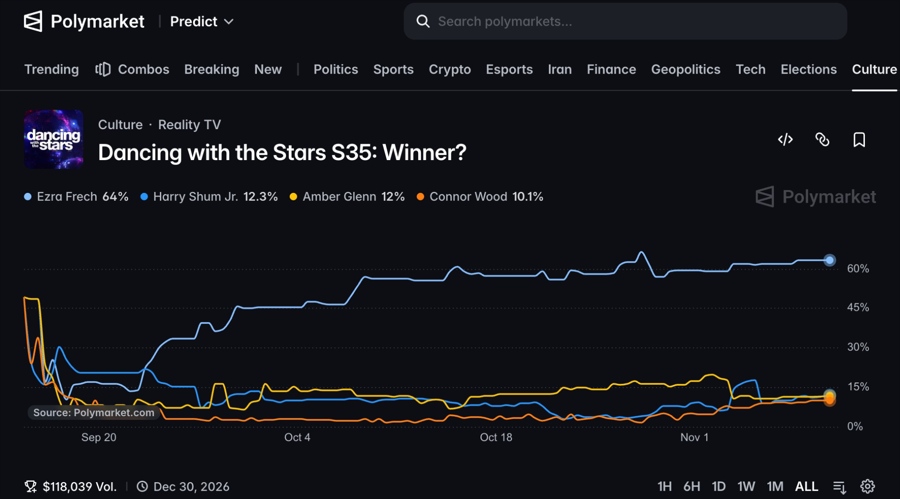
Entertainment markets have emerged as a customer acquisition opportunity. Kalshi and Polymarket are extending into reality television and popular culture, including shows such as Dancing with the Stars and Love Island.
Kalshi reportedly recorded $5.7 million of volume related to Dancing with the Stars, and its entertainment market volume has increased from $43 million in 2024 to $813 million.
Women are less than 25% of the user base on prediction markets like Kalshi and Polymarket… but are the largest consumers on Instagram and Facebook. I think Meta’s prediction market product will actually be a huge hit due to this untapped audience and the social/cultural topics they are interested in. Count me in for predicting who gets voted out next on Love Island. 🏝️
— Brit Morin 🦞 (@brit) July 7, 2026
This matters because entertainment can reach people who have little interest in elections, macroeconomic forecasts or conventional financial trading. It also offers recurring weekly events, rather than relying entirely on one-off spectacles.
Brokerages are becoming powerful distribution channels. Robinhood reported $156 million in event contract revenue in Q2 2026, more than ten times the figure for the same period last year. It handled 13.6 billion event contracts during the quarter, also more than ten times the volume recorded in Q1 2025.
In August, Kalshi announced a partnership with brokerage infrastructure provider Alpaca to distribute event contracts through brokerage infrastructure. Last month, it announced an integration with Public (an agentic brokerage), linking event contracts to customers' portfolios and AI-powered investing tools.
The strategic shift is from persuading consumers to download another specialist app to placing prediction markets where they already invest.
We have also seen platforms expand beyond conventional event contracts. In early October, Kalshi announced a stock index perpetual future, broadening its product range beyond contracts tied to discrete events.
This is evidence of convergence between prediction markets and derivatives as operators seek more reasons for users to return between major news events. It also creates a clearer distinction between forecasting a particular outcome and maintaining continuous market exposure.
Meanwhile, regulation and market integrity have become more important competitive factors. In the US, disputes over whether sports-related event contracts fall under federal derivatives oversight or state gambling laws continue, with the NFL backing a request for a US Supreme Court review.
In the UK, the FCA is reportedly engaging with Kalshi and Polymarket as they consider market entry.
For operators, regulatory clarity, reliable settlement, clear rules and credible safeguards are not just compliance costs – they can influence whether mainstream brokers and customers are willing to participate.
Five Strategies to Win and Retain Customers
So which customer acquisition strategies are proving most successful? These can be broken down into five categories:
Integration into existing financial apps
Owning the moments people already care about
Offering breadth, not just one headline market
Using social distribution, public probabilities and community
Investing in liquidity and a better trading experience
The appeal of integrating with existing financial apps is a lower-friction customer journey due to accounts, identity checks, funding arrangements and trading interfaces already being in place.
Customers can discover event contracts without starting a separate financial relationship, while providers benefit from lower incremental acquisition costs, access to an existing funded user base and cross-selling between equities, options, crypto and event contracts.
Sports tournaments, elections, central bank decisions, economic releases and reality TV finales create natural spikes in attention. Contracts tied to these events are easy to explain and have an obvious deadline. Best execution can be achieved by building a calendar of recurring events, offering markets with clear settlement criteria and retaining users by connecting one event to the next.
I have a million questions about prediction markets, and I understand things through drawing. So I sat down with the CEO of @Kalshi (@mansourtarek_) to better understand how prediction markets actually work, the counter-intuitive impact of prediction markets on elections, and why he believes they can make the world a better place. We cover: - How a prediction market works (hint: a lot like the NYSE) - 60¢ = 60%: how event contracts price probability - Prediction markets vs. the stock exchange vs. sportsbooks - Defining gambling and markets - Why he's in favor of federal regulation - Polls vs. markets: skin in the game & the pursuit of truth - Why markets reward the boring take - What you can't trade on (no wildfire markets) - Hedging 101 at the ice cream shop - Goku, growing up in Lebanon & the 120% rule Highlights: (00:00) Gambling, markets and their historically flirtatious relationship (00:34) Opening Kalshi for the first time (01:19) How a contract works: 60¢ = 60% odds (02:10) Why not just use the stock market? CFTC & derivatives (02:58) Prediction markets vs. sportsbooks: who sets the price (04:35) Where the gambling line is, according to Tarek (05:30) In favor of federal regulation (06:17) The vision: free markets in pursuit of truth (06:39) Why polls miss & markets don't (2016, 2024, Mamdani) (07:24) Echo chambers, hot takes & rewarding the boring take (08:15) What you can't trade on & why (08:54) Hedging 101 at the ice cream shop (10:17) Goku, Lebanon & the 120% rule Our first ever longform @chartsncrafts episode - the first of many.
— Natalie Fratto (@NatalieFratto) November 3, 2026
A sports-first customer may subsequently trade entertainment, politics, weather or economic outcomes, while a financial trader may be interested in interest rates, inflation or equity market outcomes. The strategic benefit is that users can move between categories as their interests change, while the platform retains their account and trading history.
A point to note here is that the number of listed markets does not always equate to greater choice. Markets need sufficient liquidity, competitive pricing and dependable resolution to convert browsing into repeat participation.
Prediction markets naturally generate shareable content, for example, a probability that a candidate will win, inflation will exceed a threshold or a particular team will prevail.
- AI in Retail Trading: Competitive Advantage or Broker Marketing Expense?
- Spreads Grab the Headlines, but Infrastructure Gets the Institutional Flow
- Southeast Asia’s Broker Boom Comes with a Catch
Publishing live market probabilities, explainers and changes in consensus can bring in people who are interested in the forecast before they are ready to trade. Public's integration of event data with portfolio analysis and AI agents illustrates how forecasting information can also be marketed as an investing tool.
The caveat here is that social reach is not proof of profitable acquisition. Public evidence is less conclusive on which referral programmes, influencers or community features generate the best retained customers.
A customer who cannot execute at a reasonable price (or cannot understand how a contract settles) is unlikely to return. Tight spreads, depth, fast execution and clear rules make a platform more useful and credible.
This creates a reinforcing effect whereby more customers can attract more liquidity, which improves the experience for subsequent customers. But it also creates a barrier for new entrants trying to compete against established venues.
For this approach, providers need to measure spreads, depth at relevant prices, fill rates, slippage, settlement disputes and customer retention by market category.
The clearest measurable results appear to be in brokerage distribution and event-driven trading. Longer-term retention is harder to establish from publicly reported volume figures.


