
Weekly Recap: FTMO Founders Discuss Futures Expansion; Plus500 Pushes Guidance Higher

Friday, 30/10/2026 | 21:25 GMT by Tareq Sikder
  • CFI reported record third-quarter trading volume of $3.45 trillion, more than doubling year on year.
  • Stocks and ETFs accounted for 86% of XTB client assets, while CFDs generated 90.5% of its Q3 trading result.
FTMO co-founders, Otakar Šuffner (right) and Marek Vašíček (left)
FTMO co-founders, Otakar Šuffner (right) and Marek Vašíček

The retail trading industry saw developments across proprietary trading, listed derivatives and broker performance this week. FTMO’s founders discussed the firm’s futures launch, its acquisition of OANDA and its ambitions to build a larger trading group. Meanwhile, Plus500 raised its full-year outlook, and NinjaTrader extended its futures platform into the UK.

London's trading industry is coming home!

Quarterly results also highlighted contrasting trends among brokers. CFI reported record trading volumes, while XTB’s profit rose sharply despite lower client trading activity. XTB’s client assets also showed a growing preference for stocks and exchange-traded funds, even as contracts for difference continued to generate most of its trading income.

Elsewhere, institutional trading technology and customer acquisition strategies remained in focus, with analysis examining execution infrastructure and the challenges of reaching forex traders across markets in the Commonwealth of Independent States.

FTMO’s Futures Launch Follows a Decade of Growth and the OANDA Deal

FTMO co-founders Otakar Šuffner and Marek Vašíček discussed the firm’s move into futures trading, its acquisition of OANDA and the challenges facing proprietary trading firms. Founded in 2015, FTMO initially focused on CFDs because it lacked the capital and experience to enter futures.

The company launched its futures offering recently, responding to customer demand and a market where futures evaluations can cost less than comparable CFD and forex challenges. The founders said combining FTMO’s business with OANDA’s established reputation could help distinguish the group from newer firms.

They also discussed regulatory uncertainty, abusive trading groups targeting evaluation systems and the possibility of a future initial public offering.

Plus500 Raises Its 2026 Outlook After Revenue Growth

David Zruia, CEO of Plus500

Plus500 expects full-year 2026 revenue and EBITDA to exceed market expectations, reversing its guidance from July, when it forecast results in line with consensus. Third-quarter revenue rose 11% year on year to $203.2 million, while EBITDA increased 7% to $88.4 million.

Revenue for the first nine months reached $666.1 million, up 11%. New customers rose 27% to 28,747 in the quarter, active customers increased 4% to 119,528 and average revenue per user reached $1,700. Customer deposits hit a quarterly record of $1.9 billion. The company also reported growth in customer trading income, while interest income fell amid lower global interest rates.

NinjaTrader Brings Its Retail Futures Platform to the UK

NinjaTrader has launched its retail futures trading platform in the UK, extending a European rollout that already covers Germany, France, Italy, Spain and the Netherlands. UK customers can access futures on US equity indices, energy, metals and foreign exchange through CME and Eurex markets.

The platform includes proprietary charting tools, algorithmic trading capabilities and native TradingView integration. NinjaTrader said UK traders had sought direct market access, transparent pricing and execution , and a platform designed specifically for futures.

The launch comes as European brokers explore listed products amid regulatory pressure on CFDs, more experienced retail traders and competition from US firms specialising in futures and options.

CFI Reports Record Quarterly Trading Volume of $3.45 Trillion

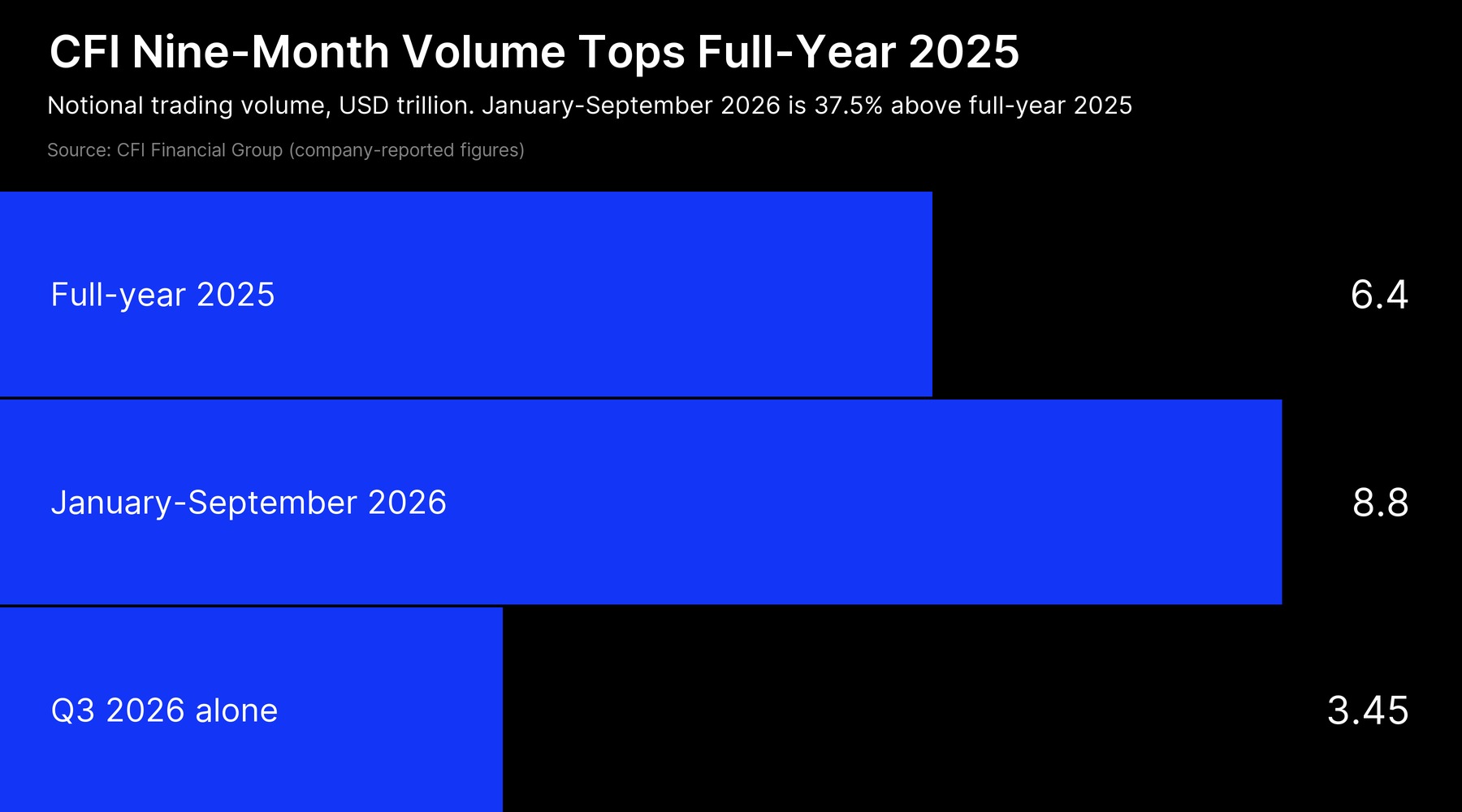
CFI Financial Group reported third-quarter notional trading volume of $3.45 trillion, a record for the Dubai-based broker and an increase of about 123% year on year. The figure was 14% higher than in the second quarter. Trading volume for the first nine months reached $8.8 trillion, roughly double the same period last year and already above CFI’s full-year 2025 total of $6.4 trillion.
CFI Volume

The company has reported higher volumes in each quarter of 2026, rising from $2.3 trillion in the first quarter to $3.03 trillion in the second. The growth came as the broader broker market tracked by Finance Magnates Intelligence contracted in the second quarter.

XTB’s Quarterly Profit Rises Fourfold Despite Lower Client Trading

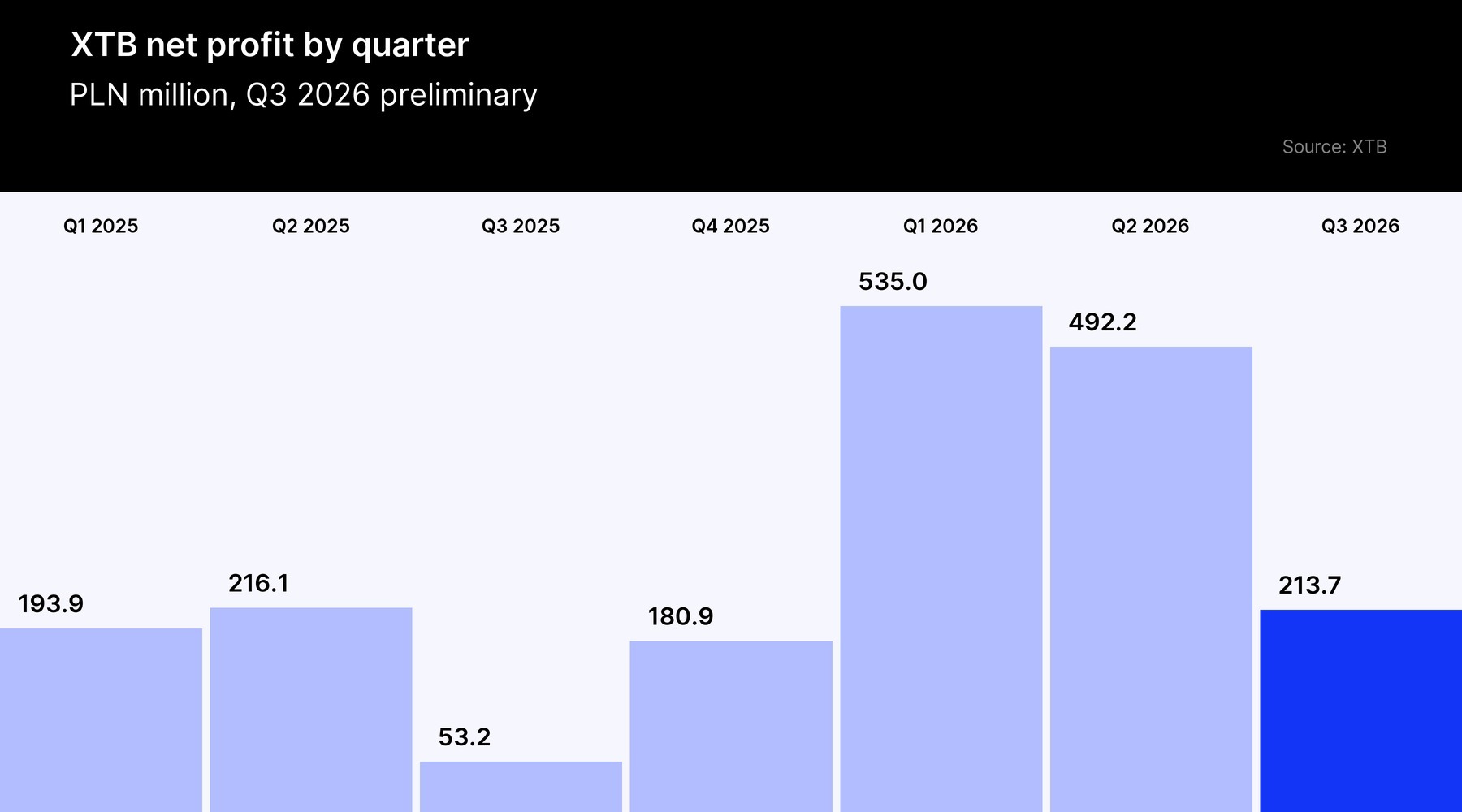
XTB reported preliminary third-quarter net profit of PLN 213.7 million, around $54 million, four times the result a year earlier and 6.4% above the average analyst forecast. The figure was nevertheless less than half the PLN 492.2 million recorded in the second quarter. Revenue rose 65.9% year on year to PLN 623.3 million, even as clients traded 18.3% fewer CFD lots.
XTB

Revenue per lot nearly doubled to PLN 301 from PLN 152 a year earlier. Commodity CFDs generated 70.8% of the broker’s gross result on financial instruments. The year-on-year comparison reflected a weaker third quarter in 2025, when low market volatility weighed on revenue and profit.

Stocks Dominate XTB Client Assets, While CFDs Drive Trading Income

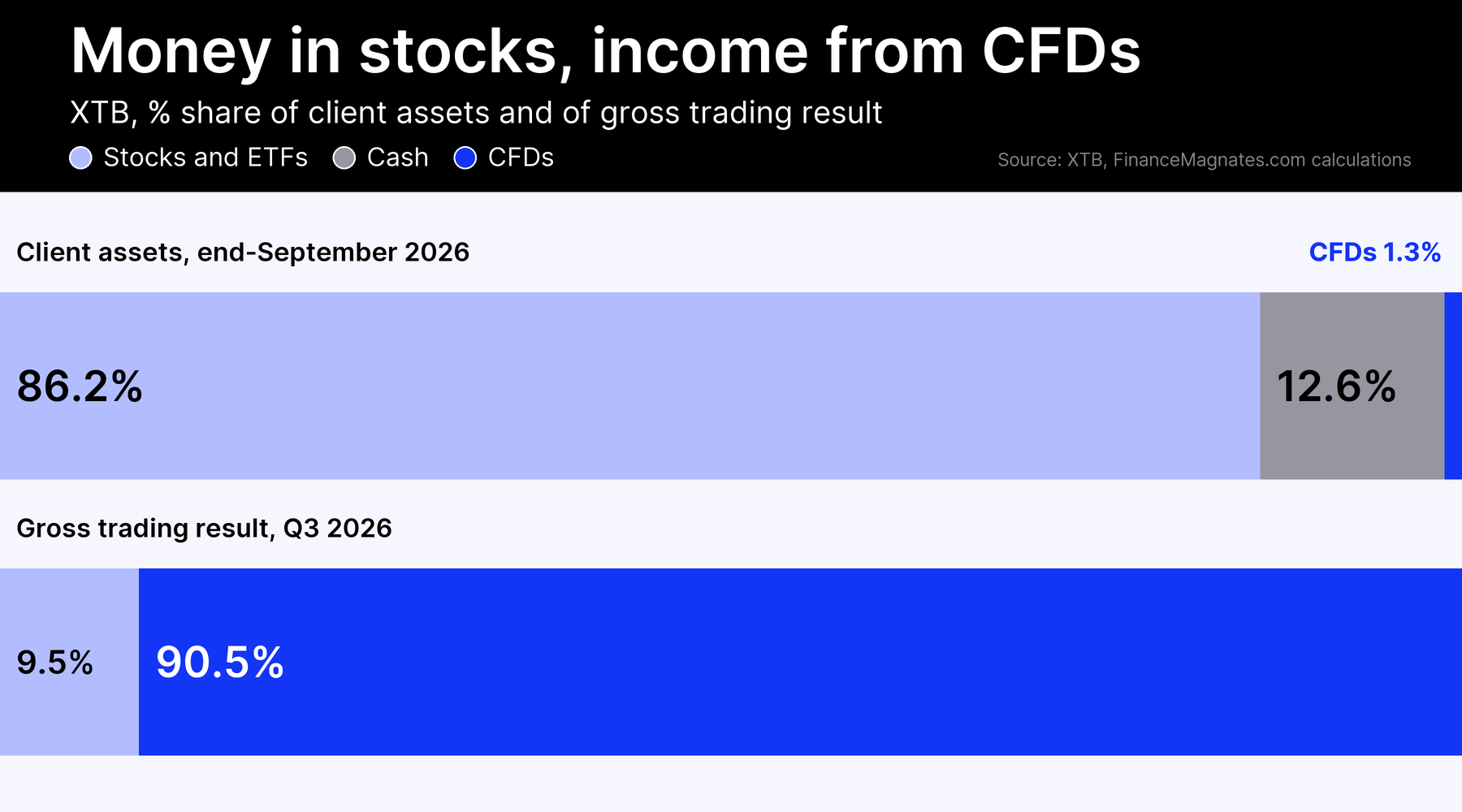
XTB clients held PLN 56.2 billion, about $14.2 billion, with the broker at the end of September, up by two-thirds since the start of the year. Stocks and exchange-traded funds accounted for 86% of those assets, while open CFD positions represented 1.3%.

However, CFDs continued to generate most of the broker’s trading income, contributing 90.5% of its gross result on financial instruments in the third quarter, based on Finance Magnates’ calculation from XTB’s preliminary report.
XTB

That share was down from 96% in the first half. Chief executive Omar Arnaout has said he wants to reduce the contribution from CFDs to around 70%, as investment products attract more clients.

Institutional Traders Put Execution Infrastructure Ahead of Spreads

Trading technology and execution quality are becoming key differentiators for brokers serving institutional clients, according to an analysis of the market. Tight spreads and deep liquidity remain important, but institutions also need pricing aggregation, low latency, smart order routing, automated hedging, reliable market data and systems that can withstand market stress.

They increasingly expect APIs and integration with order management, execution management and transaction cost analysis tools. Paul Golden highlights the difficulty of assessing execution costs for index CFDs, whose prices can be affected by futures markets, dividends and changing conditions.

Brokers may need stronger benchmarks to demonstrate execution quality, while proprietary technology can offer a closer fit for institutional requirements.
CIS

Russian-Language Campaigns Missed Audiences in Parts of the CIS

Campaign results across six Commonwealth of Independent States markets suggest that a single Russian-language acquisition strategy may overlook local differences. In an analysis, Stanislav Galandzovskyi found that switching to Uzbek-language creative and adding local payment options Click and Payme reduced the reported cost per acquisition in Uzbekistan from about $650 to around $380.

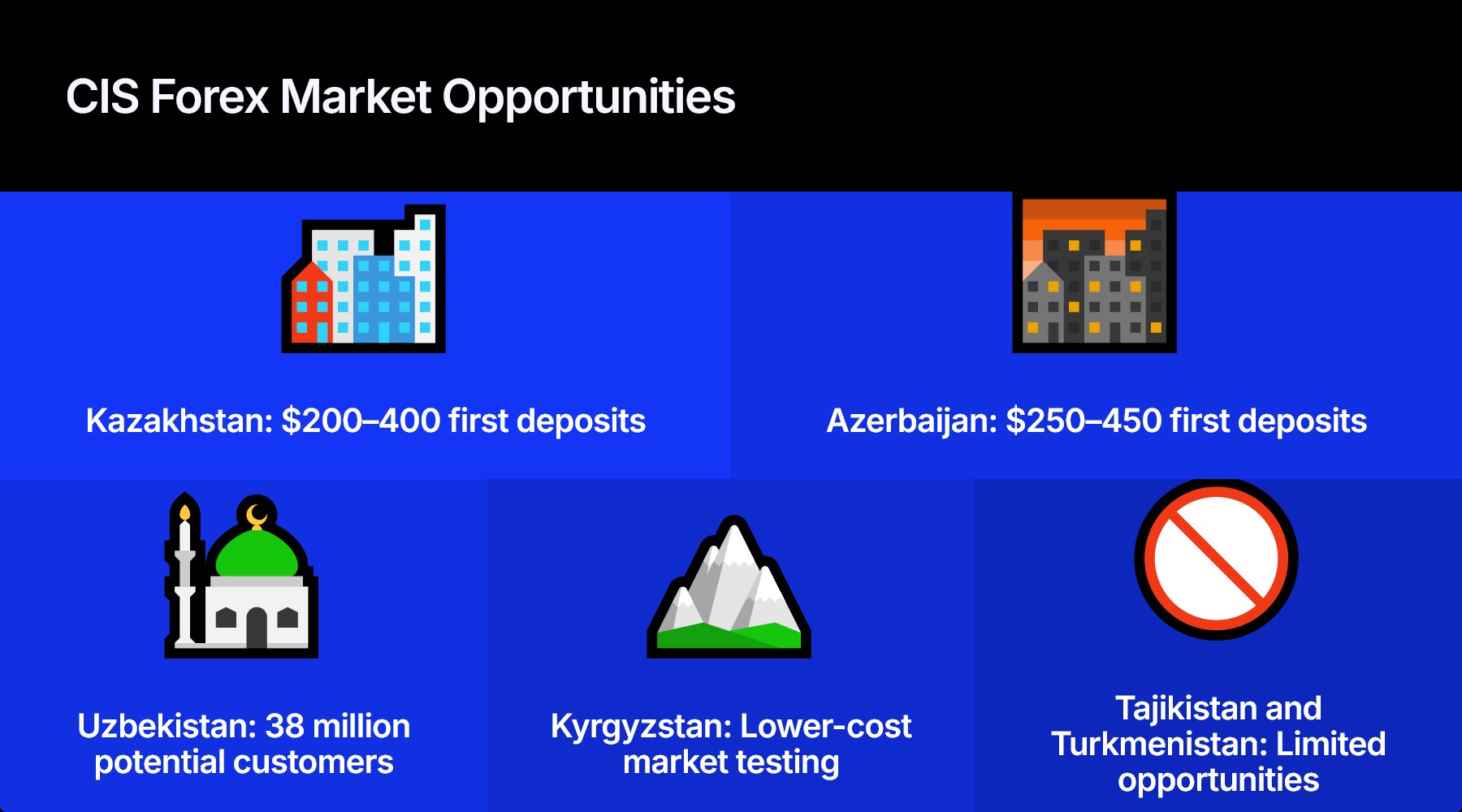
The markets also differ in purchasing power, regulation and payment access. Kazakhstan and Azerbaijan were described as higher-value opportunities, while Uzbekistan offers scale but lower average deposits. Kyrgyzstan may suit smaller tests.

Tajikistan’s limited disposable income and Turkmenistan’s currency controls, which complicate withdrawals, were cited as barriers. The analysis argued for allocating budgets according to funded-trader acquisition costs before assessing longer-term customer value.

The retail trading industry saw developments across proprietary trading, listed derivatives and broker performance this week. FTMO’s founders discussed the firm’s futures launch, its acquisition of OANDA and its ambitions to build a larger trading group. Meanwhile, Plus500 raised its full-year outlook, and NinjaTrader extended its futures platform into the UK.

London's trading industry is coming home!

Quarterly results also highlighted contrasting trends among brokers. CFI reported record trading volumes, while XTB’s profit rose sharply despite lower client trading activity. XTB’s client assets also showed a growing preference for stocks and exchange-traded funds, even as contracts for difference continued to generate most of its trading income.

Elsewhere, institutional trading technology and customer acquisition strategies remained in focus, with analysis examining execution infrastructure and the challenges of reaching forex traders across markets in the Commonwealth of Independent States.

FTMO’s Futures Launch Follows a Decade of Growth and the OANDA Deal

FTMO co-founders Otakar Šuffner and Marek Vašíček discussed the firm’s move into futures trading, its acquisition of OANDA and the challenges facing proprietary trading firms. Founded in 2015, FTMO initially focused on CFDs because it lacked the capital and experience to enter futures.

The company launched its futures offering recently, responding to customer demand and a market where futures evaluations can cost less than comparable CFD and forex challenges. The founders said combining FTMO’s business with OANDA’s established reputation could help distinguish the group from newer firms.

They also discussed regulatory uncertainty, abusive trading groups targeting evaluation systems and the possibility of a future initial public offering.

Plus500 Raises Its 2026 Outlook After Revenue Growth

David Zruia, CEO of Plus500

Plus500 expects full-year 2026 revenue and EBITDA to exceed market expectations, reversing its guidance from July, when it forecast results in line with consensus. Third-quarter revenue rose 11% year on year to $203.2 million, while EBITDA increased 7% to $88.4 million.

Revenue for the first nine months reached $666.1 million, up 11%. New customers rose 27% to 28,747 in the quarter, active customers increased 4% to 119,528 and average revenue per user reached $1,700. Customer deposits hit a quarterly record of $1.9 billion. The company also reported growth in customer trading income, while interest income fell amid lower global interest rates.

NinjaTrader Brings Its Retail Futures Platform to the UK

NinjaTrader has launched its retail futures trading platform in the UK, extending a European rollout that already covers Germany, France, Italy, Spain and the Netherlands. UK customers can access futures on US equity indices, energy, metals and foreign exchange through CME and Eurex markets.

The platform includes proprietary charting tools, algorithmic trading capabilities and native TradingView integration. NinjaTrader said UK traders had sought direct market access, transparent pricing and execution , and a platform designed specifically for futures.

The launch comes as European brokers explore listed products amid regulatory pressure on CFDs, more experienced retail traders and competition from US firms specialising in futures and options.

CFI Reports Record Quarterly Trading Volume of $3.45 Trillion

CFI Financial Group reported third-quarter notional trading volume of $3.45 trillion, a record for the Dubai-based broker and an increase of about 123% year on year. The figure was 14% higher than in the second quarter. Trading volume for the first nine months reached $8.8 trillion, roughly double the same period last year and already above CFI’s full-year 2025 total of $6.4 trillion.

CFI Volume

The company has reported higher volumes in each quarter of 2026, rising from $2.3 trillion in the first quarter to $3.03 trillion in the second. The growth came as the broader broker market tracked by Finance Magnates Intelligence contracted in the second quarter.

XTB’s Quarterly Profit Rises Fourfold Despite Lower Client Trading

XTB reported preliminary third-quarter net profit of PLN 213.7 million, around $54 million, four times the result a year earlier and 6.4% above the average analyst forecast. The figure was nevertheless less than half the PLN 492.2 million recorded in the second quarter. Revenue rose 65.9% year on year to PLN 623.3 million, even as clients traded 18.3% fewer CFD lots.

XTB

Revenue per lot nearly doubled to PLN 301 from PLN 152 a year earlier. Commodity CFDs generated 70.8% of the broker’s gross result on financial instruments. The year-on-year comparison reflected a weaker third quarter in 2025, when low market volatility weighed on revenue and profit.

Stocks Dominate XTB Client Assets, While CFDs Drive Trading Income

XTB clients held PLN 56.2 billion, about $14.2 billion, with the broker at the end of September, up by two-thirds since the start of the year. Stocks and exchange-traded funds accounted for 86% of those assets, while open CFD positions represented 1.3%.

However, CFDs continued to generate most of the broker’s trading income, contributing 90.5% of its gross result on financial instruments in the third quarter, based on Finance Magnates’ calculation from XTB’s preliminary report.

XTB

That share was down from 96% in the first half. Chief executive Omar Arnaout has said he wants to reduce the contribution from CFDs to around 70%, as investment products attract more clients.

Institutional Traders Put Execution Infrastructure Ahead of Spreads

Trading technology and execution quality are becoming key differentiators for brokers serving institutional clients, according to an analysis of the market. Tight spreads and deep liquidity remain important, but institutions also need pricing aggregation, low latency, smart order routing, automated hedging, reliable market data and systems that can withstand market stress.

They increasingly expect APIs and integration with order management, execution management and transaction cost analysis tools. Paul Golden highlights the difficulty of assessing execution costs for index CFDs, whose prices can be affected by futures markets, dividends and changing conditions.

Brokers may need stronger benchmarks to demonstrate execution quality, while proprietary technology can offer a closer fit for institutional requirements.

CIS

Russian-Language Campaigns Missed Audiences in Parts of the CIS

Campaign results across six Commonwealth of Independent States markets suggest that a single Russian-language acquisition strategy may overlook local differences. In an analysis, Stanislav Galandzovskyi found that switching to Uzbek-language creative and adding local payment options Click and Payme reduced the reported cost per acquisition in Uzbekistan from about $650 to around $380.

The markets also differ in purchasing power, regulation and payment access. Kazakhstan and Azerbaijan were described as higher-value opportunities, while Uzbekistan offers scale but lower average deposits. Kyrgyzstan may suit smaller tests.

Tajikistan’s limited disposable income and Turkmenistan’s currency controls, which complicate withdrawals, were cited as barriers. The analysis argued for allocating budgets according to funded-trader acquisition costs before assessing longer-term customer value.

About the Author: Tareq Sikder
Tareq Sikder
  • 2539 Articles
  • 48 Followers
About the Author: Tareq Sikder
Tareq is a financial writer with 15 years of experience covering global markets. His work spans technical analysis, forex broker reviews, and market sentiment, with a focus on topics relevant to retail traders. He joined Finance Magnates in 2023. At Finance Magnates, he serves as News Editor, covering retail forex and CFD brokers, cryptocurrency exchanges, fintech firms, and regulatory developments shaping the trading industry. He holds an Honours degree in Information Technology from Anfell College, London. Education: Honours degree Information Technology, Anfell College, London
  • 2539 Articles
  • 48 Followers

More from the Author

Retail FX

!"#$%&'()*+,-./0123456789:;<=>?@ABCDEFGHIJKLMNOPQRSTUVWXYZ[\]^_`abcdefghijklmnopqrstuvwxyz{|} !"#$%&'()*+,-./0123456789:;<=>?@ABCDEFGHIJKLMNOPQRSTUVWXYZ[\]^_`abcdefghijklmnopqrstuvwxyz{|}