Banks are starting to fold prediction markets into their insider‑trading compliance framework.
Why are top crypto exchanges, including Kraken, Coinbase and Binance, chasing TradFi?
CFD brokers face tougher UK reporting rules
New US playbook for crypto assets
This week, the U.S SEC and the CFTC jointly issued new guidance
clarifying how federal laws apply to crypto. The duo outlined the conditions
under which a token transitions from being a security to a commodity.
SEC Chairman Paul S. Atkins said that the new guide “acknowledges
what the former administration refused to recognize – that most crypto assets
are not themselves securities.”
TODAY 🚨: The Commission issued an interpretation that clarifies the application of federal securities laws to crypto assets.
This is a major step to provide greater clarity regarding the Commission’s treatment of crypto assets.
Our interpretation on crypto assets—grounded in existing law and informed by extensive public input—acknowledges what the former administration refused to recognize...
It also marks a major milestone in crypto
regulation, introducing a five-category classification system that replaces the
previous regulatory uncertainty. However, by shifting from a disclosure-focused model to one centered on market conduct, the framework also raises concerns about potential gaps in investor protection and the balance between innovation and oversight.
JPMorgan Chase is among the first to review its internal rules on staff trading these contracts and may issue explicit guidance for its 320,000 employees on using platforms like Kalshi and Polymarket.
The latest example is Kraken, which in late February said it
would offer perpetual futures on tokenized stocks to non-US clients, giving
traders 24/7 access to equity-like price movements with up to 20x leverage and
the ability to go long or short.
These products initially track tokenized versions of major
equity indices, commodities and well-known public companies. Perpetual futures are often described as the missing link in
tokenized equities because they have no expiry date.
IG considers crossing the Atlantic
IG Group is considering shifting its listing from London to New York to deepen its footprint in one of the world’s biggest financial markets. The broker said it is reviewing where its shares are listed, where the company is legally based, and whether it should pursue acquisitions as part of a broader growth strategy.
Chief Financial Officer Clifford Abrahams told Bloomberg that a U.S. listing could help IG stand out more among its competitors, draw in fresh investors, and give it more options for deal-making. He also noted that such a move could benefit employees by giving them better access to global capital markets and potentially more attractive equity-based incentives.
KPI
CY25
CY24
Change
Total Revenue
£1,123.4m
£1,052.2m
+7%
Net Trading Revenue
£1,004.6m
£910.6m
+10%
Net Interest Income
£118.8m
£141.6m
-16%
EBITDA
£531.1m
£525.0m
+1%
EBITDA Margin
47.3%
49.9%
-2.6pp
IG reported record revenue of £1.12 billion in 2025,
supported by strong double-digit growth in net trading revenue and a boost in
new clients from its Freetrade integration. Net trading revenue for the 12
months to 31 December 2025 rose 10% to £1,004.6 million, up from £910.6 million
in 2024.
This guidance follows a strong 2025, when Swissquote reported net revenue of CHF 723.3 million and pre-tax profit of CHF 420.2 million, up 9.4 percent and 21.6 percent, respectively. Last year’s revenue was helped by higher trading activity, which pushed net fee and commission income up 17.5 percent to CHF 209.4 million and net trading income up 52.6 percent to CHF 119.5 million.
Colmex Pro says this move is part of a longer-term plan to shift its business toward investment products and market access services. The broker now plans to focus on offerings such as equities, ETFs and other exchange-traded instruments.
Before October of that year, control rested with Lijun Li and an offshore company, which held authority from August 2022. The UK entity is now managed by Stephen Williams and Levy Benarroch, serving as director and CEO, respectively. The company’s dual exit from CySEC and the FCA underscores a clear shift away from the region’s tightly regulated frameworks.
Admirals not onboarding CFD users under Jordan and Kenya Licenses
Admirals stopped onboarding clients under its Jordanian license
in the fourth quarter of 2025 and has also ceased taking on new clients through
its Kenyan entity. Instead, new traders from both countries are now being
registered under the company’s Seychelles license.
A customer service executive told Finance Magnates that
clients had been notified about the shift and were offered solutions tailored
to regulatory requirements and individual needs. However, the representative
said the company could not share additional details for compliance reasons.
iFOREX shares stagnate
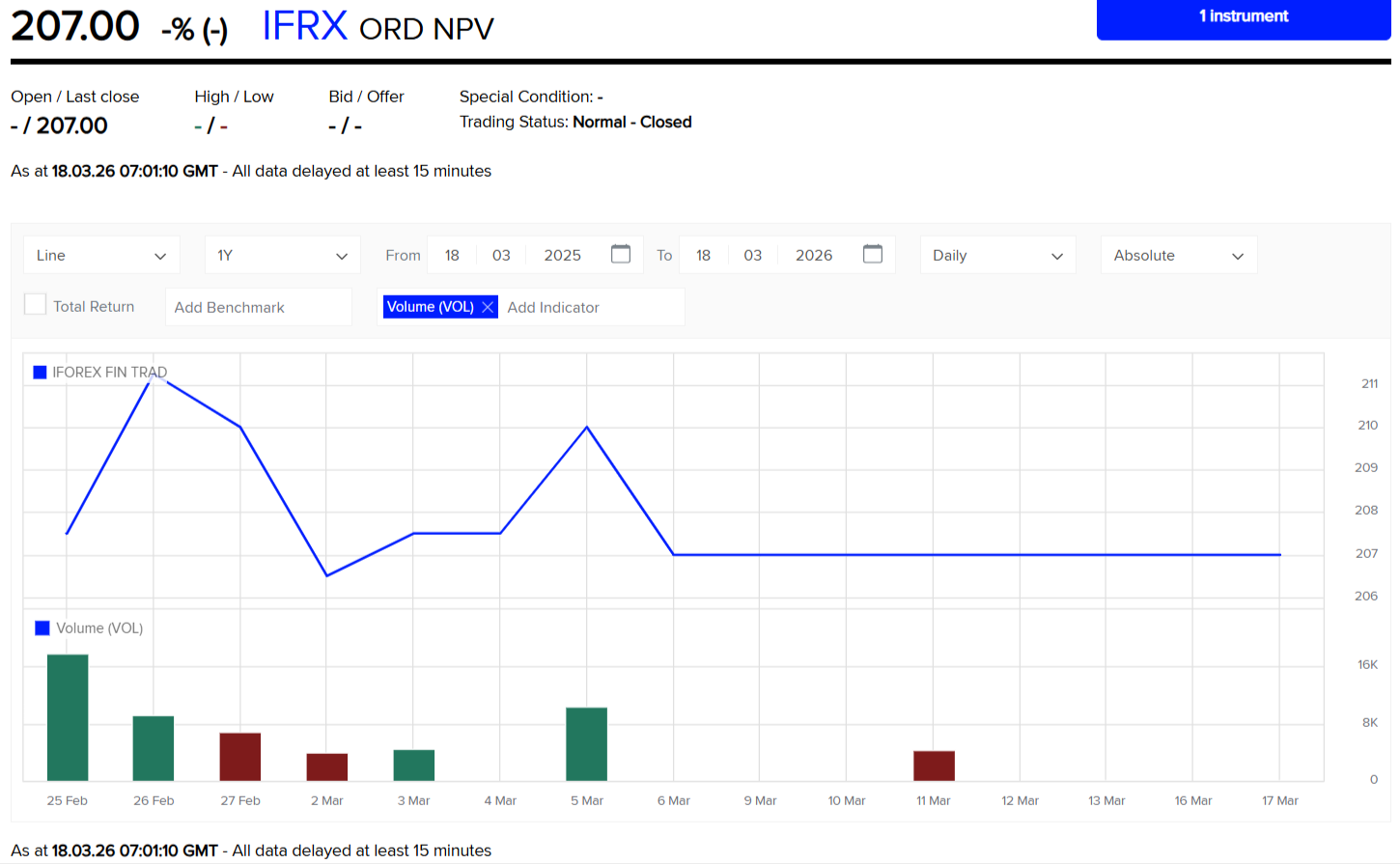
It’s been two weeks since any activity was seen in iFOREX Financial Trading Holdings shares on the London Stock Exchange, and the lack of movement is drawing attention. The CFD broker, which finally listed on the LSE’s Main Market on February 25 after an eight-month delay, was trading around 207 pence per share—about 6% higher than its 195p offer price.
Source: LSE
However, this slight gain doesn’t reveal much about investor sentiment or trading momentum. When iFOREX launched its IPO at 195 pence per share, it issued 4.49 million new shares, equal to just 20.2% of its total share capital. None of the existing investors sold their stakes, keeping most of the stock tightly held. The offering raised £8.75 million, giving the company an overall valuation of roughly £43.3 million, but with so few shares in public hands, the market now feels more frozen than free.
Is the Comoros license mirage ending?
The only legitimate financial regulator in the Union of Comoros is the Banque Centrale des Comores, despite claims from a few island-based authorities. Some entities suggest that a small fee and tropical branding can buy regulatory legitimacy, but that couldn’t be further from the truth.
The Union of Comoros consists of three islands off the East African coast—Ngazidja (Grande Comore), Mwali (Mohéli) and Ndzwani (Anjouan).
While the country has a history of political and legal quirks, its financial regulation is more complicated than advertised. Two local bodies, the Anjouan Offshore Finance Authority (AOFA) and the Mwali International Services Authority (MISA), claim to issue banking, forex, and insurance licenses. However, their authority to do so is highly questionable.
The regulator said the updated framework will make reporting clearer, more consistent, and easier to follow. It is also meant to help authorities respond faster to serious disruptions such as cyberattacks or power outages, while giving firms clearer guidance on what and when to report.
The changes follow a rise in cyber threats and operational risks across the sector. According to the FCA, more than 40% of cyber incidents reported in 2025 involved third-party providers. Recent outages affecting services linked to Cloudflare and Amazon Web Services have underscored the industry’s growing dependence on external technology partners.
Brokers confident in Singapore’s FX growth
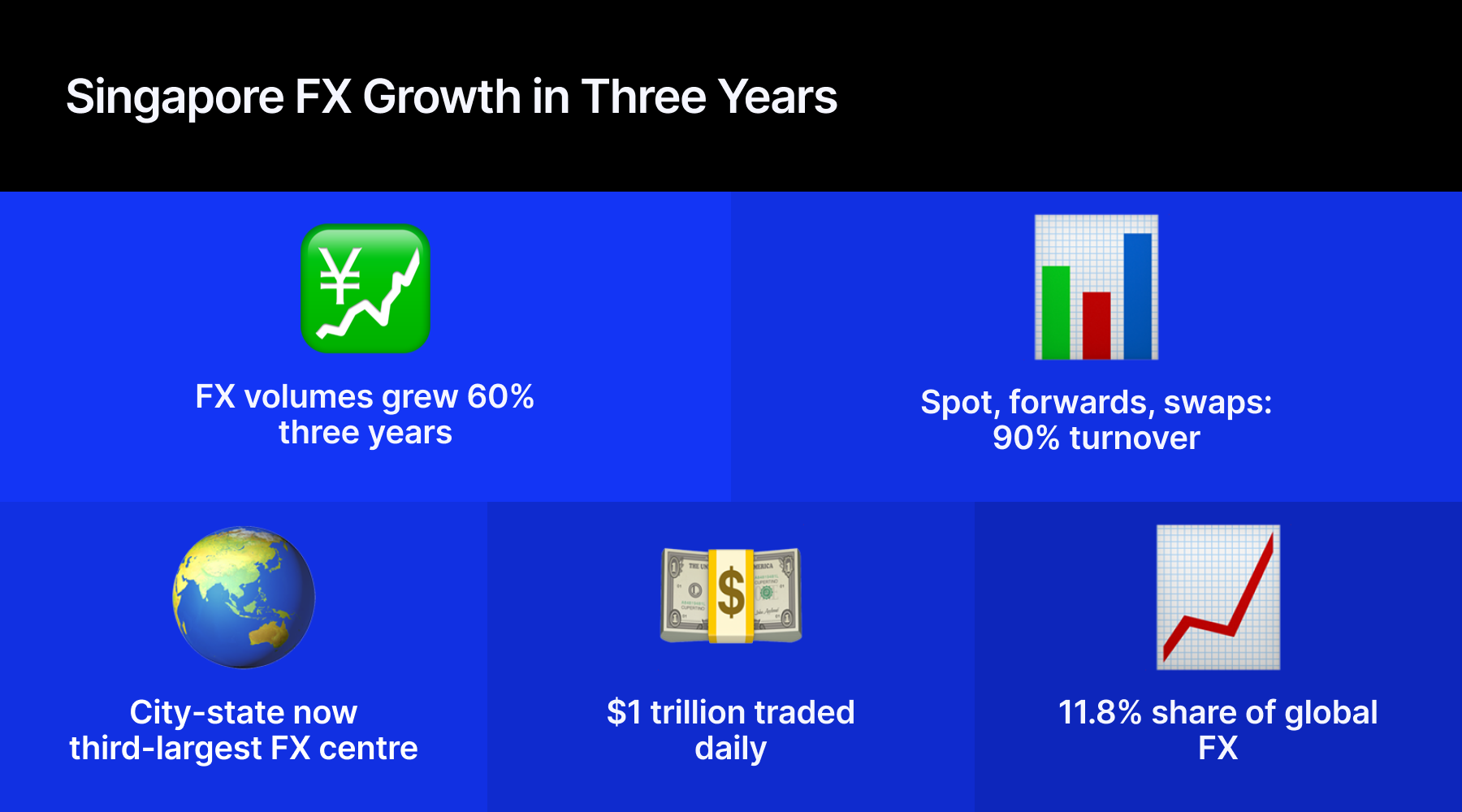
Finally, as foreign exchange (FX) trading activity continues to rise in Singapore, market participants express confidence that the country’s connectivity and trading infrastructure can support both current and future demand. Industry stakeholders say the systems in place are well-equipped to handle growing transaction volumes and increasing global participation.
According to the Bank for International Settlements’ triennial survey of global FX and OTC derivatives markets, Singapore’s average daily FX trading volume rose by 60% between April 2022 and April 2025. The growth was largely driven by strong trading in the US dollar, Japanese yen, and euro, cementing Singapore’s position as one of the world’s leading FX hubs.
At the same time, Singapore’s Monetary Authority of Singapore is advancing its leadership in asset tokenization through Project Guardian, launched in 2022. The initiative has already seen money market funds and bonds tokenized and settled on-chain, reflecting the country’s balanced approach to innovation and regulation.
New US playbook for crypto assets
This week, the U.S SEC and the CFTC jointly issued new guidance
clarifying how federal laws apply to crypto. The duo outlined the conditions
under which a token transitions from being a security to a commodity.
SEC Chairman Paul S. Atkins said that the new guide “acknowledges
what the former administration refused to recognize – that most crypto assets
are not themselves securities.”
TODAY 🚨: The Commission issued an interpretation that clarifies the application of federal securities laws to crypto assets.
This is a major step to provide greater clarity regarding the Commission’s treatment of crypto assets.
Our interpretation on crypto assets—grounded in existing law and informed by extensive public input—acknowledges what the former administration refused to recognize...
It also marks a major milestone in crypto
regulation, introducing a five-category classification system that replaces the
previous regulatory uncertainty. However, by shifting from a disclosure-focused model to one centered on market conduct, the framework also raises concerns about potential gaps in investor protection and the balance between innovation and oversight.
JPMorgan Chase is among the first to review its internal rules on staff trading these contracts and may issue explicit guidance for its 320,000 employees on using platforms like Kalshi and Polymarket.
The latest example is Kraken, which in late February said it
would offer perpetual futures on tokenized stocks to non-US clients, giving
traders 24/7 access to equity-like price movements with up to 20x leverage and
the ability to go long or short.
These products initially track tokenized versions of major
equity indices, commodities and well-known public companies. Perpetual futures are often described as the missing link in
tokenized equities because they have no expiry date.
IG considers crossing the Atlantic
IG Group is considering shifting its listing from London to New York to deepen its footprint in one of the world’s biggest financial markets. The broker said it is reviewing where its shares are listed, where the company is legally based, and whether it should pursue acquisitions as part of a broader growth strategy.
Chief Financial Officer Clifford Abrahams told Bloomberg that a U.S. listing could help IG stand out more among its competitors, draw in fresh investors, and give it more options for deal-making. He also noted that such a move could benefit employees by giving them better access to global capital markets and potentially more attractive equity-based incentives.
KPI
CY25
CY24
Change
Total Revenue
£1,123.4m
£1,052.2m
+7%
Net Trading Revenue
£1,004.6m
£910.6m
+10%
Net Interest Income
£118.8m
£141.6m
-16%
EBITDA
£531.1m
£525.0m
+1%
EBITDA Margin
47.3%
49.9%
-2.6pp
IG reported record revenue of £1.12 billion in 2025,
supported by strong double-digit growth in net trading revenue and a boost in
new clients from its Freetrade integration. Net trading revenue for the 12
months to 31 December 2025 rose 10% to £1,004.6 million, up from £910.6 million
in 2024.
This guidance follows a strong 2025, when Swissquote reported net revenue of CHF 723.3 million and pre-tax profit of CHF 420.2 million, up 9.4 percent and 21.6 percent, respectively. Last year’s revenue was helped by higher trading activity, which pushed net fee and commission income up 17.5 percent to CHF 209.4 million and net trading income up 52.6 percent to CHF 119.5 million.
Colmex Pro says this move is part of a longer-term plan to shift its business toward investment products and market access services. The broker now plans to focus on offerings such as equities, ETFs and other exchange-traded instruments.
Before October of that year, control rested with Lijun Li and an offshore company, which held authority from August 2022. The UK entity is now managed by Stephen Williams and Levy Benarroch, serving as director and CEO, respectively. The company’s dual exit from CySEC and the FCA underscores a clear shift away from the region’s tightly regulated frameworks.
Admirals not onboarding CFD users under Jordan and Kenya Licenses
Admirals stopped onboarding clients under its Jordanian license
in the fourth quarter of 2025 and has also ceased taking on new clients through
its Kenyan entity. Instead, new traders from both countries are now being
registered under the company’s Seychelles license.
A customer service executive told Finance Magnates that
clients had been notified about the shift and were offered solutions tailored
to regulatory requirements and individual needs. However, the representative
said the company could not share additional details for compliance reasons.
iFOREX shares stagnate
It’s been two weeks since any activity was seen in iFOREX Financial Trading Holdings shares on the London Stock Exchange, and the lack of movement is drawing attention. The CFD broker, which finally listed on the LSE’s Main Market on February 25 after an eight-month delay, was trading around 207 pence per share—about 6% higher than its 195p offer price.
Source: LSE
However, this slight gain doesn’t reveal much about investor sentiment or trading momentum. When iFOREX launched its IPO at 195 pence per share, it issued 4.49 million new shares, equal to just 20.2% of its total share capital. None of the existing investors sold their stakes, keeping most of the stock tightly held. The offering raised £8.75 million, giving the company an overall valuation of roughly £43.3 million, but with so few shares in public hands, the market now feels more frozen than free.
Is the Comoros license mirage ending?
The only legitimate financial regulator in the Union of Comoros is the Banque Centrale des Comores, despite claims from a few island-based authorities. Some entities suggest that a small fee and tropical branding can buy regulatory legitimacy, but that couldn’t be further from the truth.
The Union of Comoros consists of three islands off the East African coast—Ngazidja (Grande Comore), Mwali (Mohéli) and Ndzwani (Anjouan).
While the country has a history of political and legal quirks, its financial regulation is more complicated than advertised. Two local bodies, the Anjouan Offshore Finance Authority (AOFA) and the Mwali International Services Authority (MISA), claim to issue banking, forex, and insurance licenses. However, their authority to do so is highly questionable.
The regulator said the updated framework will make reporting clearer, more consistent, and easier to follow. It is also meant to help authorities respond faster to serious disruptions such as cyberattacks or power outages, while giving firms clearer guidance on what and when to report.
The changes follow a rise in cyber threats and operational risks across the sector. According to the FCA, more than 40% of cyber incidents reported in 2025 involved third-party providers. Recent outages affecting services linked to Cloudflare and Amazon Web Services have underscored the industry’s growing dependence on external technology partners.
Brokers confident in Singapore’s FX growth
Finally, as foreign exchange (FX) trading activity continues to rise in Singapore, market participants express confidence that the country’s connectivity and trading infrastructure can support both current and future demand. Industry stakeholders say the systems in place are well-equipped to handle growing transaction volumes and increasing global participation.
According to the Bank for International Settlements’ triennial survey of global FX and OTC derivatives markets, Singapore’s average daily FX trading volume rose by 60% between April 2022 and April 2025. The growth was largely driven by strong trading in the US dollar, Japanese yen, and euro, cementing Singapore’s position as one of the world’s leading FX hubs.
At the same time, Singapore’s Monetary Authority of Singapore is advancing its leadership in asset tokenization through Project Guardian, launched in 2022. The initiative has already seen money market funds and bonds tokenized and settled on-chain, reflecting the country’s balanced approach to innovation and regulation.
Jared Kirui is an Editor at Finance Magnates with more than five years of experience in financial journalism. He covers online trading, fintech, payments, and crypto industries with a focus on companies, regulation and compliance, executive moves, trading technology, and market analysis.
His work has been featured in other media outlets, including Benzinga, ZyCrypto, The Distributed, and The Daily Hodl.
Education:
Bachelor of Commerce degree (Finance option), University of Nairobi
Retail Traders Can Now Access Prediction Markets Through Binance Wallet
Featured Videos
FP Markets Winner Spotlight 🏆 | Global Broker of the Year 2025 #Trading #Broker #Innovation #Shorts
FP Markets Winner Spotlight 🏆 | Global Broker of the Year 2025 #Trading #Broker #Innovation #Shorts
FP Markets Winner Spotlight 🏆 | Global Broker of the Year 2025 #Trading #Broker #Innovation #Shorts
FP Markets Winner Spotlight 🏆 | Global Broker of the Year 2025 #Trading #Broker #Innovation #Shorts
FP Markets takes the spotlight as Global Broker of the Year 2025 at the Finance Magnates Awards.
Martin Stoilov, Head of Client Experience, shares that trust, innovation, and people played a key role in the company’s success, supported by a strong foundation of integrity and client-centricity.
Following this milestone, FP Markets continues to focus on growth, technology investment, and its core values of transparency and excellence.
👉 Be part of FM Awards 2026: https://awards.financemagnates.com/#nominate
FP Markets takes the spotlight as Global Broker of the Year 2025 at the Finance Magnates Awards.
Martin Stoilov, Head of Client Experience, shares that trust, innovation, and people played a key role in the company’s success, supported by a strong foundation of integrity and client-centricity.
Following this milestone, FP Markets continues to focus on growth, technology investment, and its core values of transparency and excellence.
👉 Be part of FM Awards 2026: https://awards.financemagnates.com/#nominate
FP Markets takes the spotlight as Global Broker of the Year 2025 at the Finance Magnates Awards.
Martin Stoilov, Head of Client Experience, shares that trust, innovation, and people played a key role in the company’s success, supported by a strong foundation of integrity and client-centricity.
Following this milestone, FP Markets continues to focus on growth, technology investment, and its core values of transparency and excellence.
👉 Be part of FM Awards 2026: https://awards.financemagnates.com/#nominate
FP Markets takes the spotlight as Global Broker of the Year 2025 at the Finance Magnates Awards.
Martin Stoilov, Head of Client Experience, shares that trust, innovation, and people played a key role in the company’s success, supported by a strong foundation of integrity and client-centricity.
Following this milestone, FP Markets continues to focus on growth, technology investment, and its core values of transparency and excellence.
👉 Be part of FM Awards 2026: https://awards.financemagnates.com/#nominate
In this video, we review @HolaPrimeMarketsOfficial, a multi-asset forex and CFDs broker offering different account types, trading platforms, and flexible trading conditions.
We cover the broker’s overall offering, including account options, trading environment, platforms like MT4 and MT5, and additional services such as managed accounts and fast withdrawals.
Watch the full video to see if Hola Prime Markets fits your trading needs.
📣 Stay up to date with the latest in finance and trading. Follow Finance Magnates for industry news, insights, and global event coverage.
Connect with us:
🔗 LinkedIn: /financemagnates
👍 Facebook: /financemagnates
📸 Instagram: https://www.instagram.com/financemagnates
🐦 X: https://x.com/financemagnates
🎥 TikTok: https://www.tiktok.com/tag/financemagnates
▶️ YouTube: /@financemagnates_official
#HolaPrime #ForexBroker #CFDTrading #FinanceMagnates #Trading #Forex #BrokerReview
In this video, we review @HolaPrimeMarketsOfficial, a multi-asset forex and CFDs broker offering different account types, trading platforms, and flexible trading conditions.
We cover the broker’s overall offering, including account options, trading environment, platforms like MT4 and MT5, and additional services such as managed accounts and fast withdrawals.
Watch the full video to see if Hola Prime Markets fits your trading needs.
📣 Stay up to date with the latest in finance and trading. Follow Finance Magnates for industry news, insights, and global event coverage.
Connect with us:
🔗 LinkedIn: /financemagnates
👍 Facebook: /financemagnates
📸 Instagram: https://www.instagram.com/financemagnates
🐦 X: https://x.com/financemagnates
🎥 TikTok: https://www.tiktok.com/tag/financemagnates
▶️ YouTube: /@financemagnates_official
#HolaPrime #ForexBroker #CFDTrading #FinanceMagnates #Trading #Forex #BrokerReview
In this video, we review @HolaPrimeMarketsOfficial, a multi-asset forex and CFDs broker offering different account types, trading platforms, and flexible trading conditions.
We cover the broker’s overall offering, including account options, trading environment, platforms like MT4 and MT5, and additional services such as managed accounts and fast withdrawals.
Watch the full video to see if Hola Prime Markets fits your trading needs.
📣 Stay up to date with the latest in finance and trading. Follow Finance Magnates for industry news, insights, and global event coverage.
Connect with us:
🔗 LinkedIn: /financemagnates
👍 Facebook: /financemagnates
📸 Instagram: https://www.instagram.com/financemagnates
🐦 X: https://x.com/financemagnates
🎥 TikTok: https://www.tiktok.com/tag/financemagnates
▶️ YouTube: /@financemagnates_official
#HolaPrime #ForexBroker #CFDTrading #FinanceMagnates #Trading #Forex #BrokerReview
In this video, we review @HolaPrimeMarketsOfficial, a multi-asset forex and CFDs broker offering different account types, trading platforms, and flexible trading conditions.
We cover the broker’s overall offering, including account options, trading environment, platforms like MT4 and MT5, and additional services such as managed accounts and fast withdrawals.
Watch the full video to see if Hola Prime Markets fits your trading needs.
📣 Stay up to date with the latest in finance and trading. Follow Finance Magnates for industry news, insights, and global event coverage.
Connect with us:
🔗 LinkedIn: /financemagnates
👍 Facebook: /financemagnates
📸 Instagram: https://www.instagram.com/financemagnates
🐦 X: https://x.com/financemagnates
🎥 TikTok: https://www.tiktok.com/tag/financemagnates
▶️ YouTube: /@financemagnates_official
#HolaPrime #ForexBroker #CFDTrading #FinanceMagnates #Trading #Forex #BrokerReview
In this video, we review @HolaPrimeMarketsOfficial, a multi-asset forex and CFDs broker offering different account types, trading platforms, and flexible trading conditions.
We cover the broker’s overall offering, including account options, trading environment, platforms like MT4 and MT5, and additional services such as managed accounts and fast withdrawals.
Watch the full video to see if Hola Prime Markets fits your trading needs.
📣 Stay up to date with the latest in finance and trading. Follow Finance Magnates for industry news, insights, and global event coverage.
Connect with us:
🔗 LinkedIn: /financemagnates
👍 Facebook: /financemagnates
📸 Instagram: https://www.instagram.com/financemagnates
🐦 X: https://x.com/financemagnates
🎥 TikTok: https://www.tiktok.com/tag/financemagnates
▶️ YouTube: /@financemagnates_official
#HolaPrime #ForexBroker #CFDTrading #FinanceMagnates #Trading #Forex #BrokerReview
In this video, we review @HolaPrimeMarketsOfficial, a multi-asset forex and CFDs broker offering different account types, trading platforms, and flexible trading conditions.
We cover the broker’s overall offering, including account options, trading environment, platforms like MT4 and MT5, and additional services such as managed accounts and fast withdrawals.
Watch the full video to see if Hola Prime Markets fits your trading needs.
📣 Stay up to date with the latest in finance and trading. Follow Finance Magnates for industry news, insights, and global event coverage.
Connect with us:
🔗 LinkedIn: /financemagnates
👍 Facebook: /financemagnates
📸 Instagram: https://www.instagram.com/financemagnates
🐦 X: https://x.com/financemagnates
🎥 TikTok: https://www.tiktok.com/tag/financemagnates
▶️ YouTube: /@financemagnates_official
#HolaPrime #ForexBroker #CFDTrading #FinanceMagnates #Trading #Forex #BrokerReview
Hola Prime Review: What You Need to Know | Full Breakdown by Finance Magnates
Hola Prime Review: What You Need to Know | Full Breakdown by Finance Magnates
Hola Prime Review: What You Need to Know | Full Breakdown by Finance Magnates
Hola Prime Review: What You Need to Know | Full Breakdown by Finance Magnates
Hola Prime Review: What You Need to Know | Full Breakdown by Finance Magnates
Hola Prime Review: What You Need to Know | Full Breakdown by Finance Magnates
In this video, we review @HolaPrime_Global, a proprietary trading firm offering evaluation programs and performance-based payouts in simulated market environments.
We cover how the challenge model works, including account types, profit splits (up to 95%), trading rules, and what it takes to reach a funded account. You’ll also learn about available platforms like MT4, MT5, cTrader, and more, along with insights into payouts, support, and trading conditions.
Watch the full video to see if Hola Prime fits your trading style.
📣 Stay up to date with the latest in finance and trading. Follow Finance Magnates for industry news, insights, and global event coverage.
Connect with us:
🔗 LinkedIn: /financemagnates
👍 Facebook: /financemagnates
📸 Instagram: https://www.instagram.com/financemagnates
🐦 X: https://x.com/financemagnates
🎥 TikTok: https://www.tiktok.com/tag/financemagnates
▶️ YouTube: /@financemagnates_official
#HolaPrime #PropFirm #Trading #FinanceMagnates #Forex #FuturesTrading #TradingReview #PropFirmReview
In this video, we review @HolaPrime_Global, a proprietary trading firm offering evaluation programs and performance-based payouts in simulated market environments.
We cover how the challenge model works, including account types, profit splits (up to 95%), trading rules, and what it takes to reach a funded account. You’ll also learn about available platforms like MT4, MT5, cTrader, and more, along with insights into payouts, support, and trading conditions.
Watch the full video to see if Hola Prime fits your trading style.
📣 Stay up to date with the latest in finance and trading. Follow Finance Magnates for industry news, insights, and global event coverage.
Connect with us:
🔗 LinkedIn: /financemagnates
👍 Facebook: /financemagnates
📸 Instagram: https://www.instagram.com/financemagnates
🐦 X: https://x.com/financemagnates
🎥 TikTok: https://www.tiktok.com/tag/financemagnates
▶️ YouTube: /@financemagnates_official
#HolaPrime #PropFirm #Trading #FinanceMagnates #Forex #FuturesTrading #TradingReview #PropFirmReview
In this video, we review @HolaPrime_Global, a proprietary trading firm offering evaluation programs and performance-based payouts in simulated market environments.
We cover how the challenge model works, including account types, profit splits (up to 95%), trading rules, and what it takes to reach a funded account. You’ll also learn about available platforms like MT4, MT5, cTrader, and more, along with insights into payouts, support, and trading conditions.
Watch the full video to see if Hola Prime fits your trading style.
📣 Stay up to date with the latest in finance and trading. Follow Finance Magnates for industry news, insights, and global event coverage.
Connect with us:
🔗 LinkedIn: /financemagnates
👍 Facebook: /financemagnates
📸 Instagram: https://www.instagram.com/financemagnates
🐦 X: https://x.com/financemagnates
🎥 TikTok: https://www.tiktok.com/tag/financemagnates
▶️ YouTube: /@financemagnates_official
#HolaPrime #PropFirm #Trading #FinanceMagnates #Forex #FuturesTrading #TradingReview #PropFirmReview
In this video, we review @HolaPrime_Global, a proprietary trading firm offering evaluation programs and performance-based payouts in simulated market environments.
We cover how the challenge model works, including account types, profit splits (up to 95%), trading rules, and what it takes to reach a funded account. You’ll also learn about available platforms like MT4, MT5, cTrader, and more, along with insights into payouts, support, and trading conditions.
Watch the full video to see if Hola Prime fits your trading style.
📣 Stay up to date with the latest in finance and trading. Follow Finance Magnates for industry news, insights, and global event coverage.
Connect with us:
🔗 LinkedIn: /financemagnates
👍 Facebook: /financemagnates
📸 Instagram: https://www.instagram.com/financemagnates
🐦 X: https://x.com/financemagnates
🎥 TikTok: https://www.tiktok.com/tag/financemagnates
▶️ YouTube: /@financemagnates_official
#HolaPrime #PropFirm #Trading #FinanceMagnates #Forex #FuturesTrading #TradingReview #PropFirmReview
In this video, we review @HolaPrime_Global, a proprietary trading firm offering evaluation programs and performance-based payouts in simulated market environments.
We cover how the challenge model works, including account types, profit splits (up to 95%), trading rules, and what it takes to reach a funded account. You’ll also learn about available platforms like MT4, MT5, cTrader, and more, along with insights into payouts, support, and trading conditions.
Watch the full video to see if Hola Prime fits your trading style.
📣 Stay up to date with the latest in finance and trading. Follow Finance Magnates for industry news, insights, and global event coverage.
Connect with us:
🔗 LinkedIn: /financemagnates
👍 Facebook: /financemagnates
📸 Instagram: https://www.instagram.com/financemagnates
🐦 X: https://x.com/financemagnates
🎥 TikTok: https://www.tiktok.com/tag/financemagnates
▶️ YouTube: /@financemagnates_official
#HolaPrime #PropFirm #Trading #FinanceMagnates #Forex #FuturesTrading #TradingReview #PropFirmReview
In this video, we review @HolaPrime_Global, a proprietary trading firm offering evaluation programs and performance-based payouts in simulated market environments.
We cover how the challenge model works, including account types, profit splits (up to 95%), trading rules, and what it takes to reach a funded account. You’ll also learn about available platforms like MT4, MT5, cTrader, and more, along with insights into payouts, support, and trading conditions.
Watch the full video to see if Hola Prime fits your trading style.
📣 Stay up to date with the latest in finance and trading. Follow Finance Magnates for industry news, insights, and global event coverage.
Connect with us:
🔗 LinkedIn: /financemagnates
👍 Facebook: /financemagnates
📸 Instagram: https://www.instagram.com/financemagnates
🐦 X: https://x.com/financemagnates
🎥 TikTok: https://www.tiktok.com/tag/financemagnates
▶️ YouTube: /@financemagnates_official
#HolaPrime #PropFirm #Trading #FinanceMagnates #Forex #FuturesTrading #TradingReview #PropFirmReview
Axi Winner Spotlight 🏆 | Global Most Innovative Broker 2025 #Innovation #Trading #Fintech #Broker
Axi Winner Spotlight 🏆 | Global Most Innovative Broker 2025 #Innovation #Trading #Fintech #Broker
Axi Winner Spotlight 🏆 | Global Most Innovative Broker 2025 #Innovation #Trading #Fintech #Broker
Axi Winner Spotlight 🏆 | Global Most Innovative Broker 2025 #Innovation #Trading #Fintech #Broker
Axi Winner Spotlight 🏆 | Global Most Innovative Broker 2025 #Innovation #Trading #Fintech #Broker
Axi Winner Spotlight 🏆 | Global Most Innovative Broker 2025 #Innovation #Trading #Fintech #Broker
Axi takes the spotlight at the Finance Magnates Awards, winning Global Most Innovative Broker 2025.
Olivia Xenofontos and Ivanna Openko share how the team will feel: proud, motivated, and ready to keep delivering.
They also describe the night as well-organized, focused, and enjoyable for all.
👉 Be part of FM Awards 2026.
Axi takes the spotlight at the Finance Magnates Awards, winning Global Most Innovative Broker 2025.
Olivia Xenofontos and Ivanna Openko share how the team will feel: proud, motivated, and ready to keep delivering.
They also describe the night as well-organized, focused, and enjoyable for all.
👉 Be part of FM Awards 2026.
Axi takes the spotlight at the Finance Magnates Awards, winning Global Most Innovative Broker 2025.
Olivia Xenofontos and Ivanna Openko share how the team will feel: proud, motivated, and ready to keep delivering.
They also describe the night as well-organized, focused, and enjoyable for all.
👉 Be part of FM Awards 2026.
Axi takes the spotlight at the Finance Magnates Awards, winning Global Most Innovative Broker 2025.
Olivia Xenofontos and Ivanna Openko share how the team will feel: proud, motivated, and ready to keep delivering.
They also describe the night as well-organized, focused, and enjoyable for all.
👉 Be part of FM Awards 2026.
Axi takes the spotlight at the Finance Magnates Awards, winning Global Most Innovative Broker 2025.
Olivia Xenofontos and Ivanna Openko share how the team will feel: proud, motivated, and ready to keep delivering.
They also describe the night as well-organized, focused, and enjoyable for all.
👉 Be part of FM Awards 2026.
Axi takes the spotlight at the Finance Magnates Awards, winning Global Most Innovative Broker 2025.
Olivia Xenofontos and Ivanna Openko share how the team will feel: proud, motivated, and ready to keep delivering.
They also describe the night as well-organized, focused, and enjoyable for all.
👉 Be part of FM Awards 2026.
Recognition that matters.
Built on transparency.
Driven by the industry.
The Finance Magnates Awards 2026.
Nominations are now open.
🔗 https://awards.financemagnates.com/?utm_source=SM&utm_medium=social&utm_campaign=recognition-matters
Recognition that matters.
Built on transparency.
Driven by the industry.
The Finance Magnates Awards 2026.
Nominations are now open.
🔗 https://awards.financemagnates.com/?utm_source=SM&utm_medium=social&utm_campaign=recognition-matters
Recognition that matters.
Built on transparency.
Driven by the industry.
The Finance Magnates Awards 2026.
Nominations are now open.
🔗 https://awards.financemagnates.com/?utm_source=SM&utm_medium=social&utm_campaign=recognition-matters
Recognition that matters.
Built on transparency.
Driven by the industry.
The Finance Magnates Awards 2026.
Nominations are now open.
🔗 https://awards.financemagnates.com/?utm_source=SM&utm_medium=social&utm_campaign=recognition-matters
Recognition that matters.
Built on transparency.
Driven by the industry.
The Finance Magnates Awards 2026.
Nominations are now open.
🔗 https://awards.financemagnates.com/?utm_source=SM&utm_medium=social&utm_campaign=recognition-matters
Recognition that matters.
Built on transparency.
Driven by the industry.
The Finance Magnates Awards 2026.
Nominations are now open.
🔗 https://awards.financemagnates.com/?utm_source=SM&utm_medium=social&utm_campaign=recognition-matters