

Volatility defined markets in 2025. For leading online brokers, it was a stress test that reshaped client behaviour, exposed weak models and, in some cases, drove record growth.
That was the message from senior executives at the Finance Magnates London Summit, where speakers from retail, institutional and liquidity-focused firms reflected on a year shaped by geopolitical shocks, surging gold prices and the market impact of US political signals.
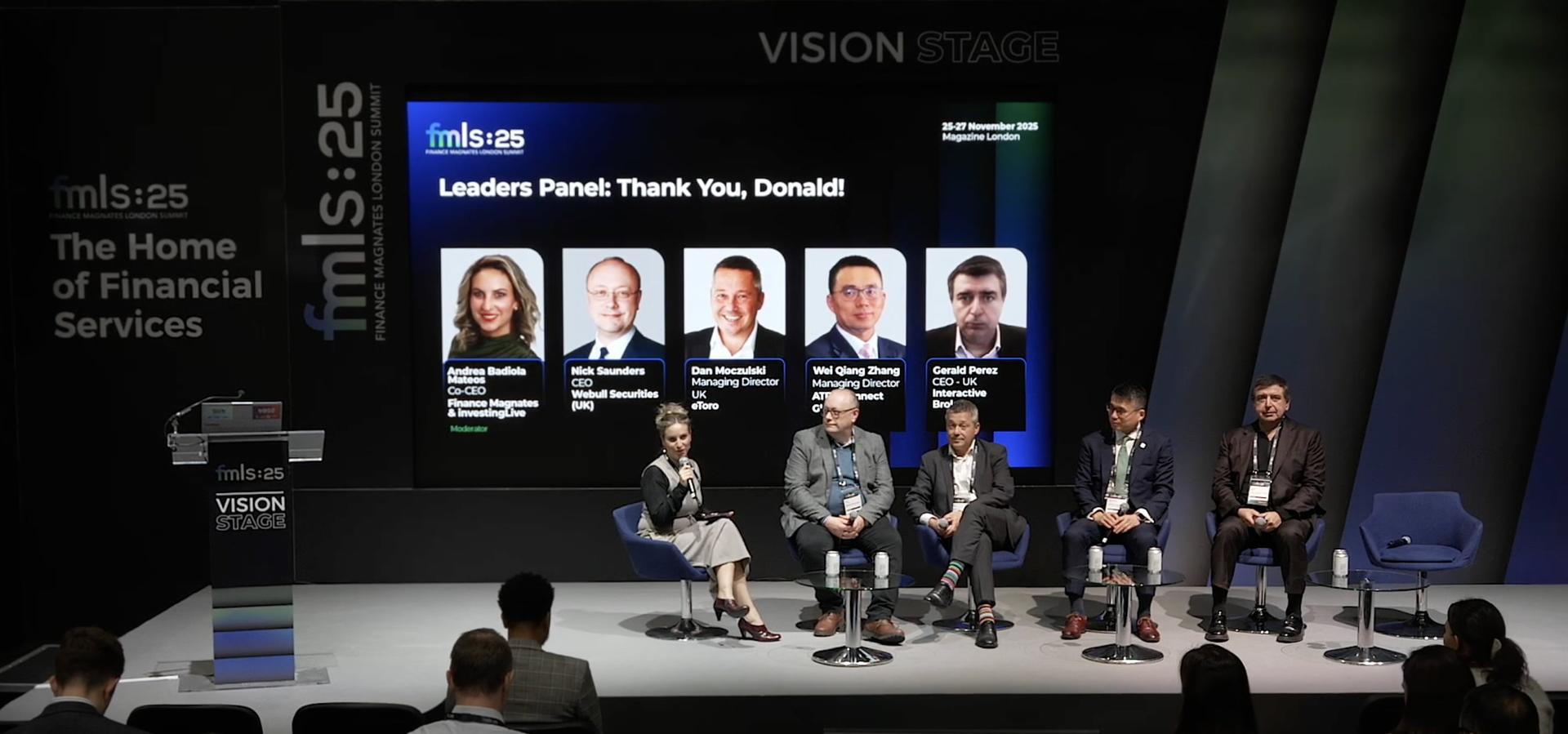
The session, titled “Leaders Panel: Thank You, Donald”, examined how market-moving statements by Donald Trump accelerated structural shifts in trading, investing and regulation.
Volatility as a Trust Test
For Interactive Brokers, volatility reinforced a focus on financial strength over price competition. Gerry Perez, chief executive of Interactive Brokers UK, said the firm entered the year expecting disruption from geopolitics and elections.
The response was to strengthen capital, tighten continuity planning and position the business around trust. The result, he said, was the strongest year in the group’s 47-year history, with UK growth of 142%.
Nick Sauders, chief executive of Webull Securities UK, made a similar point. Anticipating heavier market stress, the firm increased capital at clearers, expanded server capacity and scaled staffing.
In retail broking, he said, trust ultimately comes down to reliability - clients must be able to access markets and execute trades when volatility peaks. At eToro, volatility highlighted the value of balance rather than pure trading exposure.
Dan Moczulski, eToro’s UK managing director, said one of the firm’s most effective moves was shifting toward local wealth products such as cash ISAs and stocks and shares ISAs.
“The mistake was not doing it sooner,” he said. He added that today’s retail clients are more resilient than in previous cycles. Market pullbacks are increasingly treated as buying opportunities rather than exit signals—a sign of a more mature investor base.
When Tweets Move Markets
Political communication emerged as a major volatility driver. Perez cited tariff-related comments on China as among the most disruptive, triggering sharp equity sell-offs and shifts in retail sentiment.
Moczulski pointed to how even false or speculative reports—such as claims of a potential tariff pause—briefly pushed markets higher before rapid reversals. The effect, speakers agreed, is a market increasingly driven by expectations as much as events.
Retail investors, however, appear less reactive than in previous cycles and more willing to stay invested through headline-driven swings. Wei of ATFX Connect noted that even experienced traders have adapted, increasingly relying on social media for real-time signals—behaviour that has become standard rather than exceptional.
- Trump's Tariffs Spark Turmoil – and a Boom in Derivatives
- Traders Want to Catch the Volatility Wave in Trading, Study Finds
- Saxo Bank Issues Warning about Ruble Volatility
Regions that Defied Expectations
Several regions behaved differently from established models. China stood out for its adaptability. Perez said trade flows shifted toward Europe more quickly than expected, allowing growth to continue despite tariff pressure.
Wei cited examples from Mexico, where Chinese businesses expanded manufacturing and supply chains to maintain access to North American markets. Europe also exceeded expectations.
Saunders said assumptions that the EU would quickly concede to US pressure proved wrong, with greater political and economic cohesion supporting market performance.
Moczulski highlighted the Middle East—particularly the UAE—as the fastest-growing region for many brokers, signalling a broader geographic spread of opportunity.
Crypto’s Regulatory Pivot
Crypto divided opinion but featured prominently. Moczulski said eToro benefited from a more constructive US regulatory stance, which drove a surge in crypto volumes and enabled the firm to complete a long-delayed public listing.
Perez was more cautious, arguing that Europe remains constrained by financial promotion rules and that meaningful growth will depend on regulatory action rather than rhetoric. Interactive Brokers, he said, is preparing by strengthening infrastructure and custody frameworks.
Saunders was openly sceptical. Webull does not currently offer crypto in the UK. While demand is rising, he argued that blockchain’s long-term value lies in digitising real-world assets rather than speculative trading.
Looking ahead to 2026
Asked to name a defining trend for 2026, panelists pointed to connected themes: a shift from software-led AIand hardware, softer interest rates reshaping brokerage economics, and a more active retail investor base supported by better tools and risk controls.
The panel’s conclusion was consistent: volatility is no longer episodic. It is reshaping how brokers build trust, how clients behave and how markets react. By 2026, success is likely to depend less on avoiding shocks than on being built to withstand them.


