The way retail traders discover brokers and proprietary
trading firms is starting to shift, as a growing number of platforms attempt to
impose structure on a fragmented and often opaque market.
For years, discovery has been dominated by affiliate-driven
review sites, forums, and user-generated ratings, where commercial incentives
and inconsistent standards can make comparisons difficult. As the number of
brokers and prop trading firms expands—and as prop firm models face increasing
scrutiny—new tools are emerging that aim to standardize how traders evaluate
options.
Two such efforts moved forward. FXStreet, in partnership
with Swiset, launched Propinder, a tool focused on prop trading challenges,
while investingLive expanded its broker comparison directory. Notably,
investingLive and Finance Magnates are both part of Ultimate Group.
Two Approaches to the Same Problem
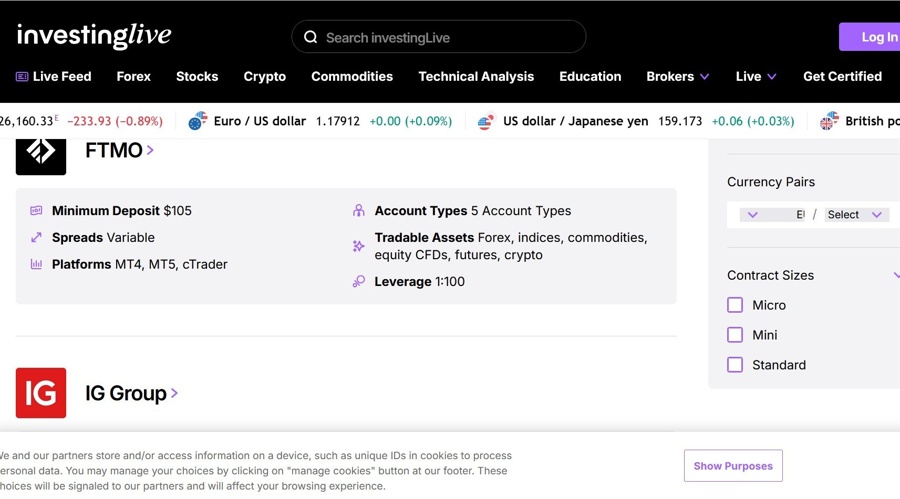
investingLive’s directory is built around structured,
side-by-side comparison. It lists brokers in a standardized format, including
regulatory licenses such as CySEC, FCA, and FSCA, along with platforms like
MT4, MT5, and cTrader, asset classes, minimum deposits, and support details.
Users can filter results by criteria such as regulation or platform.
The directory currently includes 35 brokers, reflecting a
curated rather than exhaustive approach.
Neophytos Papageorgiou, CEO of investingLive and Finance Magnates
Propinder, by contrast, takes a guided route. The tool
asks users to complete a short survey covering experience, platform
preferences, risk tolerance, and location. It then generates three prop trading
challenge suggestions, based on aggregated data from similar user profiles.
Each result highlights rules such as profit targets, drawdown limits, and time
constraints.
Both platforms are positioning themselves as clarity tools
in segments where offerings can appear similar at a glance but differ
significantly in underlying terms.
Neutrality Claims Under Scrutiny
Both companies emphasize that commercial relationships do
not influence how providers are presented.
Javier Hertfelder, CEO of Propinder, Source: LinkedIn
Neophytos Papageorgiou, CEO of investingLive and Finance Magnates, said inclusion
and evaluation are kept separate, arguing that rankings and filters are not
affected by partnerships. At Propinder, CEO Javier Hertfelder framed the
product as an educational tool, saying its goal is to ensure traders understand
conditions “before it costs them anything.”
What distinguishes the new entrants is their attempt to
standardize inputs more tightly—either through fixed data fields, as in
investingLive’s directory, or through profile-based matching, as in Propinder.
Whether that results in more reliable comparisons, or simply repackages
existing affiliate models in a more structured interface, remains to be seen.
Prop firm challenges look identical until you read the rules. 🔍
Propinder surfaces conditions, profit targets and payout structures upfront.
For brokers and prop trading firms, the emergence of more
structured discovery tools could have commercial implications.
Visibility in these environments may increasingly shape how
firms are evaluated by retail traders, raising questions about how listings are
managed, what data is surfaced, and whether paid placement becomes a factor.
Firms may also need to monitor how their conditions—spreads, rules, or funding
terms—are represented in standardized formats.
More broadly, the shift suggests that the retail discovery
layer itself is being rebuilt. The key question is whether these new tools can
balance usability with transparency, or whether they will inherit the same
trust issues that have long defined the comparison space.
The way retail traders discover brokers and proprietary
trading firms is starting to shift, as a growing number of platforms attempt to
impose structure on a fragmented and often opaque market.
For years, discovery has been dominated by affiliate-driven
review sites, forums, and user-generated ratings, where commercial incentives
and inconsistent standards can make comparisons difficult. As the number of
brokers and prop trading firms expands—and as prop firm models face increasing
scrutiny—new tools are emerging that aim to standardize how traders evaluate
options.
Two such efforts moved forward. FXStreet, in partnership
with Swiset, launched Propinder, a tool focused on prop trading challenges,
while investingLive expanded its broker comparison directory. Notably,
investingLive and Finance Magnates are both part of Ultimate Group.
Two Approaches to the Same Problem
investingLive’s directory is built around structured,
side-by-side comparison. It lists brokers in a standardized format, including
regulatory licenses such as CySEC, FCA, and FSCA, along with platforms like
MT4, MT5, and cTrader, asset classes, minimum deposits, and support details.
Users can filter results by criteria such as regulation or platform.
The directory currently includes 35 brokers, reflecting a
curated rather than exhaustive approach.
Neophytos Papageorgiou, CEO of investingLive and Finance Magnates
Propinder, by contrast, takes a guided route. The tool
asks users to complete a short survey covering experience, platform
preferences, risk tolerance, and location. It then generates three prop trading
challenge suggestions, based on aggregated data from similar user profiles.
Each result highlights rules such as profit targets, drawdown limits, and time
constraints.
Both platforms are positioning themselves as clarity tools
in segments where offerings can appear similar at a glance but differ
significantly in underlying terms.
Neutrality Claims Under Scrutiny
Both companies emphasize that commercial relationships do
not influence how providers are presented.
Javier Hertfelder, CEO of Propinder, Source: LinkedIn
Neophytos Papageorgiou, CEO of investingLive and Finance Magnates, said inclusion
and evaluation are kept separate, arguing that rankings and filters are not
affected by partnerships. At Propinder, CEO Javier Hertfelder framed the
product as an educational tool, saying its goal is to ensure traders understand
conditions “before it costs them anything.”
What distinguishes the new entrants is their attempt to
standardize inputs more tightly—either through fixed data fields, as in
investingLive’s directory, or through profile-based matching, as in Propinder.
Whether that results in more reliable comparisons, or simply repackages
existing affiliate models in a more structured interface, remains to be seen.
Prop firm challenges look identical until you read the rules. 🔍
Propinder surfaces conditions, profit targets and payout structures upfront.
For brokers and prop trading firms, the emergence of more
structured discovery tools could have commercial implications.
Visibility in these environments may increasingly shape how
firms are evaluated by retail traders, raising questions about how listings are
managed, what data is surfaced, and whether paid placement becomes a factor.
Firms may also need to monitor how their conditions—spreads, rules, or funding
terms—are represented in standardized formats.
More broadly, the shift suggests that the retail discovery
layer itself is being rebuilt. The key question is whether these new tools can
balance usability with transparency, or whether they will inherit the same
trust issues that have long defined the comparison space.
Tareq is a financial writer with 15 years of experience covering global markets. His work spans technical analysis, forex broker reviews, and market sentiment, with a focus on topics relevant to retail traders. He joined Finance Magnates in 2023.
At Finance Magnates, he serves as News Editor, covering retail forex and CFD brokers, cryptocurrency exchanges, fintech firms, and regulatory developments shaping the trading industry. He holds an Honours degree in Information Technology from Anfell College, London.
Education:
Honours degree Information Technology, Anfell College, London
CFTC Opens Public Comment on Energy Perps One Month After Opening the Door for Bitcoin
Featured Videos
FM Daily Brief – 23 June 2026
FM Daily Brief – 23 June 2026
FM Daily Brief – 23 June 2026
FM Daily Brief – 23 June 2026
Today’s Tuesday, the 23rd of June 2026, and these are our main stories: Capital.com enters South Africa with dual local licences, CMC Markets launches a native AI engine for investors, and Plus500 joins the race for 24/5 trading.
Today’s Tuesday, the 23rd of June 2026, and these are our main stories: Capital.com enters South Africa with dual local licences, CMC Markets launches a native AI engine for investors, and Plus500 joins the race for 24/5 trading.
Today’s Tuesday, the 23rd of June 2026, and these are our main stories: Capital.com enters South Africa with dual local licences, CMC Markets launches a native AI engine for investors, and Plus500 joins the race for 24/5 trading.
Today’s Tuesday, the 23rd of June 2026, and these are our main stories: Capital.com enters South Africa with dual local licences, CMC Markets launches a native AI engine for investors, and Plus500 joins the race for 24/5 trading.
Today’s Monday, the 22nd of June 2026, and these are our main stories: The operator of FXCM is likely facing a bidding war, Dukascopy’s new all-in-one mobile banking and trading app, and Bitget’s launch of real US stock ownership through its Stock plus feature.
Today’s Monday, the 22nd of June 2026, and these are our main stories: The operator of FXCM is likely facing a bidding war, Dukascopy’s new all-in-one mobile banking and trading app, and Bitget’s launch of real US stock ownership through its Stock plus feature.
Today’s Monday, the 22nd of June 2026, and these are our main stories: The operator of FXCM is likely facing a bidding war, Dukascopy’s new all-in-one mobile banking and trading app, and Bitget’s launch of real US stock ownership through its Stock plus feature.
Today’s Monday, the 22nd of June 2026, and these are our main stories: The operator of FXCM is likely facing a bidding war, Dukascopy’s new all-in-one mobile banking and trading app, and Bitget’s launch of real US stock ownership through its Stock plus feature.
Today’s Monday, the 22nd of June 2026, and these are our main stories: The operator of FXCM is likely facing a bidding war, Dukascopy’s new all-in-one mobile banking and trading app, and Bitget’s launch of real US stock ownership through its Stock plus feature.
Today’s Monday, the 22nd of June 2026, and these are our main stories: The operator of FXCM is likely facing a bidding war, Dukascopy’s new all-in-one mobile banking and trading app, and Bitget’s launch of real US stock ownership through its Stock plus feature.
FM Daily Brief – 19 June 2026
FM Daily Brief – 19 June 2026
FM Daily Brief – 19 June 2026
FM Daily Brief – 19 June 2026
FM Daily Brief – 19 June 2026
FM Daily Brief – 19 June 2026
Today’s Friday, the 19th of June 2026, and these are our main stories: Australia’s ASIC scam losses and whitelist push, Singapore adding Bybit to its alert list, and Cyprus broker executives arrested in Moscow.
Today’s Friday, the 19th of June 2026, and these are our main stories: Australia’s ASIC scam losses and whitelist push, Singapore adding Bybit to its alert list, and Cyprus broker executives arrested in Moscow.
Today’s Friday, the 19th of June 2026, and these are our main stories: Australia’s ASIC scam losses and whitelist push, Singapore adding Bybit to its alert list, and Cyprus broker executives arrested in Moscow.
Today’s Friday, the 19th of June 2026, and these are our main stories: Australia’s ASIC scam losses and whitelist push, Singapore adding Bybit to its alert list, and Cyprus broker executives arrested in Moscow.
Today’s Friday, the 19th of June 2026, and these are our main stories: Australia’s ASIC scam losses and whitelist push, Singapore adding Bybit to its alert list, and Cyprus broker executives arrested in Moscow.
Today’s Friday, the 19th of June 2026, and these are our main stories: Australia’s ASIC scam losses and whitelist push, Singapore adding Bybit to its alert list, and Cyprus broker executives arrested in Moscow.
FM Daily Brief – 18 June 2026
FM Daily Brief – 18 June 2026
FM Daily Brief – 18 June 2026
FM Daily Brief – 18 June 2026
FM Daily Brief – 18 June 2026
FM Daily Brief – 18 June 2026
Today is Thursday, the eighteenth of June 2026, and these are our main stories: CME Group is taking the CFTC to court over crypto perpetual futures, the Polish retail trading market is cooling, and Coinbase doubles down on global asset expansion.
Today is Thursday, the eighteenth of June 2026, and these are our main stories: CME Group is taking the CFTC to court over crypto perpetual futures, the Polish retail trading market is cooling, and Coinbase doubles down on global asset expansion.
Today is Thursday, the eighteenth of June 2026, and these are our main stories: CME Group is taking the CFTC to court over crypto perpetual futures, the Polish retail trading market is cooling, and Coinbase doubles down on global asset expansion.
Today is Thursday, the eighteenth of June 2026, and these are our main stories: CME Group is taking the CFTC to court over crypto perpetual futures, the Polish retail trading market is cooling, and Coinbase doubles down on global asset expansion.
Today is Thursday, the eighteenth of June 2026, and these are our main stories: CME Group is taking the CFTC to court over crypto perpetual futures, the Polish retail trading market is cooling, and Coinbase doubles down on global asset expansion.
Today is Thursday, the eighteenth of June 2026, and these are our main stories: CME Group is taking the CFTC to court over crypto perpetual futures, the Polish retail trading market is cooling, and Coinbase doubles down on global asset expansion.
FM Daily Brief – 17 June 2026
FM Daily Brief – 17 June 2026
FM Daily Brief – 17 June 2026
FM Daily Brief – 17 June 2026
FM Daily Brief – 17 June 2026
FM Daily Brief – 17 June 2026
Today’s Wednesday, the 17th of June 2026 and these are our main stories: Robinhood cuts around two hundred ninety jobs while still hiring, Binance against the clock in Europe, and Australia's whitelist against scam clones.
Today’s Wednesday, the 17th of June 2026 and these are our main stories: Robinhood cuts around two hundred ninety jobs while still hiring, Binance against the clock in Europe, and Australia's whitelist against scam clones.
Today’s Wednesday, the 17th of June 2026 and these are our main stories: Robinhood cuts around two hundred ninety jobs while still hiring, Binance against the clock in Europe, and Australia's whitelist against scam clones.
Today’s Wednesday, the 17th of June 2026 and these are our main stories: Robinhood cuts around two hundred ninety jobs while still hiring, Binance against the clock in Europe, and Australia's whitelist against scam clones.
Today’s Wednesday, the 17th of June 2026 and these are our main stories: Robinhood cuts around two hundred ninety jobs while still hiring, Binance against the clock in Europe, and Australia's whitelist against scam clones.
Today’s Wednesday, the 17th of June 2026 and these are our main stories: Robinhood cuts around two hundred ninety jobs while still hiring, Binance against the clock in Europe, and Australia's whitelist against scam clones.