The developer of one of the first social forex networks for signals has released a new web-based platform named ZuluTrade+ , initially it will allow traders who publish signals to build trading robots with Zuluscripts.
While the product is still said to be in beta mode, and first offered to traders who publish signals, it is set to be later rolled out to all clients in the ZuluTrade network, with final tweaks underway, according to an email the company sent to current account holders who publish signals in the ZuluTrade network.
The ZuluScript feature includes the ability for traders to create “scripts” or a set of custom instructions that can carry out trading operations if conditions and specified criteria are reached, and according to people familiar with the development, the platform is compatible with codes from certain 3rd party platforms like MetaTrader4, and the trading robots known as Expert Advisors (EAs) written in the MQL4 language, as told to Forex Magnates' reporters. The code behind the ZuluScript was said to be a super-set of the "C" language code widely used in software programming.
Automated Trading and Signals Go Well Together
This process of trade automation has been a key attribute on many popular trading platforms over the years, and the inclusion of it by ZuluTrade seems like a natural progression to an already sophisticated platform interface and social forex network.
The social network within ZuluTrade’s database contains some 100,000 trading strategies, and provides clients with tools to analyze strategies using quantitative and qualitative data, in an effort to sift out the most appealing performance or trading results, in addition to even screening and analyzing other traders (followers) in the network and ability to follow them (following followers).
Forex Magnates opines that a large number traders who publish signals may have run their trading robots on 3rd party platforms to generate signals sent to ZuluTrade, could now opt to run their robots locally, thus consolidating the technology into one place, and lessening the risk of depending on multiple platforms to produce an end signal at a destination venue.
ZuluTrade+ Compatible with Robots Written in MQL4
According to Forex Magnates' research, there is a number of other platform developers that have made their platforms EA friendly, metaphorically speaking, just as OpenOffice in the document management software world has created software that can open Microsoft Office documents, the ease afforded to users provides added value. The ZuluScript files have a "ZQL" extension name, as can be seen in the excerpt below.
Zuluscript ZQL [Source ZuluTrade.com]
It's also noteworthy to point out how since the ZuluTrade+ platform is web-based, the need to have a Virtual Private Server (VPS) running software 24hrs is virtually eliminated, as all the settings are saved to ZuluTrade's servers via the web, therefore the platform can be exited without the need to keep it running in one's open browser around the clock.
Leon Yohai, CEO of ZuluTrade
The signals market still remains a hot trend that has been cemented as platforms become increasingly automated in the tools and functions they feature, including trading robot development, and scripts such as the ZuluScripts has just announced.
Forex Magnates' reporters spoke with ZuluTrade's CEO, Leon Yohai, who said during a telephone interview today,"We don't believe in an all-dark or monopolistic environment, we believe in open platforms and platforms that can be connected to a wide number of brokers and offer equal opportunities to everybody and that's what ZuluTrade+ is all about."
Beta Mode Gearing Up Since November
While the company posted details about the platform on its blog in November, and ZuluTrade+ is still said to be in a beta mode version, the company said it was ready to tell its clients about it, according to the email to clients that Forex Magnates confirmed was sent.
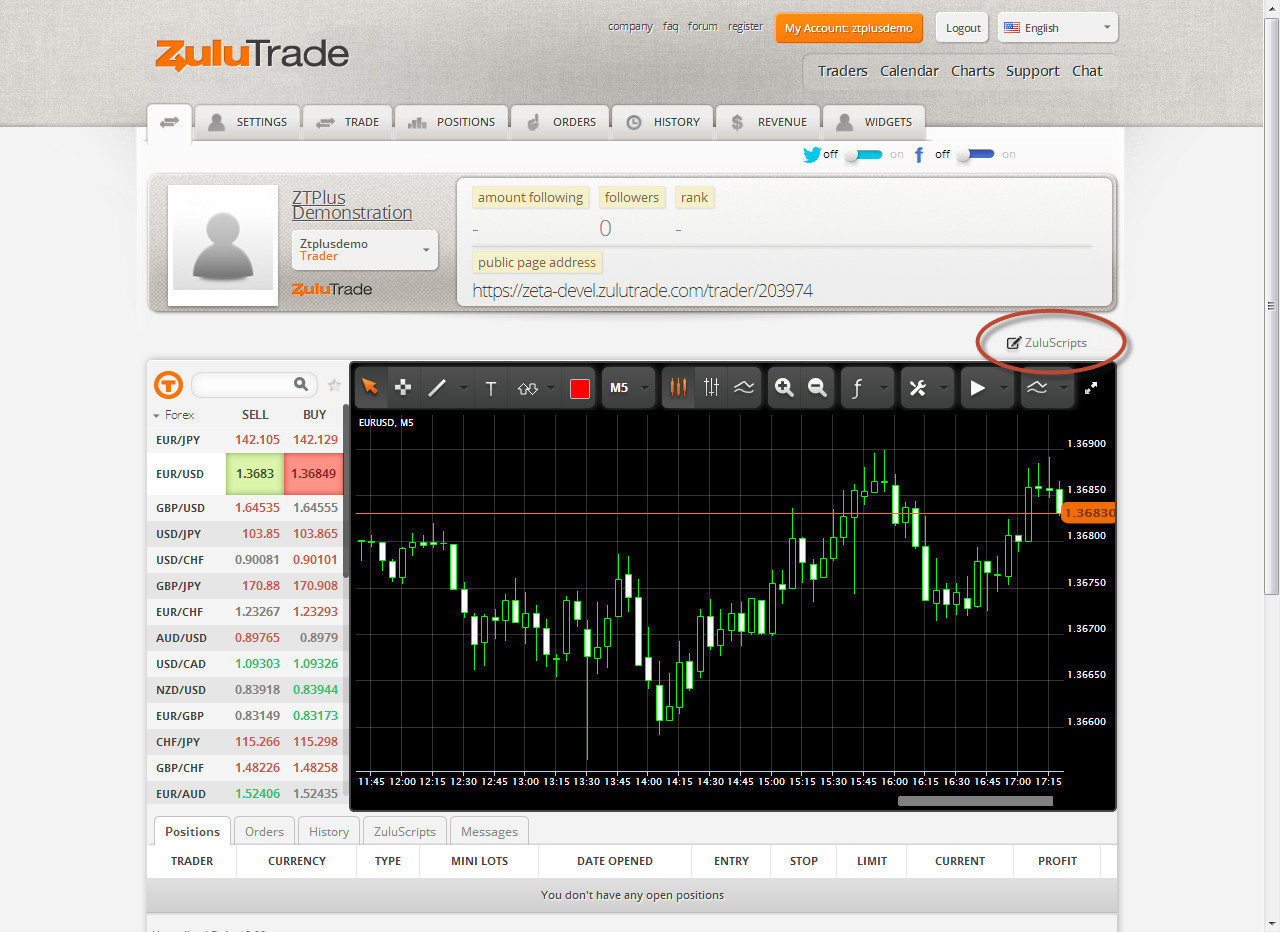
An excerpt of the scripting language can be seen in the screen shot that was included in the email ZuluTrade sent out to account holders yesterday.
Script Feature in ZuluTrade+ Web-platform
Create, Compile and Deploy Robots
A “creation guide” has been made to help clients create, compile and deploy their own experts (robots) and run them directly into their account. Access to the beta mode is available in the Settings tab and under a button that says ‘Link to a broker account’ which can link a new account or an existing account to the ZuluTrade+ trading station, only available to holders of an account that publishes signals, initially.
The company said it was adding some final tweaks to the platform before releasing it across its entire community, and was looking for feedback that could help such last minute iterations.
In the end, the company remains to be a viable competitor with a scalable business model, considering the number of employees the firm has in relation to the number of clients it services, and the fact that a large number of its staff are programmers. In addition, the firm has been able to overcome regulatory hurdles in the US, Europe and expected to launch an offering in Japan - where the signals market is very popular.
While the product is still said to be in beta mode, and first offered to traders who publish signals, it is set to be later rolled out to all clients in the ZuluTrade network, with final tweaks underway, according to an email the company sent to current account holders who publish signals in the ZuluTrade network.
The ZuluScript feature includes the ability for traders to create “scripts” or a set of custom instructions that can carry out trading operations if conditions and specified criteria are reached, and according to people familiar with the development, the platform is compatible with codes from certain 3rd party platforms like MetaTrader4, and the trading robots known as Expert Advisors (EAs) written in the MQL4 language, as told to Forex Magnates' reporters. The code behind the ZuluScript was said to be a super-set of the "C" language code widely used in software programming.
Automated Trading and Signals Go Well Together
This process of trade automation has been a key attribute on many popular trading platforms over the years, and the inclusion of it by ZuluTrade seems like a natural progression to an already sophisticated platform interface and social forex network.
The social network within ZuluTrade’s database contains some 100,000 trading strategies, and provides clients with tools to analyze strategies using quantitative and qualitative data, in an effort to sift out the most appealing performance or trading results, in addition to even screening and analyzing other traders (followers) in the network and ability to follow them (following followers).
Forex Magnates opines that a large number traders who publish signals may have run their trading robots on 3rd party platforms to generate signals sent to ZuluTrade, could now opt to run their robots locally, thus consolidating the technology into one place, and lessening the risk of depending on multiple platforms to produce an end signal at a destination venue.
ZuluTrade+ Compatible with Robots Written in MQL4
According to Forex Magnates' research, there is a number of other platform developers that have made their platforms EA friendly, metaphorically speaking, just as OpenOffice in the document management software world has created software that can open Microsoft Office documents, the ease afforded to users provides added value. The ZuluScript files have a "ZQL" extension name, as can be seen in the excerpt below.
Zuluscript ZQL [Source ZuluTrade.com]
It's also noteworthy to point out how since the ZuluTrade+ platform is web-based, the need to have a Virtual Private Server (VPS) running software 24hrs is virtually eliminated, as all the settings are saved to ZuluTrade's servers via the web, therefore the platform can be exited without the need to keep it running in one's open browser around the clock.
Leon Yohai, CEO of ZuluTrade
The signals market still remains a hot trend that has been cemented as platforms become increasingly automated in the tools and functions they feature, including trading robot development, and scripts such as the ZuluScripts has just announced.
Forex Magnates' reporters spoke with ZuluTrade's CEO, Leon Yohai, who said during a telephone interview today,"We don't believe in an all-dark or monopolistic environment, we believe in open platforms and platforms that can be connected to a wide number of brokers and offer equal opportunities to everybody and that's what ZuluTrade+ is all about."
Beta Mode Gearing Up Since November
While the company posted details about the platform on its blog in November, and ZuluTrade+ is still said to be in a beta mode version, the company said it was ready to tell its clients about it, according to the email to clients that Forex Magnates confirmed was sent.
An excerpt of the scripting language can be seen in the screen shot that was included in the email ZuluTrade sent out to account holders yesterday.
Script Feature in ZuluTrade+ Web-platform
Create, Compile and Deploy Robots
A “creation guide” has been made to help clients create, compile and deploy their own experts (robots) and run them directly into their account. Access to the beta mode is available in the Settings tab and under a button that says ‘Link to a broker account’ which can link a new account or an existing account to the ZuluTrade+ trading station, only available to holders of an account that publishes signals, initially.
The company said it was adding some final tweaks to the platform before releasing it across its entire community, and was looking for feedback that could help such last minute iterations.
In the end, the company remains to be a viable competitor with a scalable business model, considering the number of employees the firm has in relation to the number of clients it services, and the fact that a large number of its staff are programmers. In addition, the firm has been able to overcome regulatory hurdles in the US, Europe and expected to launch an offering in Japan - where the signals market is very popular.
FTMO Says Monthly Rewards Near $15 Million in September
Featured Videos
AvaTrade to Acquire Most of FXCM; NAGA Raises $8M
AvaTrade to Acquire Most of FXCM; NAGA Raises $8M
AvaTrade to Acquire Most of FXCM; NAGA Raises $8M
AvaTrade to Acquire Most of FXCM; NAGA Raises $8M
Today’s financial news recap covers AvaTrade agrees to acquire most of FXCM, NAGA secures eight million dollars in new financing, and Wise seeks a tax settlement in the UK.
Finance Magnates Daily Recap brings you the latest news from forex and CFD brokers, fintech, payments, cryptocurrency, digital assets, trading platforms, financial regulation and global markets.
Get the key company news, executive moves, deals, regulatory updates and market developments of the day, in just a few minutes. New episodes published every weekday.
Read more: https://www.financemagnates.com
#FinanceMagnates #ForexNews #FintechNews
Today’s financial news recap covers AvaTrade agrees to acquire most of FXCM, NAGA secures eight million dollars in new financing, and Wise seeks a tax settlement in the UK.
Finance Magnates Daily Recap brings you the latest news from forex and CFD brokers, fintech, payments, cryptocurrency, digital assets, trading platforms, financial regulation and global markets.
Get the key company news, executive moves, deals, regulatory updates and market developments of the day, in just a few minutes. New episodes published every weekday.
Read more: https://www.financemagnates.com
#FinanceMagnates #ForexNews #FintechNews
Today’s financial news recap covers AvaTrade agrees to acquire most of FXCM, NAGA secures eight million dollars in new financing, and Wise seeks a tax settlement in the UK.
Finance Magnates Daily Recap brings you the latest news from forex and CFD brokers, fintech, payments, cryptocurrency, digital assets, trading platforms, financial regulation and global markets.
Get the key company news, executive moves, deals, regulatory updates and market developments of the day, in just a few minutes. New episodes published every weekday.
Read more: https://www.financemagnates.com
#FinanceMagnates #ForexNews #FintechNews
Today’s financial news recap covers AvaTrade agrees to acquire most of FXCM, NAGA secures eight million dollars in new financing, and Wise seeks a tax settlement in the UK.
Finance Magnates Daily Recap brings you the latest news from forex and CFD brokers, fintech, payments, cryptocurrency, digital assets, trading platforms, financial regulation and global markets.
Get the key company news, executive moves, deals, regulatory updates and market developments of the day, in just a few minutes. New episodes published every weekday.
Read more: https://www.financemagnates.com
#FinanceMagnates #ForexNews #FintechNews
XTB Adds Overnight US Stock Trading; Nasdaq Ventures Invests in One Trading
XTB Adds Overnight US Stock Trading; Nasdaq Ventures Invests in One Trading
XTB Adds Overnight US Stock Trading; Nasdaq Ventures Invests in One Trading
XTB Adds Overnight US Stock Trading; Nasdaq Ventures Invests in One Trading
XTB Adds Overnight US Stock Trading; Nasdaq Ventures Invests in One Trading
XTB Adds Overnight US Stock Trading; Nasdaq Ventures Invests in One Trading
Today’s financial news recap covers XTB expands overnight US stock trading, Fortrade reports higher revenue, Nasdaq backs One Trading, and Vest Labs raises 13 million dollars.
Finance Magnates Daily Recap brings you the latest news from forex and CFD brokers, fintech, payments, cryptocurrency, digital assets, trading platforms, financial regulation and global markets.
Get the key company news, executive moves, deals, regulatory updates and market developments of the day, in just a few minutes. New episodes published every weekday.
Read more: https://www.financemagnates.com
#FinanceMagnates #ForexNews #FintechNews
Today’s financial news recap covers XTB expands overnight US stock trading, Fortrade reports higher revenue, Nasdaq backs One Trading, and Vest Labs raises 13 million dollars.
Finance Magnates Daily Recap brings you the latest news from forex and CFD brokers, fintech, payments, cryptocurrency, digital assets, trading platforms, financial regulation and global markets.
Get the key company news, executive moves, deals, regulatory updates and market developments of the day, in just a few minutes. New episodes published every weekday.
Read more: https://www.financemagnates.com
#FinanceMagnates #ForexNews #FintechNews
Today’s financial news recap covers XTB expands overnight US stock trading, Fortrade reports higher revenue, Nasdaq backs One Trading, and Vest Labs raises 13 million dollars.
Finance Magnates Daily Recap brings you the latest news from forex and CFD brokers, fintech, payments, cryptocurrency, digital assets, trading platforms, financial regulation and global markets.
Get the key company news, executive moves, deals, regulatory updates and market developments of the day, in just a few minutes. New episodes published every weekday.
Read more: https://www.financemagnates.com
#FinanceMagnates #ForexNews #FintechNews
Today’s financial news recap covers XTB expands overnight US stock trading, Fortrade reports higher revenue, Nasdaq backs One Trading, and Vest Labs raises 13 million dollars.
Finance Magnates Daily Recap brings you the latest news from forex and CFD brokers, fintech, payments, cryptocurrency, digital assets, trading platforms, financial regulation and global markets.
Get the key company news, executive moves, deals, regulatory updates and market developments of the day, in just a few minutes. New episodes published every weekday.
Read more: https://www.financemagnates.com
#FinanceMagnates #ForexNews #FintechNews
Today’s financial news recap covers XTB expands overnight US stock trading, Fortrade reports higher revenue, Nasdaq backs One Trading, and Vest Labs raises 13 million dollars.
Finance Magnates Daily Recap brings you the latest news from forex and CFD brokers, fintech, payments, cryptocurrency, digital assets, trading platforms, financial regulation and global markets.
Get the key company news, executive moves, deals, regulatory updates and market developments of the day, in just a few minutes. New episodes published every weekday.
Read more: https://www.financemagnates.com
#FinanceMagnates #ForexNews #FintechNews
Today’s financial news recap covers XTB expands overnight US stock trading, Fortrade reports higher revenue, Nasdaq backs One Trading, and Vest Labs raises 13 million dollars.
Finance Magnates Daily Recap brings you the latest news from forex and CFD brokers, fintech, payments, cryptocurrency, digital assets, trading platforms, financial regulation and global markets.
Get the key company news, executive moves, deals, regulatory updates and market developments of the day, in just a few minutes. New episodes published every weekday.
Read more: https://www.financemagnates.com
#FinanceMagnates #ForexNews #FintechNews
CMC Founder Downplays Volatility Hit; Devexperts Names CEO
CMC Founder Downplays Volatility Hit; Devexperts Names CEO
CMC Founder Downplays Volatility Hit; Devexperts Names CEO
CMC Founder Downplays Volatility Hit; Devexperts Names CEO
CMC Founder Downplays Volatility Hit; Devexperts Names CEO
CMC Founder Downplays Volatility Hit; Devexperts Names CEO
Today’s financial news recap covers low volatility pressures brokers, Devexperts names a new CEO, Saxo cuts onboarding time, and OKX reaches a 25 billion dollar valuation.
Finance Magnates Daily Recap brings you the latest news from forex and CFD brokers, fintech, payments, cryptocurrency, digital assets, trading platforms, financial regulation and global markets.
Get the key company news, executive moves, deals, regulatory updates and market developments of the day, in just a few minutes. New episodes published every weekday.
Read more: https://www.financemagnates.com
#FinanceMagnates #ForexNews #FintechNews
Today’s financial news recap covers low volatility pressures brokers, Devexperts names a new CEO, Saxo cuts onboarding time, and OKX reaches a 25 billion dollar valuation.
Finance Magnates Daily Recap brings you the latest news from forex and CFD brokers, fintech, payments, cryptocurrency, digital assets, trading platforms, financial regulation and global markets.
Get the key company news, executive moves, deals, regulatory updates and market developments of the day, in just a few minutes. New episodes published every weekday.
Read more: https://www.financemagnates.com
#FinanceMagnates #ForexNews #FintechNews
Today’s financial news recap covers low volatility pressures brokers, Devexperts names a new CEO, Saxo cuts onboarding time, and OKX reaches a 25 billion dollar valuation.
Finance Magnates Daily Recap brings you the latest news from forex and CFD brokers, fintech, payments, cryptocurrency, digital assets, trading platforms, financial regulation and global markets.
Get the key company news, executive moves, deals, regulatory updates and market developments of the day, in just a few minutes. New episodes published every weekday.
Read more: https://www.financemagnates.com
#FinanceMagnates #ForexNews #FintechNews
Today’s financial news recap covers low volatility pressures brokers, Devexperts names a new CEO, Saxo cuts onboarding time, and OKX reaches a 25 billion dollar valuation.
Finance Magnates Daily Recap brings you the latest news from forex and CFD brokers, fintech, payments, cryptocurrency, digital assets, trading platforms, financial regulation and global markets.
Get the key company news, executive moves, deals, regulatory updates and market developments of the day, in just a few minutes. New episodes published every weekday.
Read more: https://www.financemagnates.com
#FinanceMagnates #ForexNews #FintechNews
Today’s financial news recap covers low volatility pressures brokers, Devexperts names a new CEO, Saxo cuts onboarding time, and OKX reaches a 25 billion dollar valuation.
Finance Magnates Daily Recap brings you the latest news from forex and CFD brokers, fintech, payments, cryptocurrency, digital assets, trading platforms, financial regulation and global markets.
Get the key company news, executive moves, deals, regulatory updates and market developments of the day, in just a few minutes. New episodes published every weekday.
Read more: https://www.financemagnates.com
#FinanceMagnates #ForexNews #FintechNews
Today’s financial news recap covers low volatility pressures brokers, Devexperts names a new CEO, Saxo cuts onboarding time, and OKX reaches a 25 billion dollar valuation.
Finance Magnates Daily Recap brings you the latest news from forex and CFD brokers, fintech, payments, cryptocurrency, digital assets, trading platforms, financial regulation and global markets.
Get the key company news, executive moves, deals, regulatory updates and market developments of the day, in just a few minutes. New episodes published every weekday.
Read more: https://www.financemagnates.com
#FinanceMagnates #ForexNews #FintechNews
Today’s financial news recap covers Trade Nation buys FXCM's UK client book, Trading 212 reports higher revenue, the CFTC's move to allow perpetual index futures.
Finance Magnates Daily Recap brings you the latest news from forex and CFD brokers, fintech, payments, cryptocurrency, digital assets, trading platforms, financial regulation and global markets.
Get the key company news, executive moves, deals, regulatory updates and market developments of the day, in just a few minutes. New episodes published every weekday.
Read more: https://www.financemagnates.com
#FinanceMagnates #ForexNews #FintechNews
Today’s financial news recap covers Trade Nation buys FXCM's UK client book, Trading 212 reports higher revenue, the CFTC's move to allow perpetual index futures.
Finance Magnates Daily Recap brings you the latest news from forex and CFD brokers, fintech, payments, cryptocurrency, digital assets, trading platforms, financial regulation and global markets.
Get the key company news, executive moves, deals, regulatory updates and market developments of the day, in just a few minutes. New episodes published every weekday.
Read more: https://www.financemagnates.com
#FinanceMagnates #ForexNews #FintechNews
Today’s financial news recap covers Trade Nation buys FXCM's UK client book, Trading 212 reports higher revenue, the CFTC's move to allow perpetual index futures.
Finance Magnates Daily Recap brings you the latest news from forex and CFD brokers, fintech, payments, cryptocurrency, digital assets, trading platforms, financial regulation and global markets.
Get the key company news, executive moves, deals, regulatory updates and market developments of the day, in just a few minutes. New episodes published every weekday.
Read more: https://www.financemagnates.com
#FinanceMagnates #ForexNews #FintechNews
Today’s financial news recap covers Trade Nation buys FXCM's UK client book, Trading 212 reports higher revenue, the CFTC's move to allow perpetual index futures.
Finance Magnates Daily Recap brings you the latest news from forex and CFD brokers, fintech, payments, cryptocurrency, digital assets, trading platforms, financial regulation and global markets.
Get the key company news, executive moves, deals, regulatory updates and market developments of the day, in just a few minutes. New episodes published every weekday.
Read more: https://www.financemagnates.com
#FinanceMagnates #ForexNews #FintechNews
Today’s financial news recap covers Trade Nation buys FXCM's UK client book, Trading 212 reports higher revenue, the CFTC's move to allow perpetual index futures.
Finance Magnates Daily Recap brings you the latest news from forex and CFD brokers, fintech, payments, cryptocurrency, digital assets, trading platforms, financial regulation and global markets.
Get the key company news, executive moves, deals, regulatory updates and market developments of the day, in just a few minutes. New episodes published every weekday.
Read more: https://www.financemagnates.com
#FinanceMagnates #ForexNews #FintechNews
Today’s financial news recap covers Trade Nation buys FXCM's UK client book, Trading 212 reports higher revenue, the CFTC's move to allow perpetual index futures.
Finance Magnates Daily Recap brings you the latest news from forex and CFD brokers, fintech, payments, cryptocurrency, digital assets, trading platforms, financial regulation and global markets.
Get the key company news, executive moves, deals, regulatory updates and market developments of the day, in just a few minutes. New episodes published every weekday.
Read more: https://www.financemagnates.com
#FinanceMagnates #ForexNews #FintechNews
Your career isn’t a linear path.
Your career isn’t a linear path.
Your career isn’t a linear path.
Your career isn’t a linear path.
Your career isn’t a linear path.
Your career isn’t a linear path.
Roles change. Career goals change. Sometimes you want a completely new challenge.
But the skills and knowledge you build along the way can stay with you and give you something to build on.
For Jeff Patterson, that continued growth is key to long-term career development.
You bring the skills. FM Academy helps you build the knowledge.
#FMAcademy #FinanceMagnates #FinanceCareers #ProfessionalDevelopment #Fintech
Roles change. Career goals change. Sometimes you want a completely new challenge.
But the skills and knowledge you build along the way can stay with you and give you something to build on.
For Jeff Patterson, that continued growth is key to long-term career development.
You bring the skills. FM Academy helps you build the knowledge.
#FMAcademy #FinanceMagnates #FinanceCareers #ProfessionalDevelopment #Fintech
Roles change. Career goals change. Sometimes you want a completely new challenge.
But the skills and knowledge you build along the way can stay with you and give you something to build on.
For Jeff Patterson, that continued growth is key to long-term career development.
You bring the skills. FM Academy helps you build the knowledge.
#FMAcademy #FinanceMagnates #FinanceCareers #ProfessionalDevelopment #Fintech
Roles change. Career goals change. Sometimes you want a completely new challenge.
But the skills and knowledge you build along the way can stay with you and give you something to build on.
For Jeff Patterson, that continued growth is key to long-term career development.
You bring the skills. FM Academy helps you build the knowledge.
#FMAcademy #FinanceMagnates #FinanceCareers #ProfessionalDevelopment #Fintech
Roles change. Career goals change. Sometimes you want a completely new challenge.
But the skills and knowledge you build along the way can stay with you and give you something to build on.
For Jeff Patterson, that continued growth is key to long-term career development.
You bring the skills. FM Academy helps you build the knowledge.
#FMAcademy #FinanceMagnates #FinanceCareers #ProfessionalDevelopment #Fintech
Roles change. Career goals change. Sometimes you want a completely new challenge.
But the skills and knowledge you build along the way can stay with you and give you something to build on.
For Jeff Patterson, that continued growth is key to long-term career development.
You bring the skills. FM Academy helps you build the knowledge.
#FMAcademy #FinanceMagnates #FinanceCareers #ProfessionalDevelopment #Fintech




![Zuluscript ZQL [Source ZuluTrade.com]](https://www.financemagnates.com/wp-content/uploads/fxmag/2014/02/Screen41.jpg)