

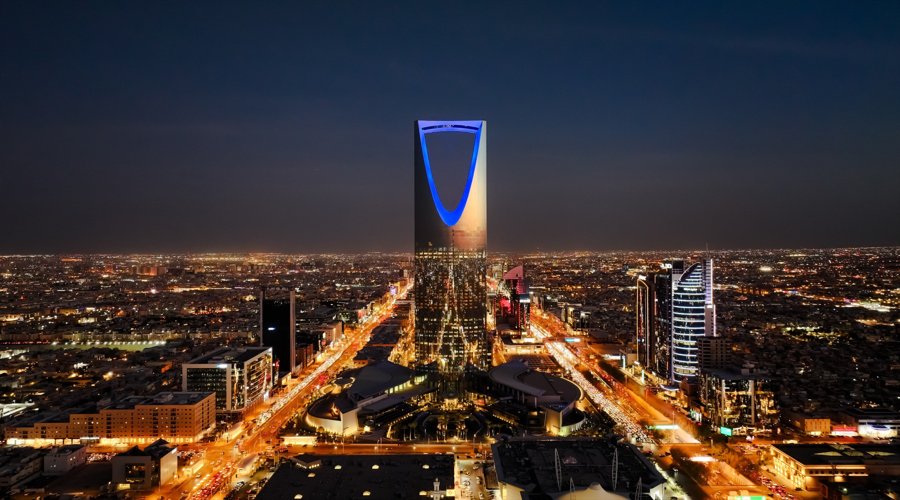
Saudi Arabia combines the Gulf’s largest population and stock market with a fast-growing investment industry, but it is not an easy extension market for an offshore retail FX or CFD broker. A CFD-only launch based on cross-border solicitation carries a much weaker regulatory and commercial case.
London's trading industry is coming home!
General Profile and Regional Position
Saudi Arabia is the largest economy and the most populous state in the Gulf Cooperation Council. It also occupies a strategic position between the Red Sea and the Arabian Gulf, is a G20 member, and plays a central role in regional energy, capital and government spending. Riyadh is increasingly the centre of the Kingdom’s financial and corporate activity, while Jeddah remains the commercial gateway to the Red Sea, and the Eastern Province connects finance with the oil, gas and industrial economy.
For a financial company, scale is one of the main attractions. According to the official 2024 population estimates, Saudi Arabia had 35.30 million residents, including 19.64 million Saudi citizens and 15.67 million non-Saudi residents.
These figures were produced after the 2022 Census and reflect the subsequent increase in the expatriate workforce.
| Market | Financial-market position | FX and CFD entry |
|---|---|---|
| Saudi Arabia | Largest population and equity market | CMA authorisation and local presence |
| UAE | Leading international financial centre | Established global brokerage market |
| Bahrain | Small market with an established regulator | Familiar leveraged-trading framework |
| Qatar | Wealthy, institution-focused market | Limited retail brokerage opportunity |
Local FX and CFD Market and Regulatory Framework
Saudi residents trade currencies, gold, global indices and overseas shares through international platforms. Arabic-language services, mobile trading and demand for swap-free accounts make the Kingdom commercially important to global brokers.
However, there is no official Saudi dataset covering the number of active FX or CFD traders, their deposits or trading volumes. Market-size estimates published by affiliate websites and lead-generation companies should therefore not be treated as official or investment-grade evidence.
The regulatory position requires a distinction between securities business conducted in Saudi Arabia and the treatment of payments connected with non-resident forex companies. The Capital Market Authority regulates securities business in the Kingdom.
The Saudi Central Bank, commonly known as SAMA, supervises banks, payments, finance companies, insurance and other financial activities within its mandate.
- Saudi Arabia's Card Payments to Grow by 14% in 2023
- Saudi Arabia CMA Greenlights Regulations for Market Making
- Survey Reveals a High Crypto Adoption Rate among Saudi Arabians
SAMA’s Restrictions on Forex-Related Transfers
SAMA’s (The Saudi Central Bank) position on non-resident forex companies combines transaction restrictions with a distinction between licensed and unlicensed foreign firms.
A circular issued on 18 May 2017 identified three categories of prohibited activity. The first covered foreign forex companies without relevant contractual relationships with licensed Saudi financial institutions that promoted or marketed their activities through websites, telephone calls or other channels.
Find the full analysis, including a detailed breakdown of the local market and business environment, in our latest “Featured Country” report from Finance Magnates Intelligence.


