The FX broker loses authorization months after the voluntary surrender announcement.
In a separate decision, the regulator removed four companies from the compensation fund, including the B2B unit of BDSwiss.
The Cyprus
Securities and Exchange Commission (CySEC) has officially withdrawn the
investment license of FIBO Markets Ltd, finalizing a process the forex broker
initiated late last year.
CySEC
announced the decision was made during its Aug. 25 meeting, formally revoking
the company's Cyprus Investment Firm (CIF) authorization number
118/10. The regulator cited FIBO Markets' express renunciation of its
license as the reason for the withdrawal.
FIBO Markets Loses Cyprus
License
The move
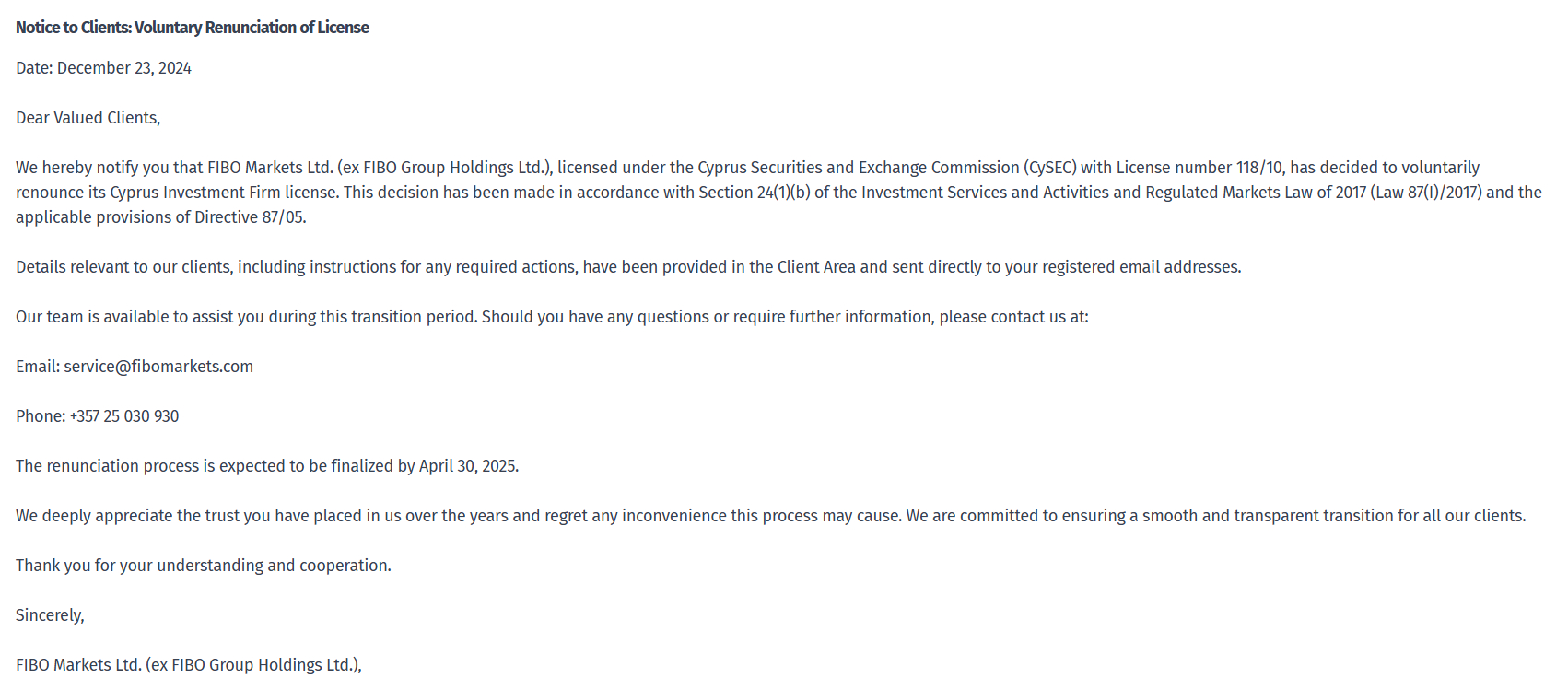
caps a months-long wind-down process that began in December 2024, when Fibo
Markets Ltd (ex FIBO Group Holdings Ltd), told clients it would voluntarily
surrender its CySEC license. At the time, the company said it expected the
renunciation process to wrap up by April 30, 2025.
“We deeply
appreciate the trust you have placed in us over the years and regret any
inconvenience this process may cause. We are committed to ensuring a smooth and
transparent transition for all our clients,” the company commented back in
December.
Source: FIBO Markets
FinanceMagnates.com
reached out to company representatives for comment, but no response had been
received at the time of publication.
While the
FiboMarkets.com website now states that the license has been surrendered, the
FIBOGroup.com website remains active, and the company is regulated by the
Financial Services Commission (FSC) in the British Virgin Islands (license
number SIBA/L/13/1063).
CySEC Takes Broader
Regulatory Action
The FIBO
Markets license withdrawal comes alongside broader enforcement activity by
CySEC. The regulator announced today (Thursday) that four other investment
firms have lost their authorizations and been removed from the Investors
Compensation Fund.
CySEC
withdrew licenses from Oasis Wealth Management Ltd, The Alternative GMI Ltd,
Itrade Global (CY) Ltd, and Viverno Markets Ltd. The regulator simultaneously
removed these companies from the ICF membership roster, though existing client
compensation rights remain protected for past investments.
It is worth
noting, however, that these are purely technical moves stemming from the
earlier withdrawal of licenses from the mentioned entities. For example, in the
case of Viverno Markets, a B2B unit of BDSwiss, authorization
was revoked in May after the company had not provided services for more
than six months.
The other
three firms, including Itrade
Global, which operates the Tradewell and TradeFW brands, had given up their
licenses some time ago, as had FIBO.
The Cyprus
Securities and Exchange Commission (CySEC) has officially withdrawn the
investment license of FIBO Markets Ltd, finalizing a process the forex broker
initiated late last year.
CySEC
announced the decision was made during its Aug. 25 meeting, formally revoking
the company's Cyprus Investment Firm (CIF) authorization number
118/10. The regulator cited FIBO Markets' express renunciation of its
license as the reason for the withdrawal.
FIBO Markets Loses Cyprus
License
The move
caps a months-long wind-down process that began in December 2024, when Fibo
Markets Ltd (ex FIBO Group Holdings Ltd), told clients it would voluntarily
surrender its CySEC license. At the time, the company said it expected the
renunciation process to wrap up by April 30, 2025.
“We deeply
appreciate the trust you have placed in us over the years and regret any
inconvenience this process may cause. We are committed to ensuring a smooth and
transparent transition for all our clients,” the company commented back in
December.
Source: FIBO Markets
FinanceMagnates.com
reached out to company representatives for comment, but no response had been
received at the time of publication.
While the
FiboMarkets.com website now states that the license has been surrendered, the
FIBOGroup.com website remains active, and the company is regulated by the
Financial Services Commission (FSC) in the British Virgin Islands (license
number SIBA/L/13/1063).
CySEC Takes Broader
Regulatory Action
The FIBO
Markets license withdrawal comes alongside broader enforcement activity by
CySEC. The regulator announced today (Thursday) that four other investment
firms have lost their authorizations and been removed from the Investors
Compensation Fund.
CySEC
withdrew licenses from Oasis Wealth Management Ltd, The Alternative GMI Ltd,
Itrade Global (CY) Ltd, and Viverno Markets Ltd. The regulator simultaneously
removed these companies from the ICF membership roster, though existing client
compensation rights remain protected for past investments.
It is worth
noting, however, that these are purely technical moves stemming from the
earlier withdrawal of licenses from the mentioned entities. For example, in the
case of Viverno Markets, a B2B unit of BDSwiss, authorization
was revoked in May after the company had not provided services for more
than six months.
The other
three firms, including Itrade
Global, which operates the Tradewell and TradeFW brands, had given up their
licenses some time ago, as had FIBO.
Damian Chmiel is a Senior Analyst & Editor at Finance Magnates with more than 15 years of experience in the CFD and online trading industry. Active as both a trader and journalist since 2010, he focuses on broker coverage, fintech innovation, and regulatory developments across Europe, the Middle East, and Asia.
His work includes interviews with C-level leaders at major brokerages and fintech platforms, as well as co-authoring Finance Magnates’ quarterly industry benchmarking reports. Damian’s reporting is data-driven, market-aware, and grounded in direct industry engagement. His analysis and commentary have also been cited by external media outlets, including Investing.com, Binance, The Asset, Stockhead, and Dispatch.
Education:
MA in Finance and Accounting, Cracow University of Economics
Italy’s Consob Tightens Net on AI-Fueled Scams With Fresh Website Bans
FP Markets Winner Spotlight 🏆 | Global Broker of the Year 2025 #Trading #Broker #Innovation #Shorts
FP Markets Winner Spotlight 🏆 | Global Broker of the Year 2025 #Trading #Broker #Innovation #Shorts
FP Markets takes the spotlight as Global Broker of the Year 2025 at the Finance Magnates Awards.
Martin Stoilov, Head of Client Experience, shares that trust, innovation, and people played a key role in the company’s success, supported by a strong foundation of integrity and client-centricity.
Following this milestone, FP Markets continues to focus on growth, technology investment, and its core values of transparency and excellence.
👉 Be part of FM Awards 2026: https://awards.financemagnates.com/#nominate
FP Markets takes the spotlight as Global Broker of the Year 2025 at the Finance Magnates Awards.
Martin Stoilov, Head of Client Experience, shares that trust, innovation, and people played a key role in the company’s success, supported by a strong foundation of integrity and client-centricity.
Following this milestone, FP Markets continues to focus on growth, technology investment, and its core values of transparency and excellence.
👉 Be part of FM Awards 2026: https://awards.financemagnates.com/#nominate
In this video, we review @HolaPrimeMarketsOfficial, a multi-asset forex and CFDs broker offering different account types, trading platforms, and flexible trading conditions.
We cover the broker’s overall offering, including account options, trading environment, platforms like MT4 and MT5, and additional services such as managed accounts and fast withdrawals.
Watch the full video to see if Hola Prime Markets fits your trading needs.
📣 Stay up to date with the latest in finance and trading. Follow Finance Magnates for industry news, insights, and global event coverage.
Connect with us:
🔗 LinkedIn: /financemagnates
👍 Facebook: /financemagnates
📸 Instagram: https://www.instagram.com/financemagnates
🐦 X: https://x.com/financemagnates
🎥 TikTok: https://www.tiktok.com/tag/financemagnates
▶️ YouTube: /@financemagnates_official
#HolaPrime #ForexBroker #CFDTrading #FinanceMagnates #Trading #Forex #BrokerReview
In this video, we review @HolaPrimeMarketsOfficial, a multi-asset forex and CFDs broker offering different account types, trading platforms, and flexible trading conditions.
We cover the broker’s overall offering, including account options, trading environment, platforms like MT4 and MT5, and additional services such as managed accounts and fast withdrawals.
Watch the full video to see if Hola Prime Markets fits your trading needs.
📣 Stay up to date with the latest in finance and trading. Follow Finance Magnates for industry news, insights, and global event coverage.
Connect with us:
🔗 LinkedIn: /financemagnates
👍 Facebook: /financemagnates
📸 Instagram: https://www.instagram.com/financemagnates
🐦 X: https://x.com/financemagnates
🎥 TikTok: https://www.tiktok.com/tag/financemagnates
▶️ YouTube: /@financemagnates_official
#HolaPrime #ForexBroker #CFDTrading #FinanceMagnates #Trading #Forex #BrokerReview
Hola Prime Review: What You Need to Know | Full Breakdown by Finance Magnates
Hola Prime Review: What You Need to Know | Full Breakdown by Finance Magnates
In this video, we review @HolaPrime_Global, a proprietary trading firm offering evaluation programs and performance-based payouts in simulated market environments.
We cover how the challenge model works, including account types, profit splits (up to 95%), trading rules, and what it takes to reach a funded account. You’ll also learn about available platforms like MT4, MT5, cTrader, and more, along with insights into payouts, support, and trading conditions.
Watch the full video to see if Hola Prime fits your trading style.
📣 Stay up to date with the latest in finance and trading. Follow Finance Magnates for industry news, insights, and global event coverage.
Connect with us:
🔗 LinkedIn: /financemagnates
👍 Facebook: /financemagnates
📸 Instagram: https://www.instagram.com/financemagnates
🐦 X: https://x.com/financemagnates
🎥 TikTok: https://www.tiktok.com/tag/financemagnates
▶️ YouTube: /@financemagnates_official
#HolaPrime #PropFirm #Trading #FinanceMagnates #Forex #FuturesTrading #TradingReview #PropFirmReview
In this video, we review @HolaPrime_Global, a proprietary trading firm offering evaluation programs and performance-based payouts in simulated market environments.
We cover how the challenge model works, including account types, profit splits (up to 95%), trading rules, and what it takes to reach a funded account. You’ll also learn about available platforms like MT4, MT5, cTrader, and more, along with insights into payouts, support, and trading conditions.
Watch the full video to see if Hola Prime fits your trading style.
📣 Stay up to date with the latest in finance and trading. Follow Finance Magnates for industry news, insights, and global event coverage.
Connect with us:
🔗 LinkedIn: /financemagnates
👍 Facebook: /financemagnates
📸 Instagram: https://www.instagram.com/financemagnates
🐦 X: https://x.com/financemagnates
🎥 TikTok: https://www.tiktok.com/tag/financemagnates
▶️ YouTube: /@financemagnates_official
#HolaPrime #PropFirm #Trading #FinanceMagnates #Forex #FuturesTrading #TradingReview #PropFirmReview
Axi Winner Spotlight 🏆 | Global Most Innovative Broker 2025 #Innovation #Trading #Fintech #Broker
Axi Winner Spotlight 🏆 | Global Most Innovative Broker 2025 #Innovation #Trading #Fintech #Broker
Axi takes the spotlight at the Finance Magnates Awards, winning Global Most Innovative Broker 2025.
Olivia Xenofontos and Ivanna Openko share how the team will feel: proud, motivated, and ready to keep delivering.
They also describe the night as well-organized, focused, and enjoyable for all.
👉 Be part of FM Awards 2026.
Axi takes the spotlight at the Finance Magnates Awards, winning Global Most Innovative Broker 2025.
Olivia Xenofontos and Ivanna Openko share how the team will feel: proud, motivated, and ready to keep delivering.
They also describe the night as well-organized, focused, and enjoyable for all.
👉 Be part of FM Awards 2026.
Recognition that matters.
Built on transparency.
Driven by the industry.
The Finance Magnates Awards 2026.
Nominations are now open.
🔗 https://awards.financemagnates.com/?utm_source=SM&utm_medium=social&utm_campaign=recognition-matters
Recognition that matters.
Built on transparency.
Driven by the industry.
The Finance Magnates Awards 2026.
Nominations are now open.
🔗 https://awards.financemagnates.com/?utm_source=SM&utm_medium=social&utm_campaign=recognition-matters