The BoJ has nearly $1.25 Trillion USD worth of reserves which it may be considering to allocate a portion of to the local FX Industry in an effort to outsource some of its monetary policy efforts.
The timing may be convenient for both the Bank of Japan (BOJ) and the local private FX sector, the latter of which may be considered to manage a portion of the central bank's currency reserves, according to reports from a Japanese government source as told to Reuters.
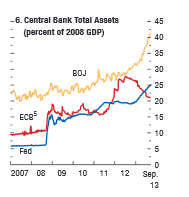
According to a recent report, the International Monetary Fund (IMF) estimates the the BOJ reserves to the tune of $1.25 trillion dollars (as of September 2013). Figure 6 above, excerpted from the World Economic Outlook (WEO) depicts the BOJ's rising assets in comparison with the ECB and US Fed since 2007.
As per reports to the media, Tohru Sasaki, head of Japanese rates and FX research at JP Morgan Tokyo, told clients in a note: "Although we do not think the Japanese government will outsource all of the foreign exchange reserve to the private sector, even just a 10 percent outsourcing will become a $120 billion business."
Timely Opportunities or Coincidence
The Japanese Financial Services Authority (JFSA) website currently lists 2,112 companies with licenses as financial instrument firms, 64 regional banks, 16 bank holding companies and 35 bank trusts, among other financial services categories. Which, if any, could be the recipient of such honor to manage a portion of BOJ's reserves is still a matter of speculation.
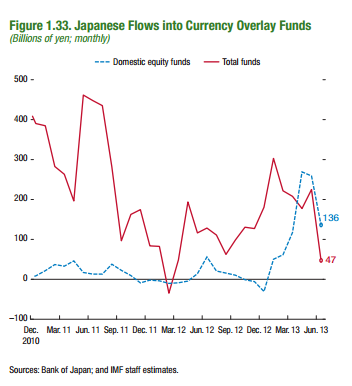
The Bank of Japan is the "central" bank of Japan, and is tasked with the common role shared by central banks globally to carry out a specific monetary policy aimed at balancing the ebbs and flows of the economy, in accordance with its needs for long- term sustainable growth or manageability. The recent flows into Currency overlay funds, as displayed in figure 1.33, has been decreasing.
According to the latest quarterly review (September) from the Bank for International Settlements (BIS), Japanese banks have recently become once again, the biggest suppliers of cross-border bank credit, a trend that has been years in the making. The BIS consolidated banking statistics show that in 2011 Japanese banks replaced German banks as the world’s largest international lenders. On a consolidated basis, US banks were the next largest cross-border lenders, with a market share of about 12% at end-March 2013, followed by German banks at 11%. This marks a return of Japanese banks to the position they held in the international banking market during the second half of the 1980's, according to the BIS report.
The World Economic Outlook (WEO) forecasts real GDP in Japan to be 1.2% in 2014 - largely due to a tightening fiscal policy - down from the 2% forecast for 2013. According to the IMF, Asia is likely to remain the world’s economic engine despite the recent soft patch in global growth and increasing volatility in international financial markets.
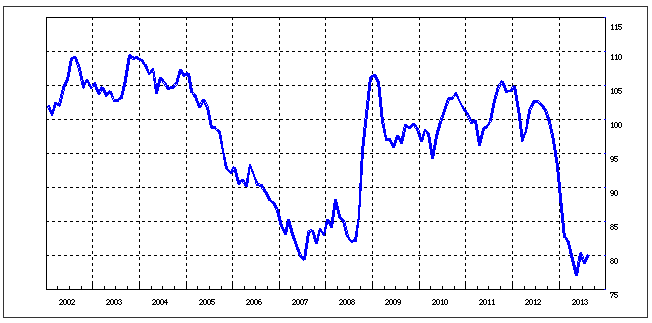
USD JPY exchange rate averaged monthly - source BoJ
Abeonomic Views
Over this past weekend, Haruhiko Kuroda, the Governor of the BOJ, commented at the Institute of International Finance (IIF) during its annual membership meeting in Washington saying, "Positive developments in the Japanese economy have become increasingly pronounced, and the outlook is perhaps brighter than at any other point since the turn of the century."
Mr. Kuroda pointed out at the BOJ's introduction of Quantitative and Qualitative Easing (QQE) in April, saying, "Regulators and supervisors must be humble about the usefulness and effectiveness of regulatory standards and rules. Risk-based capital standards should remain at the center, but other approaches must complement them in areas where capital charges cannot adequately address problematic behavior among banks. Though I do not have time to elaborate, tough and effective supervision is also very, very important. The simple leverage ratio may be a good metric in some respects, and is a useful complement to risk-based capital ratios."
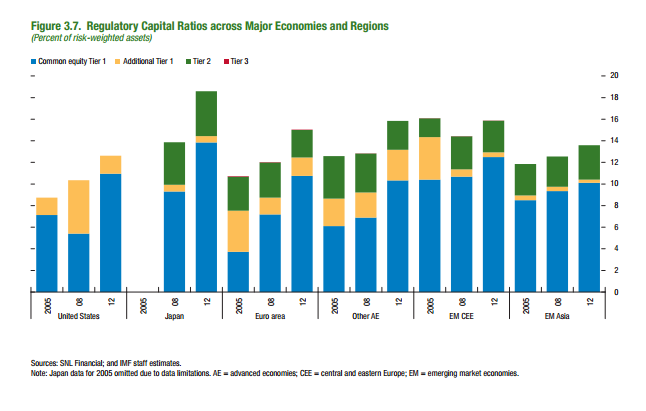
While the Governor praised and welcomed Basel III, he followed with a detailed critique expressing how other major economies have not caught up yet (due to delays), while Japan and many other economies are in full force with the new capital standard. With regards to the global regulatory approach, he compared the progress to "patching up leaks in a roof," and that the next steps are crucial. Figure 3.7 below shows how Japan stands out with regards to its high regulatory capital ratios in 2012, in comparison to other major economies in recent years.
Lessons Already Learned
The BOJ's Governor concluded that there needs to be a degree of harmonized standardization of regulations across borders, and how Japan should implement swift and fast responses reflecting the lessons learned from the Great Financial Crisis.He said that the BOJ was ready to contribute to improve the rules and standards surrounding domestic regulations, and how they tie into the global landscape.
The most recent financial statement from the BOJ for its latest fiscal year reflected net assets of nearly 164.8 trillion yen, and net assets of 3.2 trillion yen after liabilities. After gross operating profits of 1.13 trillion yen, 836 billion yen was attributed to net profits and 301 billion to a special loss listed as a transfer to provision for possible losses on foreign exchange transactions. After taxes, reserve deduction and dividend, a net income of 547 billion yen was appropriated back to the Government.
According to the WEO, the recovery in Japan has been spurred by Abenomics, but sustaining it will depend on meeting two major challenges. The first, reflected in the debate about increasing the consumption tax, is setting the right pace for fiscal consolidation; too slowly will compromise credibility, and moving too fast will kill growth. The second is implementing a credible set of structural reforms to transform what is now a cyclical recovery into sustained growth. Taro Aso, the Deputy Prime Minister of Japan also spoke over the weekend regarding revitalizing Japan's economy, at the International Monetary and Financial Committee during its 28th meeting on October 12, 2013 where he serves as Governor to the IMF for Japan.
The timing may be convenient for both the Bank of Japan (BOJ) and the local private FX sector, the latter of which may be considered to manage a portion of the central bank's currency reserves, according to reports from a Japanese government source as told to Reuters.
According to a recent report, the International Monetary Fund (IMF) estimates the the BOJ reserves to the tune of $1.25 trillion dollars (as of September 2013). Figure 6 above, excerpted from the World Economic Outlook (WEO) depicts the BOJ's rising assets in comparison with the ECB and US Fed since 2007.
As per reports to the media, Tohru Sasaki, head of Japanese rates and FX research at JP Morgan Tokyo, told clients in a note: "Although we do not think the Japanese government will outsource all of the foreign exchange reserve to the private sector, even just a 10 percent outsourcing will become a $120 billion business."
Timely Opportunities or Coincidence
The Japanese Financial Services Authority (JFSA) website currently lists 2,112 companies with licenses as financial instrument firms, 64 regional banks, 16 bank holding companies and 35 bank trusts, among other financial services categories. Which, if any, could be the recipient of such honor to manage a portion of BOJ's reserves is still a matter of speculation.
The Bank of Japan is the "central" bank of Japan, and is tasked with the common role shared by central banks globally to carry out a specific monetary policy aimed at balancing the ebbs and flows of the economy, in accordance with its needs for long- term sustainable growth or manageability. The recent flows into Currency overlay funds, as displayed in figure 1.33, has been decreasing.
According to the latest quarterly review (September) from the Bank for International Settlements (BIS), Japanese banks have recently become once again, the biggest suppliers of cross-border bank credit, a trend that has been years in the making. The BIS consolidated banking statistics show that in 2011 Japanese banks replaced German banks as the world’s largest international lenders. On a consolidated basis, US banks were the next largest cross-border lenders, with a market share of about 12% at end-March 2013, followed by German banks at 11%. This marks a return of Japanese banks to the position they held in the international banking market during the second half of the 1980's, according to the BIS report.
The World Economic Outlook (WEO) forecasts real GDP in Japan to be 1.2% in 2014 - largely due to a tightening fiscal policy - down from the 2% forecast for 2013. According to the IMF, Asia is likely to remain the world’s economic engine despite the recent soft patch in global growth and increasing volatility in international financial markets.
USD JPY exchange rate averaged monthly - source BoJ
Abeonomic Views
Over this past weekend, Haruhiko Kuroda, the Governor of the BOJ, commented at the Institute of International Finance (IIF) during its annual membership meeting in Washington saying, "Positive developments in the Japanese economy have become increasingly pronounced, and the outlook is perhaps brighter than at any other point since the turn of the century."
Mr. Kuroda pointed out at the BOJ's introduction of Quantitative and Qualitative Easing (QQE) in April, saying, "Regulators and supervisors must be humble about the usefulness and effectiveness of regulatory standards and rules. Risk-based capital standards should remain at the center, but other approaches must complement them in areas where capital charges cannot adequately address problematic behavior among banks. Though I do not have time to elaborate, tough and effective supervision is also very, very important. The simple leverage ratio may be a good metric in some respects, and is a useful complement to risk-based capital ratios."
While the Governor praised and welcomed Basel III, he followed with a detailed critique expressing how other major economies have not caught up yet (due to delays), while Japan and many other economies are in full force with the new capital standard. With regards to the global regulatory approach, he compared the progress to "patching up leaks in a roof," and that the next steps are crucial. Figure 3.7 below shows how Japan stands out with regards to its high regulatory capital ratios in 2012, in comparison to other major economies in recent years.
Lessons Already Learned
The BOJ's Governor concluded that there needs to be a degree of harmonized standardization of regulations across borders, and how Japan should implement swift and fast responses reflecting the lessons learned from the Great Financial Crisis.He said that the BOJ was ready to contribute to improve the rules and standards surrounding domestic regulations, and how they tie into the global landscape.
The most recent financial statement from the BOJ for its latest fiscal year reflected net assets of nearly 164.8 trillion yen, and net assets of 3.2 trillion yen after liabilities. After gross operating profits of 1.13 trillion yen, 836 billion yen was attributed to net profits and 301 billion to a special loss listed as a transfer to provision for possible losses on foreign exchange transactions. After taxes, reserve deduction and dividend, a net income of 547 billion yen was appropriated back to the Government.
According to the WEO, the recovery in Japan has been spurred by Abenomics, but sustaining it will depend on meeting two major challenges. The first, reflected in the debate about increasing the consumption tax, is setting the right pace for fiscal consolidation; too slowly will compromise credibility, and moving too fast will kill growth. The second is implementing a credible set of structural reforms to transform what is now a cyclical recovery into sustained growth. Taro Aso, the Deputy Prime Minister of Japan also spoke over the weekend regarding revitalizing Japan's economy, at the International Monetary and Financial Committee during its 28th meeting on October 12, 2013 where he serves as Governor to the IMF for Japan.
Trade Nation UK Turnover Hits £25 Million in 2025 as Hedging Costs Fall
Featured Videos
Tickmill Winner Spotlight | Broker of the Year 2025 (LATAM) 🏆 | Finance Magnates Awards #Trading
Tickmill Winner Spotlight | Broker of the Year 2025 (LATAM) 🏆 | Finance Magnates Awards #Trading
Tickmill Winner Spotlight | Broker of the Year 2025 (LATAM) 🏆 | Finance Magnates Awards #Trading
Tickmill Winner Spotlight | Broker of the Year 2025 (LATAM) 🏆 | Finance Magnates Awards #Trading
What helped Tickmill stand out this year?
In this Winner Spotlight, Johnny Khalil, Executive Director at Tickmill Europe, shares how listening closely to clients and delivering strong trading conditions made the difference.
A big thank you to the community whose support continues to drive progress every day.
👉 Think your brand has what it takes? Nominate for the 2026 Finance Magnates Awards: https://awards.financemagnates.com/#nominate
What helped Tickmill stand out this year?
In this Winner Spotlight, Johnny Khalil, Executive Director at Tickmill Europe, shares how listening closely to clients and delivering strong trading conditions made the difference.
A big thank you to the community whose support continues to drive progress every day.
👉 Think your brand has what it takes? Nominate for the 2026 Finance Magnates Awards: https://awards.financemagnates.com/#nominate
What helped Tickmill stand out this year?
In this Winner Spotlight, Johnny Khalil, Executive Director at Tickmill Europe, shares how listening closely to clients and delivering strong trading conditions made the difference.
A big thank you to the community whose support continues to drive progress every day.
👉 Think your brand has what it takes? Nominate for the 2026 Finance Magnates Awards: https://awards.financemagnates.com/#nominate
What helped Tickmill stand out this year?
In this Winner Spotlight, Johnny Khalil, Executive Director at Tickmill Europe, shares how listening closely to clients and delivering strong trading conditions made the difference.
A big thank you to the community whose support continues to drive progress every day.
👉 Think your brand has what it takes? Nominate for the 2026 Finance Magnates Awards: https://awards.financemagnates.com/#nominate
CMC Markets’ Artur Delijergijevs on Metals Demand, Volatility, & Stable Execution
CMC Markets’ Artur Delijergijevs on Metals Demand, Volatility, & Stable Execution
CMC Markets’ Artur Delijergijevs on Metals Demand, Volatility, & Stable Execution
CMC Markets’ Artur Delijergijevs on Metals Demand, Volatility, & Stable Execution
CMC Markets’ Artur Delijergijevs on Metals Demand, Volatility, & Stable Execution
CMC Markets’ Artur Delijergijevs on Metals Demand, Volatility, & Stable Execution
In this exclusive Executive Interview, Finance Magnates speaks with Artur Delijergijevs, Head of Systematic Market Making at CMC Markets, about the current state of metals demand and market volatility.
Delijergijevs offers a desk-level view on:
- Metals Demand: Why metals are seeing the strongest demand from both retail and institutional clients right now.
- The Safe-Haven Debate: Questioning whether gold still fits the classic safe-haven definition given large daily price movements.
- Volatile Market Prep: How a market-making desk prepares its systems and pricing for stressed market conditions and high-impact economic events.
- Hybrid Execution: Why the best execution model combines electronic speed with human relationship support, especially during volatility.
- AI in Workflow: Where CMC Markets is integrating machine learning for risk management and pricing, and the limitations of AI during stressed markets.
- Dubai's Role: The strategic importance of Dubai’s location for covering global trading sessions across Asia, Europe, and the US.
Watch to understand how CMC Markets maintains stable pricing and reliable execution quality in high-volatility environments.
#CMCmarkets #forex #metals #gold #trading #volatility #MarketMaking #iFXDubai #FinanceMagnates #Finance #Fintech #Execution #AlgorithmicTrading #RiskManagement
In this exclusive Executive Interview, Finance Magnates speaks with Artur Delijergijevs, Head of Systematic Market Making at CMC Markets, about the current state of metals demand and market volatility.
Delijergijevs offers a desk-level view on:
- Metals Demand: Why metals are seeing the strongest demand from both retail and institutional clients right now.
- The Safe-Haven Debate: Questioning whether gold still fits the classic safe-haven definition given large daily price movements.
- Volatile Market Prep: How a market-making desk prepares its systems and pricing for stressed market conditions and high-impact economic events.
- Hybrid Execution: Why the best execution model combines electronic speed with human relationship support, especially during volatility.
- AI in Workflow: Where CMC Markets is integrating machine learning for risk management and pricing, and the limitations of AI during stressed markets.
- Dubai's Role: The strategic importance of Dubai’s location for covering global trading sessions across Asia, Europe, and the US.
Watch to understand how CMC Markets maintains stable pricing and reliable execution quality in high-volatility environments.
#CMCmarkets #forex #metals #gold #trading #volatility #MarketMaking #iFXDubai #FinanceMagnates #Finance #Fintech #Execution #AlgorithmicTrading #RiskManagement
In this exclusive Executive Interview, Finance Magnates speaks with Artur Delijergijevs, Head of Systematic Market Making at CMC Markets, about the current state of metals demand and market volatility.
Delijergijevs offers a desk-level view on:
- Metals Demand: Why metals are seeing the strongest demand from both retail and institutional clients right now.
- The Safe-Haven Debate: Questioning whether gold still fits the classic safe-haven definition given large daily price movements.
- Volatile Market Prep: How a market-making desk prepares its systems and pricing for stressed market conditions and high-impact economic events.
- Hybrid Execution: Why the best execution model combines electronic speed with human relationship support, especially during volatility.
- AI in Workflow: Where CMC Markets is integrating machine learning for risk management and pricing, and the limitations of AI during stressed markets.
- Dubai's Role: The strategic importance of Dubai’s location for covering global trading sessions across Asia, Europe, and the US.
Watch to understand how CMC Markets maintains stable pricing and reliable execution quality in high-volatility environments.
#CMCmarkets #forex #metals #gold #trading #volatility #MarketMaking #iFXDubai #FinanceMagnates #Finance #Fintech #Execution #AlgorithmicTrading #RiskManagement
In this exclusive Executive Interview, Finance Magnates speaks with Artur Delijergijevs, Head of Systematic Market Making at CMC Markets, about the current state of metals demand and market volatility.
Delijergijevs offers a desk-level view on:
- Metals Demand: Why metals are seeing the strongest demand from both retail and institutional clients right now.
- The Safe-Haven Debate: Questioning whether gold still fits the classic safe-haven definition given large daily price movements.
- Volatile Market Prep: How a market-making desk prepares its systems and pricing for stressed market conditions and high-impact economic events.
- Hybrid Execution: Why the best execution model combines electronic speed with human relationship support, especially during volatility.
- AI in Workflow: Where CMC Markets is integrating machine learning for risk management and pricing, and the limitations of AI during stressed markets.
- Dubai's Role: The strategic importance of Dubai’s location for covering global trading sessions across Asia, Europe, and the US.
Watch to understand how CMC Markets maintains stable pricing and reliable execution quality in high-volatility environments.
#CMCmarkets #forex #metals #gold #trading #volatility #MarketMaking #iFXDubai #FinanceMagnates #Finance #Fintech #Execution #AlgorithmicTrading #RiskManagement
In this exclusive Executive Interview, Finance Magnates speaks with Artur Delijergijevs, Head of Systematic Market Making at CMC Markets, about the current state of metals demand and market volatility.
Delijergijevs offers a desk-level view on:
- Metals Demand: Why metals are seeing the strongest demand from both retail and institutional clients right now.
- The Safe-Haven Debate: Questioning whether gold still fits the classic safe-haven definition given large daily price movements.
- Volatile Market Prep: How a market-making desk prepares its systems and pricing for stressed market conditions and high-impact economic events.
- Hybrid Execution: Why the best execution model combines electronic speed with human relationship support, especially during volatility.
- AI in Workflow: Where CMC Markets is integrating machine learning for risk management and pricing, and the limitations of AI during stressed markets.
- Dubai's Role: The strategic importance of Dubai’s location for covering global trading sessions across Asia, Europe, and the US.
Watch to understand how CMC Markets maintains stable pricing and reliable execution quality in high-volatility environments.
#CMCmarkets #forex #metals #gold #trading #volatility #MarketMaking #iFXDubai #FinanceMagnates #Finance #Fintech #Execution #AlgorithmicTrading #RiskManagement
In this exclusive Executive Interview, Finance Magnates speaks with Artur Delijergijevs, Head of Systematic Market Making at CMC Markets, about the current state of metals demand and market volatility.
Delijergijevs offers a desk-level view on:
- Metals Demand: Why metals are seeing the strongest demand from both retail and institutional clients right now.
- The Safe-Haven Debate: Questioning whether gold still fits the classic safe-haven definition given large daily price movements.
- Volatile Market Prep: How a market-making desk prepares its systems and pricing for stressed market conditions and high-impact economic events.
- Hybrid Execution: Why the best execution model combines electronic speed with human relationship support, especially during volatility.
- AI in Workflow: Where CMC Markets is integrating machine learning for risk management and pricing, and the limitations of AI during stressed markets.
- Dubai's Role: The strategic importance of Dubai’s location for covering global trading sessions across Asia, Europe, and the US.
Watch to understand how CMC Markets maintains stable pricing and reliable execution quality in high-volatility environments.
#CMCmarkets #forex #metals #gold #trading #volatility #MarketMaking #iFXDubai #FinanceMagnates #Finance #Fintech #Execution #AlgorithmicTrading #RiskManagement
Finance Magnates Awards 2026 – Nominations Now Open
Finance Magnates Awards 2026 – Nominations Now Open
Finance Magnates Awards 2026 – Nominations Now Open
Finance Magnates Awards 2026 – Nominations Now Open
Finance Magnates Awards 2026 – Nominations Now Open
Finance Magnates Awards 2026 – Nominations Now Open
The Finance Magnates Awards 2026 nominations are now open. 🏆
From fintech innovators to leading brokers, this is where the finance industry celebrates its biggest achievements.
Winners will be announced at the Cyprus Gala Dinner on November 6, 2026.
Nominate your brand now.
https://awards.financemagnates.com/?utm_source=linkedin&utm_medium=video&utm_campaign=nominations-open
#FMAwards #FinanceMagnates #FintechAwards #Fintech #FinanceIndustry
The Finance Magnates Awards 2026 nominations are now open. 🏆
From fintech innovators to leading brokers, this is where the finance industry celebrates its biggest achievements.
Winners will be announced at the Cyprus Gala Dinner on November 6, 2026.
Nominate your brand now.
https://awards.financemagnates.com/?utm_source=linkedin&utm_medium=video&utm_campaign=nominations-open
#FMAwards #FinanceMagnates #FintechAwards #Fintech #FinanceIndustry
The Finance Magnates Awards 2026 nominations are now open. 🏆
From fintech innovators to leading brokers, this is where the finance industry celebrates its biggest achievements.
Winners will be announced at the Cyprus Gala Dinner on November 6, 2026.
Nominate your brand now.
https://awards.financemagnates.com/?utm_source=linkedin&utm_medium=video&utm_campaign=nominations-open
#FMAwards #FinanceMagnates #FintechAwards #Fintech #FinanceIndustry
The Finance Magnates Awards 2026 nominations are now open. 🏆
From fintech innovators to leading brokers, this is where the finance industry celebrates its biggest achievements.
Winners will be announced at the Cyprus Gala Dinner on November 6, 2026.
Nominate your brand now.
https://awards.financemagnates.com/?utm_source=linkedin&utm_medium=video&utm_campaign=nominations-open
#FMAwards #FinanceMagnates #FintechAwards #Fintech #FinanceIndustry
The Finance Magnates Awards 2026 nominations are now open. 🏆
From fintech innovators to leading brokers, this is where the finance industry celebrates its biggest achievements.
Winners will be announced at the Cyprus Gala Dinner on November 6, 2026.
Nominate your brand now.
https://awards.financemagnates.com/?utm_source=linkedin&utm_medium=video&utm_campaign=nominations-open
#FMAwards #FinanceMagnates #FintechAwards #Fintech #FinanceIndustry
The Finance Magnates Awards 2026 nominations are now open. 🏆
From fintech innovators to leading brokers, this is where the finance industry celebrates its biggest achievements.
Winners will be announced at the Cyprus Gala Dinner on November 6, 2026.
Nominate your brand now.
https://awards.financemagnates.com/?utm_source=linkedin&utm_medium=video&utm_campaign=nominations-open
#FMAwards #FinanceMagnates #FintechAwards #Fintech #FinanceIndustry
Finance Magnates Awards 2026 | Nominations Now Open 🏆#Fintech #FMAwards #TradingIndustry
Finance Magnates Awards 2026 | Nominations Now Open 🏆#Fintech #FMAwards #TradingIndustry
Finance Magnates Awards 2026 | Nominations Now Open 🏆#Fintech #FMAwards #TradingIndustry
Finance Magnates Awards 2026 | Nominations Now Open 🏆#Fintech #FMAwards #TradingIndustry
Finance Magnates Awards 2026 | Nominations Now Open 🏆#Fintech #FMAwards #TradingIndustry
Finance Magnates Awards 2026 | Nominations Now Open 🏆#Fintech #FMAwards #TradingIndustry
Lights on. Cameras ready. 🎬
Finance Magnates Awards 2026 nominations are now open. 🏆
#FMAwards #FinanceMagnates #FintechAwards #Fintech
Lights on. Cameras ready. 🎬
Finance Magnates Awards 2026 nominations are now open. 🏆
#FMAwards #FinanceMagnates #FintechAwards #Fintech
Lights on. Cameras ready. 🎬
Finance Magnates Awards 2026 nominations are now open. 🏆
#FMAwards #FinanceMagnates #FintechAwards #Fintech
Lights on. Cameras ready. 🎬
Finance Magnates Awards 2026 nominations are now open. 🏆
#FMAwards #FinanceMagnates #FintechAwards #Fintech
Lights on. Cameras ready. 🎬
Finance Magnates Awards 2026 nominations are now open. 🏆
#FMAwards #FinanceMagnates #FintechAwards #Fintech
Lights on. Cameras ready. 🎬
Finance Magnates Awards 2026 nominations are now open. 🏆
#FMAwards #FinanceMagnates #FintechAwards #Fintech
Exness sees trust as the key theme for growth in MENA Trading Growth for 2026
Exness sees trust as the key theme for growth in MENA Trading Growth for 2026
Exness sees trust as the key theme for growth in MENA Trading Growth for 2026
Exness sees trust as the key theme for growth in MENA Trading Growth for 2026
Exness sees trust as the key theme for growth in MENA Trading Growth for 2026
Exness sees trust as the key theme for growth in MENA Trading Growth for 2026
Mohammad Amer, Regional Commercial Director at Exness, sits down to discuss the booming MENA financial trading market. Find out why Dubai is key to the company's growth strategy, how a mobile-first generation is changing expectations, and why trust will be the defining theme for traders in 2026.
In this interview, you'll learn:
* Why Dubai and the MENA region are critical growth markets for fintech and online trading.
* How Exness is addressing the demands of mobile-first, younger traders through engineering, platform stability, and transparent conditions.
* The essential role local talent plays in providing a culturally relevant and compliant user experience.
* Mohammad Amer's outlook on the future of the online trading industry and why stronger controls and systems are necessary.
* Why "trust" isn't just a brand value, but has commercial value—and why he predicts 2026 will be the "Year of Trust."
Key Takeaways:
➡️ The MENA region is rapidly shaping global financial markets.
➡️ New traders expect stability, precise execution, and transparency.
➡️ Local expertise is key to regulatory compliance and user experience.
➡️ Future success belongs to firms capable of meeting rising standards across regulation and platform consistency.
Read the full article at: https://www.financemagnates.com/thought-leadership/exness-sees-trust-as-the-key-theme-for-growth-in-mena-trading-growth-for-2026/
#Exness #MENA #Trading #FinTech #Dubai #OnlineTrading #FinanceMagnates #MohammadAmer #Trust #MobileTrading
Mohammad Amer, Regional Commercial Director at Exness, sits down to discuss the booming MENA financial trading market. Find out why Dubai is key to the company's growth strategy, how a mobile-first generation is changing expectations, and why trust will be the defining theme for traders in 2026.
In this interview, you'll learn:
* Why Dubai and the MENA region are critical growth markets for fintech and online trading.
* How Exness is addressing the demands of mobile-first, younger traders through engineering, platform stability, and transparent conditions.
* The essential role local talent plays in providing a culturally relevant and compliant user experience.
* Mohammad Amer's outlook on the future of the online trading industry and why stronger controls and systems are necessary.
* Why "trust" isn't just a brand value, but has commercial value—and why he predicts 2026 will be the "Year of Trust."
Key Takeaways:
➡️ The MENA region is rapidly shaping global financial markets.
➡️ New traders expect stability, precise execution, and transparency.
➡️ Local expertise is key to regulatory compliance and user experience.
➡️ Future success belongs to firms capable of meeting rising standards across regulation and platform consistency.
Read the full article at: https://www.financemagnates.com/thought-leadership/exness-sees-trust-as-the-key-theme-for-growth-in-mena-trading-growth-for-2026/
#Exness #MENA #Trading #FinTech #Dubai #OnlineTrading #FinanceMagnates #MohammadAmer #Trust #MobileTrading
Mohammad Amer, Regional Commercial Director at Exness, sits down to discuss the booming MENA financial trading market. Find out why Dubai is key to the company's growth strategy, how a mobile-first generation is changing expectations, and why trust will be the defining theme for traders in 2026.
In this interview, you'll learn:
* Why Dubai and the MENA region are critical growth markets for fintech and online trading.
* How Exness is addressing the demands of mobile-first, younger traders through engineering, platform stability, and transparent conditions.
* The essential role local talent plays in providing a culturally relevant and compliant user experience.
* Mohammad Amer's outlook on the future of the online trading industry and why stronger controls and systems are necessary.
* Why "trust" isn't just a brand value, but has commercial value—and why he predicts 2026 will be the "Year of Trust."
Key Takeaways:
➡️ The MENA region is rapidly shaping global financial markets.
➡️ New traders expect stability, precise execution, and transparency.
➡️ Local expertise is key to regulatory compliance and user experience.
➡️ Future success belongs to firms capable of meeting rising standards across regulation and platform consistency.
Read the full article at: https://www.financemagnates.com/thought-leadership/exness-sees-trust-as-the-key-theme-for-growth-in-mena-trading-growth-for-2026/
#Exness #MENA #Trading #FinTech #Dubai #OnlineTrading #FinanceMagnates #MohammadAmer #Trust #MobileTrading
Mohammad Amer, Regional Commercial Director at Exness, sits down to discuss the booming MENA financial trading market. Find out why Dubai is key to the company's growth strategy, how a mobile-first generation is changing expectations, and why trust will be the defining theme for traders in 2026.
In this interview, you'll learn:
* Why Dubai and the MENA region are critical growth markets for fintech and online trading.
* How Exness is addressing the demands of mobile-first, younger traders through engineering, platform stability, and transparent conditions.
* The essential role local talent plays in providing a culturally relevant and compliant user experience.
* Mohammad Amer's outlook on the future of the online trading industry and why stronger controls and systems are necessary.
* Why "trust" isn't just a brand value, but has commercial value—and why he predicts 2026 will be the "Year of Trust."
Key Takeaways:
➡️ The MENA region is rapidly shaping global financial markets.
➡️ New traders expect stability, precise execution, and transparency.
➡️ Local expertise is key to regulatory compliance and user experience.
➡️ Future success belongs to firms capable of meeting rising standards across regulation and platform consistency.
Read the full article at: https://www.financemagnates.com/thought-leadership/exness-sees-trust-as-the-key-theme-for-growth-in-mena-trading-growth-for-2026/
#Exness #MENA #Trading #FinTech #Dubai #OnlineTrading #FinanceMagnates #MohammadAmer #Trust #MobileTrading
Mohammad Amer, Regional Commercial Director at Exness, sits down to discuss the booming MENA financial trading market. Find out why Dubai is key to the company's growth strategy, how a mobile-first generation is changing expectations, and why trust will be the defining theme for traders in 2026.
In this interview, you'll learn:
* Why Dubai and the MENA region are critical growth markets for fintech and online trading.
* How Exness is addressing the demands of mobile-first, younger traders through engineering, platform stability, and transparent conditions.
* The essential role local talent plays in providing a culturally relevant and compliant user experience.
* Mohammad Amer's outlook on the future of the online trading industry and why stronger controls and systems are necessary.
* Why "trust" isn't just a brand value, but has commercial value—and why he predicts 2026 will be the "Year of Trust."
Key Takeaways:
➡️ The MENA region is rapidly shaping global financial markets.
➡️ New traders expect stability, precise execution, and transparency.
➡️ Local expertise is key to regulatory compliance and user experience.
➡️ Future success belongs to firms capable of meeting rising standards across regulation and platform consistency.
Read the full article at: https://www.financemagnates.com/thought-leadership/exness-sees-trust-as-the-key-theme-for-growth-in-mena-trading-growth-for-2026/
#Exness #MENA #Trading #FinTech #Dubai #OnlineTrading #FinanceMagnates #MohammadAmer #Trust #MobileTrading
Mohammad Amer, Regional Commercial Director at Exness, sits down to discuss the booming MENA financial trading market. Find out why Dubai is key to the company's growth strategy, how a mobile-first generation is changing expectations, and why trust will be the defining theme for traders in 2026.
In this interview, you'll learn:
* Why Dubai and the MENA region are critical growth markets for fintech and online trading.
* How Exness is addressing the demands of mobile-first, younger traders through engineering, platform stability, and transparent conditions.
* The essential role local talent plays in providing a culturally relevant and compliant user experience.
* Mohammad Amer's outlook on the future of the online trading industry and why stronger controls and systems are necessary.
* Why "trust" isn't just a brand value, but has commercial value—and why he predicts 2026 will be the "Year of Trust."
Key Takeaways:
➡️ The MENA region is rapidly shaping global financial markets.
➡️ New traders expect stability, precise execution, and transparency.
➡️ Local expertise is key to regulatory compliance and user experience.
➡️ Future success belongs to firms capable of meeting rising standards across regulation and platform consistency.
Read the full article at: https://www.financemagnates.com/thought-leadership/exness-sees-trust-as-the-key-theme-for-growth-in-mena-trading-growth-for-2026/
#Exness #MENA #Trading #FinTech #Dubai #OnlineTrading #FinanceMagnates #MohammadAmer #Trust #MobileTrading