Pay-Per-Trade: The Broker Model That Only Works When Everything Does

Monday, 13/10/2025 | 11:23 GMT by Anya Aratovskaya
  • Some brokers run structured reward programmes where active traders earn per-lot payments, often tiered by volume and pair. OANDA’s Elite Trader Programme is one example, offering rebates of up to 34% of total trading costs.
  • A broker might rebate a few dollars per million traded, but across hundreds of active accounts, those rebates become predictable yield rather than cost.
paying traders to trade

In a saturated, low-spread market where acquisition costs (CAC) often exceed lifetime value (LTV) - especially for new or growing players - paying traders to trade is less madness and more math.

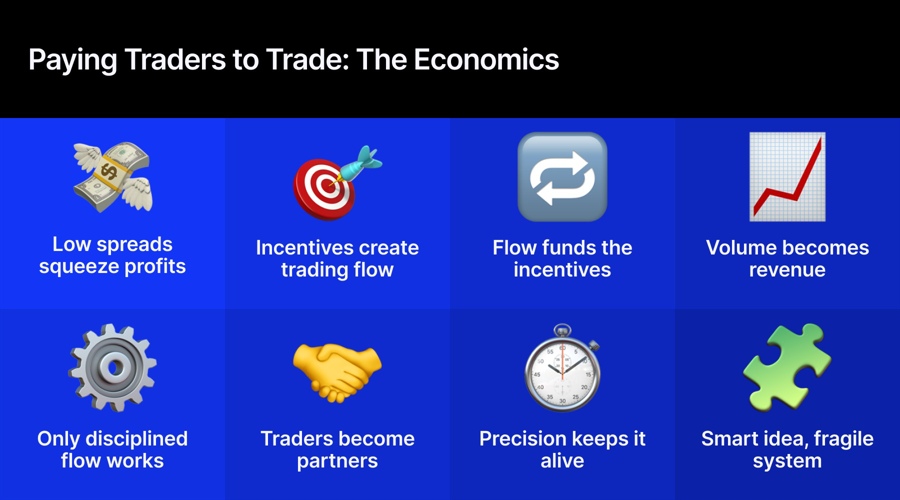
Incentives drive flow; flow drives spread capture; spread capture funds incentives. It’s a circular economy of liquidity.

Join buy side heads of FX in London at FMLS25.

The mechanics are simple enough: attract active traders with rebates or rewards, then use their trading volume to offset those payouts. Note there’s a big difference between doing this with retail flow and with what the industry calls retail-pro or semi-institutional flow - systematic, consistent, but not large enough for prime-of-prime access.

If you can capture a portion of the spread or post-trade yield without (presumably) taking directional risk, you can return part of it to clients and keep your book flat. The question is: how much can a broker realistically make - and at what cost, measured in risk?

When Innovation Meets .. Fatigue?

When a broker starts paying clients, it signals both innovation and fatigue. Innovation, because competition forces creative monetisation models. And exhaustion, because the spread-plus-commission model has hit its ceiling.

Zero-spread pricing, pay-per-limit-order, maker-taker rebates - all come from the same pressure point. The line between providing liquidity and monetising it has never been thinner.

Some brokers run structured reward programmes where active traders earn per-lot payments, often tiered by volume and pair. OANDA’s Elite Trader Programme is one example, offering rebates of up to 34% of total trading costs. But OANDA operates as a market-maker, so the economics behind those rebates differ.
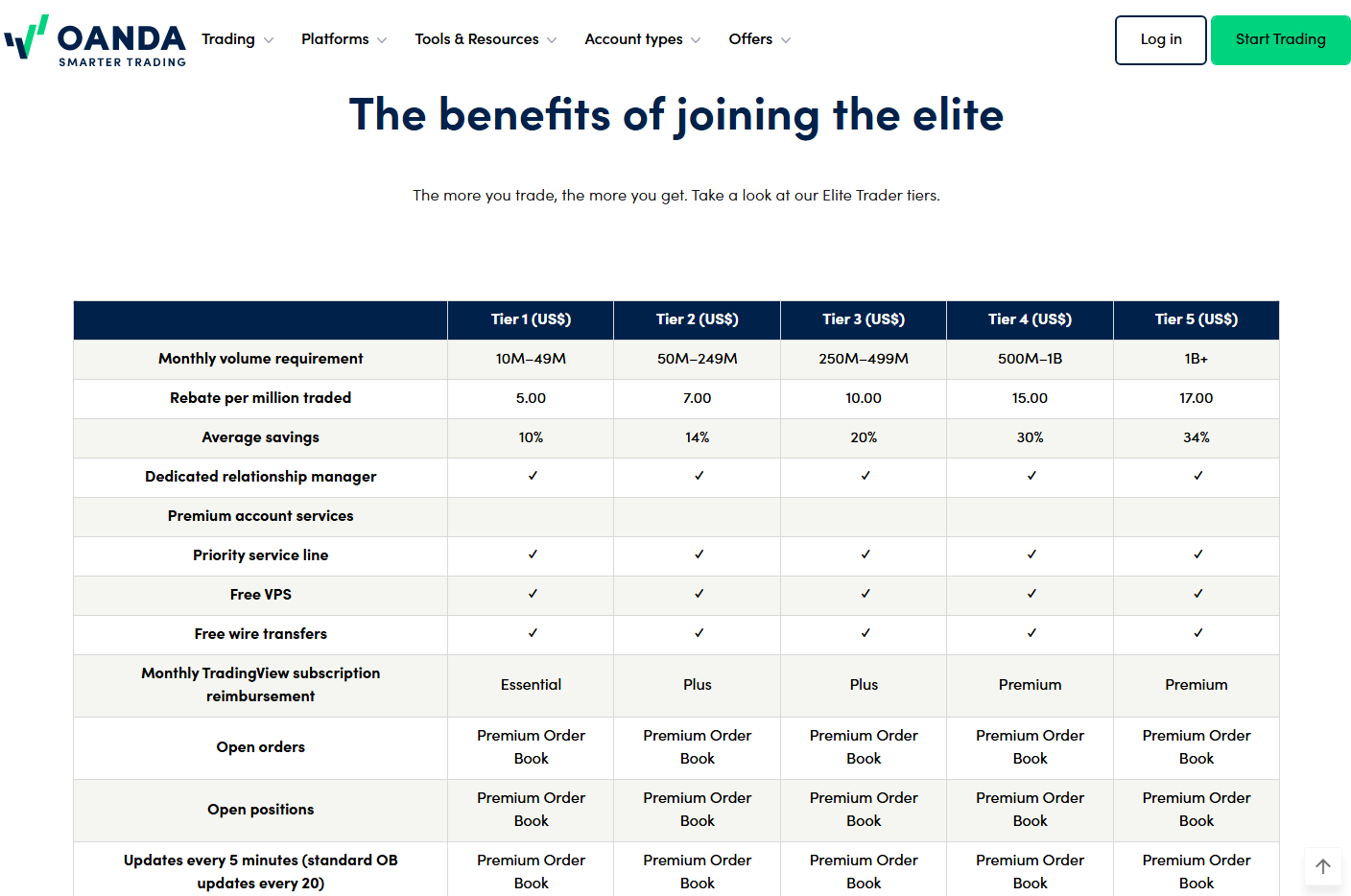
Details of OANDA's Elite Trader Program

In the pay-per-trade model, the payouts come not from client commissions but from captured market spreads - the micro-yields of post-trade optimisation. A broker (presumably) momentarily rests offsetting orders in deep liquidity pools, statistically capturing fractions of the spread thousands of times per day. A portion of that yield is then recycled back to the trader.

This differs from traditional rebates, which merely return part of what the client already paid. Here, value originates from execution efficiency rather than recycled fees.

Selective Flow, Not Open Floodgates

The most disciplined versions of this model don’t accept everyone. They want (or should want) consistent, systematic traders - not bonus hunters or latency arbitrage.

High-churn flow kills yield. Access is curated (should be curated), with approval rates closer to a prime broker than a retail broker.

Profitability depends on flow quality, not headcount. CAC is measured in sustainable spread capture per trader, not raw sign-ups.

What It Means for the Industry

When brokers pay clients, they flip the narrative: trading volume becomes the product.

The trader is no longer a customer in the traditional sense; they are a liquidity partner feeding the system.

A broker might rebate a few dollars per million traded, but across hundreds of active accounts, those rebates become predictable yield rather than cost. CAC transforms from a marketing problem into a retention one - the focus shifts from acquisition to maintaining profitable flow.

The Risk Layer(s)

These setups are elegant on paper but very fragile in practice.

Post-trade resting strategies rely on millisecond precision, risk filters, and liquidity access normally reserved for prime brokers. Execution mismatches or liquidity shocks can break the cycle quickly.

So yes - the concept is clever. But it’s not without exposure.

The main weak spots:

  1. Math vs. Market Reality

The spreadsheets assume perfect offsetting and constant liquidity. The moment volatility spikes or counterparties widen spreads, the model collapses. When yield per lot drops below payout thresholds, contribution margins turn negative. Fast.

  1. Residual Risk Transfer

“No-risk” models (look my book is flat!) often mask indirect exposure. Hedging delays, latency mismatches, and partial fills compound across high volume. A few bad ticks can erase a month’s yield.

  1. Counterparty Fragility

Most brokers don’t own their liquidity stack. A single prime tightening limits or a major LP widening spreads can crush the yield engine overnight.

  1. Flow Quality Misalignment

Rebate schemes attract volume chasers, not long-term clients. Brokers have to be exceptionally selective with onboarding.

  1. IB Displacement

The model leaves little room for introducing brokers (unless net profit is shared). To fill that gap, brokers must over-invest in direct marketing - another hit to already thin margins.

The idea isn’t bad. But it’s just very fragile.

You can call it incentive engineering, or you can call it yield recycling.

Yield recycling might be the more realistic path if the broker paid traders for limit orders and ran a hybrid execution model rather than full STP. That setup would give more hedging flexibility, less slippage risk, and a little more room to manoeuvre on margins.

But that’s my take, call me conservative, or an innovation sceptic if you like.

As for the pay-per-trade system as presented, there are simply too many points of failure for it to scale without cracking somewhere. It depends on perfect flow from the client side, perfect hedging, flawless latency, and counterparties who never blink - four conditions that almost never coexist.

In a saturated, low-spread market where acquisition costs (CAC) often exceed lifetime value (LTV) - especially for new or growing players - paying traders to trade is less madness and more math.

Incentives drive flow; flow drives spread capture; spread capture funds incentives. It’s a circular economy of liquidity.

Join buy side heads of FX in London at FMLS25.

The mechanics are simple enough: attract active traders with rebates or rewards, then use their trading volume to offset those payouts. Note there’s a big difference between doing this with retail flow and with what the industry calls retail-pro or semi-institutional flow - systematic, consistent, but not large enough for prime-of-prime access.

If you can capture a portion of the spread or post-trade yield without (presumably) taking directional risk, you can return part of it to clients and keep your book flat. The question is: how much can a broker realistically make - and at what cost, measured in risk?

When Innovation Meets .. Fatigue?

When a broker starts paying clients, it signals both innovation and fatigue. Innovation, because competition forces creative monetisation models. And exhaustion, because the spread-plus-commission model has hit its ceiling.

Zero-spread pricing, pay-per-limit-order, maker-taker rebates - all come from the same pressure point. The line between providing liquidity and monetising it has never been thinner.

Some brokers run structured reward programmes where active traders earn per-lot payments, often tiered by volume and pair. OANDA’s Elite Trader Programme is one example, offering rebates of up to 34% of total trading costs. But OANDA operates as a market-maker, so the economics behind those rebates differ.

Details of OANDA's Elite Trader Program

In the pay-per-trade model, the payouts come not from client commissions but from captured market spreads - the micro-yields of post-trade optimisation. A broker (presumably) momentarily rests offsetting orders in deep liquidity pools, statistically capturing fractions of the spread thousands of times per day. A portion of that yield is then recycled back to the trader.

This differs from traditional rebates, which merely return part of what the client already paid. Here, value originates from execution efficiency rather than recycled fees.

Selective Flow, Not Open Floodgates

The most disciplined versions of this model don’t accept everyone. They want (or should want) consistent, systematic traders - not bonus hunters or latency arbitrage.

High-churn flow kills yield. Access is curated (should be curated), with approval rates closer to a prime broker than a retail broker.

Profitability depends on flow quality, not headcount. CAC is measured in sustainable spread capture per trader, not raw sign-ups.

What It Means for the Industry

When brokers pay clients, they flip the narrative: trading volume becomes the product.

The trader is no longer a customer in the traditional sense; they are a liquidity partner feeding the system.

A broker might rebate a few dollars per million traded, but across hundreds of active accounts, those rebates become predictable yield rather than cost. CAC transforms from a marketing problem into a retention one - the focus shifts from acquisition to maintaining profitable flow.

The Risk Layer(s)

These setups are elegant on paper but very fragile in practice.

Post-trade resting strategies rely on millisecond precision, risk filters, and liquidity access normally reserved for prime brokers. Execution mismatches or liquidity shocks can break the cycle quickly.

So yes - the concept is clever. But it’s not without exposure.

The main weak spots:

  1. Math vs. Market Reality

The spreadsheets assume perfect offsetting and constant liquidity. The moment volatility spikes or counterparties widen spreads, the model collapses. When yield per lot drops below payout thresholds, contribution margins turn negative. Fast.

  1. Residual Risk Transfer

“No-risk” models (look my book is flat!) often mask indirect exposure. Hedging delays, latency mismatches, and partial fills compound across high volume. A few bad ticks can erase a month’s yield.

  1. Counterparty Fragility

Most brokers don’t own their liquidity stack. A single prime tightening limits or a major LP widening spreads can crush the yield engine overnight.

  1. Flow Quality Misalignment

Rebate schemes attract volume chasers, not long-term clients. Brokers have to be exceptionally selective with onboarding.

  1. IB Displacement

The model leaves little room for introducing brokers (unless net profit is shared). To fill that gap, brokers must over-invest in direct marketing - another hit to already thin margins.

The idea isn’t bad. But it’s just very fragile.

You can call it incentive engineering, or you can call it yield recycling.

Yield recycling might be the more realistic path if the broker paid traders for limit orders and ran a hybrid execution model rather than full STP. That setup would give more hedging flexibility, less slippage risk, and a little more room to manoeuvre on margins.

But that’s my take, call me conservative, or an innovation sceptic if you like.

As for the pay-per-trade system as presented, there are simply too many points of failure for it to scale without cracking somewhere. It depends on perfect flow from the client side, perfect hedging, flawless latency, and counterparties who never blink - four conditions that almost never coexist.

About the Author: Anya Aratovskaya
Anya Aratovskaya
  • 9 Articles
  • 11 Followers
About the Author: Anya Aratovskaya
Anya Aratovskaya is a freelance FX consultant with over 14 years of experience in the capital markets industry. She has held executive roles at leading financial and technology firms, including Advanced Markets, Fortex, and Boston Technologies. Anya has advised dozens of prop trading firms, FX brokers, and funds on everything from operational setup to strategic planning and market positioning. These days, she’s helping scale a non-financial startup and occasionally writes about the gray areas of the financial industry, marketing, platform incentives, and tech-driven business models.
  • 9 Articles
  • 11 Followers

More from the Author

Retail FX

!"#$%&'()*+,-./0123456789:;<=>?@ABCDEFGHIJKLMNOPQRSTUVWXYZ[\]^_`abcdefghijklmnopqrstuvwxyz{|} !"#$%&'()*+,-./0123456789:;<=>?@ABCDEFGHIJKLMNOPQRSTUVWXYZ[\]^_`abcdefghijklmnopqrstuvwxyz{|}