NinjaTrader Didn't Punish Alpha Futures for Failing. It Was Penalised for Succeeding.

Wednesday, 15/07/2026 | 11:00 GMT by Shervin Arian
  • A risk that activates the moment a firm tries to mitigate, Shervin Arian, Chief Strategy Officer at Arizet Labs, argues, is not a tail risk but a structural one, and the sector has not priced it.
  • Every prop firm is choosing between staying rented, building in-house, or licensing infrastructure it owns outright; no regulator is positioned to force a provider to serve a competitor.
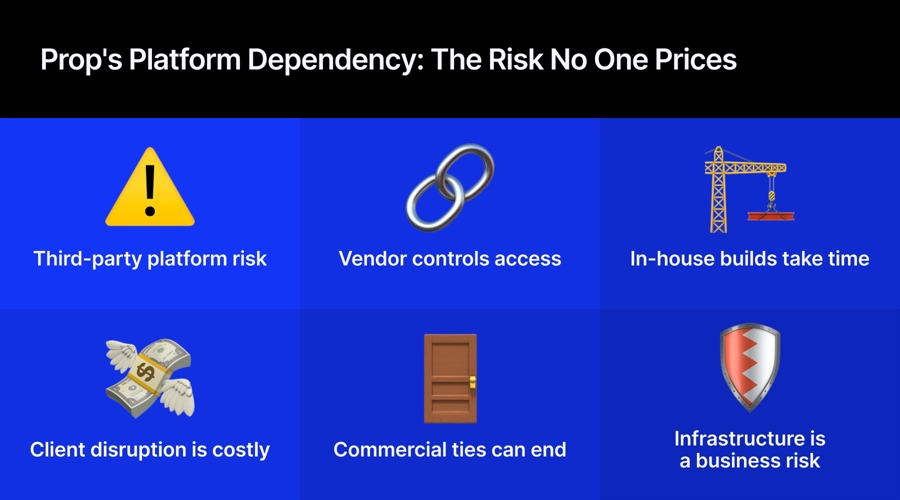
prop's platform dependency

In proprietary trading, the most consequential risks are rarely the ones firms spend the most time discussing.

Platform dependency is increasingly one of them, not as a technical inconvenience buried in a vendor contract, but as a structural liability that sits underneath the entire commercial relationship a firm has with its traders.

The assumption that has quietly underpinned the sector's growth is that execution infrastructure is a procurement decision, functionally interchangeable, and separable from the firm's own strategic direction. A platform is licensed, integrated, and treated as a fixed cost rather than a variable one.

That assumption no longer holds.

Infrastructure Was Never Just a Vendor Relationship

Most prop firms evaluate their platform provider the way they would evaluate a data feed or a CRM system: on uptime, integration cost, and price. This framing treats the platform as a neutral utility, present in the background and largely indifferent to what the firm does with it.

In practice, the platform is not neutral. It carries the firm's brand at the point of execution, shapes the trader's daily experience of the product, and increasingly determines execution quality, which in turn determines payout outcomes. A firm that does not control this layer does not fully control the thing its business is actually built on.

The distinction matters because a vendor relationship and a foundational dependency carry different risk profiles. A vendor can be replaced without threatening the business. A foundational dependency, when it breaks, threatens the business itself.

The Cost Only Becomes Visible When the Relationship Ends

This is not a theoretical concern. It surfaced publicly this month when NinjaTrader ended its relationship with Alpha Futures, a UK-based retail futures prop firm, after Alpha launched its own proprietary platform. Alpha's stated reason for building independent infrastructure was to reduce reliance on a third party. NinjaTrader's stated concern was that its backend would no longer be promoted with sufficient impartiality on a site that now competed with it.

Neither position is unreasonable in isolation. What matters is the outcome. Alpha's Premium Plan, which relied heavily on NinjaTrader's API backend, could not survive the transition, and every account on it had to be closed and refunded. The plan itself had not failed on its merits. The infrastructure assumption underneath it had.

This is the mechanism that most platform dependency risk follows. The cost does not appear while the relationship is functioning normally. It appears entirely at the moment the relationship ends, and by then it is no longer a line item; it is a client base that has to be unwound.

A Common Objection Does Not Survive Scrutiny

A reasonable objection here is that this was a one-off commercial dispute rather than evidence of a systemic pattern, and that most platform relationships in the sector are stable, long-standing, and unlikely to end this way.

That objection holds for firms that never attempt to reduce their dependency. It breaks down for the firms that do.

Alpha was not cut off for mismanaging its platform relationship. It was cut off for successfully building around it.

That is a materially different risk than ordinary vendor churn because it means the exposure activates precisely when a firm tries to do the thing that would otherwise protect it. A risk that punishes the mitigation is not a tail risk. It is a structural one.

Rescue Campaigns Reveal the Depth of the Problem, Not the Solution

The response from competing firms was immediate. Several moved to absorb Alpha's displaced traders with free accounts and funded incentives, framed publicly as support for a community affected by circumstances outside its control.

Given that roughly ninety-three percent of funded accounts never reach a payout, an entry ticket offered for free is not primarily an act of solidarity. It is customer acquisition priced against a base rate the firm already understands favours the house. The traders being absorbed are not being rescued from platform dependency. They are being moved onto infrastructure with the identical exposure, at a different firm, on a different day.

The rescue campaigns are not evidence that the sector has solved this problem. They are evidence of how normalised the underlying dependency has become, and how little firms have priced it into their own risk models.

Regulation Will Not Close This Gap

It would be convenient to fold this into the broader conversation about the sector's regulatory vacuum, and there is some truth to that framing. Oversight of retail proprietary trading remains limited across the major jurisdictions, and the frameworks that do exist focus on marketing conduct and capital requirements rather than infrastructure dependency.

But no regulator is positioned to compel a platform provider to keep serving a client that has become a competitor.

That is an ordinary commercial decision, and it will remain one regardless of how the compliance landscape around the sector evolves. Firms exposed to this risk are exposed by their own architecture, not by an absence of supervision, and no amount of future rulemaking changes that.

Read more: “Every Design Choice in Prop Trading Creates a Corresponding Risk”

Firms Are Choosing Between Three Options, Whether They Recognise It or Not

Strip the specifics away, and every prop firm is working from the same three options.

The first is to remain on third-party infrastructure indefinitely and accept that the arrangement can end whenever the provider's own commercial interests shift, as Alpha's did.

The second is to build proprietary infrastructure entirely in-house. This is what Alpha attempted, and its experience illustrates why so few firms attempt it. It is capital-intensive, slow, and it leaves a firm running unproven systems for live clients while the incumbent provider still holds the relationship for everything the new build has not yet replaced. Alpha was caught in exactly that gap when the termination came.

The third option, discussed far less than the first two, is licensing infrastructure that was designed from the outset to be owned rather than rented, where the firm retains the branding, the client relationship, and the data outright, with no promotional obligation back to a third party and no exposure to being deprioritised the moment it starts to resemble competition. This is a materially different arrangement from a conventional white-label deal, and it is the only option among the three that resolves the dependency itself rather than deferring it.

None of this is a judgment on Alpha's execution. It is a description of the menu every other firm in this sector is already working from, usually without having named it as a decision at all.

In proprietary trading, the most consequential risks are rarely the ones firms spend the most time discussing.

Platform dependency is increasingly one of them, not as a technical inconvenience buried in a vendor contract, but as a structural liability that sits underneath the entire commercial relationship a firm has with its traders.

The assumption that has quietly underpinned the sector's growth is that execution infrastructure is a procurement decision, functionally interchangeable, and separable from the firm's own strategic direction. A platform is licensed, integrated, and treated as a fixed cost rather than a variable one.

That assumption no longer holds.

Infrastructure Was Never Just a Vendor Relationship

Most prop firms evaluate their platform provider the way they would evaluate a data feed or a CRM system: on uptime, integration cost, and price. This framing treats the platform as a neutral utility, present in the background and largely indifferent to what the firm does with it.

In practice, the platform is not neutral. It carries the firm's brand at the point of execution, shapes the trader's daily experience of the product, and increasingly determines execution quality, which in turn determines payout outcomes. A firm that does not control this layer does not fully control the thing its business is actually built on.

The distinction matters because a vendor relationship and a foundational dependency carry different risk profiles. A vendor can be replaced without threatening the business. A foundational dependency, when it breaks, threatens the business itself.

The Cost Only Becomes Visible When the Relationship Ends

This is not a theoretical concern. It surfaced publicly this month when NinjaTrader ended its relationship with Alpha Futures, a UK-based retail futures prop firm, after Alpha launched its own proprietary platform. Alpha's stated reason for building independent infrastructure was to reduce reliance on a third party. NinjaTrader's stated concern was that its backend would no longer be promoted with sufficient impartiality on a site that now competed with it.

Neither position is unreasonable in isolation. What matters is the outcome. Alpha's Premium Plan, which relied heavily on NinjaTrader's API backend, could not survive the transition, and every account on it had to be closed and refunded. The plan itself had not failed on its merits. The infrastructure assumption underneath it had.

This is the mechanism that most platform dependency risk follows. The cost does not appear while the relationship is functioning normally. It appears entirely at the moment the relationship ends, and by then it is no longer a line item; it is a client base that has to be unwound.

A Common Objection Does Not Survive Scrutiny

A reasonable objection here is that this was a one-off commercial dispute rather than evidence of a systemic pattern, and that most platform relationships in the sector are stable, long-standing, and unlikely to end this way.

That objection holds for firms that never attempt to reduce their dependency. It breaks down for the firms that do.

Alpha was not cut off for mismanaging its platform relationship. It was cut off for successfully building around it.

That is a materially different risk than ordinary vendor churn because it means the exposure activates precisely when a firm tries to do the thing that would otherwise protect it. A risk that punishes the mitigation is not a tail risk. It is a structural one.

Rescue Campaigns Reveal the Depth of the Problem, Not the Solution

The response from competing firms was immediate. Several moved to absorb Alpha's displaced traders with free accounts and funded incentives, framed publicly as support for a community affected by circumstances outside its control.

Given that roughly ninety-three percent of funded accounts never reach a payout, an entry ticket offered for free is not primarily an act of solidarity. It is customer acquisition priced against a base rate the firm already understands favours the house. The traders being absorbed are not being rescued from platform dependency. They are being moved onto infrastructure with the identical exposure, at a different firm, on a different day.

The rescue campaigns are not evidence that the sector has solved this problem. They are evidence of how normalised the underlying dependency has become, and how little firms have priced it into their own risk models.

Regulation Will Not Close This Gap

It would be convenient to fold this into the broader conversation about the sector's regulatory vacuum, and there is some truth to that framing. Oversight of retail proprietary trading remains limited across the major jurisdictions, and the frameworks that do exist focus on marketing conduct and capital requirements rather than infrastructure dependency.

But no regulator is positioned to compel a platform provider to keep serving a client that has become a competitor.

That is an ordinary commercial decision, and it will remain one regardless of how the compliance landscape around the sector evolves. Firms exposed to this risk are exposed by their own architecture, not by an absence of supervision, and no amount of future rulemaking changes that.

Read more: “Every Design Choice in Prop Trading Creates a Corresponding Risk”

Firms Are Choosing Between Three Options, Whether They Recognise It or Not

Strip the specifics away, and every prop firm is working from the same three options.

The first is to remain on third-party infrastructure indefinitely and accept that the arrangement can end whenever the provider's own commercial interests shift, as Alpha's did.

The second is to build proprietary infrastructure entirely in-house. This is what Alpha attempted, and its experience illustrates why so few firms attempt it. It is capital-intensive, slow, and it leaves a firm running unproven systems for live clients while the incumbent provider still holds the relationship for everything the new build has not yet replaced. Alpha was caught in exactly that gap when the termination came.

The third option, discussed far less than the first two, is licensing infrastructure that was designed from the outset to be owned rather than rented, where the firm retains the branding, the client relationship, and the data outright, with no promotional obligation back to a third party and no exposure to being deprioritised the moment it starts to resemble competition. This is a materially different arrangement from a conventional white-label deal, and it is the only option among the three that resolves the dependency itself rather than deferring it.

None of this is a judgment on Alpha's execution. It is a description of the menu every other firm in this sector is already working from, usually without having named it as a decision at all.

About the Author: Shervin Arian
Shervin Arian
  • 3 Articles
  • 1 Follower
About the Author: Shervin Arian
Shervin Arian is a fintech strategist specializing in prop trading economics, payout optimization, and risk architecture. With over 20 years of experience overseeing portfolios exceeding $500M, he advises prop firms and brokers on scaling while controlling hidden exposure across funded account populations. He serves as Chief Strategy Officer at Arizet Labs and is the founder and CEO of OmegaRatio Advisors. He is known for his work on advanced risk models, including the Glass Box approach to payout and liquidity management.
  • 3 Articles
  • 1 Follower

More from the Author

Retail FX

!"#$%&'()*+,-./0123456789:;<=>?@ABCDEFGHIJKLMNOPQRSTUVWXYZ[\]^_`abcdefghijklmnopqrstuvwxyz{|} !"#$%&'()*+,-./0123456789:;<=>?@ABCDEFGHIJKLMNOPQRSTUVWXYZ[\]^_`abcdefghijklmnopqrstuvwxyz{|}