NinjaTrader and Alpha Futures Breakup Turns Bitter, Exposing a Big Industry Risk

Tuesday, 14/07/2026 | 14:38 GMT by Adonis Adoni
  • The platform provider has alleged a contract dispute, while the prop firm maintains that it has fulfilled its obligations.
  • Alpha Futures' decision to void payouts on the affected Premium Plan has led to massive backlash.
  • The situation has exposed the precariousness of overreliance on a single third-party vendor.
Alpha Futures vs NinjaTrade
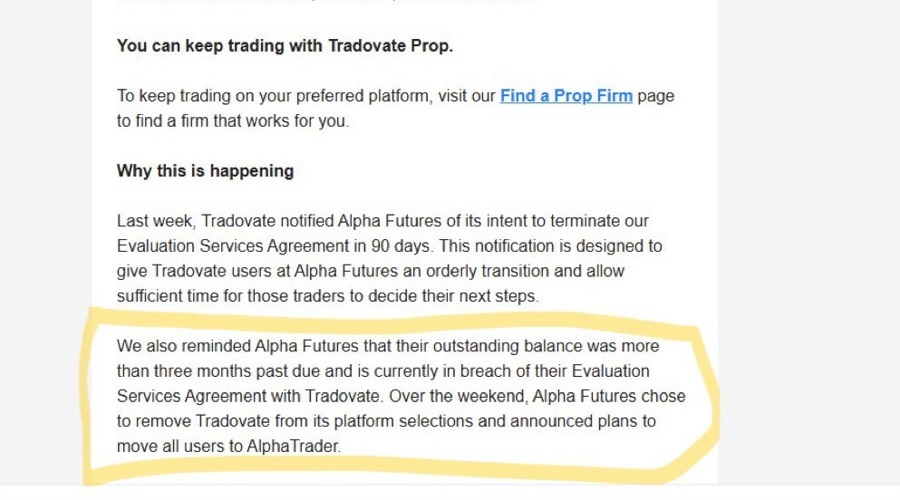
A snippet of the email sent by NinjaTrade that's circulating on X.

Following yesterday’s announcement by retail prop firm Alpha Futures that NinjaTrader had severed ties, the saga has now descended from a strategic parting of ways into public mud-slinging.

Several posts on X show that NinjaTrader had sent an email, alleging a contract dispute involving an outstanding balance more than three months past due; a clear breach, it claims, of the Evaluation Services Agreement.

Alpha Futures, however, has responded with a voluminous public defence on X, including invoices and proof of payment.

What is Alpha Claiming?

According to the prop firm, a prior US$2.4 million overcharge dispute was settled in early 2026, leaving an allegedly "outstanding" US$225,700, which was believed to be credit remaining from that settlement.

The prop firm insisted that monthly payments remained current and that subsequent discussions had revolved solely around the co-existence of NinjaTrader and Alpha’s own new platform, AlphaTrader.

The terminal notice, it claims, arrived without warning on 9 July. According to Alpha, NinjaTrader’s sudden interest in this sum was merely a pretext; the real issue was the launch of Alpha’s own platform, AlphaTrader.

If Alpha is to be believed, Ninja’s ultimatum was final; the plug would be pulled regardless of whether the cheque cleared.

Guaranteed Payouts Aren’t Always Guaranteed

The collateral damage of what is turning into a bitter spat was the prop firm’s Premium Plan, which was inextricably tied to NinjaTrader’s backend.

By pulling the plug, NinjaTrader effectively forced Alpha to liquidate the product entirely. Alpha claims to have paid out more than US$25 million via the plan in a mere two months, a rate of burn that suggests the plan was operating at a heavy loss.

For traders who successfully navigated their evaluations, the outcome is sobering: With the infrastructure gone, Alpha has closed all active accounts, offering only activation-fee refunds to those who completed their evaluations.

“All active Premium Accounts will be refunded and closed. This includes all pending and unpaid payouts on the Premium plan beyond the amount already paid,” the prop firm said in yesterday's announcement.

A Massive Backlash that Exposes A Systemic Vulnerability

The backlash has been massive.

Traders have taken to X to post screenshots showing thousands in voided profits, expressing fury and bafflement at the decision.

At the same time, Alpha Futures was delisted from major industry directories.

"Traders should not lose payouts they have already earned without breaking any clearly stated rule," PropFirmMatch stated as the reason behind the delisting.

This has triggered an industry-wide trust crisis, as traders realise that "guaranteed" payouts may only be as secure as a firm’s vendor relations.

The payout fallout is far from an isolated event; rather, it serves as a glaring symptom of a broader, more systemic vulnerability within the market.

At the core of the issue is a reliance on customer failure, with industry data suggesting that roughly only 7% of traders who purchase an evaluation challenge ever reach a payout.

Many firms rely on a steady stream of evaluation fees to cover the payouts; consequently, when an unexpected operational shock emerges or a sudden drop in new sign-ups occurs, this liquidity model is pushed to its limits.

In 2024, Belgium’s FSMA was the first EU regulator to warn against prop trading firms, noting that they make money by selling challenges to retail traders, while the promised profit share from a funded trading account does not always materialise.

Moving Away from Third-Party Dependence

As Prop Trader Edge has reported, the Alpha Futures and NinjaTrader debacle pulls back the curtain on another persistent market issue: overreliance on third-party platforms.

The industry has, of course, been here before. The MetaQuotes exodus of 2024, which was the main catalyst for wiping out some 14% of the global market, was meant to be the definitive lesson in the perils of third-party overreliance.

However, it remains a strategic risk for a model already struggling to sustain itself.

On top of a revenue model that is largely fee-based, hundreds of copycat firms are flooding the market, leading to cutthroat competition driven by unsustainable perks, while sophisticated attempts to game the system proliferate.

There is clear evidence that the path forward involves building proprietary platforms and shifting toward more resilient, modular tech stacks. Firms are exploring multi-platform setups to avoid the single point of failure trap.

Yet, even alternative turnkey systems are proving volatile; cTrader, a popular choice for those fleeing MetaTrader, has already pulled out of the US market.

Speaking to Finance Magnates, Spotware, the developer behind cTrader, described the withdrawal as a strategic decision. “Following an internal regulatory assessment during the first quarter of 2026, we made the strategic decision to restrict the onboarding of US-based traders on the platform,” a company spokesperson said.

Meanwhile, major players like Topstep are pursuing vertical integration, acquiring their own routing technology to ensure complete control.

Following yesterday’s announcement by retail prop firm Alpha Futures that NinjaTrader had severed ties, the saga has now descended from a strategic parting of ways into public mud-slinging.

Several posts on X show that NinjaTrader had sent an email, alleging a contract dispute involving an outstanding balance more than three months past due; a clear breach, it claims, of the Evaluation Services Agreement.

Alpha Futures, however, has responded with a voluminous public defence on X, including invoices and proof of payment.

What is Alpha Claiming?

According to the prop firm, a prior US$2.4 million overcharge dispute was settled in early 2026, leaving an allegedly "outstanding" US$225,700, which was believed to be credit remaining from that settlement.

The prop firm insisted that monthly payments remained current and that subsequent discussions had revolved solely around the co-existence of NinjaTrader and Alpha’s own new platform, AlphaTrader.

The terminal notice, it claims, arrived without warning on 9 July. According to Alpha, NinjaTrader’s sudden interest in this sum was merely a pretext; the real issue was the launch of Alpha’s own platform, AlphaTrader.

If Alpha is to be believed, Ninja’s ultimatum was final; the plug would be pulled regardless of whether the cheque cleared.

Guaranteed Payouts Aren’t Always Guaranteed

The collateral damage of what is turning into a bitter spat was the prop firm’s Premium Plan, which was inextricably tied to NinjaTrader’s backend.

By pulling the plug, NinjaTrader effectively forced Alpha to liquidate the product entirely. Alpha claims to have paid out more than US$25 million via the plan in a mere two months, a rate of burn that suggests the plan was operating at a heavy loss.

For traders who successfully navigated their evaluations, the outcome is sobering: With the infrastructure gone, Alpha has closed all active accounts, offering only activation-fee refunds to those who completed their evaluations.

“All active Premium Accounts will be refunded and closed. This includes all pending and unpaid payouts on the Premium plan beyond the amount already paid,” the prop firm said in yesterday's announcement.

A Massive Backlash that Exposes A Systemic Vulnerability

The backlash has been massive.

Traders have taken to X to post screenshots showing thousands in voided profits, expressing fury and bafflement at the decision.

At the same time, Alpha Futures was delisted from major industry directories.

"Traders should not lose payouts they have already earned without breaking any clearly stated rule," PropFirmMatch stated as the reason behind the delisting.

This has triggered an industry-wide trust crisis, as traders realise that "guaranteed" payouts may only be as secure as a firm’s vendor relations.

The payout fallout is far from an isolated event; rather, it serves as a glaring symptom of a broader, more systemic vulnerability within the market.

At the core of the issue is a reliance on customer failure, with industry data suggesting that roughly only 7% of traders who purchase an evaluation challenge ever reach a payout.

Many firms rely on a steady stream of evaluation fees to cover the payouts; consequently, when an unexpected operational shock emerges or a sudden drop in new sign-ups occurs, this liquidity model is pushed to its limits.

In 2024, Belgium’s FSMA was the first EU regulator to warn against prop trading firms, noting that they make money by selling challenges to retail traders, while the promised profit share from a funded trading account does not always materialise.

Moving Away from Third-Party Dependence

As Prop Trader Edge has reported, the Alpha Futures and NinjaTrader debacle pulls back the curtain on another persistent market issue: overreliance on third-party platforms.

The industry has, of course, been here before. The MetaQuotes exodus of 2024, which was the main catalyst for wiping out some 14% of the global market, was meant to be the definitive lesson in the perils of third-party overreliance.

However, it remains a strategic risk for a model already struggling to sustain itself.

On top of a revenue model that is largely fee-based, hundreds of copycat firms are flooding the market, leading to cutthroat competition driven by unsustainable perks, while sophisticated attempts to game the system proliferate.

There is clear evidence that the path forward involves building proprietary platforms and shifting toward more resilient, modular tech stacks. Firms are exploring multi-platform setups to avoid the single point of failure trap.

Yet, even alternative turnkey systems are proving volatile; cTrader, a popular choice for those fleeing MetaTrader, has already pulled out of the US market.

Speaking to Finance Magnates, Spotware, the developer behind cTrader, described the withdrawal as a strategic decision. “Following an internal regulatory assessment during the first quarter of 2026, we made the strategic decision to restrict the onboarding of US-based traders on the platform,” a company spokesperson said.

Meanwhile, major players like Topstep are pursuing vertical integration, acquiring their own routing technology to ensure complete control.

About the Author: Adonis Adoni
Adonis Adoni
  • 65 Articles
  • 2 Followers
About the Author: Adonis Adoni
Adonis Adoni is a News Editor at Finance Magnates, with more than six years of experience covering the financial services industry, technology, and their intersection. His work includes C-suite interviews with leading technology and fintech companies across Europe, the US and Asia, exclusive coverage of M&A activity and capital raising, and data-driven industry reporting, with a strong emphasis on engagement and clear storytelling. Areas of Coverage: Online trading industry news Fintech companies Digital assets and crypto markets Regulatory and compliance developments Executive interviews Education: BA in Law – Nottingham Trent University LLM in Health Law – Nottingham Trent University
  • 65 Articles
  • 2 Followers

More from the Author

Retail FX

!"#$%&'()*+,-./0123456789:;<=>?@ABCDEFGHIJKLMNOPQRSTUVWXYZ[\]^_`abcdefghijklmnopqrstuvwxyz{|} !"#$%&'()*+,-./0123456789:;<=>?@ABCDEFGHIJKLMNOPQRSTUVWXYZ[\]^_`abcdefghijklmnopqrstuvwxyz{|}