

There has been a lot of talk recently about prediction markets becoming the next major product expansion for retail brokers. However, very few brokers have made the leap so far. Tickmill appears to be preparing to join their ranks, having recently posted a job opening for a Head of Product, Prediction Markets.
The job posting does not clarify whether the underlying market infrastructure will be built entirely in-house or integrated with third-party venues, such as Kalshi.

However, the role description tasks the incoming head of product with collaborating with internal engineering teams as well as external exchanges, market makers, liquidity providers, and technology vendors.
Although the role is advertised under Tickmill’s European operations, it remains unclear whether the new product offering will be targeted at clients in the EU, the UK, or other global jurisdictions.
Tickmill did not respond to requests for comment before publication.
- Tickmill Wins Global Most Established Broker 2026 at Finance Magnates Awards
- Tickmill to Participate as Platinum Sponsor of iFX EXPO Asia 2026 in Hong Kong
- Tickmill UK’s 2025 Trading Revenue Dropped 11% Despite Demand Increase
Prediction Markets Are Hot
When Americans went to the polls last month, prediction markets became part of the political theatre. Across Kalshi and Polymarket, traders put $2.7 billion behind 34,000 election-related contracts tracked through Election Day, nearly 15 times the 2,300 markets that accompanied the 2024 cycle, according to Pew Research Center.
We're excited to announce our 2026 Midterms Hub. Watch the odds shift before the polls on America's #1 most accurate election forecast. https://t.co/vZoKFluxvw
— Polymarket (@Polymarket) September 18, 2026
Demand accelerated sharply as voting approached; trading volume on midterm contracts more than tripled across both platforms from the final week of October into election week. Including local and post-election settlements, Kalshi reported over $3 billion in cumulative midterm contract volume, while Polymarket recorded nearly $700 million.
More broadly, total prediction markets notional volume rose 75% quarter-on-quarter in Q3 2026.
Despite this momentum, only a few brokers have entered the space.
Staking a Claim
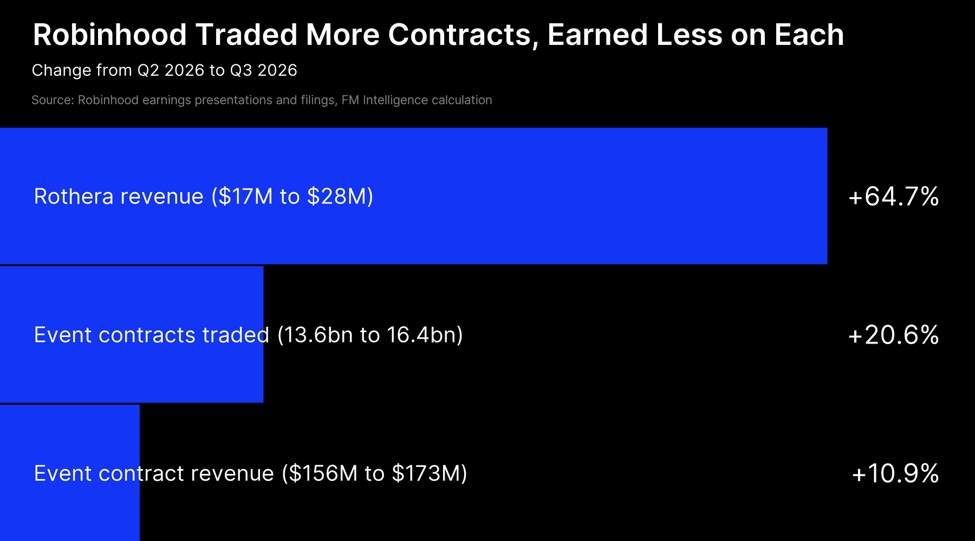
Robinhood, one of the first to enter prediction markets in 2025, has been a major beneficiary. According to FM Intelligence, its event contracts bringing in $173 million between July and September, more than the $120 million the trading platform earned from crypto and about 12% of its net revenue. It's worth mentioning that despite trading more contract, it earned less on each.
Plus500 launched CFTC-regulated prediction markets through Plus500 Futures, incorporating Kalshi contracts and expanding into sports event-based contracts in June 2026. Plus500 has described prediction markets as a structural growth opportunity within its US strategy.
IG Group also moved decisively into the sector. On July 30, 2026, it agreed to acquire Underdog, a US daily-fantasy and prediction-markets operator for some $1.3 billion. IG positioned the deal as a way to deepen its US retail-trading presence and gain greater control over product development and value-chain economics.
Regulatory Hurdles Make the Product Difficult
Entering this market presents regulatory challenges, which might explain
In July, ESMA issued a public statement reminding firms that products marketed as "event contracts" may fall under the long-standing prohibition on binary options for retail traders. Europe’s top regulator has maintained that underlying mechanics take precedence over commercial branding.
Adding to the complexity, ESMA noted that event contracts may also qualify as bets under national gambling legislation or fall under MiCA if offered in tokenized forms that are not financial instruments.
So, any firm planning to offer prediction markets in the EU must navigate an intricate regulatory landscape.
In the UK, the FCA’s March 2026 perimeter report said the financial prediction-market products it had seen were binary options and therefore remain subject to its permanent retail binary-options ban. The FCA said it would consider further work on access and perimeter clarification, but no formal rule change or timetable has been announced.
The US presents a different but equally difficult issue. The CFTC maintains that event contracts traded on registered designated contract markets fall within federal derivatives law, while several state regulators and prosecutors have challenged that position, particularly for sports-related contracts.
Sports contracts remain the primary source of trading activity. In Q3 2026, sports and multi-leg parlay contracts accounted for 83% of US notional volume, according to Predicted; parlays alone represented 44%, overtaking single-event sports contracts.
That concentration underscores the regulatory risk for a broker entering the sector. Election markets may generate headlines, but sports-related products, and especially parlays, are where much of the volume, and much of the jurisdictional conflict, sits


