In this third part of the Italian Market Series, we highlight the widening gap between Consob’s image of the Italian investor and eToro’s data showing a new generation diving into alternatives.
A tip for brokers: “Begin your journey in Italy with strong educational initiatives; Many young investors still believe the markets aren’t for them.”
Despite often being portrayed in Hollywood movies as risk-takers who live on the edge, in the financial markets, the average Italian investor would likely give up investing altogether rather than build a portfolio riskier than a default-free bond.
For years, Italy has been known for its cautious approach to investing, with most adults favouring low-risk assets like bonds and real estate. However, a shift is underway. While overall investor numbers have slightly declined since 2022, younger Italians are showing a growing appetite for financial markets—particularly in higher-risk areas like CFDs, forex, and cryptoassets.
A significant number of Italians plan to start investing or expand their portfolios in the next 12 months, potentially adding 2.1 million new investors to the market, according to a BlackRock report. Data from eToro further reinforces this trend, showing that younger Italian traders are more engaged in riskier assets compared to older generations.
Could this signal a major shift in Italy’s historically conservative investment culture?
Despite the marginal decrease in the number of investors since 2022—around 1%—while in countries like Great Britain, Germany, and France, there has been an increase well into double digits, BlackRock’s report highlights a potential and significant increase over the next 12 months.
Massimo Citoni, Regional Manager, Italy at eToro, Source: LinkedIn
Of the surveyed investors, 17% declared that it is very likely they will either start investing or increase their current investment portfolio. Among this portion of Italian adults—equivalent to 15 million people—2.1 million do not currently have an investment portfolio. If all these potential investors actually enter the financial markets, the number of Italian investors will increase by around 15% over the next 12 months, reaching 33% of adults in Italy, assuming the number of adults remains roughly the same.
Massimo Citoni, Regional Manager Italia of eToro, described a dynamic and expanding market: “Italian retail investors are often characterised as risk-averse, favouring stable assets such as bonds, real estate, or cash savings. While these traits are rooted in tradition, the full picture reveals a growing appetite for trading and investing across generations. […] Younger investors, in particular, are drawn to technology-driven opportunities like tech stocks and digital assets while also recognising the value of diversification.”
Highlighting the emerging brokerage industry of Italy, Citoni said: “Progress is driven by competition. […] At eToro, we will continue to expand our offering to provide the solutions investors need for every step of their investing journey.”
eToro is a well-known and established broker that offers services worldwide, currently counting more than 30 million users, with over 10.4% based in Italy.
Analysing the average portfolio of an eToro trader compared to the data provided by Consob is insightful because the average eToro user is significantly younger than the one analysed by the Italian market authority. This provides an exclusive advantage in identifying potential trends among younger investors.
The average Italian investor, according to Consob’s poll, is just over 50.4 years old, and only 28.37% of Italian investors are under 44 years old. On the other hand, the average age of an eToro client is 38.15 years old, with 70.12% of clients being under 44 years old.
As mentioned by Massimo Citoni, the data provided by eToro demonstrates a significant shift among younger investors towards riskier assets such as equities, cryptoassets, forex, and alternative investments. While Consob’s average portfolio allocates only 5% to derivatives and alternative investments, one in five of eToro’s younger traders invests in forex and alternative investments, suggesting a much larger portfolio allocation towards CFDs.
After analysing the charts and numbers from Consob’s report, as an Italian investor and trader, I can’t help but share my own perspective.
However, it is also important to consider that Italy has an ageing population, and most statistics are skewed by the behaviour of older generations. In reality, based on my own participation in the financial markets, I find the figures provided by eToro more reflective of the growing interest in riskier asset classes, including CFDs.
Furthermore, while the barrier to entry related to the advantages of an Italian broker remains relevant, in most cases, Italians are not afraid to open a secondary brokerage account to pursue their financial goals. The issue? Many may not yet realise they have this interest.
Most Italians, especially university students I speak with, simply dismiss the idea of investing in the financial markets, citing a lack of financial education. Therefore, brokers considering expansion into the Italian financial markets should focus on strong marketing campaigns and educational initiatives to bridge this gap and guide younger market participants towards riskier assets.
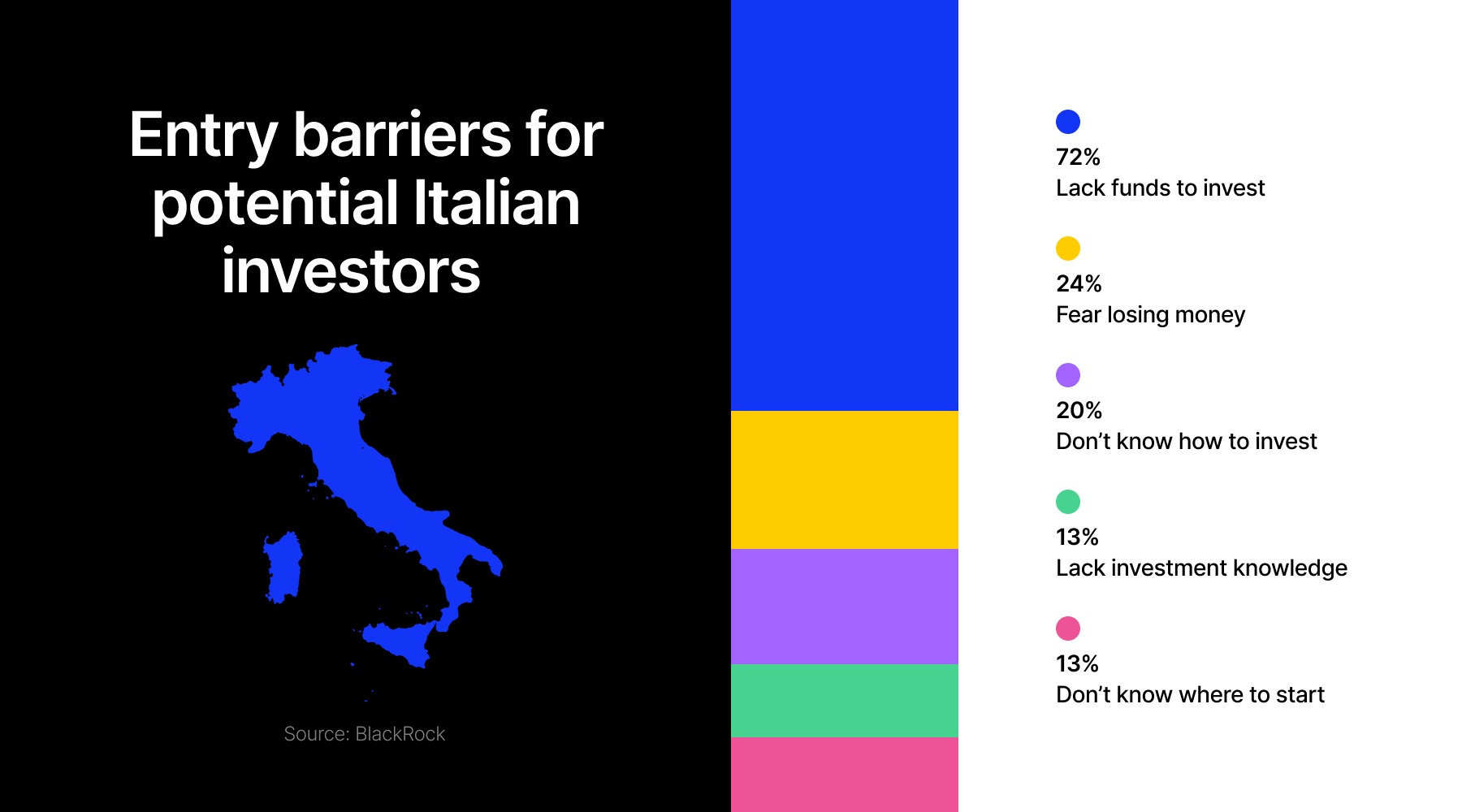
Italian investors, as a whole, are often described as cautious savers and planners—risk-averse and relatively hesitant towards alternative investments, foreign assets, and derivatives. These general characteristics are deeply rooted in tradition and fuelled by misconceptions, including the belief that they lack sufficient financial knowledge, time, or money to start investing. In reality, Consob’s data highlights a significant mismatch between Italian investors’ self-evaluation of their financial knowledge and their actual understanding. Additionally, what appears to be a lack of disposable funds is often due to the allocation of savings towards goals such as handling unexpected events, supporting family, enjoying life, and purchasing property.
However, the data provided by Massimo Citoni and the team at eToro Italia has given us a fresh perspective on the topic by analysing a younger population sample.
Among eToro’s clients, one in five investors allocates funds to alternative investments and forex, while one in three has gained exposure to cryptoassets. This contrast—especially pronounced among Gen Z investors—signals strong potential for brokers in the CFD industry in Italy, given the growing demand paired with the highest portfolio value and margin per transaction in Europe.
Despite often being portrayed in Hollywood movies as risk-takers who live on the edge, in the financial markets, the average Italian investor would likely give up investing altogether rather than build a portfolio riskier than a default-free bond.
For years, Italy has been known for its cautious approach to investing, with most adults favouring low-risk assets like bonds and real estate. However, a shift is underway. While overall investor numbers have slightly declined since 2022, younger Italians are showing a growing appetite for financial markets—particularly in higher-risk areas like CFDs, forex, and cryptoassets.
A significant number of Italians plan to start investing or expand their portfolios in the next 12 months, potentially adding 2.1 million new investors to the market, according to a BlackRock report. Data from eToro further reinforces this trend, showing that younger Italian traders are more engaged in riskier assets compared to older generations.
Could this signal a major shift in Italy’s historically conservative investment culture?
Despite the marginal decrease in the number of investors since 2022—around 1%—while in countries like Great Britain, Germany, and France, there has been an increase well into double digits, BlackRock’s report highlights a potential and significant increase over the next 12 months.
Massimo Citoni, Regional Manager, Italy at eToro, Source: LinkedIn
Of the surveyed investors, 17% declared that it is very likely they will either start investing or increase their current investment portfolio. Among this portion of Italian adults—equivalent to 15 million people—2.1 million do not currently have an investment portfolio. If all these potential investors actually enter the financial markets, the number of Italian investors will increase by around 15% over the next 12 months, reaching 33% of adults in Italy, assuming the number of adults remains roughly the same.
Massimo Citoni, Regional Manager Italia of eToro, described a dynamic and expanding market: “Italian retail investors are often characterised as risk-averse, favouring stable assets such as bonds, real estate, or cash savings. While these traits are rooted in tradition, the full picture reveals a growing appetite for trading and investing across generations. […] Younger investors, in particular, are drawn to technology-driven opportunities like tech stocks and digital assets while also recognising the value of diversification.”
Highlighting the emerging brokerage industry of Italy, Citoni said: “Progress is driven by competition. […] At eToro, we will continue to expand our offering to provide the solutions investors need for every step of their investing journey.”
eToro is a well-known and established broker that offers services worldwide, currently counting more than 30 million users, with over 10.4% based in Italy.
Analysing the average portfolio of an eToro trader compared to the data provided by Consob is insightful because the average eToro user is significantly younger than the one analysed by the Italian market authority. This provides an exclusive advantage in identifying potential trends among younger investors.
The average Italian investor, according to Consob’s poll, is just over 50.4 years old, and only 28.37% of Italian investors are under 44 years old. On the other hand, the average age of an eToro client is 38.15 years old, with 70.12% of clients being under 44 years old.
As mentioned by Massimo Citoni, the data provided by eToro demonstrates a significant shift among younger investors towards riskier assets such as equities, cryptoassets, forex, and alternative investments. While Consob’s average portfolio allocates only 5% to derivatives and alternative investments, one in five of eToro’s younger traders invests in forex and alternative investments, suggesting a much larger portfolio allocation towards CFDs.
After analysing the charts and numbers from Consob’s report, as an Italian investor and trader, I can’t help but share my own perspective.
However, it is also important to consider that Italy has an ageing population, and most statistics are skewed by the behaviour of older generations. In reality, based on my own participation in the financial markets, I find the figures provided by eToro more reflective of the growing interest in riskier asset classes, including CFDs.
Furthermore, while the barrier to entry related to the advantages of an Italian broker remains relevant, in most cases, Italians are not afraid to open a secondary brokerage account to pursue their financial goals. The issue? Many may not yet realise they have this interest.
Most Italians, especially university students I speak with, simply dismiss the idea of investing in the financial markets, citing a lack of financial education. Therefore, brokers considering expansion into the Italian financial markets should focus on strong marketing campaigns and educational initiatives to bridge this gap and guide younger market participants towards riskier assets.
Italian investors, as a whole, are often described as cautious savers and planners—risk-averse and relatively hesitant towards alternative investments, foreign assets, and derivatives. These general characteristics are deeply rooted in tradition and fuelled by misconceptions, including the belief that they lack sufficient financial knowledge, time, or money to start investing. In reality, Consob’s data highlights a significant mismatch between Italian investors’ self-evaluation of their financial knowledge and their actual understanding. Additionally, what appears to be a lack of disposable funds is often due to the allocation of savings towards goals such as handling unexpected events, supporting family, enjoying life, and purchasing property.
However, the data provided by Massimo Citoni and the team at eToro Italia has given us a fresh perspective on the topic by analysing a younger population sample.
Among eToro’s clients, one in five investors allocates funds to alternative investments and forex, while one in three has gained exposure to cryptoassets. This contrast—especially pronounced among Gen Z investors—signals strong potential for brokers in the CFD industry in Italy, given the growing demand paired with the highest portfolio value and margin per transaction in Europe.
Edoardo Catani is an Italian financial analyst and financial writer specializing in trading and investing. Since 2021, he has produced over 1,000 articles on technical and fundamental analysis for leading financial platforms, including DailyForex, Finance Magnates, and Investing.com. His expertise covers forex, stocks, cryptocurrencies, and market indices.
Passionate about global markets, he focuses on financial research, risk management, and derivative analysis. Edoardo actively manages a well-diversified portfolio of North American and European stocks and ETFs with a long-term approach. He also operates a swing trading account, optimizing value-based investment strategies through fundamental analysis and quantitative modeling.
42% of Swiss Financial Firms Have No Digital Fraud Policy, FINMA Finds
FP Markets Winner Spotlight 🏆 | Global Broker of the Year 2025 #Trading #Broker #Innovation #Shorts
FP Markets Winner Spotlight 🏆 | Global Broker of the Year 2025 #Trading #Broker #Innovation #Shorts
FP Markets takes the spotlight as Global Broker of the Year 2025 at the Finance Magnates Awards.
Martin Stoilov, Head of Client Experience, shares that trust, innovation, and people played a key role in the company’s success, supported by a strong foundation of integrity and client-centricity.
Following this milestone, FP Markets continues to focus on growth, technology investment, and its core values of transparency and excellence.
👉 Be part of FM Awards 2026: https://awards.financemagnates.com/#nominate
FP Markets takes the spotlight as Global Broker of the Year 2025 at the Finance Magnates Awards.
Martin Stoilov, Head of Client Experience, shares that trust, innovation, and people played a key role in the company’s success, supported by a strong foundation of integrity and client-centricity.
Following this milestone, FP Markets continues to focus on growth, technology investment, and its core values of transparency and excellence.
👉 Be part of FM Awards 2026: https://awards.financemagnates.com/#nominate
In this video, we review @HolaPrimeMarketsOfficial, a multi-asset forex and CFDs broker offering different account types, trading platforms, and flexible trading conditions.
We cover the broker’s overall offering, including account options, trading environment, platforms like MT4 and MT5, and additional services such as managed accounts and fast withdrawals.
Watch the full video to see if Hola Prime Markets fits your trading needs.
📣 Stay up to date with the latest in finance and trading. Follow Finance Magnates for industry news, insights, and global event coverage.
Connect with us:
🔗 LinkedIn: /financemagnates
👍 Facebook: /financemagnates
📸 Instagram: https://www.instagram.com/financemagnates
🐦 X: https://x.com/financemagnates
🎥 TikTok: https://www.tiktok.com/tag/financemagnates
▶️ YouTube: /@financemagnates_official
#HolaPrime #ForexBroker #CFDTrading #FinanceMagnates #Trading #Forex #BrokerReview
In this video, we review @HolaPrimeMarketsOfficial, a multi-asset forex and CFDs broker offering different account types, trading platforms, and flexible trading conditions.
We cover the broker’s overall offering, including account options, trading environment, platforms like MT4 and MT5, and additional services such as managed accounts and fast withdrawals.
Watch the full video to see if Hola Prime Markets fits your trading needs.
📣 Stay up to date with the latest in finance and trading. Follow Finance Magnates for industry news, insights, and global event coverage.
Connect with us:
🔗 LinkedIn: /financemagnates
👍 Facebook: /financemagnates
📸 Instagram: https://www.instagram.com/financemagnates
🐦 X: https://x.com/financemagnates
🎥 TikTok: https://www.tiktok.com/tag/financemagnates
▶️ YouTube: /@financemagnates_official
#HolaPrime #ForexBroker #CFDTrading #FinanceMagnates #Trading #Forex #BrokerReview
Hola Prime Review: What You Need to Know | Full Breakdown by Finance Magnates
Hola Prime Review: What You Need to Know | Full Breakdown by Finance Magnates
In this video, we review @HolaPrime_Global, a proprietary trading firm offering evaluation programs and performance-based payouts in simulated market environments.
We cover how the challenge model works, including account types, profit splits (up to 95%), trading rules, and what it takes to reach a funded account. You’ll also learn about available platforms like MT4, MT5, cTrader, and more, along with insights into payouts, support, and trading conditions.
Watch the full video to see if Hola Prime fits your trading style.
📣 Stay up to date with the latest in finance and trading. Follow Finance Magnates for industry news, insights, and global event coverage.
Connect with us:
🔗 LinkedIn: /financemagnates
👍 Facebook: /financemagnates
📸 Instagram: https://www.instagram.com/financemagnates
🐦 X: https://x.com/financemagnates
🎥 TikTok: https://www.tiktok.com/tag/financemagnates
▶️ YouTube: /@financemagnates_official
#HolaPrime #PropFirm #Trading #FinanceMagnates #Forex #FuturesTrading #TradingReview #PropFirmReview
In this video, we review @HolaPrime_Global, a proprietary trading firm offering evaluation programs and performance-based payouts in simulated market environments.
We cover how the challenge model works, including account types, profit splits (up to 95%), trading rules, and what it takes to reach a funded account. You’ll also learn about available platforms like MT4, MT5, cTrader, and more, along with insights into payouts, support, and trading conditions.
Watch the full video to see if Hola Prime fits your trading style.
📣 Stay up to date with the latest in finance and trading. Follow Finance Magnates for industry news, insights, and global event coverage.
Connect with us:
🔗 LinkedIn: /financemagnates
👍 Facebook: /financemagnates
📸 Instagram: https://www.instagram.com/financemagnates
🐦 X: https://x.com/financemagnates
🎥 TikTok: https://www.tiktok.com/tag/financemagnates
▶️ YouTube: /@financemagnates_official
#HolaPrime #PropFirm #Trading #FinanceMagnates #Forex #FuturesTrading #TradingReview #PropFirmReview
Axi Winner Spotlight 🏆 | Global Most Innovative Broker 2025 #Innovation #Trading #Fintech #Broker
Axi Winner Spotlight 🏆 | Global Most Innovative Broker 2025 #Innovation #Trading #Fintech #Broker
Axi takes the spotlight at the Finance Magnates Awards, winning Global Most Innovative Broker 2025.
Olivia Xenofontos and Ivanna Openko share how the team will feel: proud, motivated, and ready to keep delivering.
They also describe the night as well-organized, focused, and enjoyable for all.
👉 Be part of FM Awards 2026.
Axi takes the spotlight at the Finance Magnates Awards, winning Global Most Innovative Broker 2025.
Olivia Xenofontos and Ivanna Openko share how the team will feel: proud, motivated, and ready to keep delivering.
They also describe the night as well-organized, focused, and enjoyable for all.
👉 Be part of FM Awards 2026.
Recognition that matters.
Built on transparency.
Driven by the industry.
The Finance Magnates Awards 2026.
Nominations are now open.
🔗 https://awards.financemagnates.com/?utm_source=SM&utm_medium=social&utm_campaign=recognition-matters
Recognition that matters.
Built on transparency.
Driven by the industry.
The Finance Magnates Awards 2026.
Nominations are now open.
🔗 https://awards.financemagnates.com/?utm_source=SM&utm_medium=social&utm_campaign=recognition-matters