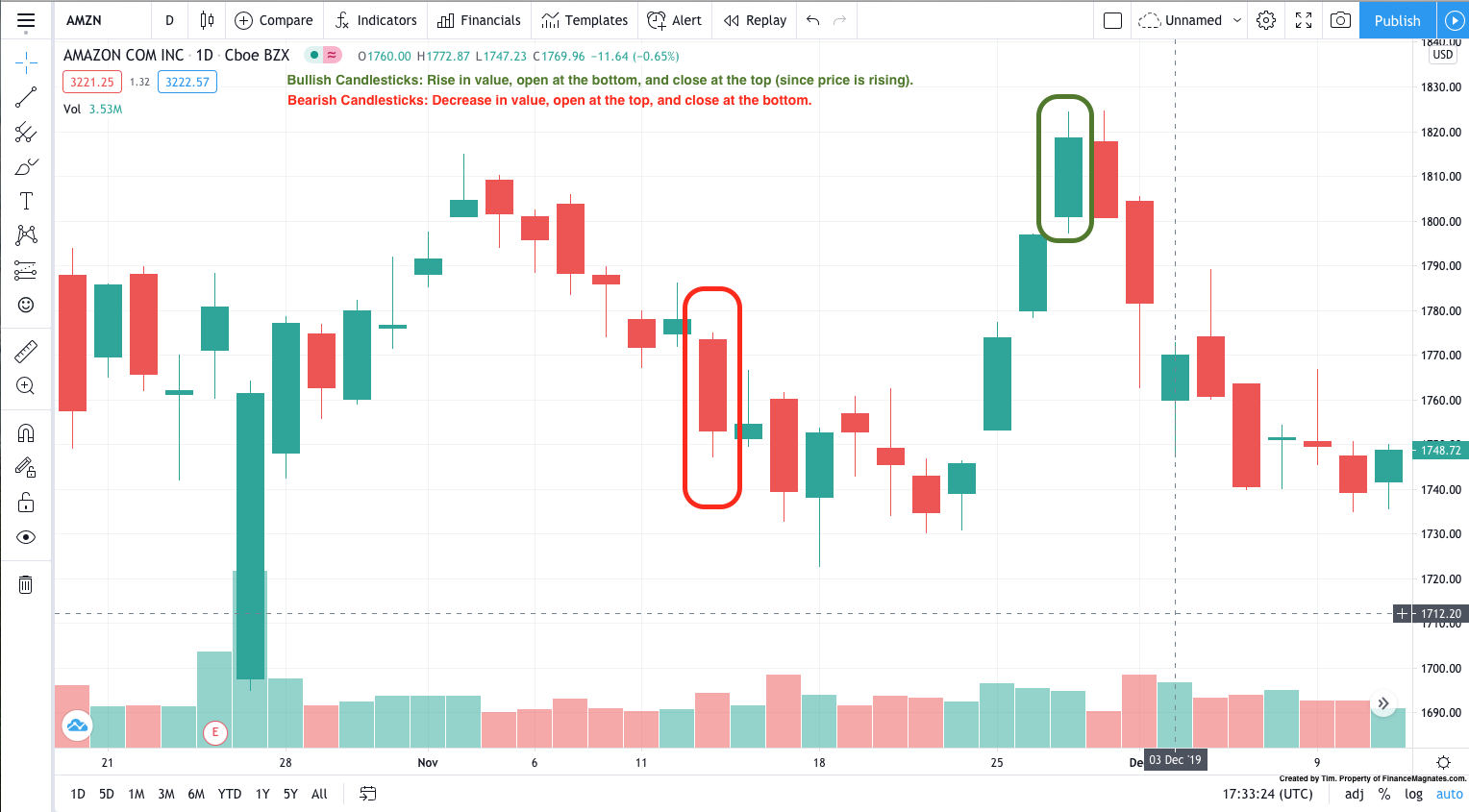
To best monitor an asset in real-time, many forex traders use Japanese candlestick charting to gain more detailed insight into an asset’s market flow. The core advantages of Japanese candlesticks include:
Gain overall market sentiment (bullish or bearish).
See how your asset is economically performing.
Japanese candlestick formations reveal market insights not seen in other charting styles.
When charting with Japanese candlesticks, know that you can change the amount of time a candlestick represents (typically 1 minute, 5 minutes, 15 minutes, 1 hour, 4 hours, one day, and one week). For instance, if you set your period to 1 hour, every candlestick reflects 1 hour of market flow. More than one candlestick composes what we know as order flow, or for forex traders, that currency pair’s price action. As a result, one of the three following market trends may occur:
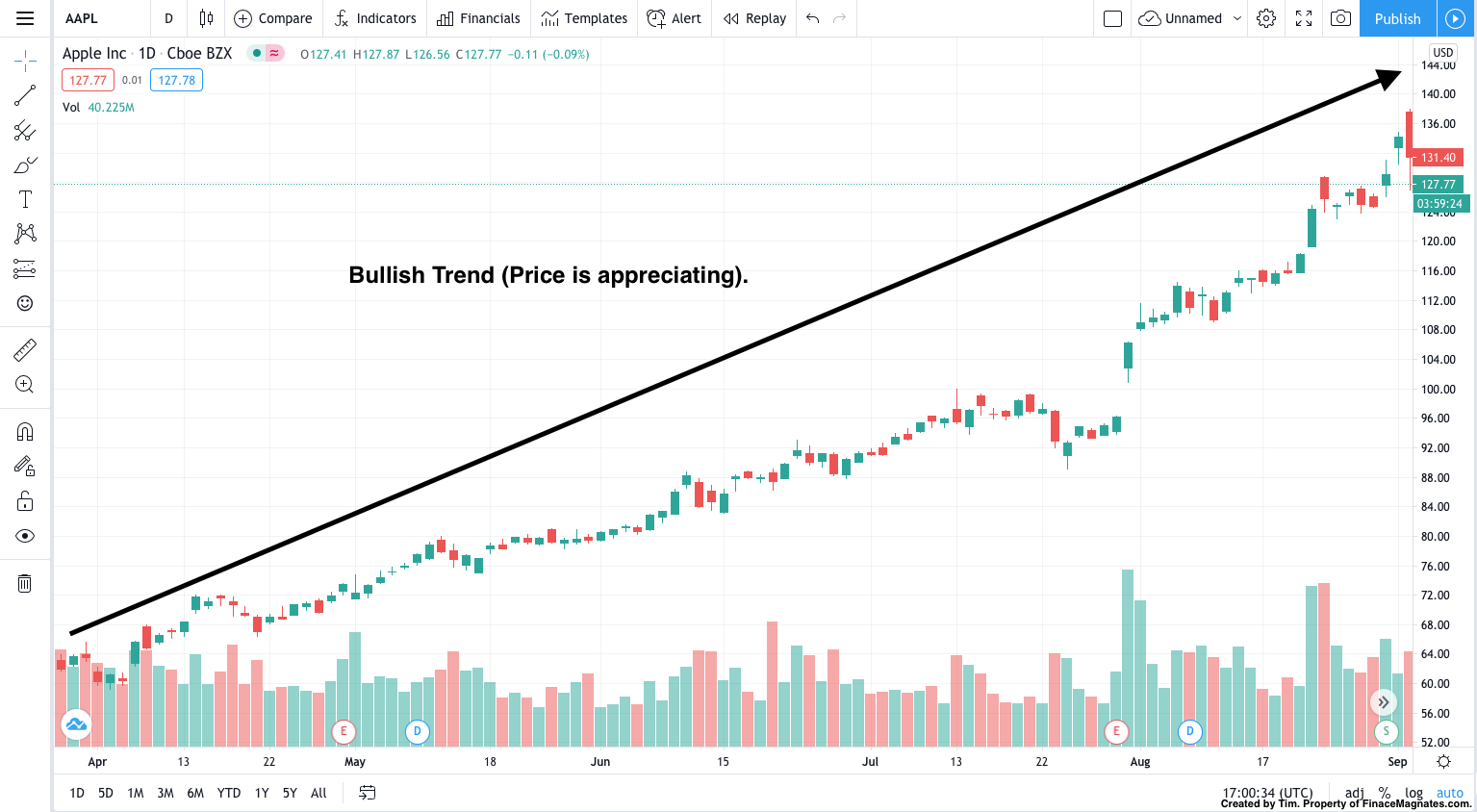
Bullish Trend
When a currency pair is appreciating, it is known as being bullish. In bullish markets, investor confidence is high, while emerging market currencies (EME), the Australian dollar (AUD), New Zealand dollar (NZD), and the Canadian dollar (CAD) tend to appreciate. On the other hand, safe-haven currencies like the US dollar (USD), Japanese Yen (JPY), and the Swiss Franc (CHF) tend to depreciate as an investor’s general risk tolerance increases. Traders strategically enter bullish markets with the intent to sell once they believe the market has peaked.
Bearish Trend
Currency pairs depreciating are known as bearish. During a bearish trend, investors begin selling less-liquidated currencies (emerging markets) to reduce risk. Due to wavering trader sentiment, safe-haven currencies like the US dollar and Japanese Yen grow in demand and tend to strengthen a bearish market. When prices fall during a bearish market, traders enter the market to buy low and sell high.
Neutral Trend
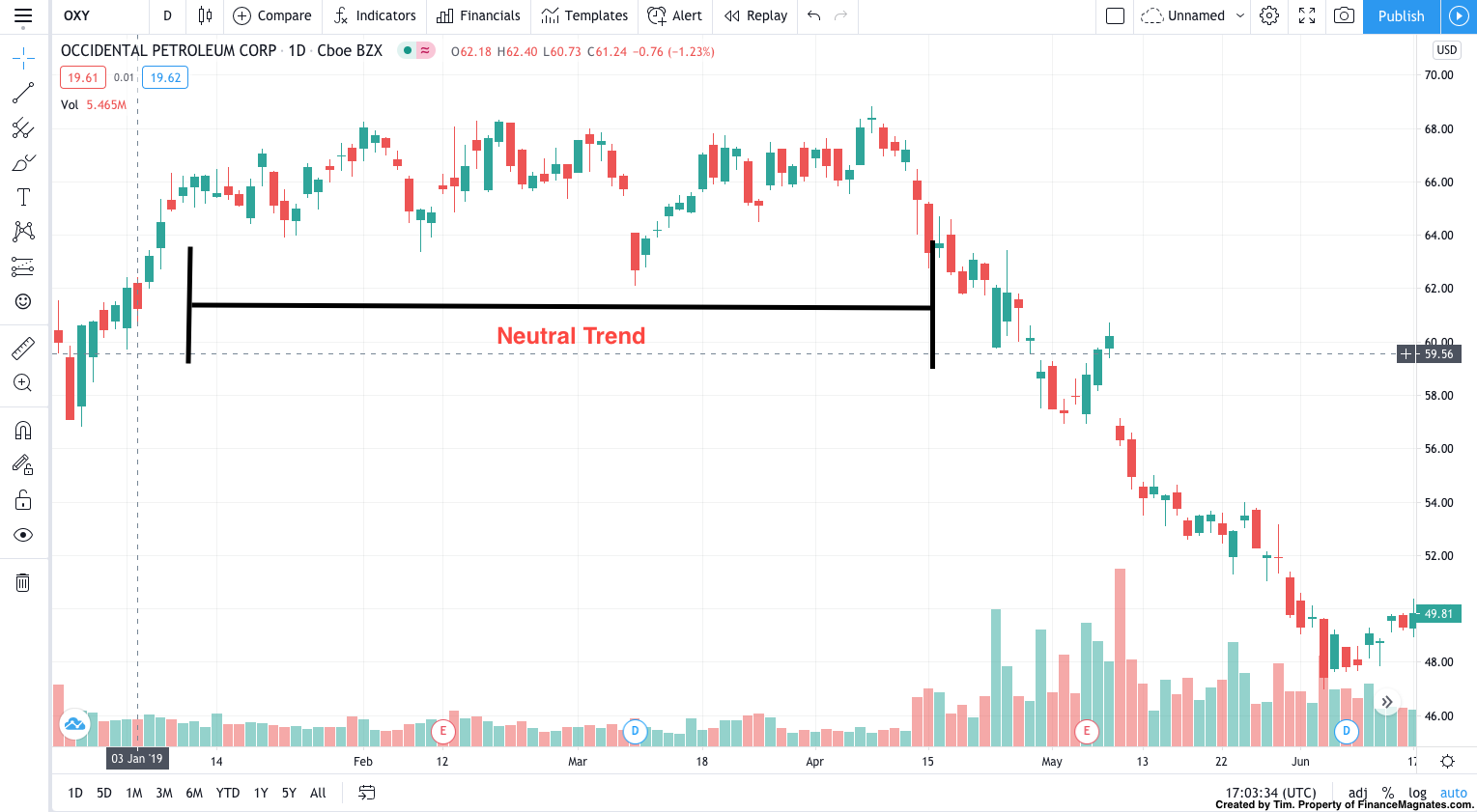
Neutral trends are neither decreasing nor increasing in value. More often than not, neutral trends are short-term byproducts of trader indecision rather than an indicator of economic uncertainty. When neutral trends are present, it is recommended not to trade unless you trade low volatility or ranging markets.
Neutral Trend Neutral trends are neither decreasing nor increasing in value. More often than not, neutral trends are short-term byproducts of trader indecision rather than an indicator of economic uncertainty. When neutral trends are present, it is recommended not to trade unless you trade low volatility or ranging markets.
Forex Definitions
First-time traders are often overwhelmed with trade terminology when entering the forex market. Therefore, we have compiled a shortlist of need-to-know forex jargon and how they relate to trading the foreign exchange market.
Pips are the smallest unit of price measurement for a currency pair. Pips stand for percentage in point and are most commonly subtracted or added from the fourth decimal point.
Example) A forex trader entered a buy trade with the EUR/USD at 1.22010 and one hour later sold the currency pair at 1.22029, resulting in a nineteen pip gain.
Spread is the resulting price difference between the rate at which a forex broker sells a currency from the rate at which that brokerage buys the currency. For example, if the EUR/USD had a bid (buy) price of 1.33408 and an ask price of 1.33439, the spread is 31 pips.
Margin is the process of borrowing capital from a broker to fulfill or maintain an investment. Sometimes investors receive a margin call should their account require additional funding to secure an investment or maintain ongoing trades.
Buy trades happen when a trader believes that a currency will appreciate against another currency. For instance, you think that the US dollar will appreciate against the Yen; therefore, you buy the USD/JPY currency pair. A sell occurs when a trader believes the opposite to be true. Should an investor think that a currency will depreciate against another, they can enter a sell position.
Leverage in forex is borrowed capital used to invest in a currency pair. For example, if your broker offers a leverage of 1:200, and you possess an account with $1,000, you can leverage up to $200,000 in credit capital to open trades. When an investor fails to maintain equity to support their leveraged positions, they receive a margin call.
How Forex Currency Pairs Are Structured
Currency pairs are denoted with a base and quote currency. To simplify, we will use the EUR/USD 1.22500 as an example. The Euro is known as the base currency, while the quote currency is the US dollar.
Structurally, the base currency compares its values against the quote currency and indicates how much quote currency is required to buy one base currency. In this instance, it means that one Euro is exchanged for 1.22500 U.S. dollars.
In forex, currency pairs are denominated with an ISO currency code (used to identify specific currencies in the international market), and they consist of three alphabetic letters.
Important Currency Codes
U.S. Dollar - (USD)
Euro - (EUR)
Japanese Yen - (JPY)
Australian Dollar - (AUD)
Swiss Franc - (CHF)
Great Britain Sterling - (GBP)
Canadian Dollar - (CAD)
New Zealand Dollar - (NZD)
Indian Rupee - (INR)
China Yuan Renminbi - (CNY)
South African Rand - (ZAR)
Major Currencies
The foreign exchange industry has a convoluted atmosphere of driving forces but perhaps none as influential as the four major currency pairs:
EUR/USD
USD/JPY
GBP/USD
USD/CHF
These currency pairs are heavily traded worldwide because their ample volume creates more competitive trading spreads. They also have a decreased probability of slippage, while their high volume makes market entry and exits seamless.
The EUR/USD makes up about 24% of all forex transactions, while the USD/JPY comes second at just over 13%. Lastly, all major currency pairs are free-floating currencies, meaning their prices are a byproduct of supply and demand.
Minor Currencies
Minor currencies, or cross-currency pairs, are currency pairs that do not include the US dollar.
The most heavily traded currencies for minor pairs include the British pound, Yen and the Euro.
Cross-Currency Pair Examples
GBP/CAD
GBP/JPY
CHF/JPY
EUR/AUD
EUR/GBP
NZD/JPY
Exotic Currencies
Exotic currency pairs have a major currency as the base currency and the currency of a developing economy as the quote currency. Generally, exotic currency pairs are challenging to find, possess less volume and liquidity and have wider spreads.
Exotic Currency Pairs
Australian Dollar/Mexican Peso (AUD/MXN)
British Pound/South African Rand (GBP/ZAR)
Euro/Turkish Lira (EUR/TRY)
Japanese Yen/Norwegian Krone (JPY/NOK)
New Zealand Dollar/Singapore Dollar (NZD/SGD)
Commodity Currencies
It is argued that the AUD/USD, NZD/USD, and USD/CAD should be major currency pairs, but as for now, they are known as commodity currencies. Debate primarily stems from how the trading volumes of all commodity currency pairs frequently surpass the USD/CHF.
Forex Turnover by Instrument
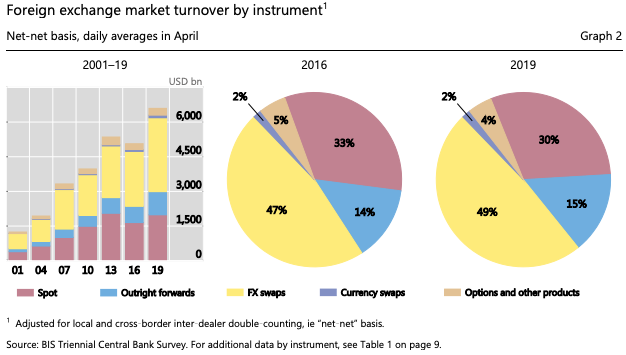
Below are the five types of forex trades that make up all foreign exchange transactions and their market turnover by instrument.
FX Swaps (49%) - FX swaps is the simultaneous purchase and sale of one currency for another and is primarily used by market participants for liquidity management and hedging of currency risk. In totality, FX swaps accounted for an average of $3.2 trillion per day, or nearly more than half of global forex trading.
Spot (30%) - Also referred to as FX spot, spot contracts are agreements between two parties to buy one currency while simultaneously selling another currency at a fixed price on a predetermined date. Currently, spot contracts average over $2 trillion per day in turnover.
Outright Forwards (15%) - A straightforward foreign exchange contract that locks in an exchange rate and a delivery date beyond the spot value date. For instance, an American company that purchased materials from a German manufacturer for €100,000 may have to pay €50,000 upfront and the remaining €50,000 six months from now.
Options and Other Products (4%) - Are financial derivatives that provide traders the right to buy or sell a specific currency pair at a fixed price (strike price) on an agreed-upon date (expiry date). Traders are not obligated to act upon OTC FX options.
Currency Swaps (2%) - Currency swaps are similar to FX swaps, except how they are traded differentiates them from FX swaps. Spot forex trades are frequently used by medium to long-term investors looking to hedge against adverse currency movements and minimize borrowing overheads.
To best monitor an asset in real-time, many forex traders use Japanese candlestick charting to gain more detailed insight into an asset’s market flow. The core advantages of Japanese candlesticks include:
Gain overall market sentiment (bullish or bearish).
See how your asset is economically performing.
Japanese candlestick formations reveal market insights not seen in other charting styles.
When charting with Japanese candlesticks, know that you can change the amount of time a candlestick represents (typically 1 minute, 5 minutes, 15 minutes, 1 hour, 4 hours, one day, and one week). For instance, if you set your period to 1 hour, every candlestick reflects 1 hour of market flow. More than one candlestick composes what we know as order flow, or for forex traders, that currency pair’s price action. As a result, one of the three following market trends may occur:
Bullish Trend
When a currency pair is appreciating, it is known as being bullish. In bullish markets, investor confidence is high, while emerging market currencies (EME), the Australian dollar (AUD), New Zealand dollar (NZD), and the Canadian dollar (CAD) tend to appreciate. On the other hand, safe-haven currencies like the US dollar (USD), Japanese Yen (JPY), and the Swiss Franc (CHF) tend to depreciate as an investor’s general risk tolerance increases. Traders strategically enter bullish markets with the intent to sell once they believe the market has peaked.
Bearish Trend
Currency pairs depreciating are known as bearish. During a bearish trend, investors begin selling less-liquidated currencies (emerging markets) to reduce risk. Due to wavering trader sentiment, safe-haven currencies like the US dollar and Japanese Yen grow in demand and tend to strengthen a bearish market. When prices fall during a bearish market, traders enter the market to buy low and sell high.
Neutral Trend
Neutral trends are neither decreasing nor increasing in value. More often than not, neutral trends are short-term byproducts of trader indecision rather than an indicator of economic uncertainty. When neutral trends are present, it is recommended not to trade unless you trade low volatility or ranging markets.
Neutral Trend Neutral trends are neither decreasing nor increasing in value. More often than not, neutral trends are short-term byproducts of trader indecision rather than an indicator of economic uncertainty. When neutral trends are present, it is recommended not to trade unless you trade low volatility or ranging markets.
Forex Definitions
First-time traders are often overwhelmed with trade terminology when entering the forex market. Therefore, we have compiled a shortlist of need-to-know forex jargon and how they relate to trading the foreign exchange market.
Pips are the smallest unit of price measurement for a currency pair. Pips stand for percentage in point and are most commonly subtracted or added from the fourth decimal point.
Example) A forex trader entered a buy trade with the EUR/USD at 1.22010 and one hour later sold the currency pair at 1.22029, resulting in a nineteen pip gain.
Spread is the resulting price difference between the rate at which a forex broker sells a currency from the rate at which that brokerage buys the currency. For example, if the EUR/USD had a bid (buy) price of 1.33408 and an ask price of 1.33439, the spread is 31 pips.
Margin is the process of borrowing capital from a broker to fulfill or maintain an investment. Sometimes investors receive a margin call should their account require additional funding to secure an investment or maintain ongoing trades.
Buy trades happen when a trader believes that a currency will appreciate against another currency. For instance, you think that the US dollar will appreciate against the Yen; therefore, you buy the USD/JPY currency pair. A sell occurs when a trader believes the opposite to be true. Should an investor think that a currency will depreciate against another, they can enter a sell position.
Leverage in forex is borrowed capital used to invest in a currency pair. For example, if your broker offers a leverage of 1:200, and you possess an account with $1,000, you can leverage up to $200,000 in credit capital to open trades. When an investor fails to maintain equity to support their leveraged positions, they receive a margin call.
How Forex Currency Pairs Are Structured
Currency pairs are denoted with a base and quote currency. To simplify, we will use the EUR/USD 1.22500 as an example. The Euro is known as the base currency, while the quote currency is the US dollar.
Structurally, the base currency compares its values against the quote currency and indicates how much quote currency is required to buy one base currency. In this instance, it means that one Euro is exchanged for 1.22500 U.S. dollars.
In forex, currency pairs are denominated with an ISO currency code (used to identify specific currencies in the international market), and they consist of three alphabetic letters.
Important Currency Codes
U.S. Dollar - (USD)
Euro - (EUR)
Japanese Yen - (JPY)
Australian Dollar - (AUD)
Swiss Franc - (CHF)
Great Britain Sterling - (GBP)
Canadian Dollar - (CAD)
New Zealand Dollar - (NZD)
Indian Rupee - (INR)
China Yuan Renminbi - (CNY)
South African Rand - (ZAR)
Major Currencies
The foreign exchange industry has a convoluted atmosphere of driving forces but perhaps none as influential as the four major currency pairs:
EUR/USD
USD/JPY
GBP/USD
USD/CHF
These currency pairs are heavily traded worldwide because their ample volume creates more competitive trading spreads. They also have a decreased probability of slippage, while their high volume makes market entry and exits seamless.
The EUR/USD makes up about 24% of all forex transactions, while the USD/JPY comes second at just over 13%. Lastly, all major currency pairs are free-floating currencies, meaning their prices are a byproduct of supply and demand.
Minor Currencies
Minor currencies, or cross-currency pairs, are currency pairs that do not include the US dollar.
The most heavily traded currencies for minor pairs include the British pound, Yen and the Euro.
Cross-Currency Pair Examples
GBP/CAD
GBP/JPY
CHF/JPY
EUR/AUD
EUR/GBP
NZD/JPY
Exotic Currencies
Exotic currency pairs have a major currency as the base currency and the currency of a developing economy as the quote currency. Generally, exotic currency pairs are challenging to find, possess less volume and liquidity and have wider spreads.
Exotic Currency Pairs
Australian Dollar/Mexican Peso (AUD/MXN)
British Pound/South African Rand (GBP/ZAR)
Euro/Turkish Lira (EUR/TRY)
Japanese Yen/Norwegian Krone (JPY/NOK)
New Zealand Dollar/Singapore Dollar (NZD/SGD)
Commodity Currencies
It is argued that the AUD/USD, NZD/USD, and USD/CAD should be major currency pairs, but as for now, they are known as commodity currencies. Debate primarily stems from how the trading volumes of all commodity currency pairs frequently surpass the USD/CHF.
Forex Turnover by Instrument
Below are the five types of forex trades that make up all foreign exchange transactions and their market turnover by instrument.
FX Swaps (49%) - FX swaps is the simultaneous purchase and sale of one currency for another and is primarily used by market participants for liquidity management and hedging of currency risk. In totality, FX swaps accounted for an average of $3.2 trillion per day, or nearly more than half of global forex trading.
Spot (30%) - Also referred to as FX spot, spot contracts are agreements between two parties to buy one currency while simultaneously selling another currency at a fixed price on a predetermined date. Currently, spot contracts average over $2 trillion per day in turnover.
Outright Forwards (15%) - A straightforward foreign exchange contract that locks in an exchange rate and a delivery date beyond the spot value date. For instance, an American company that purchased materials from a German manufacturer for €100,000 may have to pay €50,000 upfront and the remaining €50,000 six months from now.
Options and Other Products (4%) - Are financial derivatives that provide traders the right to buy or sell a specific currency pair at a fixed price (strike price) on an agreed-upon date (expiry date). Traders are not obligated to act upon OTC FX options.
Currency Swaps (2%) - Currency swaps are similar to FX swaps, except how they are traded differentiates them from FX swaps. Spot forex trades are frequently used by medium to long-term investors looking to hedge against adverse currency movements and minimize borrowing overheads.
London Stock Exchange Owner Says NVIDIA Chips Crunch Years of Trading Data in Seconds
Featured Videos
FxPro Sells EU Clients to Capital.com; NAGA H1 Profit Revised
FxPro Sells EU Clients to Capital.com; NAGA H1 Profit Revised
FxPro Sells EU Clients to Capital.com; NAGA H1 Profit Revised
FxPro Sells EU Clients to Capital.com; NAGA H1 Profit Revised
Today’s financial news recap covers FxPro agrees to sell its European client book to Capital.com, NAGA raises its first-half profit estimate, Trade Republic prepares a fee-free pension account, and Interactive Brokers introduces Ether staking.
Finance Magnates Daily Recap brings you the latest news from forex and CFD brokers, fintech, payments, cryptocurrency, digital assets, trading platforms, financial regulation and global markets.
Get the key company news, executive moves, deals, regulatory updates and market developments of the day, in just a few minutes. New episodes published every weekday.
Read more: https://www.financemagnates.com
#FinanceMagnates #ForexNews #FintechNews
Today’s financial news recap covers FxPro agrees to sell its European client book to Capital.com, NAGA raises its first-half profit estimate, Trade Republic prepares a fee-free pension account, and Interactive Brokers introduces Ether staking.
Finance Magnates Daily Recap brings you the latest news from forex and CFD brokers, fintech, payments, cryptocurrency, digital assets, trading platforms, financial regulation and global markets.
Get the key company news, executive moves, deals, regulatory updates and market developments of the day, in just a few minutes. New episodes published every weekday.
Read more: https://www.financemagnates.com
#FinanceMagnates #ForexNews #FintechNews
Today’s financial news recap covers FxPro agrees to sell its European client book to Capital.com, NAGA raises its first-half profit estimate, Trade Republic prepares a fee-free pension account, and Interactive Brokers introduces Ether staking.
Finance Magnates Daily Recap brings you the latest news from forex and CFD brokers, fintech, payments, cryptocurrency, digital assets, trading platforms, financial regulation and global markets.
Get the key company news, executive moves, deals, regulatory updates and market developments of the day, in just a few minutes. New episodes published every weekday.
Read more: https://www.financemagnates.com
#FinanceMagnates #ForexNews #FintechNews
Today’s financial news recap covers FxPro agrees to sell its European client book to Capital.com, NAGA raises its first-half profit estimate, Trade Republic prepares a fee-free pension account, and Interactive Brokers introduces Ether staking.
Finance Magnates Daily Recap brings you the latest news from forex and CFD brokers, fintech, payments, cryptocurrency, digital assets, trading platforms, financial regulation and global markets.
Get the key company news, executive moves, deals, regulatory updates and market developments of the day, in just a few minutes. New episodes published every weekday.
Read more: https://www.financemagnates.com
#FinanceMagnates #ForexNews #FintechNews
Plus500 Plans US Super-App; Investec to Offer IG Platform
Plus500 Plans US Super-App; Investec to Offer IG Platform
Plus500 Plans US Super-App; Investec to Offer IG Platform
Plus500 Plans US Super-App; Investec to Offer IG Platform
Plus500 Plans US Super-App; Investec to Offer IG Platform
Plus500 Plans US Super-App; Investec to Offer IG Platform
Today’s financial news recap covers Plus500 plans a US trading super-app, Investec partners with IG, Trade Republic reports a sevenfold profit jump, and BingX adds thousands of US stocks.
Finance Magnates Daily Recap brings you the latest news from forex and CFD brokers, fintech, payments, cryptocurrency, digital assets, trading platforms, financial regulation and global markets.
Get the key company news, executive moves, deals, regulatory updates and market developments of the day, in just a few minutes. New episodes published every weekday.
Read more: https://www.financemagnates.com
#FinanceMagnates #ForexNews #FintechNews
Today’s financial news recap covers Plus500 plans a US trading super-app, Investec partners with IG, Trade Republic reports a sevenfold profit jump, and BingX adds thousands of US stocks.
Finance Magnates Daily Recap brings you the latest news from forex and CFD brokers, fintech, payments, cryptocurrency, digital assets, trading platforms, financial regulation and global markets.
Get the key company news, executive moves, deals, regulatory updates and market developments of the day, in just a few minutes. New episodes published every weekday.
Read more: https://www.financemagnates.com
#FinanceMagnates #ForexNews #FintechNews
Today’s financial news recap covers Plus500 plans a US trading super-app, Investec partners with IG, Trade Republic reports a sevenfold profit jump, and BingX adds thousands of US stocks.
Finance Magnates Daily Recap brings you the latest news from forex and CFD brokers, fintech, payments, cryptocurrency, digital assets, trading platforms, financial regulation and global markets.
Get the key company news, executive moves, deals, regulatory updates and market developments of the day, in just a few minutes. New episodes published every weekday.
Read more: https://www.financemagnates.com
#FinanceMagnates #ForexNews #FintechNews
Today’s financial news recap covers Plus500 plans a US trading super-app, Investec partners with IG, Trade Republic reports a sevenfold profit jump, and BingX adds thousands of US stocks.
Finance Magnates Daily Recap brings you the latest news from forex and CFD brokers, fintech, payments, cryptocurrency, digital assets, trading platforms, financial regulation and global markets.
Get the key company news, executive moves, deals, regulatory updates and market developments of the day, in just a few minutes. New episodes published every weekday.
Read more: https://www.financemagnates.com
#FinanceMagnates #ForexNews #FintechNews
Today’s financial news recap covers Plus500 plans a US trading super-app, Investec partners with IG, Trade Republic reports a sevenfold profit jump, and BingX adds thousands of US stocks.
Finance Magnates Daily Recap brings you the latest news from forex and CFD brokers, fintech, payments, cryptocurrency, digital assets, trading platforms, financial regulation and global markets.
Get the key company news, executive moves, deals, regulatory updates and market developments of the day, in just a few minutes. New episodes published every weekday.
Read more: https://www.financemagnates.com
#FinanceMagnates #ForexNews #FintechNews
Today’s financial news recap covers Plus500 plans a US trading super-app, Investec partners with IG, Trade Republic reports a sevenfold profit jump, and BingX adds thousands of US stocks.
Finance Magnates Daily Recap brings you the latest news from forex and CFD brokers, fintech, payments, cryptocurrency, digital assets, trading platforms, financial regulation and global markets.
Get the key company news, executive moves, deals, regulatory updates and market developments of the day, in just a few minutes. New episodes published every weekday.
Read more: https://www.financemagnates.com
#FinanceMagnates #ForexNews #FintechNews
FXCM UK Holds $110m in Client Money; IG CEO Questions Prediction Market Volumes
FXCM UK Holds $110m in Client Money; IG CEO Questions Prediction Market Volumes
FXCM UK Holds $110m in Client Money; IG CEO Questions Prediction Market Volumes
FXCM UK Holds $110m in Client Money; IG CEO Questions Prediction Market Volumes
FXCM UK Holds $110m in Client Money; IG CEO Questions Prediction Market Volumes
FXCM UK Holds $110m in Client Money; IG CEO Questions Prediction Market Volumes
Today’s financial news recap covers FXCM's UK arm holds $110 million in client money ahead of its sale to Trade Nation, Citadel Securities' UK profit falls 38 per cent, and Kraken secures its final Dubai crypto licence.
Finance Magnates Daily Recap brings you the latest news from forex and CFD brokers, fintech, payments, cryptocurrency, digital assets, trading platforms, financial regulation and global markets.
Get the key company news, executive moves, deals, regulatory updates and market developments of the day, in just a few minutes. New episodes published every weekday.
Read more: https://www.financemagnates.com
#FinanceMagnates #ForexNews #FintechNews
Today’s financial news recap covers FXCM's UK arm holds $110 million in client money ahead of its sale to Trade Nation, Citadel Securities' UK profit falls 38 per cent, and Kraken secures its final Dubai crypto licence.
Finance Magnates Daily Recap brings you the latest news from forex and CFD brokers, fintech, payments, cryptocurrency, digital assets, trading platforms, financial regulation and global markets.
Get the key company news, executive moves, deals, regulatory updates and market developments of the day, in just a few minutes. New episodes published every weekday.
Read more: https://www.financemagnates.com
#FinanceMagnates #ForexNews #FintechNews
Today’s financial news recap covers FXCM's UK arm holds $110 million in client money ahead of its sale to Trade Nation, Citadel Securities' UK profit falls 38 per cent, and Kraken secures its final Dubai crypto licence.
Finance Magnates Daily Recap brings you the latest news from forex and CFD brokers, fintech, payments, cryptocurrency, digital assets, trading platforms, financial regulation and global markets.
Get the key company news, executive moves, deals, regulatory updates and market developments of the day, in just a few minutes. New episodes published every weekday.
Read more: https://www.financemagnates.com
#FinanceMagnates #ForexNews #FintechNews
Today’s financial news recap covers FXCM's UK arm holds $110 million in client money ahead of its sale to Trade Nation, Citadel Securities' UK profit falls 38 per cent, and Kraken secures its final Dubai crypto licence.
Finance Magnates Daily Recap brings you the latest news from forex and CFD brokers, fintech, payments, cryptocurrency, digital assets, trading platforms, financial regulation and global markets.
Get the key company news, executive moves, deals, regulatory updates and market developments of the day, in just a few minutes. New episodes published every weekday.
Read more: https://www.financemagnates.com
#FinanceMagnates #ForexNews #FintechNews
Today’s financial news recap covers FXCM's UK arm holds $110 million in client money ahead of its sale to Trade Nation, Citadel Securities' UK profit falls 38 per cent, and Kraken secures its final Dubai crypto licence.
Finance Magnates Daily Recap brings you the latest news from forex and CFD brokers, fintech, payments, cryptocurrency, digital assets, trading platforms, financial regulation and global markets.
Get the key company news, executive moves, deals, regulatory updates and market developments of the day, in just a few minutes. New episodes published every weekday.
Read more: https://www.financemagnates.com
#FinanceMagnates #ForexNews #FintechNews
Today’s financial news recap covers FXCM's UK arm holds $110 million in client money ahead of its sale to Trade Nation, Citadel Securities' UK profit falls 38 per cent, and Kraken secures its final Dubai crypto licence.
Finance Magnates Daily Recap brings you the latest news from forex and CFD brokers, fintech, payments, cryptocurrency, digital assets, trading platforms, financial regulation and global markets.
Get the key company news, executive moves, deals, regulatory updates and market developments of the day, in just a few minutes. New episodes published every weekday.
Read more: https://www.financemagnates.com
#FinanceMagnates #ForexNews #FintechNews
AvaTrade to Acquire Most of FXCM; NAGA Raises $8M
AvaTrade to Acquire Most of FXCM; NAGA Raises $8M
AvaTrade to Acquire Most of FXCM; NAGA Raises $8M
AvaTrade to Acquire Most of FXCM; NAGA Raises $8M
AvaTrade to Acquire Most of FXCM; NAGA Raises $8M
AvaTrade to Acquire Most of FXCM; NAGA Raises $8M
Today’s financial news recap covers AvaTrade agrees to acquire most of FXCM, NAGA secures eight million dollars in new financing, and Wise seeks a tax settlement in the UK.
Finance Magnates Daily Recap brings you the latest news from forex and CFD brokers, fintech, payments, cryptocurrency, digital assets, trading platforms, financial regulation and global markets.
Get the key company news, executive moves, deals, regulatory updates and market developments of the day, in just a few minutes. New episodes published every weekday.
Read more: https://www.financemagnates.com
#FinanceMagnates #ForexNews #FintechNews
Today’s financial news recap covers AvaTrade agrees to acquire most of FXCM, NAGA secures eight million dollars in new financing, and Wise seeks a tax settlement in the UK.
Finance Magnates Daily Recap brings you the latest news from forex and CFD brokers, fintech, payments, cryptocurrency, digital assets, trading platforms, financial regulation and global markets.
Get the key company news, executive moves, deals, regulatory updates and market developments of the day, in just a few minutes. New episodes published every weekday.
Read more: https://www.financemagnates.com
#FinanceMagnates #ForexNews #FintechNews
Today’s financial news recap covers AvaTrade agrees to acquire most of FXCM, NAGA secures eight million dollars in new financing, and Wise seeks a tax settlement in the UK.
Finance Magnates Daily Recap brings you the latest news from forex and CFD brokers, fintech, payments, cryptocurrency, digital assets, trading platforms, financial regulation and global markets.
Get the key company news, executive moves, deals, regulatory updates and market developments of the day, in just a few minutes. New episodes published every weekday.
Read more: https://www.financemagnates.com
#FinanceMagnates #ForexNews #FintechNews
Today’s financial news recap covers AvaTrade agrees to acquire most of FXCM, NAGA secures eight million dollars in new financing, and Wise seeks a tax settlement in the UK.
Finance Magnates Daily Recap brings you the latest news from forex and CFD brokers, fintech, payments, cryptocurrency, digital assets, trading platforms, financial regulation and global markets.
Get the key company news, executive moves, deals, regulatory updates and market developments of the day, in just a few minutes. New episodes published every weekday.
Read more: https://www.financemagnates.com
#FinanceMagnates #ForexNews #FintechNews
Today’s financial news recap covers AvaTrade agrees to acquire most of FXCM, NAGA secures eight million dollars in new financing, and Wise seeks a tax settlement in the UK.
Finance Magnates Daily Recap brings you the latest news from forex and CFD brokers, fintech, payments, cryptocurrency, digital assets, trading platforms, financial regulation and global markets.
Get the key company news, executive moves, deals, regulatory updates and market developments of the day, in just a few minutes. New episodes published every weekday.
Read more: https://www.financemagnates.com
#FinanceMagnates #ForexNews #FintechNews
Today’s financial news recap covers AvaTrade agrees to acquire most of FXCM, NAGA secures eight million dollars in new financing, and Wise seeks a tax settlement in the UK.
Finance Magnates Daily Recap brings you the latest news from forex and CFD brokers, fintech, payments, cryptocurrency, digital assets, trading platforms, financial regulation and global markets.
Get the key company news, executive moves, deals, regulatory updates and market developments of the day, in just a few minutes. New episodes published every weekday.
Read more: https://www.financemagnates.com
#FinanceMagnates #ForexNews #FintechNews
XTB Adds Overnight US Stock Trading; Nasdaq Ventures Invests in One Trading
XTB Adds Overnight US Stock Trading; Nasdaq Ventures Invests in One Trading
XTB Adds Overnight US Stock Trading; Nasdaq Ventures Invests in One Trading
XTB Adds Overnight US Stock Trading; Nasdaq Ventures Invests in One Trading
XTB Adds Overnight US Stock Trading; Nasdaq Ventures Invests in One Trading
XTB Adds Overnight US Stock Trading; Nasdaq Ventures Invests in One Trading
Today’s financial news recap covers XTB expands overnight US stock trading, Fortrade reports higher revenue, Nasdaq backs One Trading, and Vest Labs raises 13 million dollars.
Finance Magnates Daily Recap brings you the latest news from forex and CFD brokers, fintech, payments, cryptocurrency, digital assets, trading platforms, financial regulation and global markets.
Get the key company news, executive moves, deals, regulatory updates and market developments of the day, in just a few minutes. New episodes published every weekday.
Read more: https://www.financemagnates.com
#FinanceMagnates #ForexNews #FintechNews
Today’s financial news recap covers XTB expands overnight US stock trading, Fortrade reports higher revenue, Nasdaq backs One Trading, and Vest Labs raises 13 million dollars.
Finance Magnates Daily Recap brings you the latest news from forex and CFD brokers, fintech, payments, cryptocurrency, digital assets, trading platforms, financial regulation and global markets.
Get the key company news, executive moves, deals, regulatory updates and market developments of the day, in just a few minutes. New episodes published every weekday.
Read more: https://www.financemagnates.com
#FinanceMagnates #ForexNews #FintechNews
Today’s financial news recap covers XTB expands overnight US stock trading, Fortrade reports higher revenue, Nasdaq backs One Trading, and Vest Labs raises 13 million dollars.
Finance Magnates Daily Recap brings you the latest news from forex and CFD brokers, fintech, payments, cryptocurrency, digital assets, trading platforms, financial regulation and global markets.
Get the key company news, executive moves, deals, regulatory updates and market developments of the day, in just a few minutes. New episodes published every weekday.
Read more: https://www.financemagnates.com
#FinanceMagnates #ForexNews #FintechNews
Today’s financial news recap covers XTB expands overnight US stock trading, Fortrade reports higher revenue, Nasdaq backs One Trading, and Vest Labs raises 13 million dollars.
Finance Magnates Daily Recap brings you the latest news from forex and CFD brokers, fintech, payments, cryptocurrency, digital assets, trading platforms, financial regulation and global markets.
Get the key company news, executive moves, deals, regulatory updates and market developments of the day, in just a few minutes. New episodes published every weekday.
Read more: https://www.financemagnates.com
#FinanceMagnates #ForexNews #FintechNews
Today’s financial news recap covers XTB expands overnight US stock trading, Fortrade reports higher revenue, Nasdaq backs One Trading, and Vest Labs raises 13 million dollars.
Finance Magnates Daily Recap brings you the latest news from forex and CFD brokers, fintech, payments, cryptocurrency, digital assets, trading platforms, financial regulation and global markets.
Get the key company news, executive moves, deals, regulatory updates and market developments of the day, in just a few minutes. New episodes published every weekday.
Read more: https://www.financemagnates.com
#FinanceMagnates #ForexNews #FintechNews
Today’s financial news recap covers XTB expands overnight US stock trading, Fortrade reports higher revenue, Nasdaq backs One Trading, and Vest Labs raises 13 million dollars.
Finance Magnates Daily Recap brings you the latest news from forex and CFD brokers, fintech, payments, cryptocurrency, digital assets, trading platforms, financial regulation and global markets.
Get the key company news, executive moves, deals, regulatory updates and market developments of the day, in just a few minutes. New episodes published every weekday.
Read more: https://www.financemagnates.com
#FinanceMagnates #ForexNews #FintechNews