After a brief period of shock and downgrades in the outlook for major brokerages, the market appears to have fully discounted the impact from the new ESMA regulations as of the beginning of December.
Around that time, the industry got the news from the FCA that European regulators intend to make the temporary product intervention measures permanent. The uncertainty which dominated the market was finally gone, and brokers accepted the new status quo in the EU market.
Publicly Traded Brokers
Today’s market open in London brought a rally to the sector. As June Felix bought a second batch of 17,000 shares worth around £100,000, investors interpreted the move as a signal of returning confidence.
The notion that the worst is now behind us was reinforced in conversations with multiple executives from the industry sharing their views on the impact of ESMA’s measures. Most companies appear to have adapted to the new environment in one way or another.
Publicly-traded brokers who do not have the flexibility that smaller market players do have adopted their own approach to the market. Turning retail clients into professional is one of the themes which mitigated the impact from ESMA’s new regulatory move last year.
The final months of the year and a tumultuous equities market in the final quarter caused the firm to upgrade its guidance for the second half. As a result, shares of the company traded about 35 percent higher year-on-year.
CMC Markets is at the bottom when it comes to raw share price performance. The company’s stock is trading lower by 25 percent when compared to last February. IG Group’s performance is a touch better as it trades lower by 18 percent over the same period of time. GAIN Capital’s buyback program stabilized the firm’s shares as it traded only 8.5 percent lower when compared to a year ago.
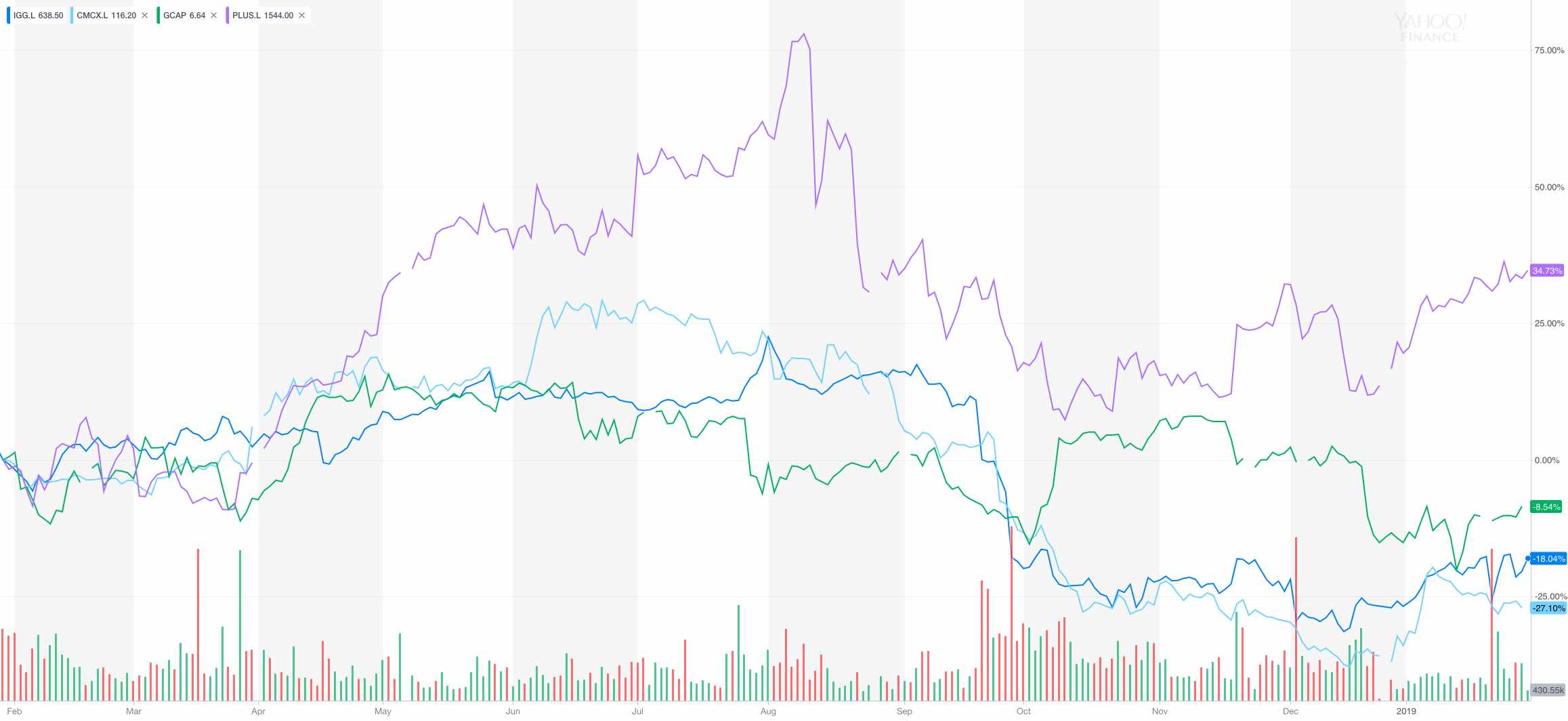
Moves in shares of publicly-traded brokers, Source: Yahoo Finance
The common denominator for all companies, however, is that they are all trading higher than in the final months of 2018. Looking at the companies’ year-to-date performance, all publicly-traded brokers are performing steadily.
CMC is up 13.7 percent in 2019, followed by Plus500 at 12.8% and IG Group at 12.1%. GAIN Capital’s performance YTD is slightly weaker as the company’s shares rallied only 7.8% so far.
In tandem with rising acquisition costs in Europe, firms have also doubled down on their efforts to attract clients from outside of the EU. While publicly-traded companies have focused on regulated markets, other market players have adopted a more flexible approach.
Offshore Branches and Brands
A number of companies from the industry have chosen different diversification tactics to mitigate the impact. While publicly-traded brokers have strictly focused on regulated markets, other companies took advantage of regulatory arbitrage opportunities.
Some companies opened offshore branches, while others started new brands for their subsidiaries located in remote island areas. Companies holding Australian licenses capitalized in a big way, while smaller firms turned to island jurisdictions like The Bahamas, Vanuatu, and Seychelles.
Despite card deposit difficulties, the new subsidiaries found different ways to process deposits and withdrawals. This part of the industry appears to have moved away from jurisdictions like Cyprus and even the FCA to open subsidiaries that can remain competitive in the current market.
After a brief period of shock and downgrades in the outlook for major brokerages, the market appears to have fully discounted the impact from the new ESMA regulations as of the beginning of December.
Around that time, the industry got the news from the FCA that European regulators intend to make the temporary product intervention measures permanent. The uncertainty which dominated the market was finally gone, and brokers accepted the new status quo in the EU market.
Publicly Traded Brokers
Today’s market open in London brought a rally to the sector. As June Felix bought a second batch of 17,000 shares worth around £100,000, investors interpreted the move as a signal of returning confidence.
The notion that the worst is now behind us was reinforced in conversations with multiple executives from the industry sharing their views on the impact of ESMA’s measures. Most companies appear to have adapted to the new environment in one way or another.
Publicly-traded brokers who do not have the flexibility that smaller market players do have adopted their own approach to the market. Turning retail clients into professional is one of the themes which mitigated the impact from ESMA’s new regulatory move last year.
The final months of the year and a tumultuous equities market in the final quarter caused the firm to upgrade its guidance for the second half. As a result, shares of the company traded about 35 percent higher year-on-year.
CMC Markets is at the bottom when it comes to raw share price performance. The company’s stock is trading lower by 25 percent when compared to last February. IG Group’s performance is a touch better as it trades lower by 18 percent over the same period of time. GAIN Capital’s buyback program stabilized the firm’s shares as it traded only 8.5 percent lower when compared to a year ago.
Moves in shares of publicly-traded brokers, Source: Yahoo Finance
The common denominator for all companies, however, is that they are all trading higher than in the final months of 2018. Looking at the companies’ year-to-date performance, all publicly-traded brokers are performing steadily.
CMC is up 13.7 percent in 2019, followed by Plus500 at 12.8% and IG Group at 12.1%. GAIN Capital’s performance YTD is slightly weaker as the company’s shares rallied only 7.8% so far.
In tandem with rising acquisition costs in Europe, firms have also doubled down on their efforts to attract clients from outside of the EU. While publicly-traded companies have focused on regulated markets, other market players have adopted a more flexible approach.
Offshore Branches and Brands
A number of companies from the industry have chosen different diversification tactics to mitigate the impact. While publicly-traded brokers have strictly focused on regulated markets, other companies took advantage of regulatory arbitrage opportunities.
Some companies opened offshore branches, while others started new brands for their subsidiaries located in remote island areas. Companies holding Australian licenses capitalized in a big way, while smaller firms turned to island jurisdictions like The Bahamas, Vanuatu, and Seychelles.
Despite card deposit difficulties, the new subsidiaries found different ways to process deposits and withdrawals. This part of the industry appears to have moved away from jurisdictions like Cyprus and even the FCA to open subsidiaries that can remain competitive in the current market.
Leverate Bundles AI Chat Assistant With a Back-Office View of Client Activity
Featured Videos
FM Daily Brief – 9 June 2026
Today’s Tuesday, the 9th of June 2026, and these are our main stories: eToro’s customer assets climbed back above $20 billion, Prop trading model in prediction markets, and Leverate launched a new AI assistant for brokers and traders.
War Stories: Lessons from 20 Years in Markets (the pain, the pitfalls and the profits)
The trades that taught me the most aren't the ones that worked. They're the ones that didn't — or the ones I almost caught and didn't have the nerve to ride. In this session, I'll tell you about the Brexit miss, the SNB shocker that nearly handed me a 5400% return, the BoJ surprise that punched me in the gut, and a few wins along the way. Each story carries a lesson, but the lessons aren't the point. Everyone who trades long enough collects a portfolio of moments like these; what separates the people who stay in the game is what they do with them.
The Engine and the Fuel: How AI & Data Drives African Future
If AI is the engine, data is the fuel. Without quality, accessible data, AI cannot work well; and without the right mindset, data remains just numbers instead of insight. In this session, leading experts will explore how AI and data are democratizing opportunities for businesses and personal growth. Discover practical ways to make AI accessible today, anticipate its transformative impact on African markets, and learn actionable steps to prepare for what's next. Let's talk about:
-How AI and data drive business efficiency and innovation in trading and fintech
-AI tools to elevate trading or business strategies
-How to access and maximise the power of data and AI
-Emerging AI and data trends in Africa and their economic ripple effects
If AI is the engine, data is the fuel. Without quality, accessible data, AI cannot work well; and without the right mindset, data remains just numbers instead of insight. In this session, leading experts will explore how AI and data are democratizing opportunities for businesses and personal growth. Discover practical ways to make AI accessible today, anticipate its transformative impact on African markets, and learn actionable steps to prepare for what's next. Let's talk about:
-How AI and data drive business efficiency and innovation in trading and fintech
-AI tools to elevate trading or business strategies
-How to access and maximise the power of data and AI
-Emerging AI and data trends in Africa and their economic ripple effects
If AI is the engine, data is the fuel. Without quality, accessible data, AI cannot work well; and without the right mindset, data remains just numbers instead of insight. In this session, leading experts will explore how AI and data are democratizing opportunities for businesses and personal growth. Discover practical ways to make AI accessible today, anticipate its transformative impact on African markets, and learn actionable steps to prepare for what's next. Let's talk about:
-How AI and data drive business efficiency and innovation in trading and fintech
-AI tools to elevate trading or business strategies
-How to access and maximise the power of data and AI
-Emerging AI and data trends in Africa and their economic ripple effects
If AI is the engine, data is the fuel. Without quality, accessible data, AI cannot work well; and without the right mindset, data remains just numbers instead of insight. In this session, leading experts will explore how AI and data are democratizing opportunities for businesses and personal growth. Discover practical ways to make AI accessible today, anticipate its transformative impact on African markets, and learn actionable steps to prepare for what's next. Let's talk about:
-How AI and data drive business efficiency and innovation in trading and fintech
-AI tools to elevate trading or business strategies
-How to access and maximise the power of data and AI
-Emerging AI and data trends in Africa and their economic ripple effects
If AI is the engine, data is the fuel. Without quality, accessible data, AI cannot work well; and without the right mindset, data remains just numbers instead of insight. In this session, leading experts will explore how AI and data are democratizing opportunities for businesses and personal growth. Discover practical ways to make AI accessible today, anticipate its transformative impact on African markets, and learn actionable steps to prepare for what's next. Let's talk about:
-How AI and data drive business efficiency and innovation in trading and fintech
-AI tools to elevate trading or business strategies
-How to access and maximise the power of data and AI
-Emerging AI and data trends in Africa and their economic ripple effects
If AI is the engine, data is the fuel. Without quality, accessible data, AI cannot work well; and without the right mindset, data remains just numbers instead of insight. In this session, leading experts will explore how AI and data are democratizing opportunities for businesses and personal growth. Discover practical ways to make AI accessible today, anticipate its transformative impact on African markets, and learn actionable steps to prepare for what's next. Let's talk about:
-How AI and data drive business efficiency and innovation in trading and fintech
-AI tools to elevate trading or business strategies
-How to access and maximise the power of data and AI
-Emerging AI and data trends in Africa and their economic ripple effects
Inside My Best Trade with Jimmy Moyaha
Most market post-mortems describe what happened to prices. Few describe what happened in the trading room while the position was open: the entry conviction, the moments that tested it, and the exit decision that closed the book.
This session brings one seasoned trader to the stage for an unfiltered account of the position that still defines how they think about markets.
Attendees will walk away with:
-A first-hand account of how a conviction trade is built, from thesis and entry through position management and exit
-Understanding of what turns a market observation into a live position, and what holds it when conditions shift
-Insight into how timing, execution quality, and market structure shaped the final result
-Perspective on what the trade revealed about edge, risk tolerance, and when to hold through a position moving against you
-Clarity on what separates a well-built trade from a well-timed one
Most market post-mortems describe what happened to prices. Few describe what happened in the trading room while the position was open: the entry conviction, the moments that tested it, and the exit decision that closed the book.
This session brings one seasoned trader to the stage for an unfiltered account of the position that still defines how they think about markets.
Attendees will walk away with:
-A first-hand account of how a conviction trade is built, from thesis and entry through position management and exit
-Understanding of what turns a market observation into a live position, and what holds it when conditions shift
-Insight into how timing, execution quality, and market structure shaped the final result
-Perspective on what the trade revealed about edge, risk tolerance, and when to hold through a position moving against you
-Clarity on what separates a well-built trade from a well-timed one
Most market post-mortems describe what happened to prices. Few describe what happened in the trading room while the position was open: the entry conviction, the moments that tested it, and the exit decision that closed the book.
This session brings one seasoned trader to the stage for an unfiltered account of the position that still defines how they think about markets.
Attendees will walk away with:
-A first-hand account of how a conviction trade is built, from thesis and entry through position management and exit
-Understanding of what turns a market observation into a live position, and what holds it when conditions shift
-Insight into how timing, execution quality, and market structure shaped the final result
-Perspective on what the trade revealed about edge, risk tolerance, and when to hold through a position moving against you
-Clarity on what separates a well-built trade from a well-timed one
Most market post-mortems describe what happened to prices. Few describe what happened in the trading room while the position was open: the entry conviction, the moments that tested it, and the exit decision that closed the book.
This session brings one seasoned trader to the stage for an unfiltered account of the position that still defines how they think about markets.
Attendees will walk away with:
-A first-hand account of how a conviction trade is built, from thesis and entry through position management and exit
-Understanding of what turns a market observation into a live position, and what holds it when conditions shift
-Insight into how timing, execution quality, and market structure shaped the final result
-Perspective on what the trade revealed about edge, risk tolerance, and when to hold through a position moving against you
-Clarity on what separates a well-built trade from a well-timed one
Most market post-mortems describe what happened to prices. Few describe what happened in the trading room while the position was open: the entry conviction, the moments that tested it, and the exit decision that closed the book.
This session brings one seasoned trader to the stage for an unfiltered account of the position that still defines how they think about markets.
Attendees will walk away with:
-A first-hand account of how a conviction trade is built, from thesis and entry through position management and exit
-Understanding of what turns a market observation into a live position, and what holds it when conditions shift
-Insight into how timing, execution quality, and market structure shaped the final result
-Perspective on what the trade revealed about edge, risk tolerance, and when to hold through a position moving against you
-Clarity on what separates a well-built trade from a well-timed one
Most market post-mortems describe what happened to prices. Few describe what happened in the trading room while the position was open: the entry conviction, the moments that tested it, and the exit decision that closed the book.
This session brings one seasoned trader to the stage for an unfiltered account of the position that still defines how they think about markets.
Attendees will walk away with:
-A first-hand account of how a conviction trade is built, from thesis and entry through position management and exit
-Understanding of what turns a market observation into a live position, and what holds it when conditions shift
-Insight into how timing, execution quality, and market structure shaped the final result
-Perspective on what the trade revealed about edge, risk tolerance, and when to hold through a position moving against you
-Clarity on what separates a well-built trade from a well-timed one
Agentic Inequality: Democratizing Financial Access Through AI & Blockchain
As crypto and CFD trading continue to expand across Africa, access to advanced tools and market insights remains uneven. This session explores how AI and blockchain can bridge that gap by empowering informal traders and underserved communities to participate more effectively in digital financial markets. The discussion will focus on practical applications of technology to improve accessibility, education, and investment outcomes in both formal and informal sectors.
In this discussion, we will explore:
-The role of AI in democratizing access to trading tools, insights, and strategy development
-How crypto and blockchain can enable broader participation beyond traditional financial systems
-Addressing access barriers: infrastructure, education, and affordability in underserved communities
-Opportunities for brokers and platforms to tap into the informal trading economy
As crypto and CFD trading continue to expand across Africa, access to advanced tools and market insights remains uneven. This session explores how AI and blockchain can bridge that gap by empowering informal traders and underserved communities to participate more effectively in digital financial markets. The discussion will focus on practical applications of technology to improve accessibility, education, and investment outcomes in both formal and informal sectors.
In this discussion, we will explore:
-The role of AI in democratizing access to trading tools, insights, and strategy development
-How crypto and blockchain can enable broader participation beyond traditional financial systems
-Addressing access barriers: infrastructure, education, and affordability in underserved communities
-Opportunities for brokers and platforms to tap into the informal trading economy
As crypto and CFD trading continue to expand across Africa, access to advanced tools and market insights remains uneven. This session explores how AI and blockchain can bridge that gap by empowering informal traders and underserved communities to participate more effectively in digital financial markets. The discussion will focus on practical applications of technology to improve accessibility, education, and investment outcomes in both formal and informal sectors.
In this discussion, we will explore:
-The role of AI in democratizing access to trading tools, insights, and strategy development
-How crypto and blockchain can enable broader participation beyond traditional financial systems
-Addressing access barriers: infrastructure, education, and affordability in underserved communities
-Opportunities for brokers and platforms to tap into the informal trading economy
As crypto and CFD trading continue to expand across Africa, access to advanced tools and market insights remains uneven. This session explores how AI and blockchain can bridge that gap by empowering informal traders and underserved communities to participate more effectively in digital financial markets. The discussion will focus on practical applications of technology to improve accessibility, education, and investment outcomes in both formal and informal sectors.
In this discussion, we will explore:
-The role of AI in democratizing access to trading tools, insights, and strategy development
-How crypto and blockchain can enable broader participation beyond traditional financial systems
-Addressing access barriers: infrastructure, education, and affordability in underserved communities
-Opportunities for brokers and platforms to tap into the informal trading economy
As crypto and CFD trading continue to expand across Africa, access to advanced tools and market insights remains uneven. This session explores how AI and blockchain can bridge that gap by empowering informal traders and underserved communities to participate more effectively in digital financial markets. The discussion will focus on practical applications of technology to improve accessibility, education, and investment outcomes in both formal and informal sectors.
In this discussion, we will explore:
-The role of AI in democratizing access to trading tools, insights, and strategy development
-How crypto and blockchain can enable broader participation beyond traditional financial systems
-Addressing access barriers: infrastructure, education, and affordability in underserved communities
-Opportunities for brokers and platforms to tap into the informal trading economy
As crypto and CFD trading continue to expand across Africa, access to advanced tools and market insights remains uneven. This session explores how AI and blockchain can bridge that gap by empowering informal traders and underserved communities to participate more effectively in digital financial markets. The discussion will focus on practical applications of technology to improve accessibility, education, and investment outcomes in both formal and informal sectors.
In this discussion, we will explore:
-The role of AI in democratizing access to trading tools, insights, and strategy development
-How crypto and blockchain can enable broader participation beyond traditional financial systems
-Addressing access barriers: infrastructure, education, and affordability in underserved communities
-Opportunities for brokers and platforms to tap into the informal trading economy