
Crypto broker LP’s either make markets on cryptocurrencies like a CFD or STP all incoming trades to crypto exchanges. Forex Brokers can either go to an STP crypto broker-LP or a market maker. In this article we will compare STP and market marker crypto broker-LP’s. Here is a breakdown of how each method works.
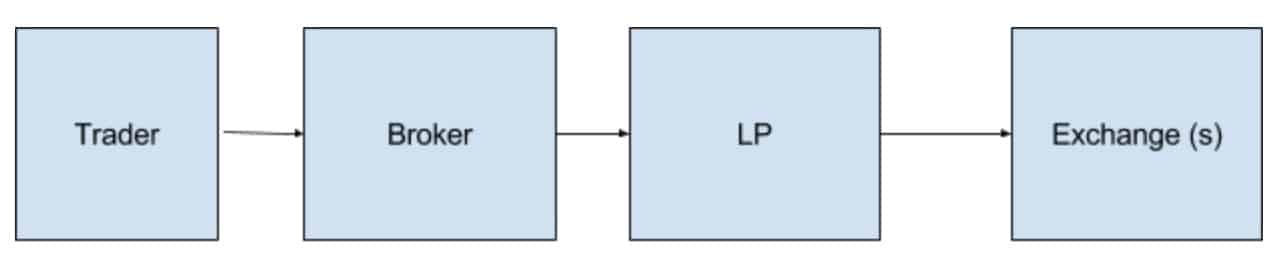
STP’ing
An STP liquidity provider will route orders from their broker clients to the exchanges. They typically automate the order flow to one or more of their exchange partners with little human interaction.
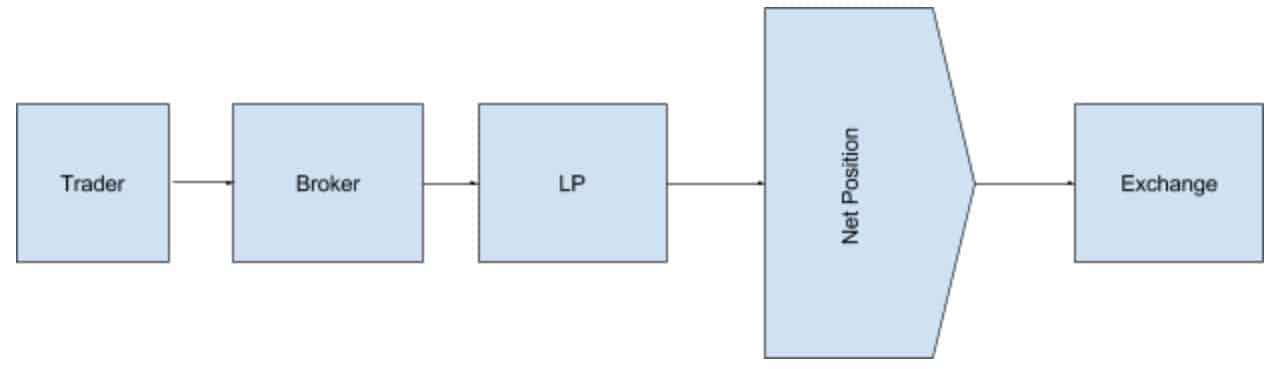
Market Maker Crypto LP
While a market making LP will quote their broker clients on what the market displays and trades are either booked internally or sent out to the market. And just like in FX, the market making (MM) can be the counterparty to a cryptocurrency transaction.
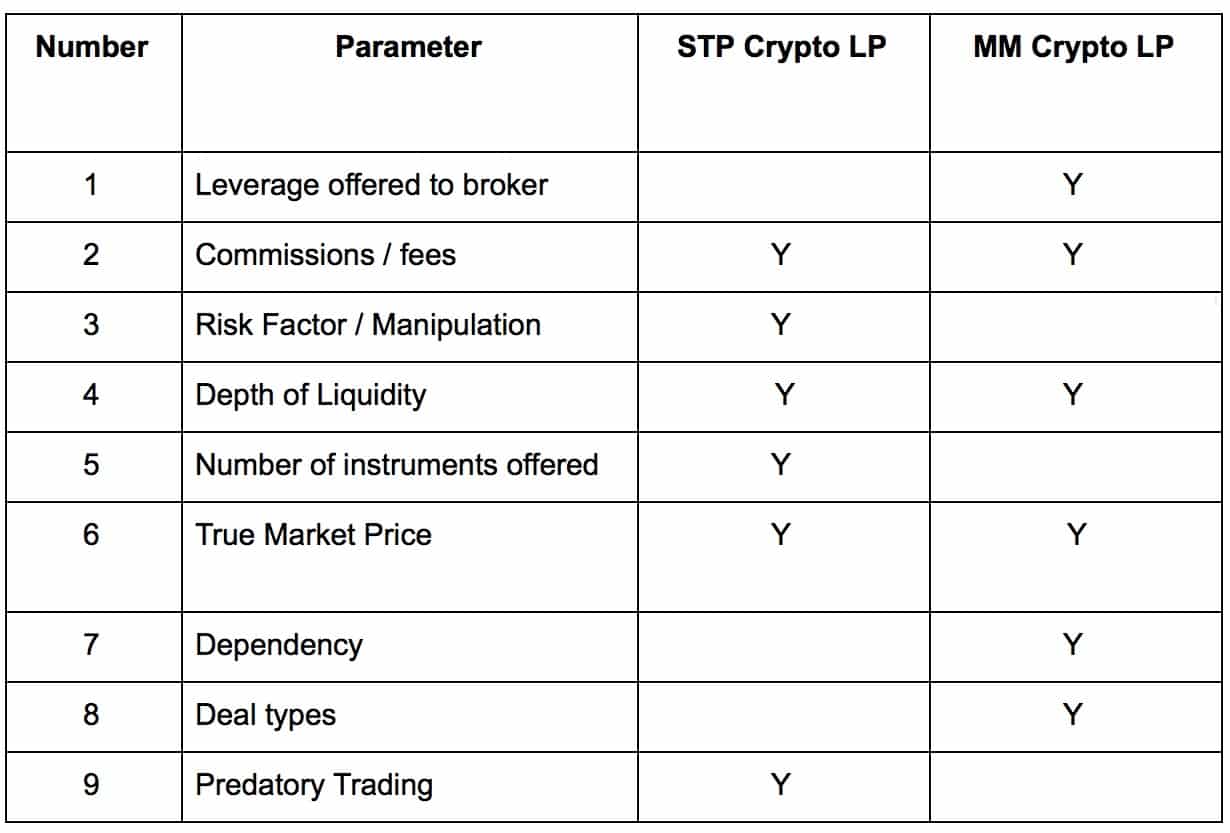
Comparison of STP and Market Maker LPs
The following table lists the important parameters that brokers should be thinking about when choosing the broker LP type they want to work with:
Leverage
In most cases, the market maker will likely offer higher leverage. An STP crypto LP is bound to the leverage offered by their exchange partners. The leverage offered is typically capped at 3:1. The MM crypto LP can go as high as 20:1 in some instances.
Commissions
STP crypto LPs are charged commissions by the exchanges and have to recoup those fees from their broker clients. While market makers make money from their market making activities and don't always need to charge commission. That being said STP LPs may be aggregating multiple exchanges and get a tighter spread than market makers.
Risk
Because cryptocurrencies are a brand new asset class, market maker LPs may have a tough time managing risk due to unexpected events and predatory trading. STP LPs simply pass that risk off to the exchanges.
Depth of market
With STP crypto LPs market depth is decided by the number and size of the exchanges they aggregate. The more exchanges a crypto LP aggregates the more market depth. With market maker crypto LPs you need to pay attention to capitalization and find out what is the maximum trading size they can handle. Bottom line is that you have to get into the specifics with each particular LP that you are planning to use to find out which one will have the best market depth.
Number of instruments
Adding more instruments for a market maker to monitor is always a daunting task. The overhead cost for adding an instrument for a MM LP is quite significant. So most MM LPs keep it simple with offering Bitcoin and Ethereum as their ‘majors’. With an STP LP, they will almost always have more crypto pairs because it’s less a strain on them compared to a MM.
Prices and spreads
The price and spread at an STP crypto LP comes directly from the exchanges they aggregate. A market making LP does not use a true price but can use an index or an average of exchanges. For example the CME now has a Bitcoin index that some market maker LPs use to determine the price they show. When it comes to price and spread you have to compare LPs individually rather than concentrate on their type.
STP brokers are typically taking their price from exchanges. Having this dependency can be a negative for the broker clients because exchanges can experience downtime. A MM LP is less likely to have these issues because they are not as dependent on the exchanges for order execution. If one exchange goes down, the market making LP will derive a quote from other sources.
Deal type
Cryptocurrencies can be very volatile. This causes retail traders to lose. Brokers may want to profit from these losses. A market maker LP would be more willing to work with a broker on a revenue sharing basis. This can create opportunities for more lucrative deals depending on your client type.
Predatory Trading
Because cryptocurrencies are a new instrument prices for the same instrument vary from broker to broker and exchange to exchange. For example, Bitcoin can be priced at 3494 at one exchange and 3500 at another. Predatory traders will try to take advantage of these price differences. If you have fast connectivity technology and use an STP crypto LP you will be less likely to be in harm’s way. Whereas with a market maker it can lose to predatory traders because it is trading against them.
Nekstream Recommendation
Both STP and market making crypto broker-LPs have their advantages and disadvantages. In a perfect world, we suggest that you aggregate multiple crypto broker-LPs into your connectivity solution (aggregator) and offer your clients an aggregated feed of STP and MM LPs. This way you hedge yourself from the risks of each LP type.
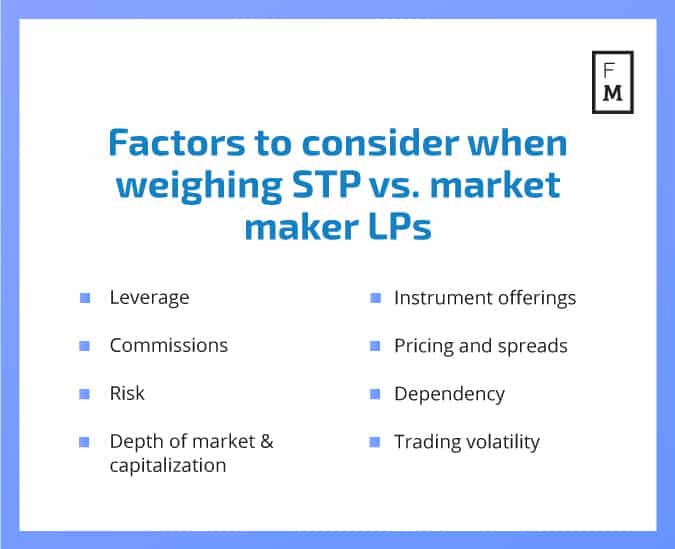
If you are planning to go with just one LP you want to look at its specific parameters. Here is the breakdown of the questions you want to ask to each LP type when making your decision.
For market makers you really want to focus on their size and capitalization, pricing and deal type and how they plan to deal with predatory traders. For STP broker LPs you want to focus on the number and the quality of the exchanges that they aggregate and the speed of their technology.

Alex Nekritin is the Managing Director of Nekstream Global, a liquidity and technology consulting company helping brokers, HFT traders and money managers to find proper liquidity and tools for their ventures. Alex has over 10 years of experience in the financial space. Contact Alex at info@nekstream.com.
Crypto broker LP’s either make markets on cryptocurrencies like a CFD or STP all incoming trades to crypto exchanges. Forex Brokers can either go to an STP crypto broker-LP or a market maker. In this article we will compare STP and market marker crypto broker-LP’s. Here is a breakdown of how each method works.
STP’ing
An STP liquidity provider will route orders from their broker clients to the exchanges. They typically automate the order flow to one or more of their exchange partners with little human interaction.
Market Maker Crypto LP
While a market making LP will quote their broker clients on what the market displays and trades are either booked internally or sent out to the market. And just like in FX, the market making (MM) can be the counterparty to a cryptocurrency transaction.
Comparison of STP and Market Maker LPs
The following table lists the important parameters that brokers should be thinking about when choosing the broker LP type they want to work with:
Leverage
In most cases, the market maker will likely offer higher leverage. An STP crypto LP is bound to the leverage offered by their exchange partners. The leverage offered is typically capped at 3:1. The MM crypto LP can go as high as 20:1 in some instances.
Commissions
STP crypto LPs are charged commissions by the exchanges and have to recoup those fees from their broker clients. While market makers make money from their market making activities and don't always need to charge commission. That being said STP LPs may be aggregating multiple exchanges and get a tighter spread than market makers.
Risk
Because cryptocurrencies are a brand new asset class, market maker LPs may have a tough time managing risk due to unexpected events and predatory trading. STP LPs simply pass that risk off to the exchanges.
Depth of market
With STP crypto LPs market depth is decided by the number and size of the exchanges they aggregate. The more exchanges a crypto LP aggregates the more market depth. With market maker crypto LPs you need to pay attention to capitalization and find out what is the maximum trading size they can handle. Bottom line is that you have to get into the specifics with each particular LP that you are planning to use to find out which one will have the best market depth.
Number of instruments
Adding more instruments for a market maker to monitor is always a daunting task. The overhead cost for adding an instrument for a MM LP is quite significant. So most MM LPs keep it simple with offering Bitcoin and Ethereum as their ‘majors’. With an STP LP, they will almost always have more crypto pairs because it’s less a strain on them compared to a MM.
Prices and spreads
The price and spread at an STP crypto LP comes directly from the exchanges they aggregate. A market making LP does not use a true price but can use an index or an average of exchanges. For example the CME now has a Bitcoin index that some market maker LPs use to determine the price they show. When it comes to price and spread you have to compare LPs individually rather than concentrate on their type.
STP brokers are typically taking their price from exchanges. Having this dependency can be a negative for the broker clients because exchanges can experience downtime. A MM LP is less likely to have these issues because they are not as dependent on the exchanges for order execution. If one exchange goes down, the market making LP will derive a quote from other sources.
Deal type
Cryptocurrencies can be very volatile. This causes retail traders to lose. Brokers may want to profit from these losses. A market maker LP would be more willing to work with a broker on a revenue sharing basis. This can create opportunities for more lucrative deals depending on your client type.
Predatory Trading
Because cryptocurrencies are a new instrument prices for the same instrument vary from broker to broker and exchange to exchange. For example, Bitcoin can be priced at 3494 at one exchange and 3500 at another. Predatory traders will try to take advantage of these price differences. If you have fast connectivity technology and use an STP crypto LP you will be less likely to be in harm’s way. Whereas with a market maker it can lose to predatory traders because it is trading against them.
Nekstream Recommendation
Both STP and market making crypto broker-LPs have their advantages and disadvantages. In a perfect world, we suggest that you aggregate multiple crypto broker-LPs into your connectivity solution (aggregator) and offer your clients an aggregated feed of STP and MM LPs. This way you hedge yourself from the risks of each LP type.
If you are planning to go with just one LP you want to look at its specific parameters. Here is the breakdown of the questions you want to ask to each LP type when making your decision.
For market makers you really want to focus on their size and capitalization, pricing and deal type and how they plan to deal with predatory traders. For STP broker LPs you want to focus on the number and the quality of the exchanges that they aggregate and the speed of their technology.
Alex Nekritin is the Managing Director of Nekstream Global, a liquidity and technology consulting company helping brokers, HFT traders and money managers to find proper liquidity and tools for their ventures. Alex has over 10 years of experience in the financial space. Contact Alex at info@nekstream.com.
Retail Trading & Prop Firms in 2025: Five Defining Trends - And One Prediction for 2026
Featured Videos
Executive Interview | Charlotte Bullock | Chief Product Officer, Bank of London | FMLS:25
In this interview, we sat down with Charlotte Bullock, Head of Product at The Bank of London, previously at SAP and now shaping product at one of the sector’s most ambitious new banking players.
Charlotte reflects on the Summit so far and talks about the culture inside fintech banks today. We look at the pressures that come with scaling, and how firms can hold onto the nimble approach that made them stand out early on.
We also cover the state of payments ahead of her appearance on the payments roundtable: the blockages financial firms face, the areas that still need fixing, and what a realistic solution looks like in 2026.
In this interview, we sat down with Charlotte Bullock, Head of Product at The Bank of London, previously at SAP and now shaping product at one of the sector’s most ambitious new banking players.
Charlotte reflects on the Summit so far and talks about the culture inside fintech banks today. We look at the pressures that come with scaling, and how firms can hold onto the nimble approach that made them stand out early on.
We also cover the state of payments ahead of her appearance on the payments roundtable: the blockages financial firms face, the areas that still need fixing, and what a realistic solution looks like in 2026.
In this interview, we sat down with Charlotte Bullock, Head of Product at The Bank of London, previously at SAP and now shaping product at one of the sector’s most ambitious new banking players.
Charlotte reflects on the Summit so far and talks about the culture inside fintech banks today. We look at the pressures that come with scaling, and how firms can hold onto the nimble approach that made them stand out early on.
We also cover the state of payments ahead of her appearance on the payments roundtable: the blockages financial firms face, the areas that still need fixing, and what a realistic solution looks like in 2026.
In this interview, we sat down with Charlotte Bullock, Head of Product at The Bank of London, previously at SAP and now shaping product at one of the sector’s most ambitious new banking players.
Charlotte reflects on the Summit so far and talks about the culture inside fintech banks today. We look at the pressures that come with scaling, and how firms can hold onto the nimble approach that made them stand out early on.
We also cover the state of payments ahead of her appearance on the payments roundtable: the blockages financial firms face, the areas that still need fixing, and what a realistic solution looks like in 2026.
In this conversation, we sit down with Drew Niv, CSO at ATFX Connect and one of the most influential figures in modern FX.
We speak about market structure, the institutional view on liquidity, and the sharp rise of prop trading, a sector Drew has been commenting on in recent months. Drew explains why he once dismissed prop trading, why his view changed, and what he now thinks the model means for brokers, clients and risk managers.
We explore subscription-fee dependency, the high reneging rate, and the long-term challenge: how brokers can build a more stable and honest version of the model. Drew also talks about the traffic advantage standalone prop firms have built and why brokers may still win in the long run if they take the right approach.
In this conversation, we sit down with Drew Niv, CSO at ATFX Connect and one of the most influential figures in modern FX.
We speak about market structure, the institutional view on liquidity, and the sharp rise of prop trading, a sector Drew has been commenting on in recent months. Drew explains why he once dismissed prop trading, why his view changed, and what he now thinks the model means for brokers, clients and risk managers.
We explore subscription-fee dependency, the high reneging rate, and the long-term challenge: how brokers can build a more stable and honest version of the model. Drew also talks about the traffic advantage standalone prop firms have built and why brokers may still win in the long run if they take the right approach.
In this conversation, we sit down with Drew Niv, CSO at ATFX Connect and one of the most influential figures in modern FX.
We speak about market structure, the institutional view on liquidity, and the sharp rise of prop trading, a sector Drew has been commenting on in recent months. Drew explains why he once dismissed prop trading, why his view changed, and what he now thinks the model means for brokers, clients and risk managers.
We explore subscription-fee dependency, the high reneging rate, and the long-term challenge: how brokers can build a more stable and honest version of the model. Drew also talks about the traffic advantage standalone prop firms have built and why brokers may still win in the long run if they take the right approach.
In this conversation, we sit down with Drew Niv, CSO at ATFX Connect and one of the most influential figures in modern FX.
We speak about market structure, the institutional view on liquidity, and the sharp rise of prop trading, a sector Drew has been commenting on in recent months. Drew explains why he once dismissed prop trading, why his view changed, and what he now thinks the model means for brokers, clients and risk managers.
We explore subscription-fee dependency, the high reneging rate, and the long-term challenge: how brokers can build a more stable and honest version of the model. Drew also talks about the traffic advantage standalone prop firms have built and why brokers may still win in the long run if they take the right approach.
In this conversation, we sit down with Drew Niv, CSO at ATFX Connect and one of the most influential figures in modern FX.
We speak about market structure, the institutional view on liquidity, and the sharp rise of prop trading, a sector Drew has been commenting on in recent months. Drew explains why he once dismissed prop trading, why his view changed, and what he now thinks the model means for brokers, clients and risk managers.
We explore subscription-fee dependency, the high reneging rate, and the long-term challenge: how brokers can build a more stable and honest version of the model. Drew also talks about the traffic advantage standalone prop firms have built and why brokers may still win in the long run if they take the right approach.
In this conversation, we sit down with Drew Niv, CSO at ATFX Connect and one of the most influential figures in modern FX.
We speak about market structure, the institutional view on liquidity, and the sharp rise of prop trading, a sector Drew has been commenting on in recent months. Drew explains why he once dismissed prop trading, why his view changed, and what he now thinks the model means for brokers, clients and risk managers.
We explore subscription-fee dependency, the high reneging rate, and the long-term challenge: how brokers can build a more stable and honest version of the model. Drew also talks about the traffic advantage standalone prop firms have built and why brokers may still win in the long run if they take the right approach.
Executive Interview | Remonda Z. Kirketerp Møller| CEO & Founder Muinmos | FMLS:25
In this interview, Remonda Z. Kirketerp Møller, founder of Muinmos, breaks down the state of AI in regtech and what responsible adoption really looks like for brokers. We talk about rising fragmentation, the pressures around compliance accuracy, and why most firms are still in the early stages of AI maturity.
Ramanda also shares insights on regulator sandboxes, shifting expectations around accountability, and the current reality of MiCA licensing and passporting in Europe.
A concise look at where compliance, onboarding, and AI-driven processes are heading next.
In this interview, Remonda Z. Kirketerp Møller, founder of Muinmos, breaks down the state of AI in regtech and what responsible adoption really looks like for brokers. We talk about rising fragmentation, the pressures around compliance accuracy, and why most firms are still in the early stages of AI maturity.
Ramanda also shares insights on regulator sandboxes, shifting expectations around accountability, and the current reality of MiCA licensing and passporting in Europe.
A concise look at where compliance, onboarding, and AI-driven processes are heading next.
In this interview, Remonda Z. Kirketerp Møller, founder of Muinmos, breaks down the state of AI in regtech and what responsible adoption really looks like for brokers. We talk about rising fragmentation, the pressures around compliance accuracy, and why most firms are still in the early stages of AI maturity.
Ramanda also shares insights on regulator sandboxes, shifting expectations around accountability, and the current reality of MiCA licensing and passporting in Europe.
A concise look at where compliance, onboarding, and AI-driven processes are heading next.
In this interview, Remonda Z. Kirketerp Møller, founder of Muinmos, breaks down the state of AI in regtech and what responsible adoption really looks like for brokers. We talk about rising fragmentation, the pressures around compliance accuracy, and why most firms are still in the early stages of AI maturity.
Ramanda also shares insights on regulator sandboxes, shifting expectations around accountability, and the current reality of MiCA licensing and passporting in Europe.
A concise look at where compliance, onboarding, and AI-driven processes are heading next.
In this interview, Remonda Z. Kirketerp Møller, founder of Muinmos, breaks down the state of AI in regtech and what responsible adoption really looks like for brokers. We talk about rising fragmentation, the pressures around compliance accuracy, and why most firms are still in the early stages of AI maturity.
Ramanda also shares insights on regulator sandboxes, shifting expectations around accountability, and the current reality of MiCA licensing and passporting in Europe.
A concise look at where compliance, onboarding, and AI-driven processes are heading next.
In this interview, Remonda Z. Kirketerp Møller, founder of Muinmos, breaks down the state of AI in regtech and what responsible adoption really looks like for brokers. We talk about rising fragmentation, the pressures around compliance accuracy, and why most firms are still in the early stages of AI maturity.
Ramanda also shares insights on regulator sandboxes, shifting expectations around accountability, and the current reality of MiCA licensing and passporting in Europe.
A concise look at where compliance, onboarding, and AI-driven processes are heading next.
In this conversation, we speak with Aydin Bonabi, CEO and co-founder of Surveill, a firm focused on fraud detection and AI-driven compliance tools for financial institutions.
We start with Aydin’s view of the Summit and the challenges brokers face as fraud tactics grow more complex. He explains how firms can stay ahead through real-time signals, data patterns, and early-stage detection.
We also talk about AI training and why compliance teams often struggle to keep models accurate, fair, and aligned with regulatory expectations. Aydin breaks down what “good” AI training looks like inside a financial environment, including the importance of clean data, domain expertise, and human oversight.
He closes with a clear message: fraud is scaling, and so must the tools that stop it.
In this conversation, we speak with Aydin Bonabi, CEO and co-founder of Surveill, a firm focused on fraud detection and AI-driven compliance tools for financial institutions.
We start with Aydin’s view of the Summit and the challenges brokers face as fraud tactics grow more complex. He explains how firms can stay ahead through real-time signals, data patterns, and early-stage detection.
We also talk about AI training and why compliance teams often struggle to keep models accurate, fair, and aligned with regulatory expectations. Aydin breaks down what “good” AI training looks like inside a financial environment, including the importance of clean data, domain expertise, and human oversight.
He closes with a clear message: fraud is scaling, and so must the tools that stop it.
In this conversation, we speak with Aydin Bonabi, CEO and co-founder of Surveill, a firm focused on fraud detection and AI-driven compliance tools for financial institutions.
We start with Aydin’s view of the Summit and the challenges brokers face as fraud tactics grow more complex. He explains how firms can stay ahead through real-time signals, data patterns, and early-stage detection.
We also talk about AI training and why compliance teams often struggle to keep models accurate, fair, and aligned with regulatory expectations. Aydin breaks down what “good” AI training looks like inside a financial environment, including the importance of clean data, domain expertise, and human oversight.
He closes with a clear message: fraud is scaling, and so must the tools that stop it.
In this conversation, we speak with Aydin Bonabi, CEO and co-founder of Surveill, a firm focused on fraud detection and AI-driven compliance tools for financial institutions.
We start with Aydin’s view of the Summit and the challenges brokers face as fraud tactics grow more complex. He explains how firms can stay ahead through real-time signals, data patterns, and early-stage detection.
We also talk about AI training and why compliance teams often struggle to keep models accurate, fair, and aligned with regulatory expectations. Aydin breaks down what “good” AI training looks like inside a financial environment, including the importance of clean data, domain expertise, and human oversight.
He closes with a clear message: fraud is scaling, and so must the tools that stop it.
In this conversation, we speak with Aydin Bonabi, CEO and co-founder of Surveill, a firm focused on fraud detection and AI-driven compliance tools for financial institutions.
We start with Aydin’s view of the Summit and the challenges brokers face as fraud tactics grow more complex. He explains how firms can stay ahead through real-time signals, data patterns, and early-stage detection.
We also talk about AI training and why compliance teams often struggle to keep models accurate, fair, and aligned with regulatory expectations. Aydin breaks down what “good” AI training looks like inside a financial environment, including the importance of clean data, domain expertise, and human oversight.
He closes with a clear message: fraud is scaling, and so must the tools that stop it.
In this conversation, we speak with Aydin Bonabi, CEO and co-founder of Surveill, a firm focused on fraud detection and AI-driven compliance tools for financial institutions.
We start with Aydin’s view of the Summit and the challenges brokers face as fraud tactics grow more complex. He explains how firms can stay ahead through real-time signals, data patterns, and early-stage detection.
We also talk about AI training and why compliance teams often struggle to keep models accurate, fair, and aligned with regulatory expectations. Aydin breaks down what “good” AI training looks like inside a financial environment, including the importance of clean data, domain expertise, and human oversight.
He closes with a clear message: fraud is scaling, and so must the tools that stop it.
Exness expands its presence in Africa: Inside our interview with Paul Margarites in Cape Town
Finance Magnates met with Paul Margarites, Exness regional commercial director for Sub-Saharan Africa, during a visit to the firm’s office opening in Cape Town. In this talk, led by Andrea Badiola Mateos, Co-CEO at Finance Magnates, Paul shares views on the South African trading space, local user behavior, mobile trends, regulation, team growth, and how Exness plans to grow in more markets across the region. @Exness
Read the article at: https://www.financemagnates.com/thought-leadership/exness-expands-its-presence-in-africa-inside-our-interview-with-paul-margarites/
#exness #financemagnates #exnesstrading #CFDtrading #tradeonline #africanews #capetown
Finance Magnates met with Paul Margarites, Exness regional commercial director for Sub-Saharan Africa, during a visit to the firm’s office opening in Cape Town. In this talk, led by Andrea Badiola Mateos, Co-CEO at Finance Magnates, Paul shares views on the South African trading space, local user behavior, mobile trends, regulation, team growth, and how Exness plans to grow in more markets across the region. @Exness
Read the article at: https://www.financemagnates.com/thought-leadership/exness-expands-its-presence-in-africa-inside-our-interview-with-paul-margarites/
#exness #financemagnates #exnesstrading #CFDtrading #tradeonline #africanews #capetown
Finance Magnates met with Paul Margarites, Exness regional commercial director for Sub-Saharan Africa, during a visit to the firm’s office opening in Cape Town. In this talk, led by Andrea Badiola Mateos, Co-CEO at Finance Magnates, Paul shares views on the South African trading space, local user behavior, mobile trends, regulation, team growth, and how Exness plans to grow in more markets across the region. @Exness
Read the article at: https://www.financemagnates.com/thought-leadership/exness-expands-its-presence-in-africa-inside-our-interview-with-paul-margarites/
#exness #financemagnates #exnesstrading #CFDtrading #tradeonline #africanews #capetown
Finance Magnates met with Paul Margarites, Exness regional commercial director for Sub-Saharan Africa, during a visit to the firm’s office opening in Cape Town. In this talk, led by Andrea Badiola Mateos, Co-CEO at Finance Magnates, Paul shares views on the South African trading space, local user behavior, mobile trends, regulation, team growth, and how Exness plans to grow in more markets across the region. @Exness
Read the article at: https://www.financemagnates.com/thought-leadership/exness-expands-its-presence-in-africa-inside-our-interview-with-paul-margarites/
#exness #financemagnates #exnesstrading #CFDtrading #tradeonline #africanews #capetown
Finance Magnates met with Paul Margarites, Exness regional commercial director for Sub-Saharan Africa, during a visit to the firm’s office opening in Cape Town. In this talk, led by Andrea Badiola Mateos, Co-CEO at Finance Magnates, Paul shares views on the South African trading space, local user behavior, mobile trends, regulation, team growth, and how Exness plans to grow in more markets across the region. @Exness
Read the article at: https://www.financemagnates.com/thought-leadership/exness-expands-its-presence-in-africa-inside-our-interview-with-paul-margarites/
#exness #financemagnates #exnesstrading #CFDtrading #tradeonline #africanews #capetown
Finance Magnates met with Paul Margarites, Exness regional commercial director for Sub-Saharan Africa, during a visit to the firm’s office opening in Cape Town. In this talk, led by Andrea Badiola Mateos, Co-CEO at Finance Magnates, Paul shares views on the South African trading space, local user behavior, mobile trends, regulation, team growth, and how Exness plans to grow in more markets across the region. @Exness
Read the article at: https://www.financemagnates.com/thought-leadership/exness-expands-its-presence-in-africa-inside-our-interview-with-paul-margarites/
#exness #financemagnates #exnesstrading #CFDtrading #tradeonline #africanews #capetown