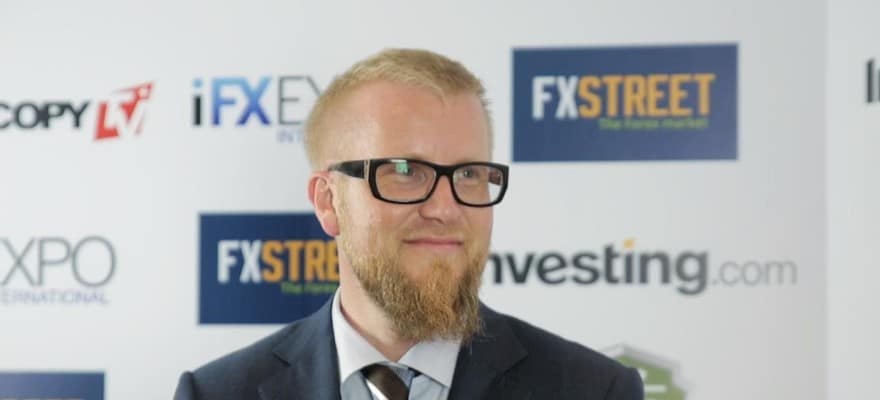
Speaking at the iFX Expo in Cyprus this Wednesday, Panda Trading Systems CEO Maor Lahav said that brokers are avoiding low Volatility
Volatility
In finance, volatility refers to the amount of change in the rate of a financial instrument, such as commodities, currencies, or stocks, over a given time period. Essentially, volatility describes the nature of an instrument’s fluctuation; a highly volatile security equates to large fluctuations in price, and a low volatile security equates to timid fluctuations in price. Volatility is an important statistical indicator used by financial traders to assist them in developing trading systems. Trad
Read this Term in the foreign exchange markets by expanding into cryptocurrency.
“Most of the volume we see from our clients is in ripple,” said Lahav. “So you can see that focusing on other asset classes means you are less susceptible to any damage that low volatility can do to your brokerage business.”
Lahav was joined on stage by James Alexander - the chief commercial officer at Invast Global. Agreeing with Lahav, Alexander pointed to the equities markets and the current trading volumes he is seeing from his clients.
“We have seen a downturn in FX trading over the past few months from retail traders,” said Alexander. “But our institutional clients, trading in the equities markets for example, are trading normally. So it’s an indication that, for brokers, diversification is key.”
Look to the east
Aside from low volatility, the panelists also discussed regulatory developments in Europe. Leverage caps that were introduced by the European Securities and Markets Authority last August have crimped brokers trading volumes. But, for one of the speakers at the iFX Expo, history can provide some answers as to how brokers should proceed.
“A lot of companies are worrying but there is a country that has already been through this - Japan,” said Harpal Sandu, the founder of the Integral Group.
“After leverage restrictions were introduced there, we did see a two or three year blip in the market. But after that, firms came back. And many of them are, today, very sophisticated in terms of their technology and Risk Management
Risk Management
One of the most common terms utilized by brokers, risk management refers to the practice of identifying potential risks in advance. Most commonly, this also involves the analysis of risk and the undertaking of precautionary steps to both mitigate and prevent for such risk.Such efforts are essential for brokers and venues in the finance industry, given the potential for fallout in the face of unforeseen events or crises. Given a more tightly regulated environment across nearly every asset class,
Read this Term.”
Agreeing that perhaps ESMA’s regulations are not destined to destroy the retail trading industry, Avner Ziv - the CEO of payments firm ZotaPay - noted that many brokers are expanding into different markets with some success.
“It’s true that Europe has long been a focal point for the industry,” said Ziv. “But we are seeing many clients start to operate successfully in Asia, MENA and Latin America. So, even if European business subsides a little, there are opportunities elsewhere to make up for it.”
Speaking at the iFX Expo in Cyprus this Wednesday, Panda Trading Systems CEO Maor Lahav said that brokers are avoiding low Volatility
Volatility
In finance, volatility refers to the amount of change in the rate of a financial instrument, such as commodities, currencies, or stocks, over a given time period. Essentially, volatility describes the nature of an instrument’s fluctuation; a highly volatile security equates to large fluctuations in price, and a low volatile security equates to timid fluctuations in price. Volatility is an important statistical indicator used by financial traders to assist them in developing trading systems. Trad
Read this Term in the foreign exchange markets by expanding into cryptocurrency.
“Most of the volume we see from our clients is in ripple,” said Lahav. “So you can see that focusing on other asset classes means you are less susceptible to any damage that low volatility can do to your brokerage business.”
Lahav was joined on stage by James Alexander - the chief commercial officer at Invast Global. Agreeing with Lahav, Alexander pointed to the equities markets and the current trading volumes he is seeing from his clients.
“We have seen a downturn in FX trading over the past few months from retail traders,” said Alexander. “But our institutional clients, trading in the equities markets for example, are trading normally. So it’s an indication that, for brokers, diversification is key.”
Look to the east
Aside from low volatility, the panelists also discussed regulatory developments in Europe. Leverage caps that were introduced by the European Securities and Markets Authority last August have crimped brokers trading volumes. But, for one of the speakers at the iFX Expo, history can provide some answers as to how brokers should proceed.
“A lot of companies are worrying but there is a country that has already been through this - Japan,” said Harpal Sandu, the founder of the Integral Group.
“After leverage restrictions were introduced there, we did see a two or three year blip in the market. But after that, firms came back. And many of them are, today, very sophisticated in terms of their technology and Risk Management
Risk Management
One of the most common terms utilized by brokers, risk management refers to the practice of identifying potential risks in advance. Most commonly, this also involves the analysis of risk and the undertaking of precautionary steps to both mitigate and prevent for such risk.Such efforts are essential for brokers and venues in the finance industry, given the potential for fallout in the face of unforeseen events or crises. Given a more tightly regulated environment across nearly every asset class,
Read this Term.”
Agreeing that perhaps ESMA’s regulations are not destined to destroy the retail trading industry, Avner Ziv - the CEO of payments firm ZotaPay - noted that many brokers are expanding into different markets with some success.
“It’s true that Europe has long been a focal point for the industry,” said Ziv. “But we are seeing many clients start to operate successfully in Asia, MENA and Latin America. So, even if European business subsides a little, there are opportunities elsewhere to make up for it.”