
But the Chinese market, although big and attractive, is also being crowded by brokers, and acquisition costs are significantly higher than they used to be when using traditional media channels. Although characterized by a longer payback time, SEO consistently reduces the acquisition cost of brokers when given the right attention and investment.
In this article I will explain a little about how search in China works, and give some input on effective SEO tactics.
Forget about Google
Probably the main reason why many brokers neglect SEO in China is that you cannot simply use the same Google approach that works in other countries. China is dominated by the local search engine, Baidu, founded in 2000 as very much a copy of Google – many things in Baidu are similar to Google, but certain important elements differ.
One of the major differences is how Baidu shows search results. At the top, Baidu offers the possibility of a brand zone to be shown when users search for brand related keywords. The brand zone will take up a considerable part of the above the fold space:
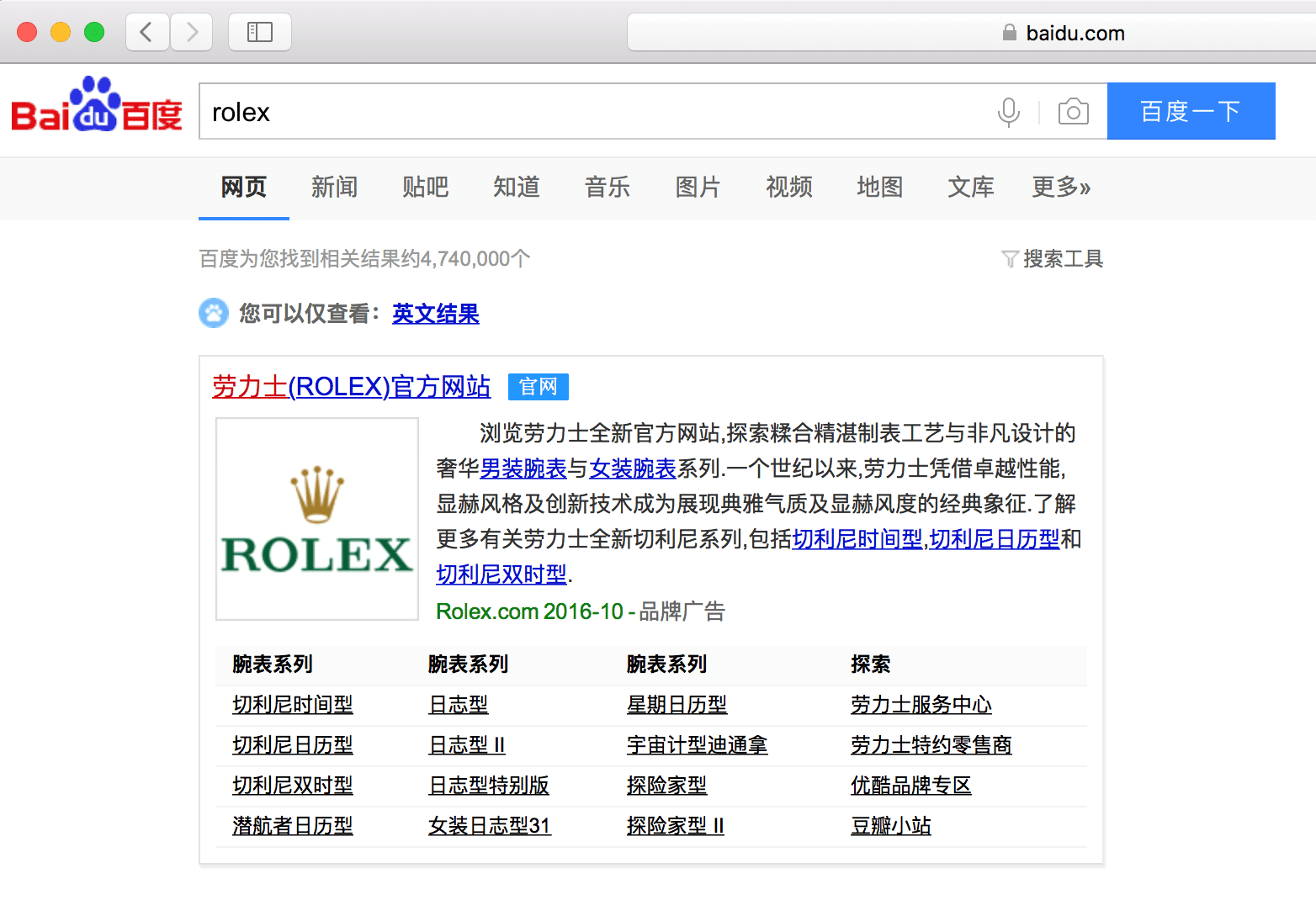
Baidu also offers related services, to name a few: a Wikipedia style encyclopedia (Baike), a Yahoo! Answers type Q&A function (Zhidao) as well as a Reddit-type bulletin board system (Tieba). If the searched keyword matches anything in these internal services, Baidu will typically display these above any other organic listing. So unlike with Google where the format is 2-3 paid links at the top followed by organic content, Baidu will shuffle it up and heavily promote its own resources before organic listings.
So in addition to the SEO efforts that should be done on your own site, it would be beneficial to build up your presence within Baidu’s own resources as well.
Turning our attention to your website now, I will highlight certain key points related to content SEO, technical SEO and legal issues.
Content SEO
Language: Everything needs to be in simplified Chinese: title tags, meta data, and content. Avoid roman characters, except in URL where preference is given to page names written in Pinyin (Chinese words written in Roman characters).
Content: Ensure all is unique, as duplicate content is penalized even more than what is seen with Google. It is not uncommon for other sites to copy your content word for word, so make it a habit to check for this regularly. Baidu also values content quality very highly, so each page should have at least 300 words of unique content.
Meta descriptions and keywords: Baidu, unlike most other search engines, still places a high value on meta descriptions and meta keywords, so make sure these are filled out.
Off-site SEO: Although they have improved in this area recently, Baidu has still been significantly behind Google in terms of evaluating inbound links. They have historically placed a higher value on quantity rather than quality in terms of inbound links, and as a result it has been possible to increase rankings through link building schemes. Expect improvement in this area, but inbound links will still continue to be valued highly.
Java, flash and iFrames: Keep your content in HTML, Baidu does not do well with java or flash and does not crawl within iFrames. Also important to keep in mind if your menu structure is java based, where having navigational links in the footer may be a solution.
Technical SEO
Simple structures: The crawling power of Baidu is not as sophisticated as Google yet, and as a result it favors simpler, flat-structured sites without too many clicks to get to the content.
Page load speed: As is known with Google, Baidu also places a high value on the page load speed of your site. Having your website hosted outside of China however will put you at a natural disadvantage, as the Great Firewall will significantly reduce the load speed. Using CDNs or even finding a way to host locally (see the legal section below) can help.
Image ALT attribute: Baidu only ranks images based on the ALT attribute, so make sure all images have these in Chinese.
Anchor text: Anchor text on links, internal and external, carry a high importance. Make sure all internal links have anchor texts, and if possible get external links to do the same.
Local domain: Baidu will prioritize locally hosted .cn/.com.cn websites the highest, then non-local .cn/.com.cn, and lastly all others. So even if it is not possible to host your website locally in China, it is highly recommendable to at least use a Chinese domain suffix.
Legal issues
Locally hosted website: If you want to host your website locally in China, and gain the advantage of higher page load speed and preference in ranking, you need to obtain an ICP (Internet Content Publishing) license. This is basically a license plate for your website, and it is only given to local companies (non-foreign owned) – even if your company is foreign-owned, there are options of renting an ICP license from a local provider. Most FX brokers are not eligible for this, as selling financial services would definitely not be approved – some have succeeded with content-only sites though.
Censorship: Censorship is quite heavy in China, and any page containing blacklisted words will cause Baidu to de-index the page or even the whole site. There are lists where you can look up a good portion of the blacklisted words, yet these have a tendency to change quite frequently (with new words added, rarely are words/phrases taken off). Also consider if your site is open for user comments, that you should be able to moderate this and remove comments that include blacklisted words.
In the above I have highlighted just a few key points on the Baidu SEO side. As with Google, SEO is a discipline that requires attention and hard work, but done right it yields a significant ROI. I hope to see more brokers focusing on SEO in their China marketing approach going forward.
This guest article was written by Morten Fillipsen is Partner and Head of Asia with Mediagroup Worldwide.
But the Chinese market, although big and attractive, is also being crowded by brokers, and acquisition costs are significantly higher than they used to be when using traditional media channels. Although characterized by a longer payback time, SEO consistently reduces the acquisition cost of brokers when given the right attention and investment.
In this article I will explain a little about how search in China works, and give some input on effective SEO tactics.
Forget about Google
Probably the main reason why many brokers neglect SEO in China is that you cannot simply use the same Google approach that works in other countries. China is dominated by the local search engine, Baidu, founded in 2000 as very much a copy of Google – many things in Baidu are similar to Google, but certain important elements differ.
One of the major differences is how Baidu shows search results. At the top, Baidu offers the possibility of a brand zone to be shown when users search for brand related keywords. The brand zone will take up a considerable part of the above the fold space:
Baidu also offers related services, to name a few: a Wikipedia style encyclopedia (Baike), a Yahoo! Answers type Q&A function (Zhidao) as well as a Reddit-type bulletin board system (Tieba). If the searched keyword matches anything in these internal services, Baidu will typically display these above any other organic listing. So unlike with Google where the format is 2-3 paid links at the top followed by organic content, Baidu will shuffle it up and heavily promote its own resources before organic listings.
So in addition to the SEO efforts that should be done on your own site, it would be beneficial to build up your presence within Baidu’s own resources as well.
Turning our attention to your website now, I will highlight certain key points related to content SEO, technical SEO and legal issues.
Content SEO
Language: Everything needs to be in simplified Chinese: title tags, meta data, and content. Avoid roman characters, except in URL where preference is given to page names written in Pinyin (Chinese words written in Roman characters).
Content: Ensure all is unique, as duplicate content is penalized even more than what is seen with Google. It is not uncommon for other sites to copy your content word for word, so make it a habit to check for this regularly. Baidu also values content quality very highly, so each page should have at least 300 words of unique content.
Meta descriptions and keywords: Baidu, unlike most other search engines, still places a high value on meta descriptions and meta keywords, so make sure these are filled out.
Off-site SEO: Although they have improved in this area recently, Baidu has still been significantly behind Google in terms of evaluating inbound links. They have historically placed a higher value on quantity rather than quality in terms of inbound links, and as a result it has been possible to increase rankings through link building schemes. Expect improvement in this area, but inbound links will still continue to be valued highly.
Java, flash and iFrames: Keep your content in HTML, Baidu does not do well with java or flash and does not crawl within iFrames. Also important to keep in mind if your menu structure is java based, where having navigational links in the footer may be a solution.
Technical SEO
Simple structures: The crawling power of Baidu is not as sophisticated as Google yet, and as a result it favors simpler, flat-structured sites without too many clicks to get to the content.
Page load speed: As is known with Google, Baidu also places a high value on the page load speed of your site. Having your website hosted outside of China however will put you at a natural disadvantage, as the Great Firewall will significantly reduce the load speed. Using CDNs or even finding a way to host locally (see the legal section below) can help.
Image ALT attribute: Baidu only ranks images based on the ALT attribute, so make sure all images have these in Chinese.
Anchor text: Anchor text on links, internal and external, carry a high importance. Make sure all internal links have anchor texts, and if possible get external links to do the same.
Local domain: Baidu will prioritize locally hosted .cn/.com.cn websites the highest, then non-local .cn/.com.cn, and lastly all others. So even if it is not possible to host your website locally in China, it is highly recommendable to at least use a Chinese domain suffix.
Legal issues
Locally hosted website: If you want to host your website locally in China, and gain the advantage of higher page load speed and preference in ranking, you need to obtain an ICP (Internet Content Publishing) license. This is basically a license plate for your website, and it is only given to local companies (non-foreign owned) – even if your company is foreign-owned, there are options of renting an ICP license from a local provider. Most FX brokers are not eligible for this, as selling financial services would definitely not be approved – some have succeeded with content-only sites though.
Censorship: Censorship is quite heavy in China, and any page containing blacklisted words will cause Baidu to de-index the page or even the whole site. There are lists where you can look up a good portion of the blacklisted words, yet these have a tendency to change quite frequently (with new words added, rarely are words/phrases taken off). Also consider if your site is open for user comments, that you should be able to moderate this and remove comments that include blacklisted words.
In the above I have highlighted just a few key points on the Baidu SEO side. As with Google, SEO is a discipline that requires attention and hard work, but done right it yields a significant ROI. I hope to see more brokers focusing on SEO in their China marketing approach going forward.
FXBO Adds IDWise KYC And AML Tools To Broker CRM Stack
Featured Videos
Precious Insights: APAC's Bullion Market amid Record Volatility
The precious metals rally has challenged how brokers and LPs think about hedging, pricing, and physical delivery. But with regional banks eyeing physical gold retail and bullion brokers across Southeast Asia harnessing new tech, volatility is not only in 'safe havens'.
This session gathers practitioners from across the bullion ecosystem to unpack what the rally means on the ground in APAC.
Attendees will walk away with:
Insight into the physical market dynamics driving retail demand across Southeast Asia, from central bank buying to store-of-value purchases
Understanding of Singapore's distinct role as APAC's bullion gateway, and competition near and far
Perspective on operational challenges unique to APAC: kilogram pricing, local delivery, and bridging CFD and physical bullion infrastructure
The precious metals rally has challenged how brokers and LPs think about hedging, pricing, and physical delivery. But with regional banks eyeing physical gold retail and bullion brokers across Southeast Asia harnessing new tech, volatility is not only in 'safe havens'.
This session gathers practitioners from across the bullion ecosystem to unpack what the rally means on the ground in APAC.
Attendees will walk away with:
Insight into the physical market dynamics driving retail demand across Southeast Asia, from central bank buying to store-of-value purchases
Understanding of Singapore's distinct role as APAC's bullion gateway, and competition near and far
Perspective on operational challenges unique to APAC: kilogram pricing, local delivery, and bridging CFD and physical bullion infrastructure
The precious metals rally has challenged how brokers and LPs think about hedging, pricing, and physical delivery. But with regional banks eyeing physical gold retail and bullion brokers across Southeast Asia harnessing new tech, volatility is not only in 'safe havens'.
This session gathers practitioners from across the bullion ecosystem to unpack what the rally means on the ground in APAC.
Attendees will walk away with:
Insight into the physical market dynamics driving retail demand across Southeast Asia, from central bank buying to store-of-value purchases
Understanding of Singapore's distinct role as APAC's bullion gateway, and competition near and far
Perspective on operational challenges unique to APAC: kilogram pricing, local delivery, and bridging CFD and physical bullion infrastructure
The precious metals rally has challenged how brokers and LPs think about hedging, pricing, and physical delivery. But with regional banks eyeing physical gold retail and bullion brokers across Southeast Asia harnessing new tech, volatility is not only in 'safe havens'.
This session gathers practitioners from across the bullion ecosystem to unpack what the rally means on the ground in APAC.
Attendees will walk away with:
Insight into the physical market dynamics driving retail demand across Southeast Asia, from central bank buying to store-of-value purchases
Understanding of Singapore's distinct role as APAC's bullion gateway, and competition near and far
Perspective on operational challenges unique to APAC: kilogram pricing, local delivery, and bridging CFD and physical bullion infrastructure
License to Fill: Market Liquidity amid Global Turmoil
Asian markets bear unique characteristics, from connectivity to asset preference. The Singapore Summit will connect global executives and local experts across the liquidity chain to discuss volatility fluctuations, diversification vs over-reliance on single assets, and the role of trust and liquidity relationships in an increasingly automated sphere.
Regional Focus: Thailand, Vietnam
Bangkok is consolidating as Southeast Asia's broker hub for CLMV access, while Vietnam's trading volumes have made it harder to ignore from any regional headquarters. Most brokers know both exist. Fewer have tested what operating there actually requires.
This session gathers practitioners with on-the-ground experience in both markets to examine what it takes to build and run operations in Thailand and Vietnam.
Attendees will walk away with:
A clear view of setup requirements in both markets: entity structures, timelines, and what first-time operators tend to get wrong
Understanding of the offshore broker model and how compliant operators work within domestic restrictions in each jurisdiction
Insight into talent acquisition, client onboarding, and distribution in markets where language, culture, and acquisition channels don't follow standard APAC assumptions
Perspective on adjacent Southeast Asian markets worth monitoring for the next regional move
Bangkok is consolidating as Southeast Asia's broker hub for CLMV access, while Vietnam's trading volumes have made it harder to ignore from any regional headquarters. Most brokers know both exist. Fewer have tested what operating there actually requires.
This session gathers practitioners with on-the-ground experience in both markets to examine what it takes to build and run operations in Thailand and Vietnam.
Attendees will walk away with:
A clear view of setup requirements in both markets: entity structures, timelines, and what first-time operators tend to get wrong
Understanding of the offshore broker model and how compliant operators work within domestic restrictions in each jurisdiction
Insight into talent acquisition, client onboarding, and distribution in markets where language, culture, and acquisition channels don't follow standard APAC assumptions
Perspective on adjacent Southeast Asian markets worth monitoring for the next regional move
Bangkok is consolidating as Southeast Asia's broker hub for CLMV access, while Vietnam's trading volumes have made it harder to ignore from any regional headquarters. Most brokers know both exist. Fewer have tested what operating there actually requires.
This session gathers practitioners with on-the-ground experience in both markets to examine what it takes to build and run operations in Thailand and Vietnam.
Attendees will walk away with:
A clear view of setup requirements in both markets: entity structures, timelines, and what first-time operators tend to get wrong
Understanding of the offshore broker model and how compliant operators work within domestic restrictions in each jurisdiction
Insight into talent acquisition, client onboarding, and distribution in markets where language, culture, and acquisition channels don't follow standard APAC assumptions
Perspective on adjacent Southeast Asian markets worth monitoring for the next regional move
Bangkok is consolidating as Southeast Asia's broker hub for CLMV access, while Vietnam's trading volumes have made it harder to ignore from any regional headquarters. Most brokers know both exist. Fewer have tested what operating there actually requires.
This session gathers practitioners with on-the-ground experience in both markets to examine what it takes to build and run operations in Thailand and Vietnam.
Attendees will walk away with:
A clear view of setup requirements in both markets: entity structures, timelines, and what first-time operators tend to get wrong
Understanding of the offshore broker model and how compliant operators work within domestic restrictions in each jurisdiction
Insight into talent acquisition, client onboarding, and distribution in markets where language, culture, and acquisition channels don't follow standard APAC assumptions
Perspective on adjacent Southeast Asian markets worth monitoring for the next regional move
Bangkok is consolidating as Southeast Asia's broker hub for CLMV access, while Vietnam's trading volumes have made it harder to ignore from any regional headquarters. Most brokers know both exist. Fewer have tested what operating there actually requires.
This session gathers practitioners with on-the-ground experience in both markets to examine what it takes to build and run operations in Thailand and Vietnam.
Attendees will walk away with:
A clear view of setup requirements in both markets: entity structures, timelines, and what first-time operators tend to get wrong
Understanding of the offshore broker model and how compliant operators work within domestic restrictions in each jurisdiction
Insight into talent acquisition, client onboarding, and distribution in markets where language, culture, and acquisition channels don't follow standard APAC assumptions
Perspective on adjacent Southeast Asian markets worth monitoring for the next regional move
Bangkok is consolidating as Southeast Asia's broker hub for CLMV access, while Vietnam's trading volumes have made it harder to ignore from any regional headquarters. Most brokers know both exist. Fewer have tested what operating there actually requires.
This session gathers practitioners with on-the-ground experience in both markets to examine what it takes to build and run operations in Thailand and Vietnam.
Attendees will walk away with:
A clear view of setup requirements in both markets: entity structures, timelines, and what first-time operators tend to get wrong
Understanding of the offshore broker model and how compliant operators work within domestic restrictions in each jurisdiction
Insight into talent acquisition, client onboarding, and distribution in markets where language, culture, and acquisition channels don't follow standard APAC assumptions
Perspective on adjacent Southeast Asian markets worth monitoring for the next regional move
Join The Club: What Premium Clients Want
High-net-worth traders account for an outsized portion of revenues for various retail brokers.
This session will gather heads of premium, acquisition, and product experts to reveal how they build their client base in Asia.
Attendees will walk away with:
Understanding of how brokers view premium clients (beyond deposit size).
Insight into which services, products, and benefits increase trust and LTV.
Examples of offerings that scale without inflating cost or operational burden.
Lessons from leading brokers on growing premium segments and what’s next.
High-net-worth traders account for an outsized portion of revenues for various retail brokers.
This session will gather heads of premium, acquisition, and product experts to reveal how they build their client base in Asia.
Attendees will walk away with:
Understanding of how brokers view premium clients (beyond deposit size).
Insight into which services, products, and benefits increase trust and LTV.
Examples of offerings that scale without inflating cost or operational burden.
Lessons from leading brokers on growing premium segments and what’s next.
High-net-worth traders account for an outsized portion of revenues for various retail brokers.
This session will gather heads of premium, acquisition, and product experts to reveal how they build their client base in Asia.
Attendees will walk away with:
Understanding of how brokers view premium clients (beyond deposit size).
Insight into which services, products, and benefits increase trust and LTV.
Examples of offerings that scale without inflating cost or operational burden.
Lessons from leading brokers on growing premium segments and what’s next.
High-net-worth traders account for an outsized portion of revenues for various retail brokers.
This session will gather heads of premium, acquisition, and product experts to reveal how they build their client base in Asia.
Attendees will walk away with:
Understanding of how brokers view premium clients (beyond deposit size).
Insight into which services, products, and benefits increase trust and LTV.
Examples of offerings that scale without inflating cost or operational burden.
Lessons from leading brokers on growing premium segments and what’s next.
High-net-worth traders account for an outsized portion of revenues for various retail brokers.
This session will gather heads of premium, acquisition, and product experts to reveal how they build their client base in Asia.
Attendees will walk away with:
Understanding of how brokers view premium clients (beyond deposit size).
Insight into which services, products, and benefits increase trust and LTV.
Examples of offerings that scale without inflating cost or operational burden.
Lessons from leading brokers on growing premium segments and what’s next.
High-net-worth traders account for an outsized portion of revenues for various retail brokers.
This session will gather heads of premium, acquisition, and product experts to reveal how they build their client base in Asia.
Attendees will walk away with:
Understanding of how brokers view premium clients (beyond deposit size).
Insight into which services, products, and benefits increase trust and LTV.
Examples of offerings that scale without inflating cost or operational burden.
Lessons from leading brokers on growing premium segments and what’s next.
Buying The Deep: Digital Asset Adoption in APAC and Beyond
The persisting price drops test the industry's commitment to crypto adoption. While on-chain innovation is making headway across market mechanics, from stablecoins to tokenization, investors remains cautious.
This session brings together market structure experts and institutional investors to explore how a prolonged bear market affects their long-term strategy, and where the opportunities lie ahead of the next cycle.
Attendees will walk away with:
First-hand account of the bear market's impact on various industry players
Understanding of what custody, connectivity, and settlement gaps still hamper growth in APAC
Insight into how client mandates and operational readiness are shaping who moves and who waits
Perspective on what institutional investors need to move toward actual digital asset capital deployment
The persisting price drops test the industry's commitment to crypto adoption. While on-chain innovation is making headway across market mechanics, from stablecoins to tokenization, investors remains cautious.
This session brings together market structure experts and institutional investors to explore how a prolonged bear market affects their long-term strategy, and where the opportunities lie ahead of the next cycle.
Attendees will walk away with:
First-hand account of the bear market's impact on various industry players
Understanding of what custody, connectivity, and settlement gaps still hamper growth in APAC
Insight into how client mandates and operational readiness are shaping who moves and who waits
Perspective on what institutional investors need to move toward actual digital asset capital deployment
The persisting price drops test the industry's commitment to crypto adoption. While on-chain innovation is making headway across market mechanics, from stablecoins to tokenization, investors remains cautious.
This session brings together market structure experts and institutional investors to explore how a prolonged bear market affects their long-term strategy, and where the opportunities lie ahead of the next cycle.
Attendees will walk away with:
First-hand account of the bear market's impact on various industry players
Understanding of what custody, connectivity, and settlement gaps still hamper growth in APAC
Insight into how client mandates and operational readiness are shaping who moves and who waits
Perspective on what institutional investors need to move toward actual digital asset capital deployment
The persisting price drops test the industry's commitment to crypto adoption. While on-chain innovation is making headway across market mechanics, from stablecoins to tokenization, investors remains cautious.
This session brings together market structure experts and institutional investors to explore how a prolonged bear market affects their long-term strategy, and where the opportunities lie ahead of the next cycle.
Attendees will walk away with:
First-hand account of the bear market's impact on various industry players
Understanding of what custody, connectivity, and settlement gaps still hamper growth in APAC
Insight into how client mandates and operational readiness are shaping who moves and who waits
Perspective on what institutional investors need to move toward actual digital asset capital deployment
The persisting price drops test the industry's commitment to crypto adoption. While on-chain innovation is making headway across market mechanics, from stablecoins to tokenization, investors remains cautious.
This session brings together market structure experts and institutional investors to explore how a prolonged bear market affects their long-term strategy, and where the opportunities lie ahead of the next cycle.
Attendees will walk away with:
First-hand account of the bear market's impact on various industry players
Understanding of what custody, connectivity, and settlement gaps still hamper growth in APAC
Insight into how client mandates and operational readiness are shaping who moves and who waits
Perspective on what institutional investors need to move toward actual digital asset capital deployment
The persisting price drops test the industry's commitment to crypto adoption. While on-chain innovation is making headway across market mechanics, from stablecoins to tokenization, investors remains cautious.
This session brings together market structure experts and institutional investors to explore how a prolonged bear market affects their long-term strategy, and where the opportunities lie ahead of the next cycle.
Attendees will walk away with:
First-hand account of the bear market's impact on various industry players
Understanding of what custody, connectivity, and settlement gaps still hamper growth in APAC
Insight into how client mandates and operational readiness are shaping who moves and who waits
Perspective on what institutional investors need to move toward actual digital asset capital deployment