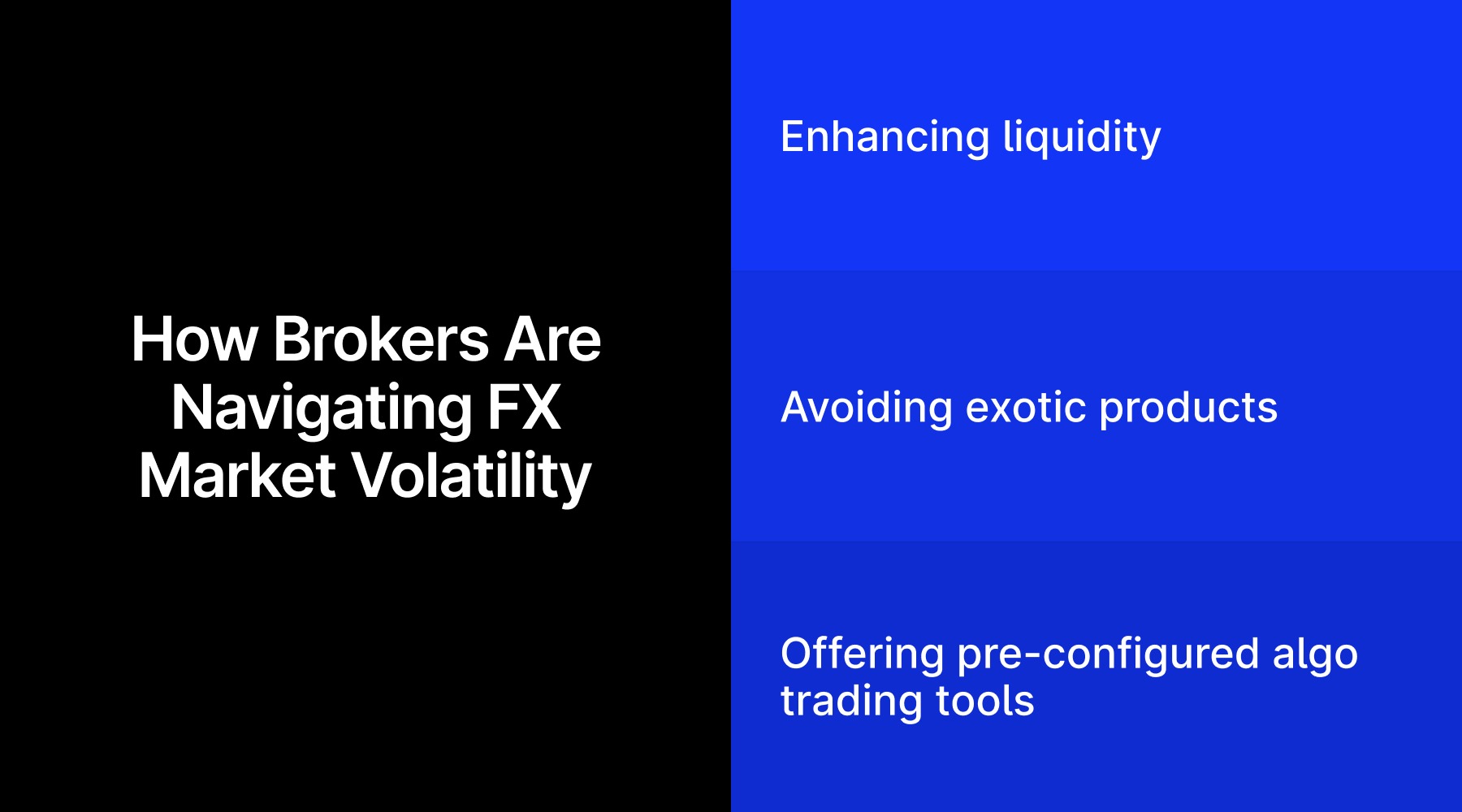
FX brokers focus on better services, like enhancing liquidity and introducing of innovative trading tools.
Traders are also adopting low volatility of 'majors' as with cost-effective hedging strategies.
Low market volatility might not be a great environment for FX brokers, but for reasons relating to cost and risk in particular they almost unanimously reject the suggestion that the answer is to simply offer more exotic products.
Increased Volatility in the Market
Currency volatility has increased over the last six months – the Deutsche Bank Currency Volatility Index started this week at 8.16 compared to 5.97 in early July 2024. But traders will no doubt be looking back fondly to the 12 month period from April 2022 when the index reached the heady heights of 13.44.
With no indication of a return to such levels any time soon, brokers are having to work hard to grab traders’ interest.
While volatility in major traded currencies such as the dollar, pound and euro may be low, volatility can always be found elsewhere in the market for those seeking it, suggests Kourosh Khanloo, director of corporate strategy at Tradu.
“For instance, emerging market currencies can remain volatile when the rest of the market is relatively stable,” he adds. “Opening up access to currencies such as the Chilean peso, Indian rupee and Korean won broadens the scope for users, enabling them to expand their trading options and find opportunities when they are absent in the main areas of the market.”
Services over Products
Brokers have eschewed new products in favour of enhancing existing services. Pete Mulmat, CEO of tastyfx refers to innovation in the technology and content around FX markets, such as his firm’s quick ticket trading mode for high speed scalping.
Pete Mulmat, CEO of tastyfx
There have also been advances in spread tracking tools that provide real time comparisons of spreads across brokers. Costs in the FX market can often be opaque with many brokers hiding fees in the spread - spread trackers enable traders to track spread expenses more accurately.
“Whilst some innovations have been around for a long time in terms of copy trading and social trading, they have seen huge advances recently through more competitive and accessible offerings,” says Ross Maxwell, global strategy and operations lead at VT Markets. “We also see some brokers providing pre-configured algorithmic trading tools designed to operate in specific market conditions.”
David Morrison, Senior Market Analyst at Trade Nation
David Morrison, senior market analyst at Trade Nation refers to the importance of keeping fixed cost spreads as competitive as possible. “Pairings of ‘exotic’ currencies tend to be illiquid when compared to majors such as EUR/USD and so price moves are volatile,” he observes. “But spreads and margin requirements will usually be higher as well.”
Filip Kaczmarzyk, XTB board member goes further, suggesting that traders are not necessarily looking for new products. He also suggests that exotic products are not the answer as they typically come with wide spreads and low volatility or a peg to a major currency and adds that liquidity remains the key selling point that encourages traders to engage in FX transactions.
Filip Kaczmarzyk, Member of the Management Board at XTB
“We believe the solution is not to offer more exotic products but to provide a platform where clients can decide how to adapt to market conditions on their terms without pushing any specific type of product,” concurs Steve Sanders, EVP of marketing and product development at Interactive Brokers.
Demand for Vanilla Products
In low volatility environments, vanilla products - such as forward contracts - are often favoured due to their cost efficiency for execution. However, these contracts lack flexibility at maturity, which can limit their adaptability if market conditions change.
Daniel Fiore, Senior Trader at Monex
“On the other hand, options-based solutions allow for greater flexibility and responsiveness at execution while being typically more expensive at execution,” says Daniel Fiore, senior trader at Monex.
Innovation should play out in traders’ connection to the markets in the form of deep liquidity, tight spreads, rapid execution and highly accurate data, notably in charting. That is the view of Chris Weston, head of research at Pepperstone, who says a new, boutique product will always look interesting but will never replace a mainstream pair.
Chris Weston, Head of Research at Pepperstone; Photo: LinkedIn
In a period of low volatility and range compression, traders could be expected to take positions with tighter stop loss but subsequently increase the position sizing and even look to dial up the leverage where possible.
In such a market environment there is often an increased confidence to carry risk over when traders are not in front of their screens, with increased hold times and often improved trading performance as they feel less inclined to close a profitable position early simply to capture a small win.
Weston says he doesn’t buy the argument that just because we are seeing low volatility in major currency pairs that traders are going to start trading USD/CLP (Chilean peso), for example.
Steve Sanders, EVP of Marketing and Product Development at Interactive Brokers, Source: LinkedIn
“Of course you would see increased volume if the movement was far higher than normal, but this increased volume would be from those who would typically trade USD/CLP increasing their trade frequency and taking down their position size as opposed to someone who had never traded it doing so just for the sake of trading a high volatility market,” he adds.
Many Opportunities in Low Volatility
Fiore suggests low volatility periods provide a unique opportunity to secure cost-effective hedging strategies such as vanilla options, where premiums are typically lower.
Ross Maxwell, Global Strategy and Operations Lead at VT Markets
Brokers can also look to target different types of traders by reducing spreads and keeping trading costs low to attract scalpers and high frequency traders that can still thrive and participate in low volatility markets.
“Traders may switch to rangebound trading strategies, although these reduce trading frequency and come with increased risk and trading costs,” says Maxwell. “Increasing leverage to take advantage of smaller price movements can be dangerous if not done by an experienced trader able to manage their exposure.”
During quieter periods in the FX market, traders tend to shift their trading behaviour towards carry trades and focus more on interest rate differentials.
“We have not seen a drastic change in active traders or trade size,” says Mulmat. “However, they don't tend to trade as much in low volatility environments given the reduced range. For example, they might enter limit orders at multiple net change increments and only get dinged on their first order.”
Low market volatility might not be a great environment for FX brokers, but for reasons relating to cost and risk in particular they almost unanimously reject the suggestion that the answer is to simply offer more exotic products.
Increased Volatility in the Market
Currency volatility has increased over the last six months – the Deutsche Bank Currency Volatility Index started this week at 8.16 compared to 5.97 in early July 2024. But traders will no doubt be looking back fondly to the 12 month period from April 2022 when the index reached the heady heights of 13.44.
With no indication of a return to such levels any time soon, brokers are having to work hard to grab traders’ interest.
While volatility in major traded currencies such as the dollar, pound and euro may be low, volatility can always be found elsewhere in the market for those seeking it, suggests Kourosh Khanloo, director of corporate strategy at Tradu.
“For instance, emerging market currencies can remain volatile when the rest of the market is relatively stable,” he adds. “Opening up access to currencies such as the Chilean peso, Indian rupee and Korean won broadens the scope for users, enabling them to expand their trading options and find opportunities when they are absent in the main areas of the market.”
Services over Products
Brokers have eschewed new products in favour of enhancing existing services. Pete Mulmat, CEO of tastyfx refers to innovation in the technology and content around FX markets, such as his firm’s quick ticket trading mode for high speed scalping.
Pete Mulmat, CEO of tastyfx
There have also been advances in spread tracking tools that provide real time comparisons of spreads across brokers. Costs in the FX market can often be opaque with many brokers hiding fees in the spread - spread trackers enable traders to track spread expenses more accurately.
“Whilst some innovations have been around for a long time in terms of copy trading and social trading, they have seen huge advances recently through more competitive and accessible offerings,” says Ross Maxwell, global strategy and operations lead at VT Markets. “We also see some brokers providing pre-configured algorithmic trading tools designed to operate in specific market conditions.”
David Morrison, Senior Market Analyst at Trade Nation
David Morrison, senior market analyst at Trade Nation refers to the importance of keeping fixed cost spreads as competitive as possible. “Pairings of ‘exotic’ currencies tend to be illiquid when compared to majors such as EUR/USD and so price moves are volatile,” he observes. “But spreads and margin requirements will usually be higher as well.”
Filip Kaczmarzyk, XTB board member goes further, suggesting that traders are not necessarily looking for new products. He also suggests that exotic products are not the answer as they typically come with wide spreads and low volatility or a peg to a major currency and adds that liquidity remains the key selling point that encourages traders to engage in FX transactions.
Filip Kaczmarzyk, Member of the Management Board at XTB
“We believe the solution is not to offer more exotic products but to provide a platform where clients can decide how to adapt to market conditions on their terms without pushing any specific type of product,” concurs Steve Sanders, EVP of marketing and product development at Interactive Brokers.
Demand for Vanilla Products
In low volatility environments, vanilla products - such as forward contracts - are often favoured due to their cost efficiency for execution. However, these contracts lack flexibility at maturity, which can limit their adaptability if market conditions change.
Daniel Fiore, Senior Trader at Monex
“On the other hand, options-based solutions allow for greater flexibility and responsiveness at execution while being typically more expensive at execution,” says Daniel Fiore, senior trader at Monex.
Innovation should play out in traders’ connection to the markets in the form of deep liquidity, tight spreads, rapid execution and highly accurate data, notably in charting. That is the view of Chris Weston, head of research at Pepperstone, who says a new, boutique product will always look interesting but will never replace a mainstream pair.
Chris Weston, Head of Research at Pepperstone; Photo: LinkedIn
In a period of low volatility and range compression, traders could be expected to take positions with tighter stop loss but subsequently increase the position sizing and even look to dial up the leverage where possible.
In such a market environment there is often an increased confidence to carry risk over when traders are not in front of their screens, with increased hold times and often improved trading performance as they feel less inclined to close a profitable position early simply to capture a small win.
Weston says he doesn’t buy the argument that just because we are seeing low volatility in major currency pairs that traders are going to start trading USD/CLP (Chilean peso), for example.
Steve Sanders, EVP of Marketing and Product Development at Interactive Brokers, Source: LinkedIn
“Of course you would see increased volume if the movement was far higher than normal, but this increased volume would be from those who would typically trade USD/CLP increasing their trade frequency and taking down their position size as opposed to someone who had never traded it doing so just for the sake of trading a high volatility market,” he adds.
Many Opportunities in Low Volatility
Fiore suggests low volatility periods provide a unique opportunity to secure cost-effective hedging strategies such as vanilla options, where premiums are typically lower.
Ross Maxwell, Global Strategy and Operations Lead at VT Markets
Brokers can also look to target different types of traders by reducing spreads and keeping trading costs low to attract scalpers and high frequency traders that can still thrive and participate in low volatility markets.
“Traders may switch to rangebound trading strategies, although these reduce trading frequency and come with increased risk and trading costs,” says Maxwell. “Increasing leverage to take advantage of smaller price movements can be dangerous if not done by an experienced trader able to manage their exposure.”
During quieter periods in the FX market, traders tend to shift their trading behaviour towards carry trades and focus more on interest rate differentials.
“We have not seen a drastic change in active traders or trade size,” says Mulmat. “However, they don't tend to trade as much in low volatility environments given the reduced range. For example, they might enter limit orders at multiple net change increments and only get dinged on their first order.”
Paul Golden is an experienced freelance financial journalist with a strong institutional background. Over the past two decades, he has written for globally recognised financial publications, covering topics such as market structure, regulation, trading behaviour, and economic policy.
Webull Spent Big to Hit Record Revenue, and the Bill Is in the Fine Print
FP Markets Winner Spotlight 🏆 | Global Broker of the Year 2025 #Trading #Broker #Innovation #Shorts
FP Markets Winner Spotlight 🏆 | Global Broker of the Year 2025 #Trading #Broker #Innovation #Shorts
FP Markets takes the spotlight as Global Broker of the Year 2025 at the Finance Magnates Awards.
Martin Stoilov, Head of Client Experience, shares that trust, innovation, and people played a key role in the company’s success, supported by a strong foundation of integrity and client-centricity.
Following this milestone, FP Markets continues to focus on growth, technology investment, and its core values of transparency and excellence.
👉 Be part of FM Awards 2026: https://awards.financemagnates.com/#nominate
FP Markets takes the spotlight as Global Broker of the Year 2025 at the Finance Magnates Awards.
Martin Stoilov, Head of Client Experience, shares that trust, innovation, and people played a key role in the company’s success, supported by a strong foundation of integrity and client-centricity.
Following this milestone, FP Markets continues to focus on growth, technology investment, and its core values of transparency and excellence.
👉 Be part of FM Awards 2026: https://awards.financemagnates.com/#nominate
In this video, we review @HolaPrimeMarketsOfficial, a multi-asset forex and CFDs broker offering different account types, trading platforms, and flexible trading conditions.
We cover the broker’s overall offering, including account options, trading environment, platforms like MT4 and MT5, and additional services such as managed accounts and fast withdrawals.
Watch the full video to see if Hola Prime Markets fits your trading needs.
📣 Stay up to date with the latest in finance and trading. Follow Finance Magnates for industry news, insights, and global event coverage.
Connect with us:
🔗 LinkedIn: /financemagnates
👍 Facebook: /financemagnates
📸 Instagram: https://www.instagram.com/financemagnates
🐦 X: https://x.com/financemagnates
🎥 TikTok: https://www.tiktok.com/tag/financemagnates
▶️ YouTube: /@financemagnates_official
#HolaPrime #ForexBroker #CFDTrading #FinanceMagnates #Trading #Forex #BrokerReview
In this video, we review @HolaPrimeMarketsOfficial, a multi-asset forex and CFDs broker offering different account types, trading platforms, and flexible trading conditions.
We cover the broker’s overall offering, including account options, trading environment, platforms like MT4 and MT5, and additional services such as managed accounts and fast withdrawals.
Watch the full video to see if Hola Prime Markets fits your trading needs.
📣 Stay up to date with the latest in finance and trading. Follow Finance Magnates for industry news, insights, and global event coverage.
Connect with us:
🔗 LinkedIn: /financemagnates
👍 Facebook: /financemagnates
📸 Instagram: https://www.instagram.com/financemagnates
🐦 X: https://x.com/financemagnates
🎥 TikTok: https://www.tiktok.com/tag/financemagnates
▶️ YouTube: /@financemagnates_official
#HolaPrime #ForexBroker #CFDTrading #FinanceMagnates #Trading #Forex #BrokerReview
Hola Prime Review: What You Need to Know | Full Breakdown by Finance Magnates
Hola Prime Review: What You Need to Know | Full Breakdown by Finance Magnates
In this video, we review @HolaPrime_Global, a proprietary trading firm offering evaluation programs and performance-based payouts in simulated market environments.
We cover how the challenge model works, including account types, profit splits (up to 95%), trading rules, and what it takes to reach a funded account. You’ll also learn about available platforms like MT4, MT5, cTrader, and more, along with insights into payouts, support, and trading conditions.
Watch the full video to see if Hola Prime fits your trading style.
📣 Stay up to date with the latest in finance and trading. Follow Finance Magnates for industry news, insights, and global event coverage.
Connect with us:
🔗 LinkedIn: /financemagnates
👍 Facebook: /financemagnates
📸 Instagram: https://www.instagram.com/financemagnates
🐦 X: https://x.com/financemagnates
🎥 TikTok: https://www.tiktok.com/tag/financemagnates
▶️ YouTube: /@financemagnates_official
#HolaPrime #PropFirm #Trading #FinanceMagnates #Forex #FuturesTrading #TradingReview #PropFirmReview
In this video, we review @HolaPrime_Global, a proprietary trading firm offering evaluation programs and performance-based payouts in simulated market environments.
We cover how the challenge model works, including account types, profit splits (up to 95%), trading rules, and what it takes to reach a funded account. You’ll also learn about available platforms like MT4, MT5, cTrader, and more, along with insights into payouts, support, and trading conditions.
Watch the full video to see if Hola Prime fits your trading style.
📣 Stay up to date with the latest in finance and trading. Follow Finance Magnates for industry news, insights, and global event coverage.
Connect with us:
🔗 LinkedIn: /financemagnates
👍 Facebook: /financemagnates
📸 Instagram: https://www.instagram.com/financemagnates
🐦 X: https://x.com/financemagnates
🎥 TikTok: https://www.tiktok.com/tag/financemagnates
▶️ YouTube: /@financemagnates_official
#HolaPrime #PropFirm #Trading #FinanceMagnates #Forex #FuturesTrading #TradingReview #PropFirmReview
Axi Winner Spotlight 🏆 | Global Most Innovative Broker 2025 #Innovation #Trading #Fintech #Broker
Axi Winner Spotlight 🏆 | Global Most Innovative Broker 2025 #Innovation #Trading #Fintech #Broker
Axi takes the spotlight at the Finance Magnates Awards, winning Global Most Innovative Broker 2025.
Olivia Xenofontos and Ivanna Openko share how the team will feel: proud, motivated, and ready to keep delivering.
They also describe the night as well-organized, focused, and enjoyable for all.
👉 Be part of FM Awards 2026.
Axi takes the spotlight at the Finance Magnates Awards, winning Global Most Innovative Broker 2025.
Olivia Xenofontos and Ivanna Openko share how the team will feel: proud, motivated, and ready to keep delivering.
They also describe the night as well-organized, focused, and enjoyable for all.
👉 Be part of FM Awards 2026.
Recognition that matters.
Built on transparency.
Driven by the industry.
The Finance Magnates Awards 2026.
Nominations are now open.
🔗 https://awards.financemagnates.com/?utm_source=SM&utm_medium=social&utm_campaign=recognition-matters
Recognition that matters.
Built on transparency.
Driven by the industry.
The Finance Magnates Awards 2026.
Nominations are now open.
🔗 https://awards.financemagnates.com/?utm_source=SM&utm_medium=social&utm_campaign=recognition-matters