Australia’s Fraud-Intel Network Exposes $60M in Scams as Account Takeovers Rise 47%

Wednesday, 26/11/2025 | 13:44 GMT by Jared Kirui
  • Many fraud schemes reportedly originate from organized criminal groups in Southeast Asia, some linked to Chinese crime groups.
  • Scam trends in 2025 showed mixed movements, with phone and purchase scams remaining dominant.
Current threat landscape in Australia

Australian banks uncovered more than $60 million in suspected fraud attempts in the third quarter alone as a new real-time intelligence-sharing network analysed over 180 million payments worth more than $330 billion.

In the latest report, BioCatch Trust Australia, launched in late 2024, processed the payments between July and September 2025. The network now covers more than 85% of all banked Australians.

Rising Scam Pressure Through Behaviour Patterns

BioCatch executives say the system can retrieve a beneficiary’s account risk profile in more than 70% of transactions. This gives banks a clearer picture before money leaves a customer’s account.

“When the network makes that match, its signals now detect better than 70% of social engineering scam payments,” BioCatch SVP of Emerging Solutions and Network Tim Dalgleish said.

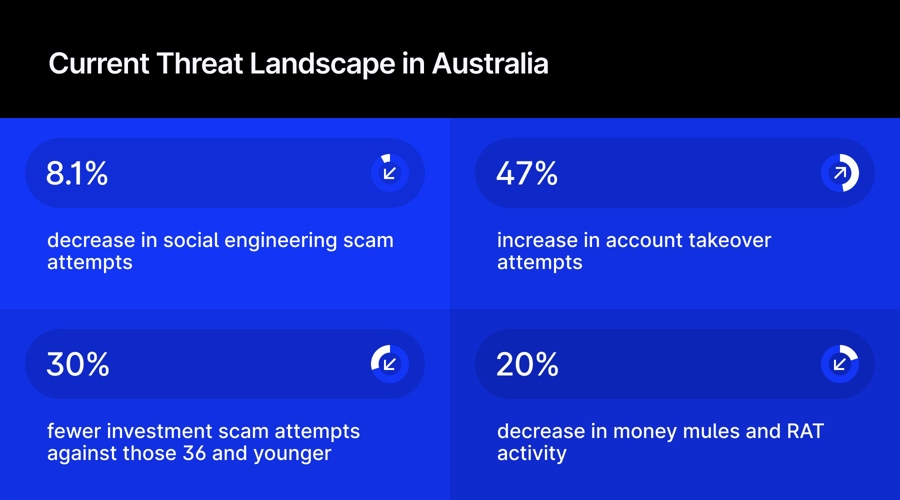
The company’s new 2025 Digital Banking Fraud Trends in Australia report showed mixed results across crime categories. There was a 20% drop in money-mule activity at participating banks, but account takeover attempts climbed 47% in the past year and more than doubled in the last six months.

Criminal Networks Expand Their Reach

Analysts also see a regional dimension behind the surge. OSINT Combine said many schemes originate from compounds across Southeast Asia.

“These compounds are not fringe criminal enclaves but entrenched infrastructures that exploit governance gaps, regional passivity, and parallel financial systems,” said Emerald Sage, principal intelligence advisor at OSINT Combine. She added that links to Chinese organized crime groups widen their reach across Asia.

Emerald Sage, Source: LinkedIn

The report includes a commentary from the Australian Payments Network. Head of Economic Crime Toby Evans argued that rapid innovation in payments has outpaced safety controls.

Related: Australia to Shut Down 95 Companies for Their Possible Links to “Hydra-Like” Scams

“The digital payments landscape continues to evolve, from AI-driven e-commerce to cross-border links between fast payment systems,” Evans said. “Each advance brings new opportunities, but also new risks. By embedding safety into systems from the start, payments can remain innovative, secure, and resilient without forcing consumers to shoulder risk.”

Shifts in Fraud Trends

Banks reported varied changes in scam types through 2025. Phone and purchase scams remained the most common. Social-engineering cases fell slightly in early 2025, likely because of seasonal patterns. Investment scams dropped overall, but the decline concentrated among younger users. Cases affecting those aged 56 and older rose 18%.

Remote Access Tool usage fell about 20% from 2024, suggesting criminals may favour more scalable social-engineering methods.Two more financial institutions, including Macquarie Bank, joined BioCatch Trust during the year. The network recently won industry awards for scam prevention and collaborative anti-fraud work.

The intelligence-sharing model is still new, but the early data suggests that banks have gained a wider view of high-risk behaviour. Whether the system can keep pace with accelerating account takeovers and increasingly coordinated criminal networks will shape Australia’s fraud landscape in the year ahead.

In a separate report, the Australian Securities and Investments Commission removed 6,900 investment scam and phishing websites in the year ending June 30. The action was part of ASIC ’s expanded efforts to protect consumers from online fraud.

The takedowns included around 2,800 fake investment platforms, 2,400 cryptocurrency scams, 1,400 phishing links, and 250 fraudulent online advertisements. During the same period, ASIC added 1,035 warnings to its Investor Alert List and issued consumer advisories on schemes targeting retirement savings.

Australian banks uncovered more than $60 million in suspected fraud attempts in the third quarter alone as a new real-time intelligence-sharing network analysed over 180 million payments worth more than $330 billion.

In the latest report, BioCatch Trust Australia, launched in late 2024, processed the payments between July and September 2025. The network now covers more than 85% of all banked Australians.

Rising Scam Pressure Through Behaviour Patterns

BioCatch executives say the system can retrieve a beneficiary’s account risk profile in more than 70% of transactions. This gives banks a clearer picture before money leaves a customer’s account.

“When the network makes that match, its signals now detect better than 70% of social engineering scam payments,” BioCatch SVP of Emerging Solutions and Network Tim Dalgleish said.

The company’s new 2025 Digital Banking Fraud Trends in Australia report showed mixed results across crime categories. There was a 20% drop in money-mule activity at participating banks, but account takeover attempts climbed 47% in the past year and more than doubled in the last six months.

Criminal Networks Expand Their Reach

Analysts also see a regional dimension behind the surge. OSINT Combine said many schemes originate from compounds across Southeast Asia.

“These compounds are not fringe criminal enclaves but entrenched infrastructures that exploit governance gaps, regional passivity, and parallel financial systems,” said Emerald Sage, principal intelligence advisor at OSINT Combine. She added that links to Chinese organized crime groups widen their reach across Asia.

Emerald Sage, Source: LinkedIn

The report includes a commentary from the Australian Payments Network. Head of Economic Crime Toby Evans argued that rapid innovation in payments has outpaced safety controls.

Related: Australia to Shut Down 95 Companies for Their Possible Links to “Hydra-Like” Scams

“The digital payments landscape continues to evolve, from AI-driven e-commerce to cross-border links between fast payment systems,” Evans said. “Each advance brings new opportunities, but also new risks. By embedding safety into systems from the start, payments can remain innovative, secure, and resilient without forcing consumers to shoulder risk.”

Shifts in Fraud Trends

Banks reported varied changes in scam types through 2025. Phone and purchase scams remained the most common. Social-engineering cases fell slightly in early 2025, likely because of seasonal patterns. Investment scams dropped overall, but the decline concentrated among younger users. Cases affecting those aged 56 and older rose 18%.

Remote Access Tool usage fell about 20% from 2024, suggesting criminals may favour more scalable social-engineering methods.Two more financial institutions, including Macquarie Bank, joined BioCatch Trust during the year. The network recently won industry awards for scam prevention and collaborative anti-fraud work.

The intelligence-sharing model is still new, but the early data suggests that banks have gained a wider view of high-risk behaviour. Whether the system can keep pace with accelerating account takeovers and increasingly coordinated criminal networks will shape Australia’s fraud landscape in the year ahead.

In a separate report, the Australian Securities and Investments Commission removed 6,900 investment scam and phishing websites in the year ending June 30. The action was part of ASIC ’s expanded efforts to protect consumers from online fraud.

The takedowns included around 2,800 fake investment platforms, 2,400 cryptocurrency scams, 1,400 phishing links, and 250 fraudulent online advertisements. During the same period, ASIC added 1,035 warnings to its Investor Alert List and issued consumer advisories on schemes targeting retirement savings.

About the Author: Jared Kirui
Jared Kirui
  • 2477 Articles
  • 50 Followers
About the Author: Jared Kirui
Jared is an experienced financial journalist passionate about all things forex and CFDs.
  • 2477 Articles
  • 50 Followers

More from the Author

Retail FX

!"#$%&'()*+,-./0123456789:;<=>?@ABCDEFGHIJKLMNOPQRSTUVWXYZ[\]^_`abcdefghijklmnopqrstuvwxyz{|} !"#$%&'()*+,-./0123456789:;<=>?@ABCDEFGHIJKLMNOPQRSTUVWXYZ[\]^_`abcdefghijklmnopqrstuvwxyz{|}