Sarafina Wolde Gabriel, CEO at Rightlander, highlights the difficulty of detecting potentially non-compliant content across fast-moving social media platforms.
Seventeen regulators joined the FCA’s Global Action Week targeting non-compliant finfluencers.
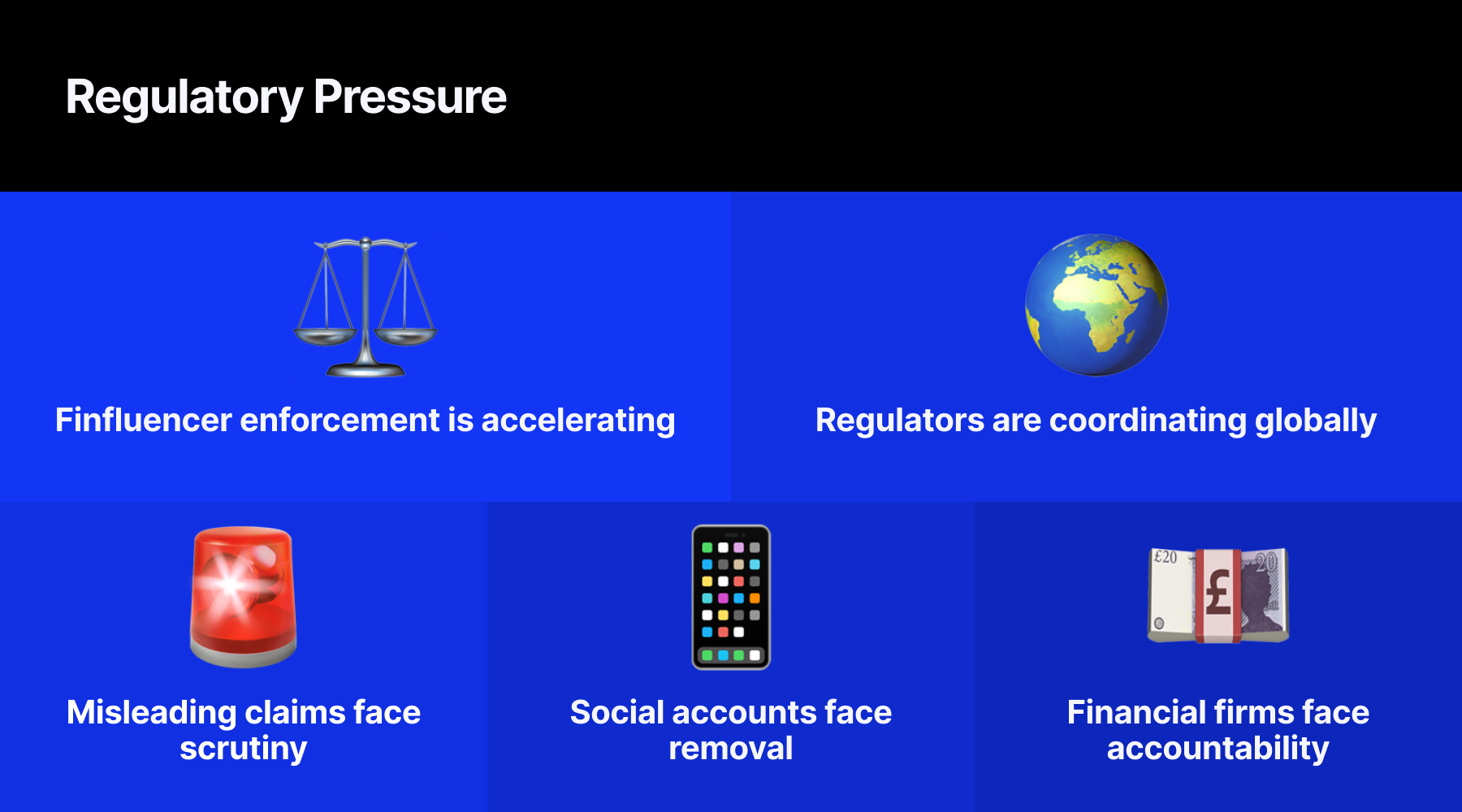
Enforcement on non-compliant finfluencers, the name given to
influencers that promote financial products and services, has accelerated in
2026. Regulators and courts in the UK, US, Canada, Australia, and India have
imposed more fines, market bans, and custodial sentences on finfluencers than
in previous years.
In recent years, there has been a notable increase in the
promotion of financial offers from ‘finfluencers’ with little or no background
in finance. They use their influence to advertise complex trading and
investment products to large audiences on social media and in messaging apps.
Whilst they may attract large audiences to promote to,
without a good understanding of or exposure to financial trading and investment
products, the potential risk of misinforming, making false claims, or
misleading can be high.
One of the biggest challenges when working with finfluencers
is visibility into published content. The sheer volume, speed, and often
short-lived nature of social media content make comprehensive manual monitoring
increasingly difficult.
Regulators around the world are raising the alarm on the
risks some finfluencers pose. In particular, regulators are focusing on
finfluencers that are making misleading investment claims, exaggerating
financial returns, or promoting products that are banned in specific markets.
Financial regulators have stepped up their finfluencer
enforcement in 2026. There also appears to be a concerted effort to go after
both finfluencers and the financial companies that are sponsoring them.
Following the Global Week of Action mentioned earlier, a
series of cases against unlawful finfluencers were brought in multiple
countries.
In the UK, the FCA:
● secured a guilty plea from the influencer Aaron Chalmers;
● began criminal proceedings against another two
individuals;
● sent four targeted warning letters to suspected
finfluencers;
● issued 34 new warning alerts;
● requested the removal of 120 social-media accounts; and
● identified 1,267 illegal financial adverts reaching at
least 2.34 million UK accounts.
Australia simultaneously issued four finfluencer warning
notices and heavily scrutinised 15 finfluencers working under financial
services licences.
ASIC Commissioner Alan Kirkland said, ‘Unlawful finfluencer
activity doesn’t respect borders, which is why regulators are taking strong
action together for a second year in a row.
‘What people see online is shaped by algorithms designed to
drive clicks and engagement, rather than promoting accurate information. This
means consumers are more exposed to biased or misleading content.’
Deciding which finfluencers to partner with requires more
than a sweep through their existing content. Brands need to make a detailed
assessment of the diverse content being produced, including text, video, and
images used. Similarly, the types of associations also need to be vetted for
credibility.
However, the risk doesn’t stop with what a finfluencer says;
it extends to how quickly and visibly they can become associated with your
brand. A tracking link, promo code, commission arrangement, or sponsored post
can create a clear financial connection.
And with new content being published,
shared, and updated around the clock, that connection can appear in minutes and
spread quickly. For financial brands, the challenge isn’t simply reviewing
content — it’s keeping pace with a constant stream of new posts, videos, and
promotions before potential compliance issues become blind spots.
In Australia, for example, ASIC’s stance is clear: those
holding financial services licences bear ultimate accountability for their
representatives. Regulators now demand evidence of proactive, documented
oversight of marketing partners, explicitly rejecting any ‘set-and-forget’ type
activity.
Reduce Risk When Working with Finfluencers
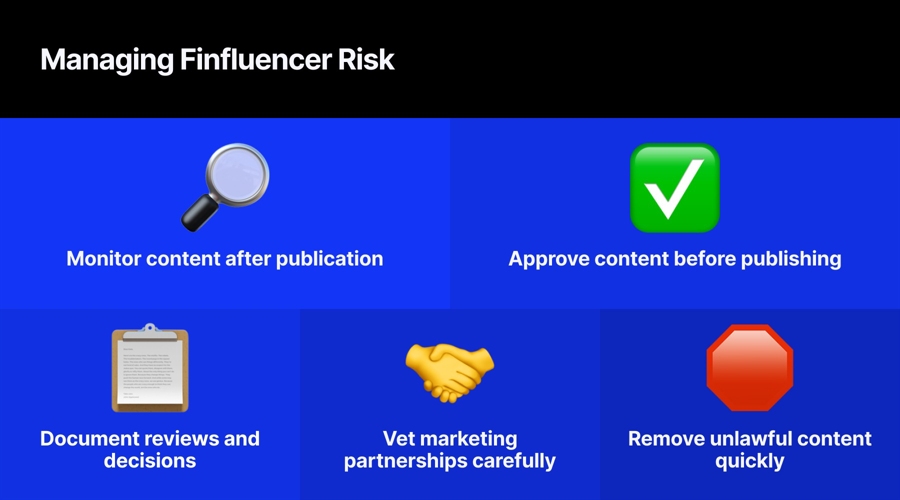
Companies should review their current policies when working
with finfluencers and satisfactorily ask these questions:
● Who can speak about your company's financial products?
● Which types of content specifically require approval
before publication?
● Are all posts monitored after going live?
● Can your company demonstrate what has been reviewed,
approved, or rejected?
● Are there company policies for taking down unlawful
content from finfluencers?
● Can unlawful content be quickly removed?
Financial companies working with finfluencers need to
demonstrate that they can hold these partners to account should any situation
arise. Finfluencer
marketing can be very powerful and generate lots of new business. However,
the inherent risks for finance brands are increasing with every passing year.
Finfluencer enforcement in 2026 has not been the exception;
it appears to be the new normal, which is something brands in this sector
should pay close attention to if they want to avoid regulatory scrutiny.
Enforcement on non-compliant finfluencers, the name given to
influencers that promote financial products and services, has accelerated in
2026. Regulators and courts in the UK, US, Canada, Australia, and India have
imposed more fines, market bans, and custodial sentences on finfluencers than
in previous years.
In recent years, there has been a notable increase in the
promotion of financial offers from ‘finfluencers’ with little or no background
in finance. They use their influence to advertise complex trading and
investment products to large audiences on social media and in messaging apps.
Whilst they may attract large audiences to promote to,
without a good understanding of or exposure to financial trading and investment
products, the potential risk of misinforming, making false claims, or
misleading can be high.
One of the biggest challenges when working with finfluencers
is visibility into published content. The sheer volume, speed, and often
short-lived nature of social media content make comprehensive manual monitoring
increasingly difficult.
Regulators around the world are raising the alarm on the
risks some finfluencers pose. In particular, regulators are focusing on
finfluencers that are making misleading investment claims, exaggerating
financial returns, or promoting products that are banned in specific markets.
Financial regulators have stepped up their finfluencer
enforcement in 2026. There also appears to be a concerted effort to go after
both finfluencers and the financial companies that are sponsoring them.
Following the Global Week of Action mentioned earlier, a
series of cases against unlawful finfluencers were brought in multiple
countries.
In the UK, the FCA:
● secured a guilty plea from the influencer Aaron Chalmers;
● began criminal proceedings against another two
individuals;
● sent four targeted warning letters to suspected
finfluencers;
● issued 34 new warning alerts;
● requested the removal of 120 social-media accounts; and
● identified 1,267 illegal financial adverts reaching at
least 2.34 million UK accounts.
Australia simultaneously issued four finfluencer warning
notices and heavily scrutinised 15 finfluencers working under financial
services licences.
ASIC Commissioner Alan Kirkland said, ‘Unlawful finfluencer
activity doesn’t respect borders, which is why regulators are taking strong
action together for a second year in a row.
‘What people see online is shaped by algorithms designed to
drive clicks and engagement, rather than promoting accurate information. This
means consumers are more exposed to biased or misleading content.’
Deciding which finfluencers to partner with requires more
than a sweep through their existing content. Brands need to make a detailed
assessment of the diverse content being produced, including text, video, and
images used. Similarly, the types of associations also need to be vetted for
credibility.
However, the risk doesn’t stop with what a finfluencer says;
it extends to how quickly and visibly they can become associated with your
brand. A tracking link, promo code, commission arrangement, or sponsored post
can create a clear financial connection.
And with new content being published,
shared, and updated around the clock, that connection can appear in minutes and
spread quickly. For financial brands, the challenge isn’t simply reviewing
content — it’s keeping pace with a constant stream of new posts, videos, and
promotions before potential compliance issues become blind spots.
In Australia, for example, ASIC’s stance is clear: those
holding financial services licences bear ultimate accountability for their
representatives. Regulators now demand evidence of proactive, documented
oversight of marketing partners, explicitly rejecting any ‘set-and-forget’ type
activity.
Reduce Risk When Working with Finfluencers
Companies should review their current policies when working
with finfluencers and satisfactorily ask these questions:
● Who can speak about your company's financial products?
● Which types of content specifically require approval
before publication?
● Are all posts monitored after going live?
● Can your company demonstrate what has been reviewed,
approved, or rejected?
● Are there company policies for taking down unlawful
content from finfluencers?
● Can unlawful content be quickly removed?
Financial companies working with finfluencers need to
demonstrate that they can hold these partners to account should any situation
arise. Finfluencer
marketing can be very powerful and generate lots of new business. However,
the inherent risks for finance brands are increasing with every passing year.
Finfluencer enforcement in 2026 has not been the exception;
it appears to be the new normal, which is something brands in this sector
should pay close attention to if they want to avoid regulatory scrutiny.
Sarafina Wolde Gabriel has over 19 years of experience in digital marketing and more than a decade’s worth of expertise in leadership within the performance and affiliate marketing sectors. Sarafina joined Paysafe’s Income Access, a digital marketing technology and services provider, in 2004. Serving as Director of Affiliate Marketing, she successfully managed the affiliate department, which collected six awards for the Best Affiliate Network. She then served as the company’s CMO until 2016, which saw the company pick up five awards in the ‘Best Affiliate Software’ category, as well as three ‘Best Acquisition Partner’ awards.
Currently serving as Chief Strategy Officer at Rightlander, a marketing compliance company, Sarafina’s responsibilities include developing business strategies to help grow and expand into new markets and verticals, evaluate new product opportunities and build strategic partnerships.
Google Takes Back Its Danish CFD Ad Ban and Throws In Chile
Featured Videos
How Much Are CFD Industry Executives Making; Plus500 Buys Brazilian Broker
How Much Are CFD Industry Executives Making; Plus500 Buys Brazilian Broker
How Much Are CFD Industry Executives Making; Plus500 Buys Brazilian Broker
How Much Are CFD Industry Executives Making; Plus500 Buys Brazilian Broker
Today’s financial news recap covers FinTop Consulting shared its 2026 salary surveys for Dubai, London and Cyprus with Finance Magnates, Plus500 buys a Brazilian broker, and Google opens the door to CFD ads in Denmark and Chile.
Finance Magnates Daily Recap brings you the latest news from forex and CFD brokers, fintech, payments, cryptocurrency, digital assets, trading platforms, financial regulation and global markets.
Get the key company news, executive moves, deals, regulatory updates and market developments of the day, in just a few minutes. New episodes published every weekday.
Read more: https://www.financemagnates.com
#FinanceMagnates #ForexNews #FintechNews
Today’s financial news recap covers FinTop Consulting shared its 2026 salary surveys for Dubai, London and Cyprus with Finance Magnates, Plus500 buys a Brazilian broker, and Google opens the door to CFD ads in Denmark and Chile.
Finance Magnates Daily Recap brings you the latest news from forex and CFD brokers, fintech, payments, cryptocurrency, digital assets, trading platforms, financial regulation and global markets.
Get the key company news, executive moves, deals, regulatory updates and market developments of the day, in just a few minutes. New episodes published every weekday.
Read more: https://www.financemagnates.com
#FinanceMagnates #ForexNews #FintechNews
Today’s financial news recap covers FinTop Consulting shared its 2026 salary surveys for Dubai, London and Cyprus with Finance Magnates, Plus500 buys a Brazilian broker, and Google opens the door to CFD ads in Denmark and Chile.
Finance Magnates Daily Recap brings you the latest news from forex and CFD brokers, fintech, payments, cryptocurrency, digital assets, trading platforms, financial regulation and global markets.
Get the key company news, executive moves, deals, regulatory updates and market developments of the day, in just a few minutes. New episodes published every weekday.
Read more: https://www.financemagnates.com
#FinanceMagnates #ForexNews #FintechNews
Today’s financial news recap covers FinTop Consulting shared its 2026 salary surveys for Dubai, London and Cyprus with Finance Magnates, Plus500 buys a Brazilian broker, and Google opens the door to CFD ads in Denmark and Chile.
Finance Magnates Daily Recap brings you the latest news from forex and CFD brokers, fintech, payments, cryptocurrency, digital assets, trading platforms, financial regulation and global markets.
Get the key company news, executive moves, deals, regulatory updates and market developments of the day, in just a few minutes. New episodes published every weekday.
Read more: https://www.financemagnates.com
#FinanceMagnates #ForexNews #FintechNews
Capital.com UAE Clients Trade $1T in H1; Saxo Signs Nine Athletes
Capital.com UAE Clients Trade $1T in H1; Saxo Signs Nine Athletes
Capital.com UAE Clients Trade $1T in H1; Saxo Signs Nine Athletes
Capital.com UAE Clients Trade $1T in H1; Saxo Signs Nine Athletes
Capital.com UAE Clients Trade $1T in H1; Saxo Signs Nine Athletes
Capital.com UAE Clients Trade $1T in H1; Saxo Signs Nine Athletes
Today’s financial news recap covers Capital.com’s trading data, Saxo Bank’s athlete campaign, Revolut’s Gibraltar crypto licence, and eToro’s new desktop terminal.
Finance Magnates Daily Recap brings you the latest news from forex and CFD brokers, fintech, payments, cryptocurrency, digital assets, trading platforms, financial regulation and global markets.
Get the key company news, executive moves, deals, regulatory updates and market developments of the day, in just a few minutes. New episodes published every weekday.
Read more: https://www.financemagnates.com
#FinanceMagnates #ForexNews #FintechNews
Today’s financial news recap covers Capital.com’s trading data, Saxo Bank’s athlete campaign, Revolut’s Gibraltar crypto licence, and eToro’s new desktop terminal.
Finance Magnates Daily Recap brings you the latest news from forex and CFD brokers, fintech, payments, cryptocurrency, digital assets, trading platforms, financial regulation and global markets.
Get the key company news, executive moves, deals, regulatory updates and market developments of the day, in just a few minutes. New episodes published every weekday.
Read more: https://www.financemagnates.com
#FinanceMagnates #ForexNews #FintechNews
Today’s financial news recap covers Capital.com’s trading data, Saxo Bank’s athlete campaign, Revolut’s Gibraltar crypto licence, and eToro’s new desktop terminal.
Finance Magnates Daily Recap brings you the latest news from forex and CFD brokers, fintech, payments, cryptocurrency, digital assets, trading platforms, financial regulation and global markets.
Get the key company news, executive moves, deals, regulatory updates and market developments of the day, in just a few minutes. New episodes published every weekday.
Read more: https://www.financemagnates.com
#FinanceMagnates #ForexNews #FintechNews
Today’s financial news recap covers Capital.com’s trading data, Saxo Bank’s athlete campaign, Revolut’s Gibraltar crypto licence, and eToro’s new desktop terminal.
Finance Magnates Daily Recap brings you the latest news from forex and CFD brokers, fintech, payments, cryptocurrency, digital assets, trading platforms, financial regulation and global markets.
Get the key company news, executive moves, deals, regulatory updates and market developments of the day, in just a few minutes. New episodes published every weekday.
Read more: https://www.financemagnates.com
#FinanceMagnates #ForexNews #FintechNews
Today’s financial news recap covers Capital.com’s trading data, Saxo Bank’s athlete campaign, Revolut’s Gibraltar crypto licence, and eToro’s new desktop terminal.
Finance Magnates Daily Recap brings you the latest news from forex and CFD brokers, fintech, payments, cryptocurrency, digital assets, trading platforms, financial regulation and global markets.
Get the key company news, executive moves, deals, regulatory updates and market developments of the day, in just a few minutes. New episodes published every weekday.
Read more: https://www.financemagnates.com
#FinanceMagnates #ForexNews #FintechNews
Today’s financial news recap covers Capital.com’s trading data, Saxo Bank’s athlete campaign, Revolut’s Gibraltar crypto licence, and eToro’s new desktop terminal.
Finance Magnates Daily Recap brings you the latest news from forex and CFD brokers, fintech, payments, cryptocurrency, digital assets, trading platforms, financial regulation and global markets.
Get the key company news, executive moves, deals, regulatory updates and market developments of the day, in just a few minutes. New episodes published every weekday.
Read more: https://www.financemagnates.com
#FinanceMagnates #ForexNews #FintechNews
CXM Group to Buy TD Markets; Interactive Brokers Raises Dividend
CXM Group to Buy TD Markets; Interactive Brokers Raises Dividend
CXM Group to Buy TD Markets; Interactive Brokers Raises Dividend
CXM Group to Buy TD Markets; Interactive Brokers Raises Dividend
CXM Group to Buy TD Markets; Interactive Brokers Raises Dividend
CXM Group to Buy TD Markets; Interactive Brokers Raises Dividend
Today’s financial news recap covers CXM Group agrees to acquire TD Markets, Interactive Brokers raises its dividend, Your Bourse and 4XPORTAL formalise a technology partnership, and IC completes its rebranding from IC Markets.
Finance Magnates Daily Recap brings you the latest news from forex and CFD brokers, fintech, payments, cryptocurrency, digital assets, trading platforms, financial regulation and global markets.
Get the key company news, executive moves, deals, regulatory updates and market developments of the day, in just a few minutes. New episodes published every weekday.
Read more: https://www.financemagnates.com
#FinanceMagnates #ForexNews #FintechNews
Today’s financial news recap covers CXM Group agrees to acquire TD Markets, Interactive Brokers raises its dividend, Your Bourse and 4XPORTAL formalise a technology partnership, and IC completes its rebranding from IC Markets.
Finance Magnates Daily Recap brings you the latest news from forex and CFD brokers, fintech, payments, cryptocurrency, digital assets, trading platforms, financial regulation and global markets.
Get the key company news, executive moves, deals, regulatory updates and market developments of the day, in just a few minutes. New episodes published every weekday.
Read more: https://www.financemagnates.com
#FinanceMagnates #ForexNews #FintechNews
Today’s financial news recap covers CXM Group agrees to acquire TD Markets, Interactive Brokers raises its dividend, Your Bourse and 4XPORTAL formalise a technology partnership, and IC completes its rebranding from IC Markets.
Finance Magnates Daily Recap brings you the latest news from forex and CFD brokers, fintech, payments, cryptocurrency, digital assets, trading platforms, financial regulation and global markets.
Get the key company news, executive moves, deals, regulatory updates and market developments of the day, in just a few minutes. New episodes published every weekday.
Read more: https://www.financemagnates.com
#FinanceMagnates #ForexNews #FintechNews
Today’s financial news recap covers CXM Group agrees to acquire TD Markets, Interactive Brokers raises its dividend, Your Bourse and 4XPORTAL formalise a technology partnership, and IC completes its rebranding from IC Markets.
Finance Magnates Daily Recap brings you the latest news from forex and CFD brokers, fintech, payments, cryptocurrency, digital assets, trading platforms, financial regulation and global markets.
Get the key company news, executive moves, deals, regulatory updates and market developments of the day, in just a few minutes. New episodes published every weekday.
Read more: https://www.financemagnates.com
#FinanceMagnates #ForexNews #FintechNews
Today’s financial news recap covers CXM Group agrees to acquire TD Markets, Interactive Brokers raises its dividend, Your Bourse and 4XPORTAL formalise a technology partnership, and IC completes its rebranding from IC Markets.
Finance Magnates Daily Recap brings you the latest news from forex and CFD brokers, fintech, payments, cryptocurrency, digital assets, trading platforms, financial regulation and global markets.
Get the key company news, executive moves, deals, regulatory updates and market developments of the day, in just a few minutes. New episodes published every weekday.
Read more: https://www.financemagnates.com
#FinanceMagnates #ForexNews #FintechNews
Today’s financial news recap covers CXM Group agrees to acquire TD Markets, Interactive Brokers raises its dividend, Your Bourse and 4XPORTAL formalise a technology partnership, and IC completes its rebranding from IC Markets.
Finance Magnates Daily Recap brings you the latest news from forex and CFD brokers, fintech, payments, cryptocurrency, digital assets, trading platforms, financial regulation and global markets.
Get the key company news, executive moves, deals, regulatory updates and market developments of the day, in just a few minutes. New episodes published every weekday.
Read more: https://www.financemagnates.com
#FinanceMagnates #ForexNews #FintechNews
Trade Nation Enters Poland; FCA Finds Gaps at Seven Brokers
Trade Nation Enters Poland; FCA Finds Gaps at Seven Brokers
Trade Nation Enters Poland; FCA Finds Gaps at Seven Brokers
Trade Nation Enters Poland; FCA Finds Gaps at Seven Brokers
Trade Nation Enters Poland; FCA Finds Gaps at Seven Brokers
Trade Nation Enters Poland; FCA Finds Gaps at Seven Brokers
Today’s financial news recap covers Trade Nation expands into Poland, the FCA finds surveillance gaps at seven UK retail brokers, perpetual futures on US stocks could launch within weeks, and Australia's crypto platforms face a new regulatory deadline.
Finance Magnates Daily Recap brings you the latest news from forex and CFD brokers, fintech, payments, cryptocurrency, digital assets, trading platforms, financial regulation and global markets.
Get the key company news, executive moves, deals, regulatory updates and market developments of the day, in just a few minutes. New episodes published every weekday.
Read more: https://www.financemagnates.com
#FinanceMagnates #ForexNews #FintechNews
Today’s financial news recap covers Trade Nation expands into Poland, the FCA finds surveillance gaps at seven UK retail brokers, perpetual futures on US stocks could launch within weeks, and Australia's crypto platforms face a new regulatory deadline.
Finance Magnates Daily Recap brings you the latest news from forex and CFD brokers, fintech, payments, cryptocurrency, digital assets, trading platforms, financial regulation and global markets.
Get the key company news, executive moves, deals, regulatory updates and market developments of the day, in just a few minutes. New episodes published every weekday.
Read more: https://www.financemagnates.com
#FinanceMagnates #ForexNews #FintechNews
Today’s financial news recap covers Trade Nation expands into Poland, the FCA finds surveillance gaps at seven UK retail brokers, perpetual futures on US stocks could launch within weeks, and Australia's crypto platforms face a new regulatory deadline.
Finance Magnates Daily Recap brings you the latest news from forex and CFD brokers, fintech, payments, cryptocurrency, digital assets, trading platforms, financial regulation and global markets.
Get the key company news, executive moves, deals, regulatory updates and market developments of the day, in just a few minutes. New episodes published every weekday.
Read more: https://www.financemagnates.com
#FinanceMagnates #ForexNews #FintechNews
Today’s financial news recap covers Trade Nation expands into Poland, the FCA finds surveillance gaps at seven UK retail brokers, perpetual futures on US stocks could launch within weeks, and Australia's crypto platforms face a new regulatory deadline.
Finance Magnates Daily Recap brings you the latest news from forex and CFD brokers, fintech, payments, cryptocurrency, digital assets, trading platforms, financial regulation and global markets.
Get the key company news, executive moves, deals, regulatory updates and market developments of the day, in just a few minutes. New episodes published every weekday.
Read more: https://www.financemagnates.com
#FinanceMagnates #ForexNews #FintechNews
Today’s financial news recap covers Trade Nation expands into Poland, the FCA finds surveillance gaps at seven UK retail brokers, perpetual futures on US stocks could launch within weeks, and Australia's crypto platforms face a new regulatory deadline.
Finance Magnates Daily Recap brings you the latest news from forex and CFD brokers, fintech, payments, cryptocurrency, digital assets, trading platforms, financial regulation and global markets.
Get the key company news, executive moves, deals, regulatory updates and market developments of the day, in just a few minutes. New episodes published every weekday.
Read more: https://www.financemagnates.com
#FinanceMagnates #ForexNews #FintechNews
Today’s financial news recap covers Trade Nation expands into Poland, the FCA finds surveillance gaps at seven UK retail brokers, perpetual futures on US stocks could launch within weeks, and Australia's crypto platforms face a new regulatory deadline.
Finance Magnates Daily Recap brings you the latest news from forex and CFD brokers, fintech, payments, cryptocurrency, digital assets, trading platforms, financial regulation and global markets.
Get the key company news, executive moves, deals, regulatory updates and market developments of the day, in just a few minutes. New episodes published every weekday.
Read more: https://www.financemagnates.com
#FinanceMagnates #ForexNews #FintechNews
FxPro Sells EU Clients to Capital.com; NAGA H1 Profit Revised
FxPro Sells EU Clients to Capital.com; NAGA H1 Profit Revised
FxPro Sells EU Clients to Capital.com; NAGA H1 Profit Revised
FxPro Sells EU Clients to Capital.com; NAGA H1 Profit Revised
FxPro Sells EU Clients to Capital.com; NAGA H1 Profit Revised
FxPro Sells EU Clients to Capital.com; NAGA H1 Profit Revised
Today’s financial news recap covers FxPro agrees to sell its European client book to Capital.com, NAGA raises its first-half profit estimate, Trade Republic prepares a fee-free pension account, and Interactive Brokers introduces Ether staking.
Finance Magnates Daily Recap brings you the latest news from forex and CFD brokers, fintech, payments, cryptocurrency, digital assets, trading platforms, financial regulation and global markets.
Get the key company news, executive moves, deals, regulatory updates and market developments of the day, in just a few minutes. New episodes published every weekday.
Read more: https://www.financemagnates.com
#FinanceMagnates #ForexNews #FintechNews
Today’s financial news recap covers FxPro agrees to sell its European client book to Capital.com, NAGA raises its first-half profit estimate, Trade Republic prepares a fee-free pension account, and Interactive Brokers introduces Ether staking.
Finance Magnates Daily Recap brings you the latest news from forex and CFD brokers, fintech, payments, cryptocurrency, digital assets, trading platforms, financial regulation and global markets.
Get the key company news, executive moves, deals, regulatory updates and market developments of the day, in just a few minutes. New episodes published every weekday.
Read more: https://www.financemagnates.com
#FinanceMagnates #ForexNews #FintechNews
Today’s financial news recap covers FxPro agrees to sell its European client book to Capital.com, NAGA raises its first-half profit estimate, Trade Republic prepares a fee-free pension account, and Interactive Brokers introduces Ether staking.
Finance Magnates Daily Recap brings you the latest news from forex and CFD brokers, fintech, payments, cryptocurrency, digital assets, trading platforms, financial regulation and global markets.
Get the key company news, executive moves, deals, regulatory updates and market developments of the day, in just a few minutes. New episodes published every weekday.
Read more: https://www.financemagnates.com
#FinanceMagnates #ForexNews #FintechNews
Today’s financial news recap covers FxPro agrees to sell its European client book to Capital.com, NAGA raises its first-half profit estimate, Trade Republic prepares a fee-free pension account, and Interactive Brokers introduces Ether staking.
Finance Magnates Daily Recap brings you the latest news from forex and CFD brokers, fintech, payments, cryptocurrency, digital assets, trading platforms, financial regulation and global markets.
Get the key company news, executive moves, deals, regulatory updates and market developments of the day, in just a few minutes. New episodes published every weekday.
Read more: https://www.financemagnates.com
#FinanceMagnates #ForexNews #FintechNews
Today’s financial news recap covers FxPro agrees to sell its European client book to Capital.com, NAGA raises its first-half profit estimate, Trade Republic prepares a fee-free pension account, and Interactive Brokers introduces Ether staking.
Finance Magnates Daily Recap brings you the latest news from forex and CFD brokers, fintech, payments, cryptocurrency, digital assets, trading platforms, financial regulation and global markets.
Get the key company news, executive moves, deals, regulatory updates and market developments of the day, in just a few minutes. New episodes published every weekday.
Read more: https://www.financemagnates.com
#FinanceMagnates #ForexNews #FintechNews
Today’s financial news recap covers FxPro agrees to sell its European client book to Capital.com, NAGA raises its first-half profit estimate, Trade Republic prepares a fee-free pension account, and Interactive Brokers introduces Ether staking.
Finance Magnates Daily Recap brings you the latest news from forex and CFD brokers, fintech, payments, cryptocurrency, digital assets, trading platforms, financial regulation and global markets.
Get the key company news, executive moves, deals, regulatory updates and market developments of the day, in just a few minutes. New episodes published every weekday.
Read more: https://www.financemagnates.com
#FinanceMagnates #ForexNews #FintechNews