Axi, Hantec Markets, OANDA and IC Markets now offer prop trading.
CFD brokers offer a safer and more regulated trading environment, unlike other prop firms.
Proprietary
trading has become a hot topic in recent months, drawing attention from retail investors and sparking regulation controversies. After unlicensed companies failed to maintain traders' trust, FX/CFD brokers started offering prop trading services, recognizing a new niche in the industry. As experts interviewed by Finance Magnates claim, the niche can be really rewarding in the near future. Prop trading is set to become the next revolution and the future for the CFD sector.
Four companies, including OANDA, Axi, IC Markets, and Hantec Markets, have decided to pursue this market so far. In this article, we compare their
"challenges" and trading conditions.
FX/CFD Brokers Join the
Prop Trading Boom
Modern prop
firms allow retail traders to leverage significant amounts of the brokerage’s
capital without risking their own funds. Trading is predominantly conducted
with virtual funds, yet the profits are real.
To qualify,
traders typically pay a small fee to enter an evaluation process where they
demonstrate their skills through simulated trading. Successful traders gain
access to a funded account and keep a substantial portion of the profits they
generate, often between 60-90%.
This model
is particularly enticing for novice investors: Imagine accessing an account
worth $100,000 for just a few hundred dollars. This undoubtedly ignites traders' imaginations and contributes to the popularity of prop trading.
Currently,
these include OANDA, which introduced OANDA Labs Prop Trader, Axi with its Axi
Select, Hantec Markets launching Hantec Trader, and IC Markets with IC Funded.
Axi Select and the
"100% Free" Funded Trader Program
Axi was a
pioneer among FX/CFD brokers to implement a prop trading service. As part of
its new product Axi Select, it offered retail investors the opportunity to access up to $1 million in capital last September. Unlike traditional prop
trading firms, this service has no registration or monthly fees and is promoted
as a “100% Free” funded trading program. However, it is not entirely free of
charge. To join the first available stage, an initial capital is required.
Investors
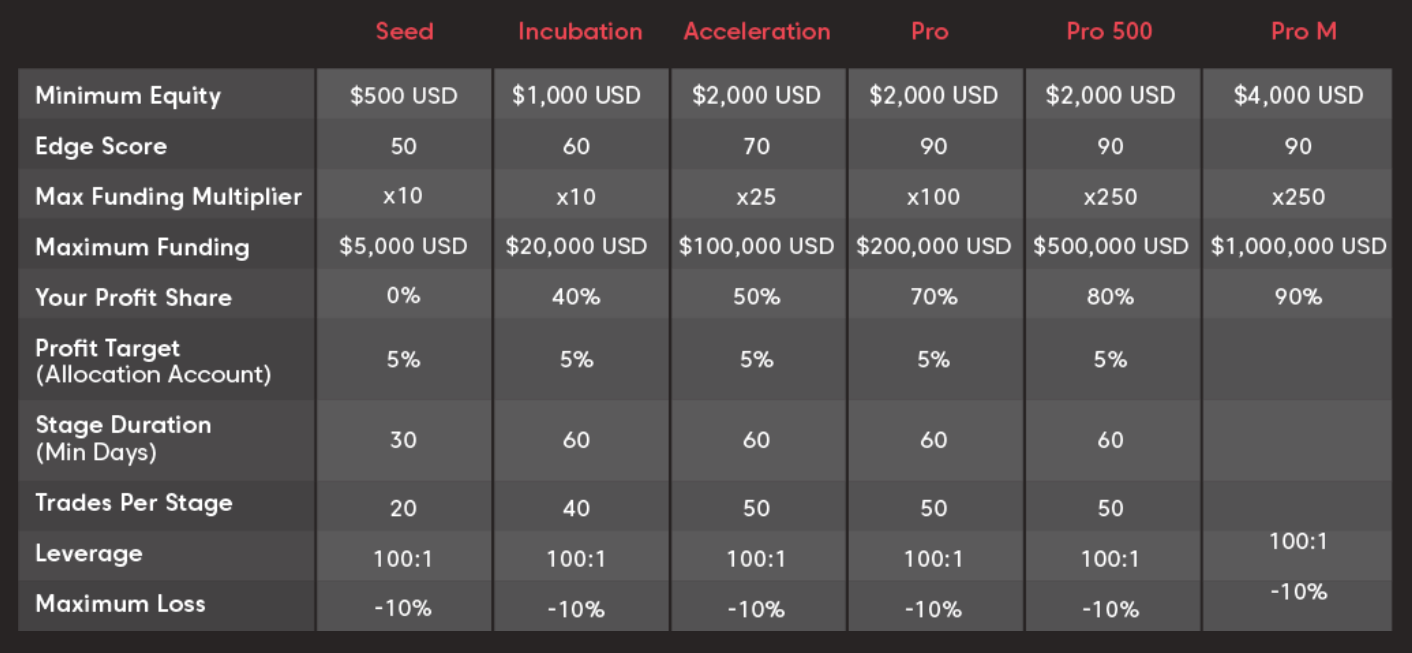
start with at least $500 at the "Seed" stage, during which they can
receive maximum funding of $5,000. If they achieve a profit target of 5%, they
can progress to the next level. Interestingly, Axi Select does not use a demo account model but instead offers live trading. At the same time, it claims that demo prop trading may soon collapse.
There are
six levels in total, each with increasing minimum equity requirements, up to
$40,000. With each level, the maximum financing and profit share also increase.
Like standard prop firm offerings, there is also a maximum loss limit set at
10% per stage; exceeding this sends the account into "quarantine."
Axi Select
OANDA Labs Prop Trader and
Accounts up to $500,000
A few
months after Axi, in late January 2024, OANDA launched the OANDA Labs Prop
Trader service. Its offer closely resembles those well-known from other props: traders
select one of the available "challenges" to join, pay a startup fee,
and gain access to an account of a specified amount.
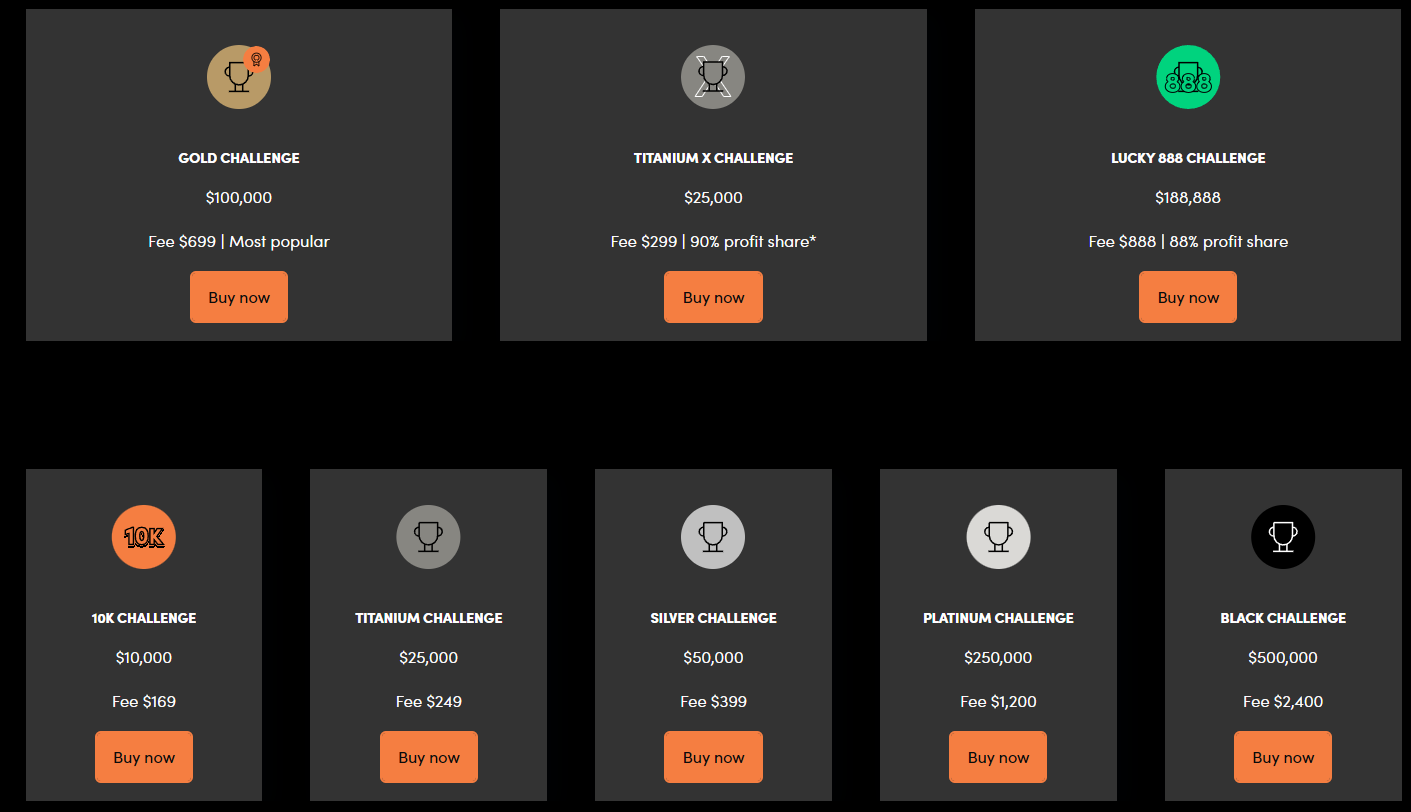
The first
challenge is available from $169, providing investors with $10,000 in virtual
funds. There are two profit targets to achieve: the first at 8% and the second
at 5%. Daily account losses cannot exceed 5%, and the maximum drawdown is 10%,
with the profit share in this challenge being 80%.
Unlike
other platforms, challenges are not tiered; beginners can start immediately
from the most expensive Black Challenge, which has a fee of $2,400 and an account worth $500,000. If daily or cumulative losses are exceeded, the challenge is lost, but it can be reattempted with a 20% discount.
OANDA Labs Prop Trader
Hantec Trader Offers Simple
Structure and $200,000
Just a day
later, Hantec Markets also presented its prop trading offer through the newly
opened entity, Hantec Trader. Like its competitors, trading takes place on
virtual funds, but the process of selecting challenges has been significantly
simplified.
Traders can
choose between two of them: Hantec Express Trader and Hantec Enhanced Trader.
In both cases, funded accounts range from $2,000 to $200,000. Traders must pay
an initial fee ranging from $39 to $999 (refundable for profitable traders) and
then meet the challenge conditions. In Express Trader, only one stage is
required per challenge, while in Enhanced Trader, there are two stages.
After
achieving the profit target, traders have the opportunity to scale up to the
next challenge free of charge. To do this, they must attempt the same challenge
again, ultimately reaching up to $200,000 without additional fees.
The profit
split in Hantec Trader can be up to 75%, but it can be increased to 90% through
the purchase of special add-ons, which also increase the initial fee.
"Hantec
Trader has experienced strong double-digit month-on-month growth since its
launch, and we anticipate this trend will continue for the remainder of the
year,” said Bashar Gokal, the Operations Manager at Hantec Trader. “It’s
evident that customers are seeking reliable and experienced firms to partner
with, given the ongoing uncertainty in the industry. We expect the demand for prop
trading to continue growing as prop trading providers target new market segments."
Hantec Trader
IC Markets Implements IC
Funded with up to 80% Gain Share
The latest
broker to enter the world of prop trading was IC Markets. In March, it
soft-launched IC Funded, where retail investors can obtain up to $500,000 in
funding and up to 80% gain share. However it looks like the platform is still
in the beta testing phase.
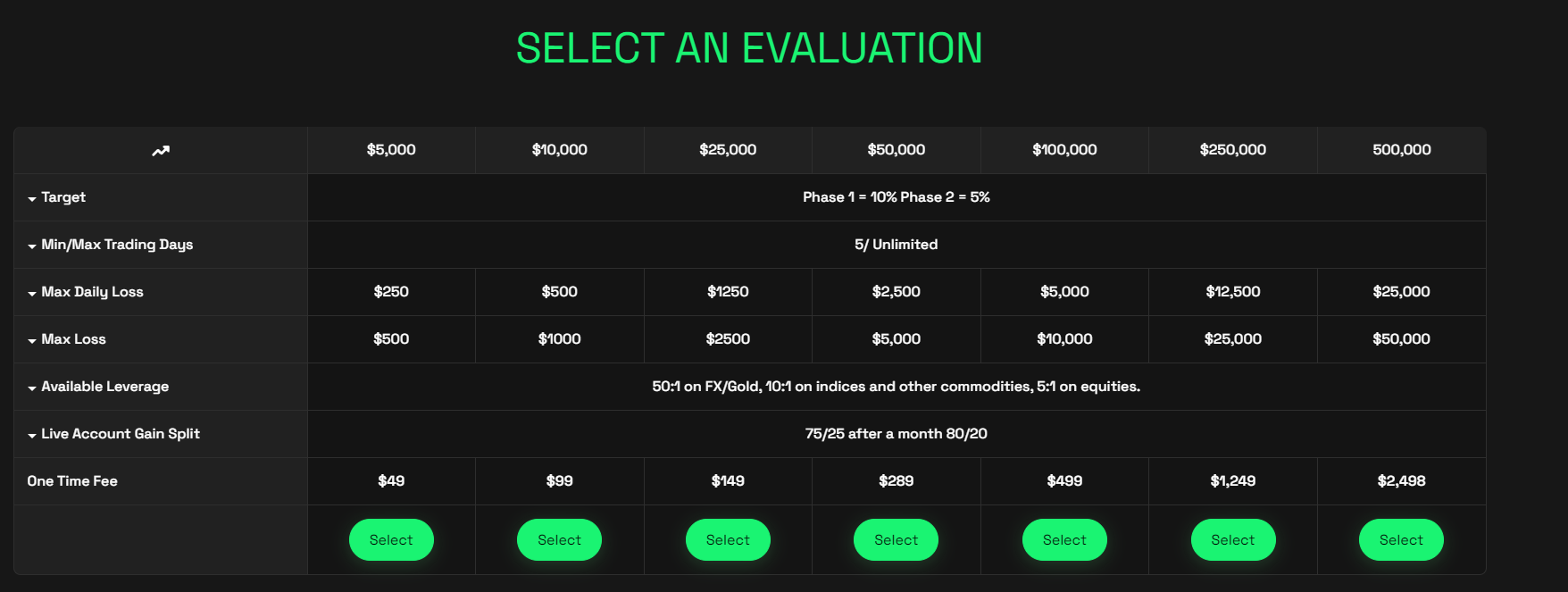
The offer
is also based on tiers and challenges, though IC Funded terms them
"evaluations." The first evaluation stage starts with a one-time
fee of $49 and an account funded with $5,000.
The
evaluation is divided into two stages, the first with a profit target of 10%
and the second of 5%. The maximum daily loss cannot exceed 5%, and the maximum
cumulative drawdown is 10%. These rules apply to all subsequent evaluations, of
which there are seven in total.
At the
highest level, the one-time fee is $2,498, allowing for trading with $500,000.
However, the profit split is not dependent on the trader's level but on the
duration of cooperation with IC Funded. During the first month, it is up to
75%, and after that, it is up to 80%.
IC Funded
Which Offer is the Best?
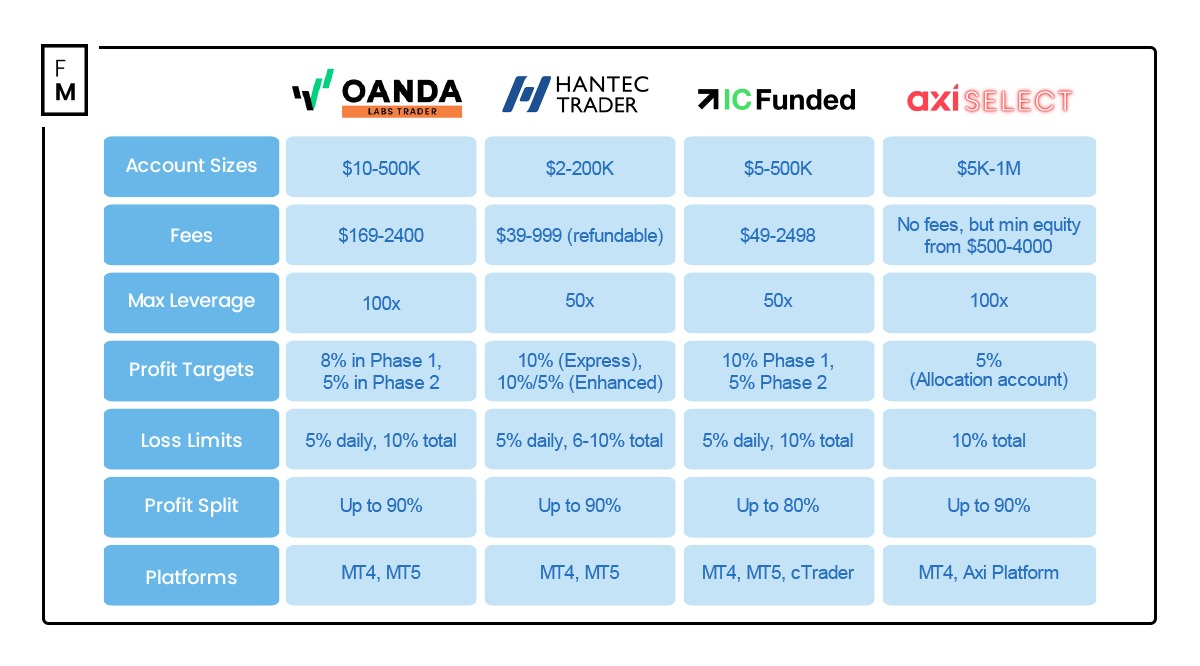
The products of various FX/CFD brokers offering prop trading are very similar regarding platforms, profit splits, loss limits, and leverage. Differences can
be seen in the profit target, with Axi Select having the lowest entry
threshold. Although the company suggests that it does not charge fees, the
smallest account must have a deposit of at least $500.
On the
other hand, Hantec Trader stands out for the lowest fees. The cheapest challenge costs $39, and the smallest account size is $2,000. However, for
$49 at IC Funded, traders can receive an account worth $5,000.
OANDA Labs
Trader appears to have the best ratio of the lowest challenge price to
account size. For $169, the investor gets an account worth $10,000, and the first
profit target is not the standard 10% but 8%.
Before deciding on a specific platform, it is worthwhile
to compare details, such as the possibility of hedging, the necessity (or
absence) of using stop losses, the ability to trade on macroeconomic data, the
use of copy trading, etc.
Industry
professionals Finance Magnates spoke with in the newest Quarterly
Industry Report overwhelmingly agree that modern prop trading could be the
future and an important part of the development of FX/CFD brokers. "I
believe this is obvious," commented Maciej Wojciechowski, the Head of
Business Development at OnEquity.
Proprietary
trading has become a hot topic in recent months, drawing attention from retail investors and sparking regulation controversies. After unlicensed companies failed to maintain traders' trust, FX/CFD brokers started offering prop trading services, recognizing a new niche in the industry. As experts interviewed by Finance Magnates claim, the niche can be really rewarding in the near future. Prop trading is set to become the next revolution and the future for the CFD sector.
Four companies, including OANDA, Axi, IC Markets, and Hantec Markets, have decided to pursue this market so far. In this article, we compare their
"challenges" and trading conditions.
FX/CFD Brokers Join the
Prop Trading Boom
Modern prop
firms allow retail traders to leverage significant amounts of the brokerage’s
capital without risking their own funds. Trading is predominantly conducted
with virtual funds, yet the profits are real.
To qualify,
traders typically pay a small fee to enter an evaluation process where they
demonstrate their skills through simulated trading. Successful traders gain
access to a funded account and keep a substantial portion of the profits they
generate, often between 60-90%.
This model
is particularly enticing for novice investors: Imagine accessing an account
worth $100,000 for just a few hundred dollars. This undoubtedly ignites traders' imaginations and contributes to the popularity of prop trading.
Currently,
these include OANDA, which introduced OANDA Labs Prop Trader, Axi with its Axi
Select, Hantec Markets launching Hantec Trader, and IC Markets with IC Funded.
Axi Select and the
"100% Free" Funded Trader Program
Axi was a
pioneer among FX/CFD brokers to implement a prop trading service. As part of
its new product Axi Select, it offered retail investors the opportunity to access up to $1 million in capital last September. Unlike traditional prop
trading firms, this service has no registration or monthly fees and is promoted
as a “100% Free” funded trading program. However, it is not entirely free of
charge. To join the first available stage, an initial capital is required.
Investors
start with at least $500 at the "Seed" stage, during which they can
receive maximum funding of $5,000. If they achieve a profit target of 5%, they
can progress to the next level. Interestingly, Axi Select does not use a demo account model but instead offers live trading. At the same time, it claims that demo prop trading may soon collapse.
There are
six levels in total, each with increasing minimum equity requirements, up to
$40,000. With each level, the maximum financing and profit share also increase.
Like standard prop firm offerings, there is also a maximum loss limit set at
10% per stage; exceeding this sends the account into "quarantine."
Axi Select
OANDA Labs Prop Trader and
Accounts up to $500,000
A few
months after Axi, in late January 2024, OANDA launched the OANDA Labs Prop
Trader service. Its offer closely resembles those well-known from other props: traders
select one of the available "challenges" to join, pay a startup fee,
and gain access to an account of a specified amount.
The first
challenge is available from $169, providing investors with $10,000 in virtual
funds. There are two profit targets to achieve: the first at 8% and the second
at 5%. Daily account losses cannot exceed 5%, and the maximum drawdown is 10%,
with the profit share in this challenge being 80%.
Unlike
other platforms, challenges are not tiered; beginners can start immediately
from the most expensive Black Challenge, which has a fee of $2,400 and an account worth $500,000. If daily or cumulative losses are exceeded, the challenge is lost, but it can be reattempted with a 20% discount.
OANDA Labs Prop Trader
Hantec Trader Offers Simple
Structure and $200,000
Just a day
later, Hantec Markets also presented its prop trading offer through the newly
opened entity, Hantec Trader. Like its competitors, trading takes place on
virtual funds, but the process of selecting challenges has been significantly
simplified.
Traders can
choose between two of them: Hantec Express Trader and Hantec Enhanced Trader.
In both cases, funded accounts range from $2,000 to $200,000. Traders must pay
an initial fee ranging from $39 to $999 (refundable for profitable traders) and
then meet the challenge conditions. In Express Trader, only one stage is
required per challenge, while in Enhanced Trader, there are two stages.
After
achieving the profit target, traders have the opportunity to scale up to the
next challenge free of charge. To do this, they must attempt the same challenge
again, ultimately reaching up to $200,000 without additional fees.
The profit
split in Hantec Trader can be up to 75%, but it can be increased to 90% through
the purchase of special add-ons, which also increase the initial fee.
"Hantec
Trader has experienced strong double-digit month-on-month growth since its
launch, and we anticipate this trend will continue for the remainder of the
year,” said Bashar Gokal, the Operations Manager at Hantec Trader. “It’s
evident that customers are seeking reliable and experienced firms to partner
with, given the ongoing uncertainty in the industry. We expect the demand for prop
trading to continue growing as prop trading providers target new market segments."
Hantec Trader
IC Markets Implements IC
Funded with up to 80% Gain Share
The latest
broker to enter the world of prop trading was IC Markets. In March, it
soft-launched IC Funded, where retail investors can obtain up to $500,000 in
funding and up to 80% gain share. However it looks like the platform is still
in the beta testing phase.
The offer
is also based on tiers and challenges, though IC Funded terms them
"evaluations." The first evaluation stage starts with a one-time
fee of $49 and an account funded with $5,000.
The
evaluation is divided into two stages, the first with a profit target of 10%
and the second of 5%. The maximum daily loss cannot exceed 5%, and the maximum
cumulative drawdown is 10%. These rules apply to all subsequent evaluations, of
which there are seven in total.
At the
highest level, the one-time fee is $2,498, allowing for trading with $500,000.
However, the profit split is not dependent on the trader's level but on the
duration of cooperation with IC Funded. During the first month, it is up to
75%, and after that, it is up to 80%.
IC Funded
Which Offer is the Best?
The products of various FX/CFD brokers offering prop trading are very similar regarding platforms, profit splits, loss limits, and leverage. Differences can
be seen in the profit target, with Axi Select having the lowest entry
threshold. Although the company suggests that it does not charge fees, the
smallest account must have a deposit of at least $500.
On the
other hand, Hantec Trader stands out for the lowest fees. The cheapest challenge costs $39, and the smallest account size is $2,000. However, for
$49 at IC Funded, traders can receive an account worth $5,000.
OANDA Labs
Trader appears to have the best ratio of the lowest challenge price to
account size. For $169, the investor gets an account worth $10,000, and the first
profit target is not the standard 10% but 8%.
Before deciding on a specific platform, it is worthwhile
to compare details, such as the possibility of hedging, the necessity (or
absence) of using stop losses, the ability to trade on macroeconomic data, the
use of copy trading, etc.
Industry
professionals Finance Magnates spoke with in the newest Quarterly
Industry Report overwhelmingly agree that modern prop trading could be the
future and an important part of the development of FX/CFD brokers. "I
believe this is obvious," commented Maciej Wojciechowski, the Head of
Business Development at OnEquity.
Damian Chmiel is a Senior Analyst & Editor at Finance Magnates with more than 15 years of experience in the CFD and online trading industry. Active as both a trader and journalist since 2010, he focuses on broker coverage, fintech innovation, and regulatory developments across Europe, the Middle East, and Asia.
His work includes interviews with C-level leaders at major brokerages and fintech platforms, as well as co-authoring Finance Magnates’ quarterly industry benchmarking reports. Damian’s reporting is data-driven, market-aware, and grounded in direct industry engagement. His analysis and commentary have also been cited by external media outlets, including Investing.com, Binance, The Asset, Stockhead, and Dispatch.
Education:
MA in Finance and Accounting, Cracow University of Economics
In this video, we review @HolaPrimeMarketsOfficial, a multi-asset forex and CFDs broker offering different account types, trading platforms, and flexible trading conditions.
We cover the broker’s overall offering, including account options, trading environment, platforms like MT4 and MT5, and additional services such as managed accounts and fast withdrawals.
Watch the full video to see if Hola Prime Markets fits your trading needs.
📣 Stay up to date with the latest in finance and trading. Follow Finance Magnates for industry news, insights, and global event coverage.
Connect with us:
🔗 LinkedIn: /financemagnates
👍 Facebook: /financemagnates
📸 Instagram: https://www.instagram.com/financemagnates
🐦 X: https://x.com/financemagnates
🎥 TikTok: https://www.tiktok.com/tag/financemagnates
▶️ YouTube: /@financemagnates_official
#HolaPrime #ForexBroker #CFDTrading #FinanceMagnates #Trading #Forex #BrokerReview
In this video, we review @HolaPrimeMarketsOfficial, a multi-asset forex and CFDs broker offering different account types, trading platforms, and flexible trading conditions.
We cover the broker’s overall offering, including account options, trading environment, platforms like MT4 and MT5, and additional services such as managed accounts and fast withdrawals.
Watch the full video to see if Hola Prime Markets fits your trading needs.
📣 Stay up to date with the latest in finance and trading. Follow Finance Magnates for industry news, insights, and global event coverage.
Connect with us:
🔗 LinkedIn: /financemagnates
👍 Facebook: /financemagnates
📸 Instagram: https://www.instagram.com/financemagnates
🐦 X: https://x.com/financemagnates
🎥 TikTok: https://www.tiktok.com/tag/financemagnates
▶️ YouTube: /@financemagnates_official
#HolaPrime #ForexBroker #CFDTrading #FinanceMagnates #Trading #Forex #BrokerReview
Hola Prime Review: What You Need to Know | Full Breakdown by Finance Magnates
Hola Prime Review: What You Need to Know | Full Breakdown by Finance Magnates
In this video, we review @HolaPrime_Global, a proprietary trading firm offering evaluation programs and performance-based payouts in simulated market environments.
We cover how the challenge model works, including account types, profit splits (up to 95%), trading rules, and what it takes to reach a funded account. You’ll also learn about available platforms like MT4, MT5, cTrader, and more, along with insights into payouts, support, and trading conditions.
Watch the full video to see if Hola Prime fits your trading style.
📣 Stay up to date with the latest in finance and trading. Follow Finance Magnates for industry news, insights, and global event coverage.
Connect with us:
🔗 LinkedIn: /financemagnates
👍 Facebook: /financemagnates
📸 Instagram: https://www.instagram.com/financemagnates
🐦 X: https://x.com/financemagnates
🎥 TikTok: https://www.tiktok.com/tag/financemagnates
▶️ YouTube: /@financemagnates_official
#HolaPrime #PropFirm #Trading #FinanceMagnates #Forex #FuturesTrading #TradingReview #PropFirmReview
In this video, we review @HolaPrime_Global, a proprietary trading firm offering evaluation programs and performance-based payouts in simulated market environments.
We cover how the challenge model works, including account types, profit splits (up to 95%), trading rules, and what it takes to reach a funded account. You’ll also learn about available platforms like MT4, MT5, cTrader, and more, along with insights into payouts, support, and trading conditions.
Watch the full video to see if Hola Prime fits your trading style.
📣 Stay up to date with the latest in finance and trading. Follow Finance Magnates for industry news, insights, and global event coverage.
Connect with us:
🔗 LinkedIn: /financemagnates
👍 Facebook: /financemagnates
📸 Instagram: https://www.instagram.com/financemagnates
🐦 X: https://x.com/financemagnates
🎥 TikTok: https://www.tiktok.com/tag/financemagnates
▶️ YouTube: /@financemagnates_official
#HolaPrime #PropFirm #Trading #FinanceMagnates #Forex #FuturesTrading #TradingReview #PropFirmReview
Axi Winner Spotlight 🏆 | Global Most Innovative Broker 2025 #Innovation #Trading #Fintech #Broker
Axi Winner Spotlight 🏆 | Global Most Innovative Broker 2025 #Innovation #Trading #Fintech #Broker
Axi takes the spotlight at the Finance Magnates Awards, winning Global Most Innovative Broker 2025.
Olivia Xenofontos and Ivanna Openko share how the team will feel: proud, motivated, and ready to keep delivering.
They also describe the night as well-organized, focused, and enjoyable for all.
👉 Be part of FM Awards 2026.
Axi takes the spotlight at the Finance Magnates Awards, winning Global Most Innovative Broker 2025.
Olivia Xenofontos and Ivanna Openko share how the team will feel: proud, motivated, and ready to keep delivering.
They also describe the night as well-organized, focused, and enjoyable for all.
👉 Be part of FM Awards 2026.
Recognition that matters.
Built on transparency.
Driven by the industry.
The Finance Magnates Awards 2026.
Nominations are now open.
🔗 https://awards.financemagnates.com/?utm_source=SM&utm_medium=social&utm_campaign=recognition-matters
Recognition that matters.
Built on transparency.
Driven by the industry.
The Finance Magnates Awards 2026.
Nominations are now open.
🔗 https://awards.financemagnates.com/?utm_source=SM&utm_medium=social&utm_campaign=recognition-matters
Tickmill Winner Spotlight | Broker of the Year 2025 (LATAM) 🏆 | Finance Magnates Awards #Trading
Tickmill Winner Spotlight | Broker of the Year 2025 (LATAM) 🏆 | Finance Magnates Awards #Trading
What helped Tickmill stand out this year?
In this Winner Spotlight, Johnny Khalil, Executive Director at Tickmill Europe, shares how listening closely to clients and delivering strong trading conditions made the difference.
A big thank you to the community whose support continues to drive progress every day.
👉 Think your brand has what it takes? Nominate for the 2026 Finance Magnates Awards: https://awards.financemagnates.com/#nominate
What helped Tickmill stand out this year?
In this Winner Spotlight, Johnny Khalil, Executive Director at Tickmill Europe, shares how listening closely to clients and delivering strong trading conditions made the difference.
A big thank you to the community whose support continues to drive progress every day.
👉 Think your brand has what it takes? Nominate for the 2026 Finance Magnates Awards: https://awards.financemagnates.com/#nominate