Morgan Stanley Settles for $2.6 Billion - but What Exactly Did They Do?
Thursday,26/02/2015|16:09GMTby
Kenny Mariasin
The settlement is another one in a long string of regulatory steps taken against the company over similar allegations. Forex Magnates traces back the chronology of negligence by due diligence senior officers.
Morgan Stanley has agreed to pay a $2.6 billion Settlement to the US Department of Justice over the firm’s creation and sale of residential mortgage-backed securities, leading to the 2008 financial crisis.
The settlement is another one in a long string of regulatory steps taken against the company over similar allegations. Last year the firm settled with the Federal Housing Finance Agency for $1.25 billion over accusations that the bank sold faulty mortgage-backed securities to Fannie Mae and Freddie Mac.
The company reached a similar settlement in July for $275 million with the Securities and Exchange Commission over accusations that the company understated the number of delinquent loans backing subprime mortgage securities.
But what exactly did the bank do to warrant these enormous settlements? Highlights of internal documents revealed in legal proceedings show a frightening level of negligence.
For instance, one due-diligence email read, "The real issue is that the loan requests do not make sense." It cited an example of one borrower listing his salary as $12,ooo a month while working at a tarot reading parlour. Another email pointed out that "deteriorating appraisal quality is very flagrant."
Not only did higher-ups pay no heed to these concerns, the situation was made light of by Pamela Barrow, top due diligence executive. Some choice quotes of hers mocking home buyers include, "First payment defaulting straw buyin' house-swappin first time wanna be home buyers," and, "We should call all their mommas." She continues, "Betcha that would get some of them good old boys to pay that house bill."
In direct response to an email from a due-diligence officer, Bernard Zahn, where he voiced concern that the problem was very widespread, she wrote, "Good find on the fraud :)" but continued with a frank, "Unfortunately, I don't think we will be able to utilize you or any other third party individual in the valuation department any longer."
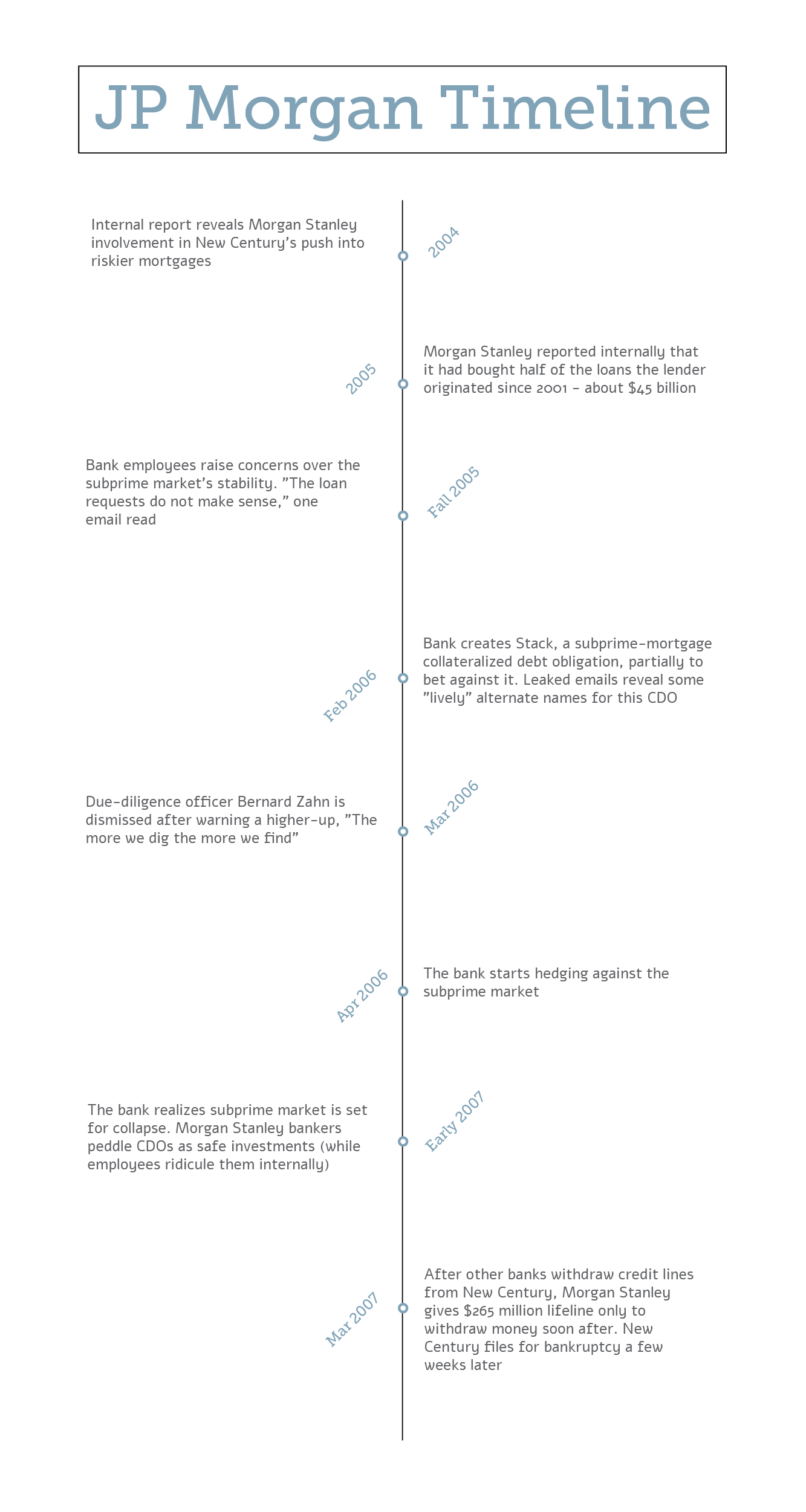
To paint readers a clearer picture we’ve put together a timeline of Morgan Stanley’s role in the years leading to the subprime mortgage crisis.
For reference, New Century Financial Corporation was a real estate investment trust that originated mortgage loans in the United States. As of January 1, 2007, New Century was the second-largest subprime mortgage lender in the US.
This marks the fourth time over the past five years that the company has been forced to reduce earnings in the weeks following an earnings announcement as the company has now cut 2014 income from continuing operations by $2.7 billion due to the increase in legal reserves related to mortgages.
Morgan Stanley has agreed to pay a $2.6 billion Settlement to the US Department of Justice over the firm’s creation and sale of residential mortgage-backed securities, leading to the 2008 financial crisis.
The settlement is another one in a long string of regulatory steps taken against the company over similar allegations. Last year the firm settled with the Federal Housing Finance Agency for $1.25 billion over accusations that the bank sold faulty mortgage-backed securities to Fannie Mae and Freddie Mac.
The company reached a similar settlement in July for $275 million with the Securities and Exchange Commission over accusations that the company understated the number of delinquent loans backing subprime mortgage securities.
But what exactly did the bank do to warrant these enormous settlements? Highlights of internal documents revealed in legal proceedings show a frightening level of negligence.
For instance, one due-diligence email read, "The real issue is that the loan requests do not make sense." It cited an example of one borrower listing his salary as $12,ooo a month while working at a tarot reading parlour. Another email pointed out that "deteriorating appraisal quality is very flagrant."
Not only did higher-ups pay no heed to these concerns, the situation was made light of by Pamela Barrow, top due diligence executive. Some choice quotes of hers mocking home buyers include, "First payment defaulting straw buyin' house-swappin first time wanna be home buyers," and, "We should call all their mommas." She continues, "Betcha that would get some of them good old boys to pay that house bill."
In direct response to an email from a due-diligence officer, Bernard Zahn, where he voiced concern that the problem was very widespread, she wrote, "Good find on the fraud :)" but continued with a frank, "Unfortunately, I don't think we will be able to utilize you or any other third party individual in the valuation department any longer."
To paint readers a clearer picture we’ve put together a timeline of Morgan Stanley’s role in the years leading to the subprime mortgage crisis.
For reference, New Century Financial Corporation was a real estate investment trust that originated mortgage loans in the United States. As of January 1, 2007, New Century was the second-largest subprime mortgage lender in the US.
This marks the fourth time over the past five years that the company has been forced to reduce earnings in the weeks following an earnings announcement as the company has now cut 2014 income from continuing operations by $2.7 billion due to the increase in legal reserves related to mortgages.
Italy’s Consob Tightens Net on AI-Fueled Scams With Fresh Website Bans
FP Markets Winner Spotlight 🏆 | Global Broker of the Year 2025 #Trading #Broker #Innovation #Shorts
FP Markets Winner Spotlight 🏆 | Global Broker of the Year 2025 #Trading #Broker #Innovation #Shorts
FP Markets takes the spotlight as Global Broker of the Year 2025 at the Finance Magnates Awards.
Martin Stoilov, Head of Client Experience, shares that trust, innovation, and people played a key role in the company’s success, supported by a strong foundation of integrity and client-centricity.
Following this milestone, FP Markets continues to focus on growth, technology investment, and its core values of transparency and excellence.
👉 Be part of FM Awards 2026: https://awards.financemagnates.com/#nominate
FP Markets takes the spotlight as Global Broker of the Year 2025 at the Finance Magnates Awards.
Martin Stoilov, Head of Client Experience, shares that trust, innovation, and people played a key role in the company’s success, supported by a strong foundation of integrity and client-centricity.
Following this milestone, FP Markets continues to focus on growth, technology investment, and its core values of transparency and excellence.
👉 Be part of FM Awards 2026: https://awards.financemagnates.com/#nominate
In this video, we review @HolaPrimeMarketsOfficial, a multi-asset forex and CFDs broker offering different account types, trading platforms, and flexible trading conditions.
We cover the broker’s overall offering, including account options, trading environment, platforms like MT4 and MT5, and additional services such as managed accounts and fast withdrawals.
Watch the full video to see if Hola Prime Markets fits your trading needs.
📣 Stay up to date with the latest in finance and trading. Follow Finance Magnates for industry news, insights, and global event coverage.
Connect with us:
🔗 LinkedIn: /financemagnates
👍 Facebook: /financemagnates
📸 Instagram: https://www.instagram.com/financemagnates
🐦 X: https://x.com/financemagnates
🎥 TikTok: https://www.tiktok.com/tag/financemagnates
▶️ YouTube: /@financemagnates_official
#HolaPrime #ForexBroker #CFDTrading #FinanceMagnates #Trading #Forex #BrokerReview
In this video, we review @HolaPrimeMarketsOfficial, a multi-asset forex and CFDs broker offering different account types, trading platforms, and flexible trading conditions.
We cover the broker’s overall offering, including account options, trading environment, platforms like MT4 and MT5, and additional services such as managed accounts and fast withdrawals.
Watch the full video to see if Hola Prime Markets fits your trading needs.
📣 Stay up to date with the latest in finance and trading. Follow Finance Magnates for industry news, insights, and global event coverage.
Connect with us:
🔗 LinkedIn: /financemagnates
👍 Facebook: /financemagnates
📸 Instagram: https://www.instagram.com/financemagnates
🐦 X: https://x.com/financemagnates
🎥 TikTok: https://www.tiktok.com/tag/financemagnates
▶️ YouTube: /@financemagnates_official
#HolaPrime #ForexBroker #CFDTrading #FinanceMagnates #Trading #Forex #BrokerReview
Hola Prime Review: What You Need to Know | Full Breakdown by Finance Magnates
Hola Prime Review: What You Need to Know | Full Breakdown by Finance Magnates
In this video, we review @HolaPrime_Global, a proprietary trading firm offering evaluation programs and performance-based payouts in simulated market environments.
We cover how the challenge model works, including account types, profit splits (up to 95%), trading rules, and what it takes to reach a funded account. You’ll also learn about available platforms like MT4, MT5, cTrader, and more, along with insights into payouts, support, and trading conditions.
Watch the full video to see if Hola Prime fits your trading style.
📣 Stay up to date with the latest in finance and trading. Follow Finance Magnates for industry news, insights, and global event coverage.
Connect with us:
🔗 LinkedIn: /financemagnates
👍 Facebook: /financemagnates
📸 Instagram: https://www.instagram.com/financemagnates
🐦 X: https://x.com/financemagnates
🎥 TikTok: https://www.tiktok.com/tag/financemagnates
▶️ YouTube: /@financemagnates_official
#HolaPrime #PropFirm #Trading #FinanceMagnates #Forex #FuturesTrading #TradingReview #PropFirmReview
In this video, we review @HolaPrime_Global, a proprietary trading firm offering evaluation programs and performance-based payouts in simulated market environments.
We cover how the challenge model works, including account types, profit splits (up to 95%), trading rules, and what it takes to reach a funded account. You’ll also learn about available platforms like MT4, MT5, cTrader, and more, along with insights into payouts, support, and trading conditions.
Watch the full video to see if Hola Prime fits your trading style.
📣 Stay up to date with the latest in finance and trading. Follow Finance Magnates for industry news, insights, and global event coverage.
Connect with us:
🔗 LinkedIn: /financemagnates
👍 Facebook: /financemagnates
📸 Instagram: https://www.instagram.com/financemagnates
🐦 X: https://x.com/financemagnates
🎥 TikTok: https://www.tiktok.com/tag/financemagnates
▶️ YouTube: /@financemagnates_official
#HolaPrime #PropFirm #Trading #FinanceMagnates #Forex #FuturesTrading #TradingReview #PropFirmReview
Axi Winner Spotlight 🏆 | Global Most Innovative Broker 2025 #Innovation #Trading #Fintech #Broker
Axi Winner Spotlight 🏆 | Global Most Innovative Broker 2025 #Innovation #Trading #Fintech #Broker
Axi takes the spotlight at the Finance Magnates Awards, winning Global Most Innovative Broker 2025.
Olivia Xenofontos and Ivanna Openko share how the team will feel: proud, motivated, and ready to keep delivering.
They also describe the night as well-organized, focused, and enjoyable for all.
👉 Be part of FM Awards 2026.
Axi takes the spotlight at the Finance Magnates Awards, winning Global Most Innovative Broker 2025.
Olivia Xenofontos and Ivanna Openko share how the team will feel: proud, motivated, and ready to keep delivering.
They also describe the night as well-organized, focused, and enjoyable for all.
👉 Be part of FM Awards 2026.
Recognition that matters.
Built on transparency.
Driven by the industry.
The Finance Magnates Awards 2026.
Nominations are now open.
🔗 https://awards.financemagnates.com/?utm_source=SM&utm_medium=social&utm_campaign=recognition-matters
Recognition that matters.
Built on transparency.
Driven by the industry.
The Finance Magnates Awards 2026.
Nominations are now open.
🔗 https://awards.financemagnates.com/?utm_source=SM&utm_medium=social&utm_campaign=recognition-matters