Forex Magnates recaps its visit to Dukascopy's monthly gathering of local business professionals, which took place yesterday, we also looked at its upgraded video production as part of its white label offering.
Reporting for Forex Magnates, we had a chance to interview several executives from both established and newly launched brokerage service providers in the Foreign exchange industry during our trip to Switzerland which concluded today.
Forex Magnates Interviews in Switzerland's Financial Hub: Geneva
One of the interviewees was Roy Hen, Chief Projects Officer with Cyprus-based financial services marketing firm Conversion Pros, who is Chief Producer of iFX EXPO, a key Foreign Exchange industry event co-organized with Forex Magnates in different parts of the world.
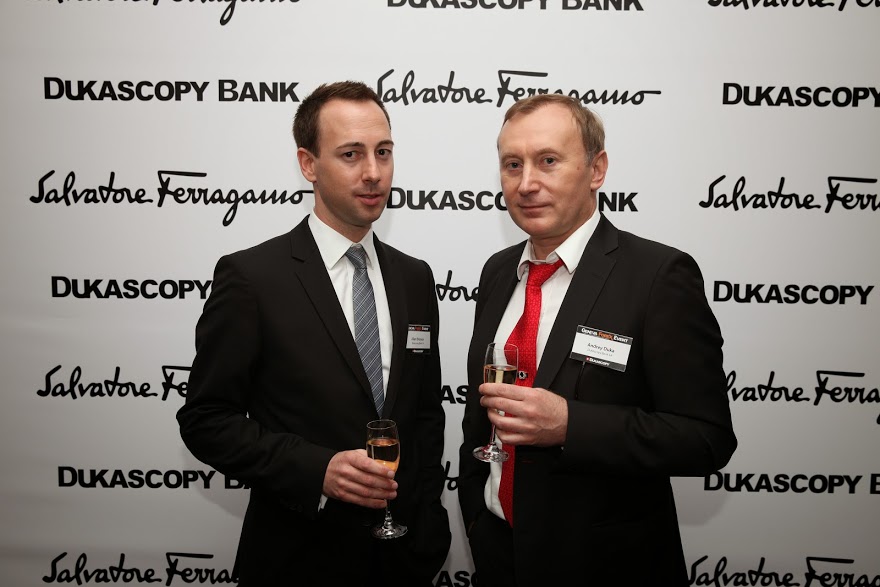
Alain Broyon, CEO, Dukascopy (Left), Andre Duka, Co-Founder, Dukascopy (Right)
The interviews with Mr. Hen and other invited guests from Forex companies were conducted one by one on Dukascopy TV- and are expected to be broadcasted in the coming days ahead, with participants sharing their views in response to questions we asked revolving around Foreign Exchange during the sessions.
The brief recordings focused on some common topics that have been on the forefront of brokers’ attention, as will be revealed in greater detail in the upcoming Forex Magnates Quarterly Industry Report for the first quarter (QIR1) of 2014, after our reporters visited with senior executives of a few major FX brokers in New York last week –as part of that research.
Dukascopy TV, Online Brokerage-Bank Takes Video Production to TV Level
In addition to the meetings in Geneva, we had a chance to speak with Alain Broyon, CEO of Dukascopy Bank, who was also interviewed by Forex Magnates in his company’s studios.
As part of its white-label solution, Dukascopy provides select brokers with the ability to have content related to market analysis, fundamental news and other trader relevant data that Dukascopy TV produces – as branded with the broker's own logo, and in a web-page layout similar to the bank’s own published version – as well as in multiple languages.
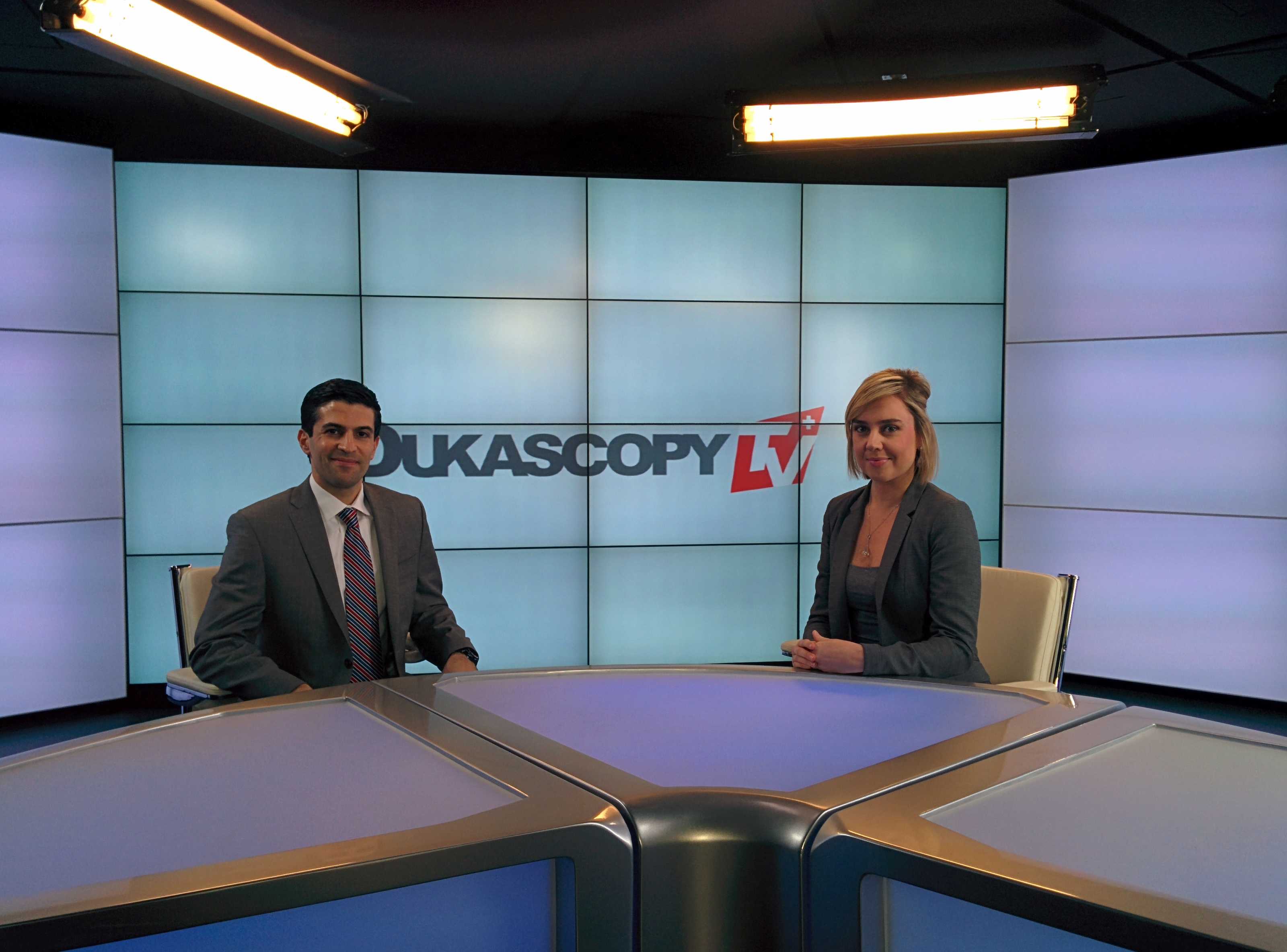
Steven Hatzakis, Editor, Forex Magnates (Left), and Monica Gibson, Journalist, Dukascopy TV (Right), During an interview this week.
The company has invested several million dollars in its studio alone as explained to us by people close to the project at the company, and the cost to operate the production, including teams in Geneva and Latvia, is part of a large offering that brokers can get outsourced rather than having to dedicate the human capital and resources including time to create their own production studio.
Considering that only a handful of brokerages and banks have very serious video production studios with capabilities exceeding the standard “green room,” with some firms able to stream directly to TV stations using special equipment, these are beyond what most brokers do. Thus using an advanced setup of professional TV quality could provide a value-add as people look for different forms of content to consume relevant to the financial markets, and the quality which could be an appealing factor.
Appeal of Swiss Banks Amid Challenges, Geneva Still an Attractive Hub
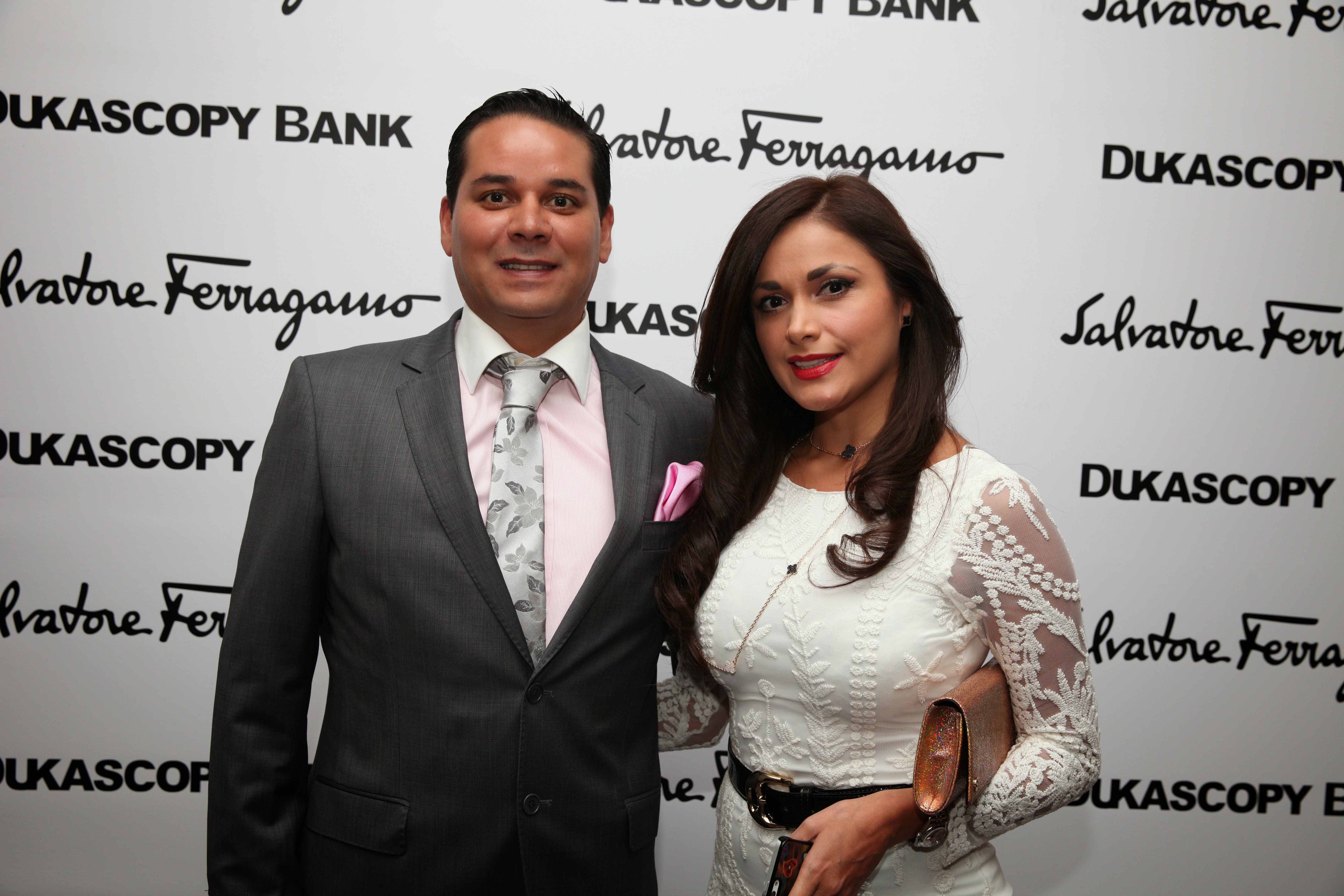
The invitation to Switzerland coincided with our reporters attending the Geneva Forex Event yesterday, a monthly networking gathering that brings professionals from around Geneva to gather in one place in formal attire and sipping fine champagne to share the latest scoops and rumors among themselves, in the setting of a 5-star luxury hotel.
Photo taken by Dukascopy TV staff on March 20, 2014, at the Four Seasons in Geneva, at the Geneva Forex Event
Geneva remains a major financial hub within Europe. While Switzerland is not a member of the European Union (EU) nor European Economic Activity (EEA) area and not under the effects of ESMA and recently implemented EMIR reporting mandates, Swiss banks have recently come under scrutiny surrounding bank secrecy, tax evasion by Americans hiding unreported assets in Switzerland, and the ongoing Forex probe that was first revealed by Swiss regulator FINMA last year.
Despite these challenges, the country’s currency and the amount of deposits it holds in comparison to global deposits remains among the top of market share holders, with some Swiss bankers claiming around ¼ of global deposits, and with the banking sector in Switzerland coming under more regulatory pressure this could actually be a good thing over the long-term - as it could bring more credibility to an already established safe haven for assets to be held.
Accordingly, Geneva attracts corporations from around the world looking to establish presence in the prestigious municipality of only 200,000 inhabitants, in addition to other key regions like the capital Bern and Zurich, as the credibility and legal structure of Switzerland come to mind, and thus a reason for the large number of business professionals there - especially in banking.
Attracting Non-Forex People as Bank Aims to Be Unique
The Forex Geneva Event is attended by people not only from the FX world but also by people who have no direct role in financial services - let alone Forex, but rather come to network with other locals and share scoops and rumors on the latest developments in town. Such an unorthodox strategy to target a different audience may have its merits as brokers look for more sophisticated clients even if they are initially new to trading and/or not already involved in the financial services.
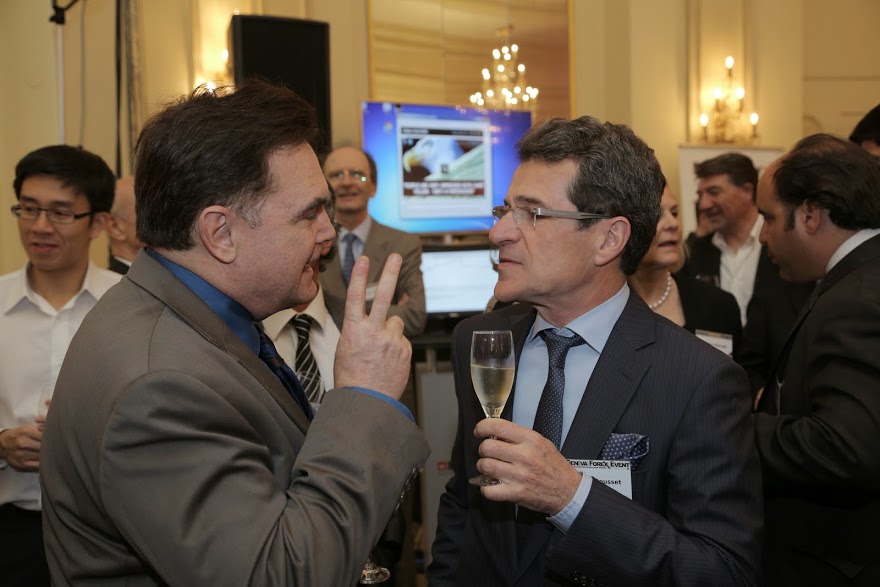
Random Networking at Geneva Forex Event,March 20, 2014
While the online world of social networking has emerged to be a new dimension for many of us, following the advent of Facebook and LinkedIn, meeting face-to-face remains paramount for many and clearly a more important function – when time can permit.
For the sake of time, having access to both is essential as often emails and networking through apps such as LinkedIn or the recently launched Mingler, and business networking apps like these - can be a great tool for making virtual business connections either before or after meeting in person - or just while building your network.
Combining Fashion with Forex and Local Workforce Mingling
Dukascopy has already been organizing these events for several years holding them once a month, the one that took place last night having been one of the largest and most successful, with over 500 attendees.
This recent success was highlighted with sponsors such as Salvatore Ferragamo and high-end watch designers like Corum, as well as jewelry makers, all helping to sponsor the event. As Geneva provides some of the finest luxuries like fine watches and chocolate, as well as 5-star deluxe hotels, this upscale quality appeals to certain markets such as the fashion industry whose target client audience could share characteristics found within audiences forex brokers look for (such as wealthier clients, or more sophisticated, or those concerned about status or quality - versus shopping for a broker purely on price without regard to the relationship benefits).
Geneva Forex Event, March 20, 2014
A key point that comes to mind is what do these brand names have to do with Forex? Obviously, they don’t have a connection with FX as they are companies related to fashion and clothing; however, that was the exact plan for Dukascopy by bringing something different. After all, every business professional who has worked in a financial services company would adhere to some degree of professional attire and a sense of style and fashion (hopefully) in order to dress to impress (as opposed to wearing flip-flops and shorts to the office – as some might do).
Therefore, there are parallels, however indirect they may be, that make sense to merge fashion and forex. For this event a more precise description would be networking meetup for professionals, organized by a forex company, with fashion related events taking place in a cocktail party setting, of course this is just one way of looking at it.
From the dozens or so people with whom Forex Magnates' reporters exchanged business cards at the event, there were several FX related people in attendance as well as others in fields as disparate as pharmaceuticals, civil engineering, and then people close to finance just in other markets such as corporate debt finance and bonds, and money managers that trade equities. In other words, there were professionals from almost all industries. The crowd was indeed diverse given the nature of the event with local professionals from different sectors in attendance, which happened to include banking as part of its main focus.
We also met with executives from brokerages as far as Turkey who had come to attend the monthly gathering, including Kivanc Memisoglu, General Manager at Integral Menkul Degerler A.S., one of the forex brokerages in Turkey with interests in other assets classes as well. Attending the event was also Kadir Cenk Ulukartal, Managing Director of the Board, at Ulukartal Holding - the parent company behind Integral Menkul Degerler.
In less than a few weeks (April 4th to April 5th) Forex Magnates will be holding the Turkey FX Conference which already has 800 financial markets professionals registered to attend. The local market in Turkey is hot for Forex after it has just recently evolved in during the last decade.
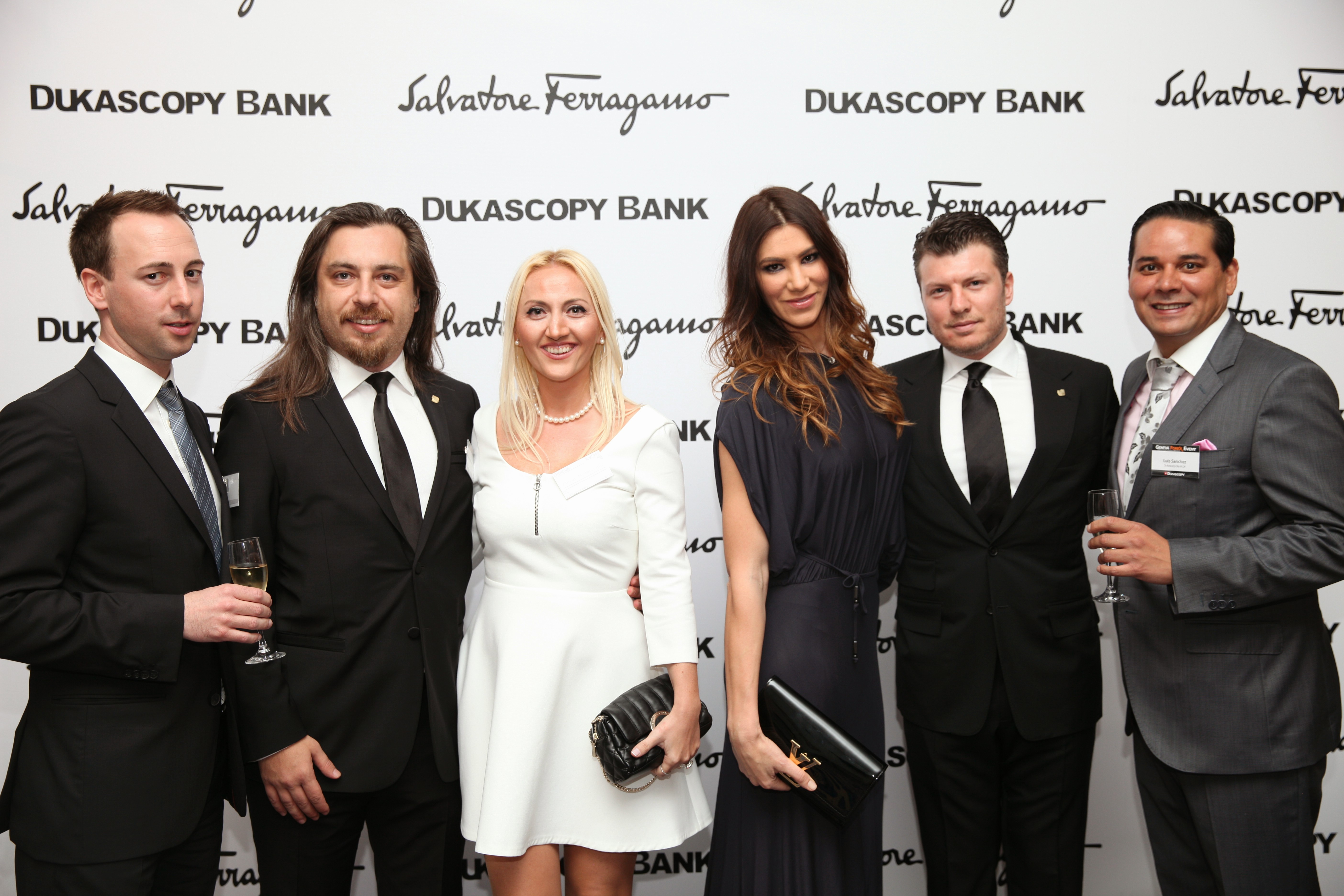
Left to Right: Alain Broyon, CEO, Dukascopy, Kivanc Memisoglu, General Manager, Integral Menkul Degerler & his guest, guest of Kadir Cenk Ulukartal, Kadir Cenk Ulukartal, Managing Director of The Board at Ulukartal Holding, and Luis Sanchez, Vice President and head of Institutional Sales for Europe and America, Dukascopy
Off-Line Social Networking Still Important for Business
Dukascopy, as well as many other brokerages and banks involved in capital markets agree on the value of specialized events like the Forex Magnates' London Summit and Tokyo Summit, attended by senior foreign exchange executives; therefore, each event has its purpose and merit.
In New York for example, meetup.com is widely used by individuals as a way to organize local meet-ups, meeting at fancy hotels and involving a variety of subjects, hobbies, or professional interest. We can see this as an analogy to the way that networking has changed - when compared to FX related industry or retail events.
Just as each meeting within a company has a purpose, the same can be said for organized events, with lectures and seminars or workshops - a growing part of ways that people use these mediums to communicate their respective fields of interest to potentially interested audiences.
Events Are Changing, Dynamic Approach Is Key
During the interview we conducted on Dukascopy TV, Roy Hen, the chief producer of the iFX Expo and Chief Projects Officer at Conversion Pros, said that a key element was to keep things dynamic and constantly changing with regards to the events so that attendees are surprised with new exhibitors and fresh content, rather than replicating the past.
It appears that the Geneva Forex Event can be great for locals in Geneva, including firms elsewhere looking to build their list of contacts on the ground floor in Switzerland, and willing to hop on a flight or train to attend, and with the goal of making introductions and meeting people in person - again time permitting.
Another critical point is that the attendee name badges at the Geneva Forex Event didn't include the company for which they work, making it a more anonymous gathering where only the first name and last name is on display (on the wearable ID badge that was given to attendees upon entrance). Thus making the networking more about the personal interaction than the company (since the company name is omitted), and something that was done on purpose, as explained by people close to the event coordination.
Meeting over drinks or dinner is a fairly standard way of solidifying or vetting a deal after meeting formally whether the deal starts in the office, on the phone or via email, the human real-life interaction still remains the most powerful, to put a face behind a voice or a picture behind a name.
Building Other Dimensions of Communication: Events and TV
During our stay in Geneva it was clear that Dukascopy has invested considerably in building its professional television studio to the point where major local news publications such as L’AGEFI - which was founded in 1950 - uses Dukascopy TV production studio to film their own content.
As FX companies build out their content, including webinars, educational tutorials, or daily market commentary, the question is to what level does the production quality need to be taken to? Is a TV level studio needed, or only to serve some other, greater or different purpose, such as expanding that part of a firm's business?
For Dukascopy it seems to be the direction they have taken, and looks to capitalize on, as the company continues to use this medium to drive traffic and as part of its white-label offering to other brokers, whose underlying clients' flow come back to help the Swiss bank revenues grow.
Mr. & Mrs. Sanchez
Luis Sanchez, Dukascopy’s Vice President and head of Institutional Sales for Europe and America, shared with Forex Magnates that the Geneva Forex Event “Is breaking misconceptions about us – bankers and fashion shows by elite designers coming together in one gathering. It appears as a great solution to bring a fresh air-stream and to make a change needed every now and then. So the idea is simple: to create a monthly meeting point to follow-up on current events, to network and to establish Public Relations, and to be present among the elite in a relaxed atmosphere. Let's come together in a place that one guest called 'my Thursday Party and fashion Catwalk'.”
Indeed while the event can be viewed as a Public Relations (PR) stunt, such as the branding that is aimed for when a firm sponsors a major national sports team, or hires a famous spokesperson, or other forms of marketing that are harder to measure the direct return-on-investment, it appears that an effort like the Geneva Forex Event could have other dimensions in addition to branding, by bringing people together and within the local community of where the broker/bank is physically located.
Reporting for Forex Magnates, we had a chance to interview several executives from both established and newly launched brokerage service providers in the Foreign exchange industry during our trip to Switzerland which concluded today.
Forex Magnates Interviews in Switzerland's Financial Hub: Geneva
One of the interviewees was Roy Hen, Chief Projects Officer with Cyprus-based financial services marketing firm Conversion Pros, who is Chief Producer of iFX EXPO, a key Foreign Exchange industry event co-organized with Forex Magnates in different parts of the world.
Alain Broyon, CEO, Dukascopy (Left), Andre Duka, Co-Founder, Dukascopy (Right)
The interviews with Mr. Hen and other invited guests from Forex companies were conducted one by one on Dukascopy TV- and are expected to be broadcasted in the coming days ahead, with participants sharing their views in response to questions we asked revolving around Foreign Exchange during the sessions.
The brief recordings focused on some common topics that have been on the forefront of brokers’ attention, as will be revealed in greater detail in the upcoming Forex Magnates Quarterly Industry Report for the first quarter (QIR1) of 2014, after our reporters visited with senior executives of a few major FX brokers in New York last week –as part of that research.
Dukascopy TV, Online Brokerage-Bank Takes Video Production to TV Level
In addition to the meetings in Geneva, we had a chance to speak with Alain Broyon, CEO of Dukascopy Bank, who was also interviewed by Forex Magnates in his company’s studios.
As part of its white-label solution, Dukascopy provides select brokers with the ability to have content related to market analysis, fundamental news and other trader relevant data that Dukascopy TV produces – as branded with the broker's own logo, and in a web-page layout similar to the bank’s own published version – as well as in multiple languages.
Steven Hatzakis, Editor, Forex Magnates (Left), and Monica Gibson, Journalist, Dukascopy TV (Right), During an interview this week.
The company has invested several million dollars in its studio alone as explained to us by people close to the project at the company, and the cost to operate the production, including teams in Geneva and Latvia, is part of a large offering that brokers can get outsourced rather than having to dedicate the human capital and resources including time to create their own production studio.
Considering that only a handful of brokerages and banks have very serious video production studios with capabilities exceeding the standard “green room,” with some firms able to stream directly to TV stations using special equipment, these are beyond what most brokers do. Thus using an advanced setup of professional TV quality could provide a value-add as people look for different forms of content to consume relevant to the financial markets, and the quality which could be an appealing factor.
Appeal of Swiss Banks Amid Challenges, Geneva Still an Attractive Hub
The invitation to Switzerland coincided with our reporters attending the Geneva Forex Event yesterday, a monthly networking gathering that brings professionals from around Geneva to gather in one place in formal attire and sipping fine champagne to share the latest scoops and rumors among themselves, in the setting of a 5-star luxury hotel.
Photo taken by Dukascopy TV staff on March 20, 2014, at the Four Seasons in Geneva, at the Geneva Forex Event
Geneva remains a major financial hub within Europe. While Switzerland is not a member of the European Union (EU) nor European Economic Activity (EEA) area and not under the effects of ESMA and recently implemented EMIR reporting mandates, Swiss banks have recently come under scrutiny surrounding bank secrecy, tax evasion by Americans hiding unreported assets in Switzerland, and the ongoing Forex probe that was first revealed by Swiss regulator FINMA last year.
Despite these challenges, the country’s currency and the amount of deposits it holds in comparison to global deposits remains among the top of market share holders, with some Swiss bankers claiming around ¼ of global deposits, and with the banking sector in Switzerland coming under more regulatory pressure this could actually be a good thing over the long-term - as it could bring more credibility to an already established safe haven for assets to be held.
Accordingly, Geneva attracts corporations from around the world looking to establish presence in the prestigious municipality of only 200,000 inhabitants, in addition to other key regions like the capital Bern and Zurich, as the credibility and legal structure of Switzerland come to mind, and thus a reason for the large number of business professionals there - especially in banking.
Attracting Non-Forex People as Bank Aims to Be Unique
The Forex Geneva Event is attended by people not only from the FX world but also by people who have no direct role in financial services - let alone Forex, but rather come to network with other locals and share scoops and rumors on the latest developments in town. Such an unorthodox strategy to target a different audience may have its merits as brokers look for more sophisticated clients even if they are initially new to trading and/or not already involved in the financial services.
Random Networking at Geneva Forex Event,March 20, 2014
While the online world of social networking has emerged to be a new dimension for many of us, following the advent of Facebook and LinkedIn, meeting face-to-face remains paramount for many and clearly a more important function – when time can permit.
For the sake of time, having access to both is essential as often emails and networking through apps such as LinkedIn or the recently launched Mingler, and business networking apps like these - can be a great tool for making virtual business connections either before or after meeting in person - or just while building your network.
Combining Fashion with Forex and Local Workforce Mingling
Dukascopy has already been organizing these events for several years holding them once a month, the one that took place last night having been one of the largest and most successful, with over 500 attendees.
This recent success was highlighted with sponsors such as Salvatore Ferragamo and high-end watch designers like Corum, as well as jewelry makers, all helping to sponsor the event. As Geneva provides some of the finest luxuries like fine watches and chocolate, as well as 5-star deluxe hotels, this upscale quality appeals to certain markets such as the fashion industry whose target client audience could share characteristics found within audiences forex brokers look for (such as wealthier clients, or more sophisticated, or those concerned about status or quality - versus shopping for a broker purely on price without regard to the relationship benefits).
Geneva Forex Event, March 20, 2014
A key point that comes to mind is what do these brand names have to do with Forex? Obviously, they don’t have a connection with FX as they are companies related to fashion and clothing; however, that was the exact plan for Dukascopy by bringing something different. After all, every business professional who has worked in a financial services company would adhere to some degree of professional attire and a sense of style and fashion (hopefully) in order to dress to impress (as opposed to wearing flip-flops and shorts to the office – as some might do).
Therefore, there are parallels, however indirect they may be, that make sense to merge fashion and forex. For this event a more precise description would be networking meetup for professionals, organized by a forex company, with fashion related events taking place in a cocktail party setting, of course this is just one way of looking at it.
From the dozens or so people with whom Forex Magnates' reporters exchanged business cards at the event, there were several FX related people in attendance as well as others in fields as disparate as pharmaceuticals, civil engineering, and then people close to finance just in other markets such as corporate debt finance and bonds, and money managers that trade equities. In other words, there were professionals from almost all industries. The crowd was indeed diverse given the nature of the event with local professionals from different sectors in attendance, which happened to include banking as part of its main focus.
We also met with executives from brokerages as far as Turkey who had come to attend the monthly gathering, including Kivanc Memisoglu, General Manager at Integral Menkul Degerler A.S., one of the forex brokerages in Turkey with interests in other assets classes as well. Attending the event was also Kadir Cenk Ulukartal, Managing Director of the Board, at Ulukartal Holding - the parent company behind Integral Menkul Degerler.
In less than a few weeks (April 4th to April 5th) Forex Magnates will be holding the Turkey FX Conference which already has 800 financial markets professionals registered to attend. The local market in Turkey is hot for Forex after it has just recently evolved in during the last decade.
Left to Right: Alain Broyon, CEO, Dukascopy, Kivanc Memisoglu, General Manager, Integral Menkul Degerler & his guest, guest of Kadir Cenk Ulukartal, Kadir Cenk Ulukartal, Managing Director of The Board at Ulukartal Holding, and Luis Sanchez, Vice President and head of Institutional Sales for Europe and America, Dukascopy
Off-Line Social Networking Still Important for Business
Dukascopy, as well as many other brokerages and banks involved in capital markets agree on the value of specialized events like the Forex Magnates' London Summit and Tokyo Summit, attended by senior foreign exchange executives; therefore, each event has its purpose and merit.
In New York for example, meetup.com is widely used by individuals as a way to organize local meet-ups, meeting at fancy hotels and involving a variety of subjects, hobbies, or professional interest. We can see this as an analogy to the way that networking has changed - when compared to FX related industry or retail events.
Just as each meeting within a company has a purpose, the same can be said for organized events, with lectures and seminars or workshops - a growing part of ways that people use these mediums to communicate their respective fields of interest to potentially interested audiences.
Events Are Changing, Dynamic Approach Is Key
During the interview we conducted on Dukascopy TV, Roy Hen, the chief producer of the iFX Expo and Chief Projects Officer at Conversion Pros, said that a key element was to keep things dynamic and constantly changing with regards to the events so that attendees are surprised with new exhibitors and fresh content, rather than replicating the past.
It appears that the Geneva Forex Event can be great for locals in Geneva, including firms elsewhere looking to build their list of contacts on the ground floor in Switzerland, and willing to hop on a flight or train to attend, and with the goal of making introductions and meeting people in person - again time permitting.
Another critical point is that the attendee name badges at the Geneva Forex Event didn't include the company for which they work, making it a more anonymous gathering where only the first name and last name is on display (on the wearable ID badge that was given to attendees upon entrance). Thus making the networking more about the personal interaction than the company (since the company name is omitted), and something that was done on purpose, as explained by people close to the event coordination.
Meeting over drinks or dinner is a fairly standard way of solidifying or vetting a deal after meeting formally whether the deal starts in the office, on the phone or via email, the human real-life interaction still remains the most powerful, to put a face behind a voice or a picture behind a name.
Building Other Dimensions of Communication: Events and TV
During our stay in Geneva it was clear that Dukascopy has invested considerably in building its professional television studio to the point where major local news publications such as L’AGEFI - which was founded in 1950 - uses Dukascopy TV production studio to film their own content.
As FX companies build out their content, including webinars, educational tutorials, or daily market commentary, the question is to what level does the production quality need to be taken to? Is a TV level studio needed, or only to serve some other, greater or different purpose, such as expanding that part of a firm's business?
For Dukascopy it seems to be the direction they have taken, and looks to capitalize on, as the company continues to use this medium to drive traffic and as part of its white-label offering to other brokers, whose underlying clients' flow come back to help the Swiss bank revenues grow.
Mr. & Mrs. Sanchez
Luis Sanchez, Dukascopy’s Vice President and head of Institutional Sales for Europe and America, shared with Forex Magnates that the Geneva Forex Event “Is breaking misconceptions about us – bankers and fashion shows by elite designers coming together in one gathering. It appears as a great solution to bring a fresh air-stream and to make a change needed every now and then. So the idea is simple: to create a monthly meeting point to follow-up on current events, to network and to establish Public Relations, and to be present among the elite in a relaxed atmosphere. Let's come together in a place that one guest called 'my Thursday Party and fashion Catwalk'.”
Indeed while the event can be viewed as a Public Relations (PR) stunt, such as the branding that is aimed for when a firm sponsors a major national sports team, or hires a famous spokesperson, or other forms of marketing that are harder to measure the direct return-on-investment, it appears that an effort like the Geneva Forex Event could have other dimensions in addition to branding, by bringing people together and within the local community of where the broker/bank is physically located.
Swiss Banks, Brokers and Fintechs Must Prove Online Clients Are Real People
Featured Videos
AvaTrade to Acquire Most of FXCM; NAGA Raises $8M
AvaTrade to Acquire Most of FXCM; NAGA Raises $8M
AvaTrade to Acquire Most of FXCM; NAGA Raises $8M
AvaTrade to Acquire Most of FXCM; NAGA Raises $8M
Today’s financial news recap covers AvaTrade agrees to acquire most of FXCM, NAGA secures eight million dollars in new financing, and Wise seeks a tax settlement in the UK.
Finance Magnates Daily Recap brings you the latest news from forex and CFD brokers, fintech, payments, cryptocurrency, digital assets, trading platforms, financial regulation and global markets.
Get the key company news, executive moves, deals, regulatory updates and market developments of the day, in just a few minutes. New episodes published every weekday.
Read more: https://www.financemagnates.com
#FinanceMagnates #ForexNews #FintechNews
Today’s financial news recap covers AvaTrade agrees to acquire most of FXCM, NAGA secures eight million dollars in new financing, and Wise seeks a tax settlement in the UK.
Finance Magnates Daily Recap brings you the latest news from forex and CFD brokers, fintech, payments, cryptocurrency, digital assets, trading platforms, financial regulation and global markets.
Get the key company news, executive moves, deals, regulatory updates and market developments of the day, in just a few minutes. New episodes published every weekday.
Read more: https://www.financemagnates.com
#FinanceMagnates #ForexNews #FintechNews
Today’s financial news recap covers AvaTrade agrees to acquire most of FXCM, NAGA secures eight million dollars in new financing, and Wise seeks a tax settlement in the UK.
Finance Magnates Daily Recap brings you the latest news from forex and CFD brokers, fintech, payments, cryptocurrency, digital assets, trading platforms, financial regulation and global markets.
Get the key company news, executive moves, deals, regulatory updates and market developments of the day, in just a few minutes. New episodes published every weekday.
Read more: https://www.financemagnates.com
#FinanceMagnates #ForexNews #FintechNews
Today’s financial news recap covers AvaTrade agrees to acquire most of FXCM, NAGA secures eight million dollars in new financing, and Wise seeks a tax settlement in the UK.
Finance Magnates Daily Recap brings you the latest news from forex and CFD brokers, fintech, payments, cryptocurrency, digital assets, trading platforms, financial regulation and global markets.
Get the key company news, executive moves, deals, regulatory updates and market developments of the day, in just a few minutes. New episodes published every weekday.
Read more: https://www.financemagnates.com
#FinanceMagnates #ForexNews #FintechNews
XTB Adds Overnight US Stock Trading; Nasdaq Ventures Invests in One Trading
XTB Adds Overnight US Stock Trading; Nasdaq Ventures Invests in One Trading
XTB Adds Overnight US Stock Trading; Nasdaq Ventures Invests in One Trading
XTB Adds Overnight US Stock Trading; Nasdaq Ventures Invests in One Trading
XTB Adds Overnight US Stock Trading; Nasdaq Ventures Invests in One Trading
XTB Adds Overnight US Stock Trading; Nasdaq Ventures Invests in One Trading
Today’s financial news recap covers XTB expands overnight US stock trading, Fortrade reports higher revenue, Nasdaq backs One Trading, and Vest Labs raises 13 million dollars.
Finance Magnates Daily Recap brings you the latest news from forex and CFD brokers, fintech, payments, cryptocurrency, digital assets, trading platforms, financial regulation and global markets.
Get the key company news, executive moves, deals, regulatory updates and market developments of the day, in just a few minutes. New episodes published every weekday.
Read more: https://www.financemagnates.com
#FinanceMagnates #ForexNews #FintechNews
Today’s financial news recap covers XTB expands overnight US stock trading, Fortrade reports higher revenue, Nasdaq backs One Trading, and Vest Labs raises 13 million dollars.
Finance Magnates Daily Recap brings you the latest news from forex and CFD brokers, fintech, payments, cryptocurrency, digital assets, trading platforms, financial regulation and global markets.
Get the key company news, executive moves, deals, regulatory updates and market developments of the day, in just a few minutes. New episodes published every weekday.
Read more: https://www.financemagnates.com
#FinanceMagnates #ForexNews #FintechNews
Today’s financial news recap covers XTB expands overnight US stock trading, Fortrade reports higher revenue, Nasdaq backs One Trading, and Vest Labs raises 13 million dollars.
Finance Magnates Daily Recap brings you the latest news from forex and CFD brokers, fintech, payments, cryptocurrency, digital assets, trading platforms, financial regulation and global markets.
Get the key company news, executive moves, deals, regulatory updates and market developments of the day, in just a few minutes. New episodes published every weekday.
Read more: https://www.financemagnates.com
#FinanceMagnates #ForexNews #FintechNews
Today’s financial news recap covers XTB expands overnight US stock trading, Fortrade reports higher revenue, Nasdaq backs One Trading, and Vest Labs raises 13 million dollars.
Finance Magnates Daily Recap brings you the latest news from forex and CFD brokers, fintech, payments, cryptocurrency, digital assets, trading platforms, financial regulation and global markets.
Get the key company news, executive moves, deals, regulatory updates and market developments of the day, in just a few minutes. New episodes published every weekday.
Read more: https://www.financemagnates.com
#FinanceMagnates #ForexNews #FintechNews
Today’s financial news recap covers XTB expands overnight US stock trading, Fortrade reports higher revenue, Nasdaq backs One Trading, and Vest Labs raises 13 million dollars.
Finance Magnates Daily Recap brings you the latest news from forex and CFD brokers, fintech, payments, cryptocurrency, digital assets, trading platforms, financial regulation and global markets.
Get the key company news, executive moves, deals, regulatory updates and market developments of the day, in just a few minutes. New episodes published every weekday.
Read more: https://www.financemagnates.com
#FinanceMagnates #ForexNews #FintechNews
Today’s financial news recap covers XTB expands overnight US stock trading, Fortrade reports higher revenue, Nasdaq backs One Trading, and Vest Labs raises 13 million dollars.
Finance Magnates Daily Recap brings you the latest news from forex and CFD brokers, fintech, payments, cryptocurrency, digital assets, trading platforms, financial regulation and global markets.
Get the key company news, executive moves, deals, regulatory updates and market developments of the day, in just a few minutes. New episodes published every weekday.
Read more: https://www.financemagnates.com
#FinanceMagnates #ForexNews #FintechNews
CMC Founder Downplays Volatility Hit; Devexperts Names CEO
CMC Founder Downplays Volatility Hit; Devexperts Names CEO
CMC Founder Downplays Volatility Hit; Devexperts Names CEO
CMC Founder Downplays Volatility Hit; Devexperts Names CEO
CMC Founder Downplays Volatility Hit; Devexperts Names CEO
CMC Founder Downplays Volatility Hit; Devexperts Names CEO
Today’s financial news recap covers low volatility pressures brokers, Devexperts names a new CEO, Saxo cuts onboarding time, and OKX reaches a 25 billion dollar valuation.
Finance Magnates Daily Recap brings you the latest news from forex and CFD brokers, fintech, payments, cryptocurrency, digital assets, trading platforms, financial regulation and global markets.
Get the key company news, executive moves, deals, regulatory updates and market developments of the day, in just a few minutes. New episodes published every weekday.
Read more: https://www.financemagnates.com
#FinanceMagnates #ForexNews #FintechNews
Today’s financial news recap covers low volatility pressures brokers, Devexperts names a new CEO, Saxo cuts onboarding time, and OKX reaches a 25 billion dollar valuation.
Finance Magnates Daily Recap brings you the latest news from forex and CFD brokers, fintech, payments, cryptocurrency, digital assets, trading platforms, financial regulation and global markets.
Get the key company news, executive moves, deals, regulatory updates and market developments of the day, in just a few minutes. New episodes published every weekday.
Read more: https://www.financemagnates.com
#FinanceMagnates #ForexNews #FintechNews
Today’s financial news recap covers low volatility pressures brokers, Devexperts names a new CEO, Saxo cuts onboarding time, and OKX reaches a 25 billion dollar valuation.
Finance Magnates Daily Recap brings you the latest news from forex and CFD brokers, fintech, payments, cryptocurrency, digital assets, trading platforms, financial regulation and global markets.
Get the key company news, executive moves, deals, regulatory updates and market developments of the day, in just a few minutes. New episodes published every weekday.
Read more: https://www.financemagnates.com
#FinanceMagnates #ForexNews #FintechNews
Today’s financial news recap covers low volatility pressures brokers, Devexperts names a new CEO, Saxo cuts onboarding time, and OKX reaches a 25 billion dollar valuation.
Finance Magnates Daily Recap brings you the latest news from forex and CFD brokers, fintech, payments, cryptocurrency, digital assets, trading platforms, financial regulation and global markets.
Get the key company news, executive moves, deals, regulatory updates and market developments of the day, in just a few minutes. New episodes published every weekday.
Read more: https://www.financemagnates.com
#FinanceMagnates #ForexNews #FintechNews
Today’s financial news recap covers low volatility pressures brokers, Devexperts names a new CEO, Saxo cuts onboarding time, and OKX reaches a 25 billion dollar valuation.
Finance Magnates Daily Recap brings you the latest news from forex and CFD brokers, fintech, payments, cryptocurrency, digital assets, trading platforms, financial regulation and global markets.
Get the key company news, executive moves, deals, regulatory updates and market developments of the day, in just a few minutes. New episodes published every weekday.
Read more: https://www.financemagnates.com
#FinanceMagnates #ForexNews #FintechNews
Today’s financial news recap covers low volatility pressures brokers, Devexperts names a new CEO, Saxo cuts onboarding time, and OKX reaches a 25 billion dollar valuation.
Finance Magnates Daily Recap brings you the latest news from forex and CFD brokers, fintech, payments, cryptocurrency, digital assets, trading platforms, financial regulation and global markets.
Get the key company news, executive moves, deals, regulatory updates and market developments of the day, in just a few minutes. New episodes published every weekday.
Read more: https://www.financemagnates.com
#FinanceMagnates #ForexNews #FintechNews
Today’s financial news recap covers Trade Nation buys FXCM's UK client book, Trading 212 reports higher revenue, the CFTC's move to allow perpetual index futures.
Finance Magnates Daily Recap brings you the latest news from forex and CFD brokers, fintech, payments, cryptocurrency, digital assets, trading platforms, financial regulation and global markets.
Get the key company news, executive moves, deals, regulatory updates and market developments of the day, in just a few minutes. New episodes published every weekday.
Read more: https://www.financemagnates.com
#FinanceMagnates #ForexNews #FintechNews
Today’s financial news recap covers Trade Nation buys FXCM's UK client book, Trading 212 reports higher revenue, the CFTC's move to allow perpetual index futures.
Finance Magnates Daily Recap brings you the latest news from forex and CFD brokers, fintech, payments, cryptocurrency, digital assets, trading platforms, financial regulation and global markets.
Get the key company news, executive moves, deals, regulatory updates and market developments of the day, in just a few minutes. New episodes published every weekday.
Read more: https://www.financemagnates.com
#FinanceMagnates #ForexNews #FintechNews
Today’s financial news recap covers Trade Nation buys FXCM's UK client book, Trading 212 reports higher revenue, the CFTC's move to allow perpetual index futures.
Finance Magnates Daily Recap brings you the latest news from forex and CFD brokers, fintech, payments, cryptocurrency, digital assets, trading platforms, financial regulation and global markets.
Get the key company news, executive moves, deals, regulatory updates and market developments of the day, in just a few minutes. New episodes published every weekday.
Read more: https://www.financemagnates.com
#FinanceMagnates #ForexNews #FintechNews
Today’s financial news recap covers Trade Nation buys FXCM's UK client book, Trading 212 reports higher revenue, the CFTC's move to allow perpetual index futures.
Finance Magnates Daily Recap brings you the latest news from forex and CFD brokers, fintech, payments, cryptocurrency, digital assets, trading platforms, financial regulation and global markets.
Get the key company news, executive moves, deals, regulatory updates and market developments of the day, in just a few minutes. New episodes published every weekday.
Read more: https://www.financemagnates.com
#FinanceMagnates #ForexNews #FintechNews
Today’s financial news recap covers Trade Nation buys FXCM's UK client book, Trading 212 reports higher revenue, the CFTC's move to allow perpetual index futures.
Finance Magnates Daily Recap brings you the latest news from forex and CFD brokers, fintech, payments, cryptocurrency, digital assets, trading platforms, financial regulation and global markets.
Get the key company news, executive moves, deals, regulatory updates and market developments of the day, in just a few minutes. New episodes published every weekday.
Read more: https://www.financemagnates.com
#FinanceMagnates #ForexNews #FintechNews
Today’s financial news recap covers Trade Nation buys FXCM's UK client book, Trading 212 reports higher revenue, the CFTC's move to allow perpetual index futures.
Finance Magnates Daily Recap brings you the latest news from forex and CFD brokers, fintech, payments, cryptocurrency, digital assets, trading platforms, financial regulation and global markets.
Get the key company news, executive moves, deals, regulatory updates and market developments of the day, in just a few minutes. New episodes published every weekday.
Read more: https://www.financemagnates.com
#FinanceMagnates #ForexNews #FintechNews
Your career isn’t a linear path.
Your career isn’t a linear path.
Your career isn’t a linear path.
Your career isn’t a linear path.
Your career isn’t a linear path.
Your career isn’t a linear path.
Roles change. Career goals change. Sometimes you want a completely new challenge.
But the skills and knowledge you build along the way can stay with you and give you something to build on.
For Jeff Patterson, that continued growth is key to long-term career development.
You bring the skills. FM Academy helps you build the knowledge.
#FMAcademy #FinanceMagnates #FinanceCareers #ProfessionalDevelopment #Fintech
Roles change. Career goals change. Sometimes you want a completely new challenge.
But the skills and knowledge you build along the way can stay with you and give you something to build on.
For Jeff Patterson, that continued growth is key to long-term career development.
You bring the skills. FM Academy helps you build the knowledge.
#FMAcademy #FinanceMagnates #FinanceCareers #ProfessionalDevelopment #Fintech
Roles change. Career goals change. Sometimes you want a completely new challenge.
But the skills and knowledge you build along the way can stay with you and give you something to build on.
For Jeff Patterson, that continued growth is key to long-term career development.
You bring the skills. FM Academy helps you build the knowledge.
#FMAcademy #FinanceMagnates #FinanceCareers #ProfessionalDevelopment #Fintech
Roles change. Career goals change. Sometimes you want a completely new challenge.
But the skills and knowledge you build along the way can stay with you and give you something to build on.
For Jeff Patterson, that continued growth is key to long-term career development.
You bring the skills. FM Academy helps you build the knowledge.
#FMAcademy #FinanceMagnates #FinanceCareers #ProfessionalDevelopment #Fintech
Roles change. Career goals change. Sometimes you want a completely new challenge.
But the skills and knowledge you build along the way can stay with you and give you something to build on.
For Jeff Patterson, that continued growth is key to long-term career development.
You bring the skills. FM Academy helps you build the knowledge.
#FMAcademy #FinanceMagnates #FinanceCareers #ProfessionalDevelopment #Fintech
Roles change. Career goals change. Sometimes you want a completely new challenge.
But the skills and knowledge you build along the way can stay with you and give you something to build on.
For Jeff Patterson, that continued growth is key to long-term career development.
You bring the skills. FM Academy helps you build the knowledge.
#FMAcademy #FinanceMagnates #FinanceCareers #ProfessionalDevelopment #Fintech