Conflicts from Ukraine to Iran change global FX, with daily swings wiping out monthly profits.
Fintech Grain has tripled its growth in this new reality, as companies seek AI-powered solutions to navigate choppy market waters.
Currency
markets are experiencing their most turbulent period in almost two decades,
with daily swings of 2–6% wiping out entire months of trading profits. Geopolitical tensions from Ukraine to the Middle East reshape global financial
dynamics.
Why the Dollar's Old Rules
Don't Work in Today's Volatile Markets
The
volatility surge is forcing businesses to rethink their foreign exchange
strategies, particularly as traditional correlations break down. The dollar no
longer reliably rises when markets fall, while Japan's hawkish monetary policy
shift and Europe's defense spending ramp-up add new variables to an already
complex equation.
“We're
clearly in the early stages of a prolonged period of uncertainty, which is
driving volatility across financial markets, particularly in FX,” commented Grain,
the Tel Aviv-based fintech that processes over $150 million monthly across more
than 50 currencies.
The
company, co-founded by former Barclays Israel COO Michal Beinish, has seen
transaction volumes grow at an annualized rate of over 3x as businesses
struggle with conventional hedging tools that executives describe as
“expensive, blunt, and often too slow” to handle rapid market shifts.
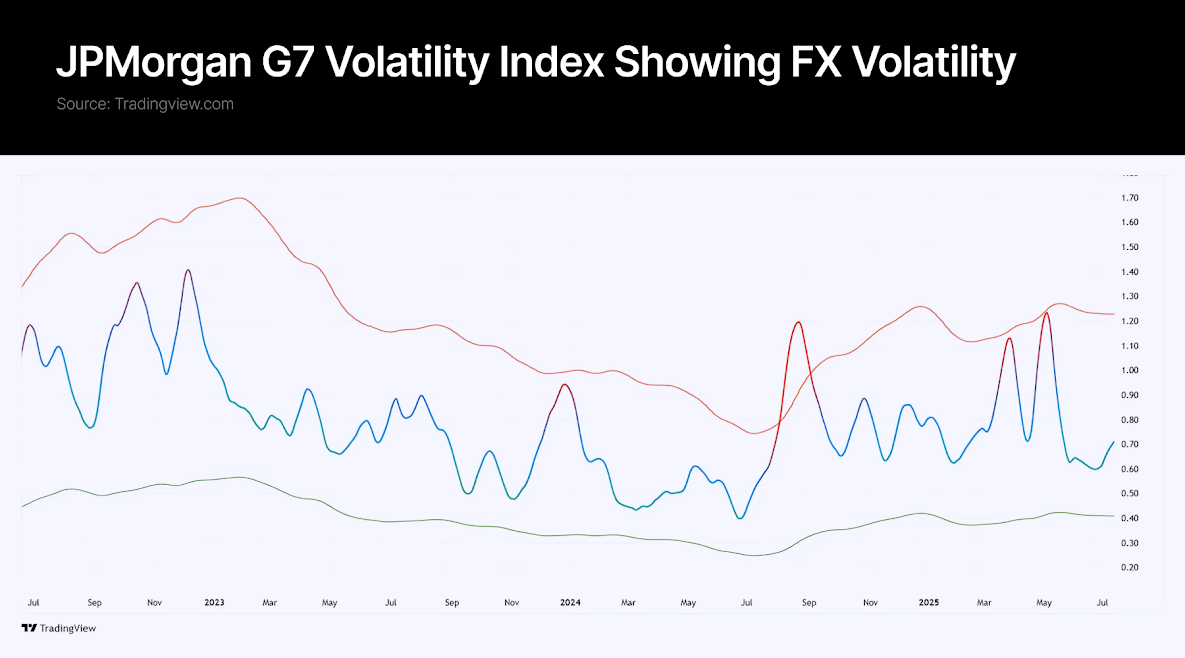
JPMorgan G7 volatility index
Middle East Conflicts
Ripple Through Global Markets
For
companies operating across borders, a single currency move triggered by
tariffs, elections, or rate decisions can erase an entire month's gains.
Traditional hedging approaches are falling short as correlations weaken and
uncertainty spreads to formerly stable G10 currencies.
Dor Golan, CEO of Grain
“While
geopolitical tensions influence overall FX volatility, our growth is primarily
fueled by product-market fit rather than macro events alone,” said Dor
Golan, CEO of Grain.
Cancellation Patterns
Signal Market Stress
The
company's data reveals telling patterns about how geopolitical stress affects
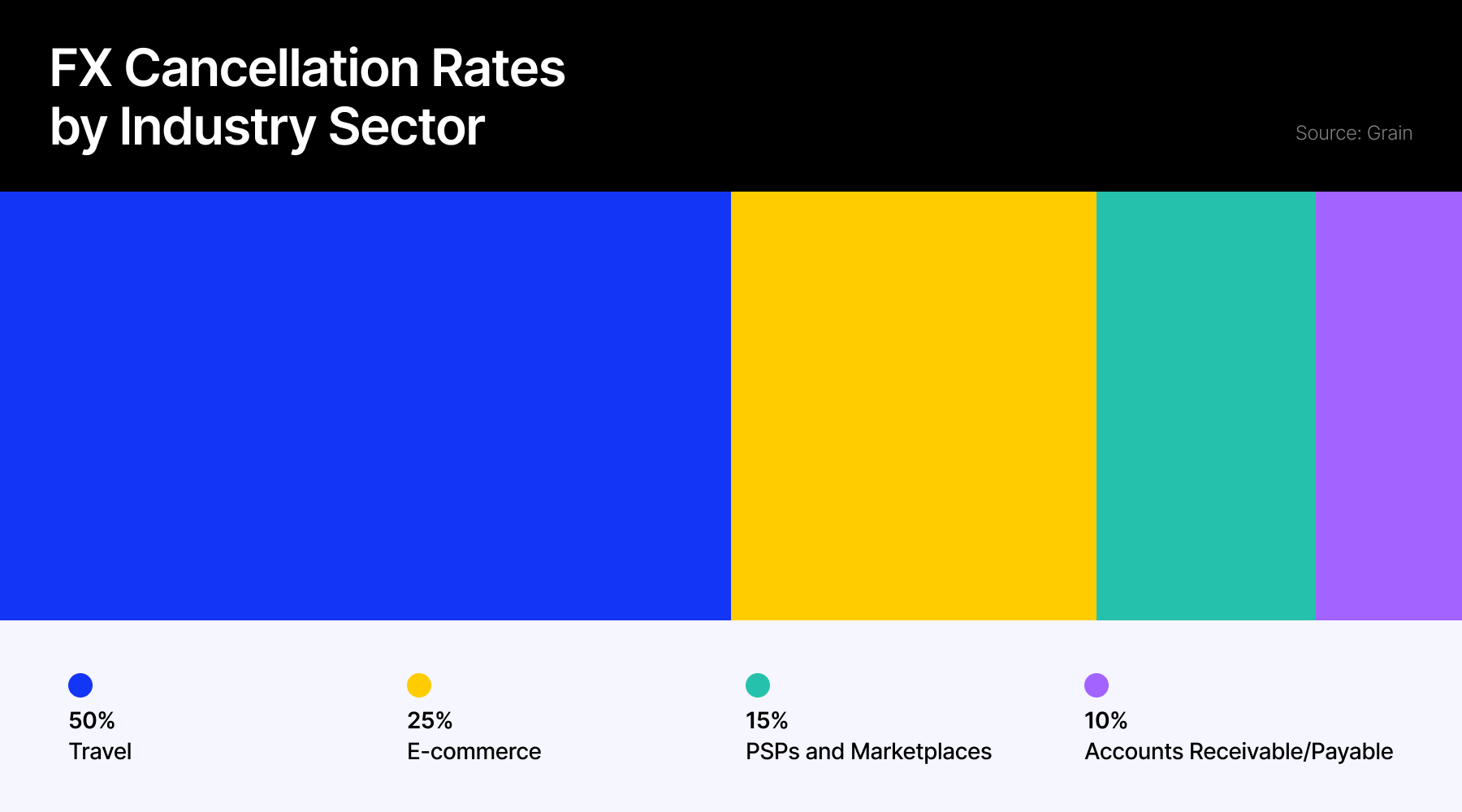
cross-border commerce. Grain observes cancellation rates of approximately 50%
in travel, 25% in e-commerce, 15% in payment service providers and
marketplaces, and 10% in accounts receivable/payable use cases.
“As
geopolitical tensions rise, we've observed a growing correlation between
cancellation rates and FX market volatility,” Golan noted. The company
processes up to 200 million transactions daily for some customers, giving it
unusual visibility into real-time market behavior.
The fintech
uses artificial intelligence and machine learning to assume FX risk in
scenarios traditionally considered unsolvable at scale, absorbing
mark-to-market risk on cancellations so customers don't need to post collateral
or manage exposure themselves.
AI-Powered Pricing Adapts
to Volatility
Grain's
pricing engine analyzes real-time behavioral data and live market inputs to
personalize FX rates for individual users. Two users may receive rates that
differ by up to 30% based purely on risk and reliability assessments.
“This
behavioral sensitivity enables us to detect early shifts in volatility and
exploit pricing discrepancies between hedge cost and user risk,” Golan
explained. “It also allows our customers to leverage FX prices that are
typically 1–3% more competitive, and that drive 6–8% lift in sales conversion
and volume at their checkouts.”
The
company's approach of integrating directly into customer systems provides
visibility into transaction flows, allowing it to aggregate risk across
portfolios and unlock pricing efficiency that can deliver FX savings up to 5%
per transaction.
Businesses Seek New
Solutions
The
prolonged uncertainty is accelerating adoption of automated, data-driven FX
risk management tools as businesses realize that static approaches leave them
vulnerable to market shifts and competitive pressure.
“Prolonged
uncertainty is accelerating the shift toward automated, data-driven, and
AI-powered FX risk management. But more importantly, it's highlighting FX as a
powerful competitive lever,” Golan said.
The company
serves payment service providers, marketplaces, accounts payable and receivable
platforms, fintechs, and payroll providers with globally distributed customer
bases. Its FX volume spreads fairly evenly across the four major trading
sessions in Tokyo, London, New York, and Sydney, with a skew toward the Western
Hemisphere.
“We're
seeing rising demand across the board, including in traditionally ‘stable’
currencies like those in the G10. Businesses are realizing that static, legacy
approaches to FX management leave them vulnerable to market shifts and
competitive pressure,” Grain’s CEO concluded.
Currency
markets are experiencing their most turbulent period in almost two decades,
with daily swings of 2–6% wiping out entire months of trading profits. Geopolitical tensions from Ukraine to the Middle East reshape global financial
dynamics.
Why the Dollar's Old Rules
Don't Work in Today's Volatile Markets
The
volatility surge is forcing businesses to rethink their foreign exchange
strategies, particularly as traditional correlations break down. The dollar no
longer reliably rises when markets fall, while Japan's hawkish monetary policy
shift and Europe's defense spending ramp-up add new variables to an already
complex equation.
“We're
clearly in the early stages of a prolonged period of uncertainty, which is
driving volatility across financial markets, particularly in FX,” commented Grain,
the Tel Aviv-based fintech that processes over $150 million monthly across more
than 50 currencies.
The
company, co-founded by former Barclays Israel COO Michal Beinish, has seen
transaction volumes grow at an annualized rate of over 3x as businesses
struggle with conventional hedging tools that executives describe as
“expensive, blunt, and often too slow” to handle rapid market shifts.
JPMorgan G7 volatility index
Middle East Conflicts
Ripple Through Global Markets
For
companies operating across borders, a single currency move triggered by
tariffs, elections, or rate decisions can erase an entire month's gains.
Traditional hedging approaches are falling short as correlations weaken and
uncertainty spreads to formerly stable G10 currencies.
Dor Golan, CEO of Grain
“While
geopolitical tensions influence overall FX volatility, our growth is primarily
fueled by product-market fit rather than macro events alone,” said Dor
Golan, CEO of Grain.
Cancellation Patterns
Signal Market Stress
The
company's data reveals telling patterns about how geopolitical stress affects
cross-border commerce. Grain observes cancellation rates of approximately 50%
in travel, 25% in e-commerce, 15% in payment service providers and
marketplaces, and 10% in accounts receivable/payable use cases.
“As
geopolitical tensions rise, we've observed a growing correlation between
cancellation rates and FX market volatility,” Golan noted. The company
processes up to 200 million transactions daily for some customers, giving it
unusual visibility into real-time market behavior.
The fintech
uses artificial intelligence and machine learning to assume FX risk in
scenarios traditionally considered unsolvable at scale, absorbing
mark-to-market risk on cancellations so customers don't need to post collateral
or manage exposure themselves.
AI-Powered Pricing Adapts
to Volatility
Grain's
pricing engine analyzes real-time behavioral data and live market inputs to
personalize FX rates for individual users. Two users may receive rates that
differ by up to 30% based purely on risk and reliability assessments.
“This
behavioral sensitivity enables us to detect early shifts in volatility and
exploit pricing discrepancies between hedge cost and user risk,” Golan
explained. “It also allows our customers to leverage FX prices that are
typically 1–3% more competitive, and that drive 6–8% lift in sales conversion
and volume at their checkouts.”
The
company's approach of integrating directly into customer systems provides
visibility into transaction flows, allowing it to aggregate risk across
portfolios and unlock pricing efficiency that can deliver FX savings up to 5%
per transaction.
Businesses Seek New
Solutions
The
prolonged uncertainty is accelerating adoption of automated, data-driven FX
risk management tools as businesses realize that static approaches leave them
vulnerable to market shifts and competitive pressure.
“Prolonged
uncertainty is accelerating the shift toward automated, data-driven, and
AI-powered FX risk management. But more importantly, it's highlighting FX as a
powerful competitive lever,” Golan said.
The company
serves payment service providers, marketplaces, accounts payable and receivable
platforms, fintechs, and payroll providers with globally distributed customer
bases. Its FX volume spreads fairly evenly across the four major trading
sessions in Tokyo, London, New York, and Sydney, with a skew toward the Western
Hemisphere.
“We're
seeing rising demand across the board, including in traditionally ‘stable’
currencies like those in the G10. Businesses are realizing that static, legacy
approaches to FX management leave them vulnerable to market shifts and
competitive pressure,” Grain’s CEO concluded.
Damian Chmiel is a Senior Analyst & Editor at Finance Magnates with more than 15 years of experience in the CFD and online trading industry. Active as both a trader and journalist since 2010, he focuses on broker coverage, fintech innovation, and regulatory developments across Europe, the Middle East, and Asia.
His work includes interviews with C-level leaders at major brokerages and fintech platforms, as well as co-authoring Finance Magnates’ quarterly industry benchmarking reports. Damian’s reporting is data-driven, market-aware, and grounded in direct industry engagement. His analysis and commentary have also been cited by external media outlets, including Investing.com, Binance, The Asset, Stockhead, and Dispatch.
Education:
MA in Finance and Accounting, Cracow University of Economics
ESMA’s Common Supervisory Action Follows Enforcement: Should CFD Brokers Be Worried?
FP Markets Winner Spotlight 🏆 | Global Broker of the Year 2025 #Trading #Broker #Innovation #Shorts
FP Markets Winner Spotlight 🏆 | Global Broker of the Year 2025 #Trading #Broker #Innovation #Shorts
FP Markets takes the spotlight as Global Broker of the Year 2025 at the Finance Magnates Awards.
Martin Stoilov, Head of Client Experience, shares that trust, innovation, and people played a key role in the company’s success, supported by a strong foundation of integrity and client-centricity.
Following this milestone, FP Markets continues to focus on growth, technology investment, and its core values of transparency and excellence.
👉 Be part of FM Awards 2026: https://awards.financemagnates.com/#nominate
FP Markets takes the spotlight as Global Broker of the Year 2025 at the Finance Magnates Awards.
Martin Stoilov, Head of Client Experience, shares that trust, innovation, and people played a key role in the company’s success, supported by a strong foundation of integrity and client-centricity.
Following this milestone, FP Markets continues to focus on growth, technology investment, and its core values of transparency and excellence.
👉 Be part of FM Awards 2026: https://awards.financemagnates.com/#nominate
In this video, we review @HolaPrimeMarketsOfficial, a multi-asset forex and CFDs broker offering different account types, trading platforms, and flexible trading conditions.
We cover the broker’s overall offering, including account options, trading environment, platforms like MT4 and MT5, and additional services such as managed accounts and fast withdrawals.
Watch the full video to see if Hola Prime Markets fits your trading needs.
📣 Stay up to date with the latest in finance and trading. Follow Finance Magnates for industry news, insights, and global event coverage.
Connect with us:
🔗 LinkedIn: /financemagnates
👍 Facebook: /financemagnates
📸 Instagram: https://www.instagram.com/financemagnates
🐦 X: https://x.com/financemagnates
🎥 TikTok: https://www.tiktok.com/tag/financemagnates
▶️ YouTube: /@financemagnates_official
#HolaPrime #ForexBroker #CFDTrading #FinanceMagnates #Trading #Forex #BrokerReview
In this video, we review @HolaPrimeMarketsOfficial, a multi-asset forex and CFDs broker offering different account types, trading platforms, and flexible trading conditions.
We cover the broker’s overall offering, including account options, trading environment, platforms like MT4 and MT5, and additional services such as managed accounts and fast withdrawals.
Watch the full video to see if Hola Prime Markets fits your trading needs.
📣 Stay up to date with the latest in finance and trading. Follow Finance Magnates for industry news, insights, and global event coverage.
Connect with us:
🔗 LinkedIn: /financemagnates
👍 Facebook: /financemagnates
📸 Instagram: https://www.instagram.com/financemagnates
🐦 X: https://x.com/financemagnates
🎥 TikTok: https://www.tiktok.com/tag/financemagnates
▶️ YouTube: /@financemagnates_official
#HolaPrime #ForexBroker #CFDTrading #FinanceMagnates #Trading #Forex #BrokerReview
Hola Prime Review: What You Need to Know | Full Breakdown by Finance Magnates
Hola Prime Review: What You Need to Know | Full Breakdown by Finance Magnates
In this video, we review @HolaPrime_Global, a proprietary trading firm offering evaluation programs and performance-based payouts in simulated market environments.
We cover how the challenge model works, including account types, profit splits (up to 95%), trading rules, and what it takes to reach a funded account. You’ll also learn about available platforms like MT4, MT5, cTrader, and more, along with insights into payouts, support, and trading conditions.
Watch the full video to see if Hola Prime fits your trading style.
📣 Stay up to date with the latest in finance and trading. Follow Finance Magnates for industry news, insights, and global event coverage.
Connect with us:
🔗 LinkedIn: /financemagnates
👍 Facebook: /financemagnates
📸 Instagram: https://www.instagram.com/financemagnates
🐦 X: https://x.com/financemagnates
🎥 TikTok: https://www.tiktok.com/tag/financemagnates
▶️ YouTube: /@financemagnates_official
#HolaPrime #PropFirm #Trading #FinanceMagnates #Forex #FuturesTrading #TradingReview #PropFirmReview
In this video, we review @HolaPrime_Global, a proprietary trading firm offering evaluation programs and performance-based payouts in simulated market environments.
We cover how the challenge model works, including account types, profit splits (up to 95%), trading rules, and what it takes to reach a funded account. You’ll also learn about available platforms like MT4, MT5, cTrader, and more, along with insights into payouts, support, and trading conditions.
Watch the full video to see if Hola Prime fits your trading style.
📣 Stay up to date with the latest in finance and trading. Follow Finance Magnates for industry news, insights, and global event coverage.
Connect with us:
🔗 LinkedIn: /financemagnates
👍 Facebook: /financemagnates
📸 Instagram: https://www.instagram.com/financemagnates
🐦 X: https://x.com/financemagnates
🎥 TikTok: https://www.tiktok.com/tag/financemagnates
▶️ YouTube: /@financemagnates_official
#HolaPrime #PropFirm #Trading #FinanceMagnates #Forex #FuturesTrading #TradingReview #PropFirmReview
Axi Winner Spotlight 🏆 | Global Most Innovative Broker 2025 #Innovation #Trading #Fintech #Broker
Axi Winner Spotlight 🏆 | Global Most Innovative Broker 2025 #Innovation #Trading #Fintech #Broker
Axi takes the spotlight at the Finance Magnates Awards, winning Global Most Innovative Broker 2025.
Olivia Xenofontos and Ivanna Openko share how the team will feel: proud, motivated, and ready to keep delivering.
They also describe the night as well-organized, focused, and enjoyable for all.
👉 Be part of FM Awards 2026.
Axi takes the spotlight at the Finance Magnates Awards, winning Global Most Innovative Broker 2025.
Olivia Xenofontos and Ivanna Openko share how the team will feel: proud, motivated, and ready to keep delivering.
They also describe the night as well-organized, focused, and enjoyable for all.
👉 Be part of FM Awards 2026.
Recognition that matters.
Built on transparency.
Driven by the industry.
The Finance Magnates Awards 2026.
Nominations are now open.
🔗 https://awards.financemagnates.com/?utm_source=SM&utm_medium=social&utm_campaign=recognition-matters
Recognition that matters.
Built on transparency.
Driven by the industry.
The Finance Magnates Awards 2026.
Nominations are now open.
🔗 https://awards.financemagnates.com/?utm_source=SM&utm_medium=social&utm_campaign=recognition-matters