
A CySEC-regulated broker spending $250,000 a month on paid media switched its Google and Meta campaigns to the platforms’ AI audience expansion in the spring of 2026. Within three weeks, cost per lead was down 25% and lead volume was up 33%. The weekly report went green. Ninety days later, the cost of a funded client who had made a second deposit was up about 60%.
London's trading industry is coming home!
That is the shape of most AI stories we hear from brokers, and it is what the title means. AI lowers a broker’s acquisition cost in four places, all after the click, and the movement is only visible in cost per funded client against a control group over 90 days. On cost per lead, every AI tool works, including the ones quietly making the book worse.
The figures come from CySEC-regulated broker accounts we have worked on, selling into EU markets. No published, controlled result shows AI lowering a broker’s cost per first-time depositor through day 90, so read them as observations: cost per lead of $40–150, 4–6% of leads funding, about $1,900 per first-time depositor at the midpoints, on a $250,000 monthly budget.
The Auction Is Rented

Most of the AI a broker can buy for its media side already sits inside the platforms: Advantage+, Performance Max and Smart Bidding choose the audience, the placement and the bid. What they do when a broker lets them is widen the audience.
Expansion finds people who will submit a form at a lower price because the form is the event it was told to find, and the people it adds are the ones narrower targeting excluded for a reason.
The expansion is structural: bidding models need dozens of conversion events a month per campaign before they learn, and a broker with 115 first deposits a month across 6–8 markets cannot give any campaign that many, so the account gets optimised to the form.
- Brokers Spent 2026 Plugging Into AI Assistants. A London Summit Panel Asks What Comes Next
- Vietnam Hands “Mr Pips” Life Term in $60 Million Forex Fraud Case
- Weekly Review: eToro Crypto Trades Fall 62%; IG Group Secures Court Approval for Jersey Move
The way out is a synthetic event: a qualified lead that fires when the lead score crosses a threshold, which gives the auction hundreds of quality-weighted events a month without waiting 90 days for a deposit. Plus500 already measures at that level: it reports acquisition cost as marketing spend per first-time depositor, $1,230 for the first half of 2026, and no cost per lead.
The Test a Use Case Has to Pass
A use case is on the list if it moved cost per funded client against a holdout, a 20–30% share of the same traffic running the old process for at least a month, and the movement held at day 90, measured as the share of first-time depositors who deposit again, 40–50% in our accounts.
The denominator is the full budget, including the 10–15% lost to disapprovals and account pauses. Every AI use case we tested improved some number on the weekly report; three moved this one, and a fourth made the test affordable.
4 use cases, 1 denominator
Use case | Lever it moves | Shift observed | Cost per FTD, alone | Who owns it |
AI creative iteration | Cost per lead | CPL −15–25%; lead-to-FTD flat; 5–10 to 40–60 variants a month | −20% | Creative lead |
AI lead scoring before the call | Lead to FTD; the auction’s quality signal | +0.5–1 pp; first-hour call funds at 2–3x next-day | −13% | Head of sales |
AI compliance pre-review | Budget that never delivers | 10–15% of budget to 2–4% | −10% | Compliance officer |
AI cohort analysis | Time from data to decision | Monthly read to weekly; 2–3 analyst days to under 1 hour | Makes the other three compound | Owner of the number |
Creative iteration. Financial creative has 2–3 weeks before frequency pushes its cost up, and the bottleneck has always been how many compliant variants a team can produce in that window. AI-assisted production takes a broker from 5–10 fresh variants a month to 40–60 and the test cadence from monthly to weekly.
Cost per lead falls 15–25% because the winner is found sooner and retired before it decays. Lead-to-deposit conversion did not move because the offer, the market and the audience stayed the same. The cheaper lead was the same lead.
Lead scoring before the call. A sales floor has a fixed number of calls it can make in the first hour after a form arrives, and that hour is where deposits are decided: a lead called within the hour funds at 2–3 times the rate of one called the next day.
At peak, the floor reaches 40–60% of leads in time; the score decides which. Scoring on submission, from the form fields, landing path, device and market, adds 0.5–1 percentage point to lead-to-deposit conversion, a 10–20% gain in funded clients from the same spend. Sent back to the platform as a qualified-lead event, the same score is what keeps expansion honest.
Compliance pre-review of creative. Between disapprovals, review pauses and verification holds, a broker in this segment loses 10–15% of its monthly budget, and the risk grew on 23 July 2026, when Google extended financial services verification to 24 more EEA markets, Cyprus among them.
Running every variant through a model trained on the platform’s financial policies and the broker’s own disapproval history before upload brings the loss to 2–4%. Of 40–60 variants a month, 30–50% come back from compliance on the first pass; pre-review moves those returns off the platform, where each costs a pause, into an internal loop, where each costs an hour.
Cost per lead does not move; cost per funded client falls about 10% because 10% more of the budget is buying leads.
Cohort analysis. Everything above rests on the cohort table, which most brokers do not build because it was too expensive: a holdout comparison cut by creative, market and lead score at day 30 and day 90 takes an analyst 2–3 days a month, and by then the creative it measures has been retired.
That is why the 90-day cohort in the opening story arrived three months late: the data existed from day one; nobody had the hours to read it. With an AI analyst on the same exports, the table takes under an hour and runs weekly.
The second deposit still takes 90 days; what moves is the distance between data and decision, and the other three use cases live in that distance, each a loop that only pays if it is read faster than the creative decays, the score drifts or the policy changes.
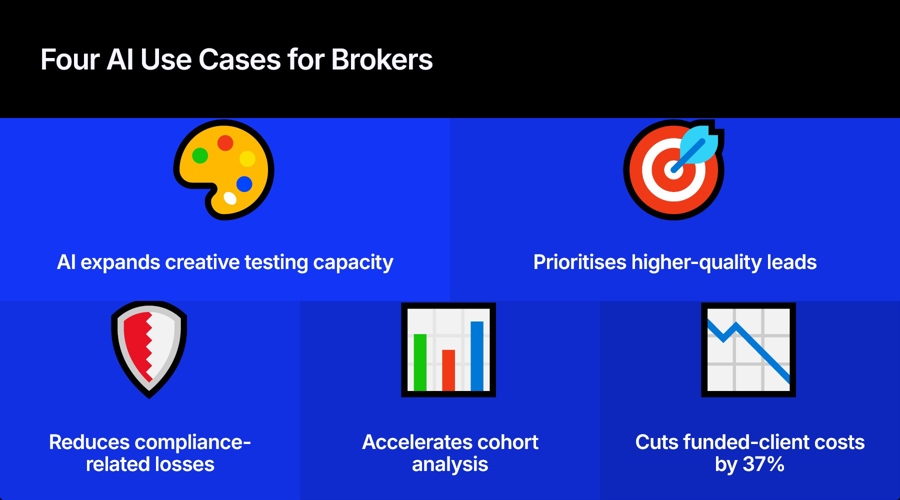
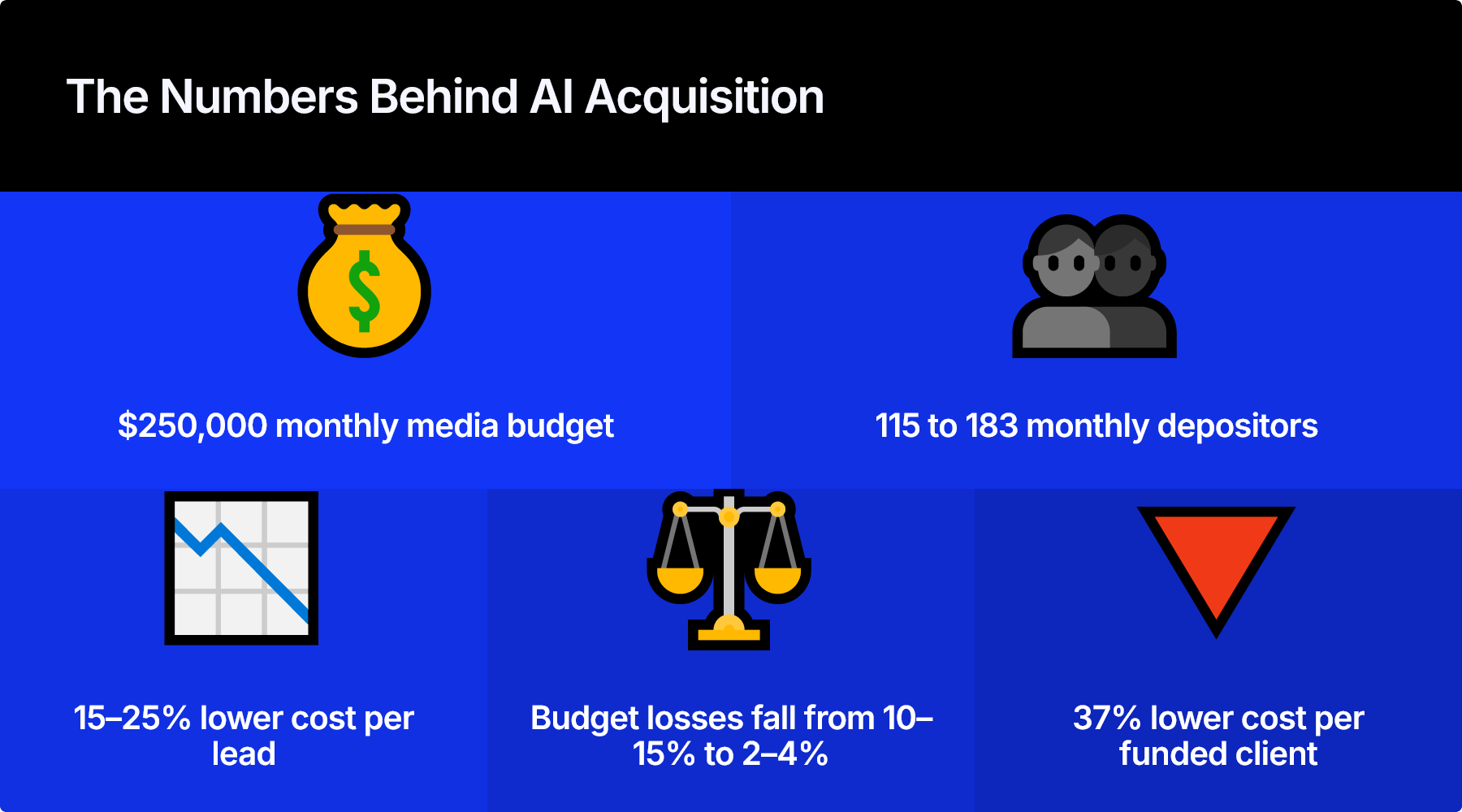
Together, the four take the same $250,000 from about 115 first-time depositors a month to about 183, and cost per funded client on the full budget from about $2,170 to about $1,360, a 37% reduction. We would treat that as the ceiling at current tooling; a halving is a cost-per-lead claim under a different label.
3 That Only Look Like It
Audience expansion cuts cost per lead 20–30%, drops lead-to-deposit conversion from 4–6% to 3–4% and the 90-day second-deposit share from 40–50% to 25–35%: 5–10% worse on cost per funded client, about 60% worse on cost per client who came back.
IG told investors in July 2026 that a Japanese promotion in early 2025 produced about 5,000 first trades and was discontinued because returns and retention were unacceptable; the same shape, without AI. Chatbots, AI lead magnets and AI-generated content raise form counts, and in our tests none moved deposits because each widens the definition of a lead.
One Broker, 6 Months
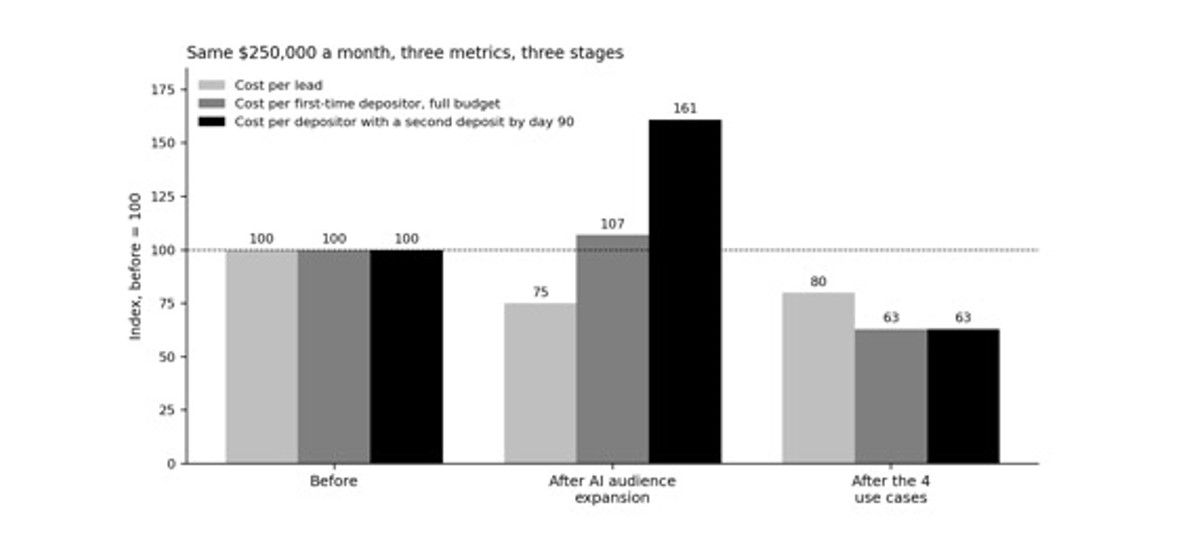
Figure 1. The same $250,000 a month, indexed to the starting month. Only the post-click phase moves the cost of a client who came back.
The broker in the opening paragraph ran expansion first, then the four use cases over the next four months; the figures are our model at the broker’s observed inputs, and the broker has verified the direction and order of magnitude. Cost per lead after the four use cases is higher than under expansion, $76 against $71, and a team measured on cost per lead would have called that a step backwards.
First-time depositors rose about 60% and the cost of a client with a second deposit fell about 37%. The broker got there without cheaper people: it lost less budget before the click, found the winning ad faster, called the right lead first and read the result the same week.
The Edge Has Moved Off the Ad Account
Every broker now rents the same bidding model from the same two platforms at the same price, so media-buying skill, the thing brokers have hired and fired marketers over for 15 years, is converging on the platform average. What does not converge is the data a broker owns and the platform cannot see: which lead funded, which depositor came back, which claim got the account flagged.
None of the four use cases lives in the paid media team. The broker that gets the 37% is the one whose head of marketing owns those lines and reports on one figure: cost per depositor who came back.
That figure is also the test for any AI vendor with a case study: ask what happened to the second deposit. If the answer is a cost-per-lead chart, the case study is the opening paragraph of this article with a different logo. The auction is rented. The funnel behind it is the only part of acquisition a broker still owns, and the next 37% goes to the broker that reads it fastest.


