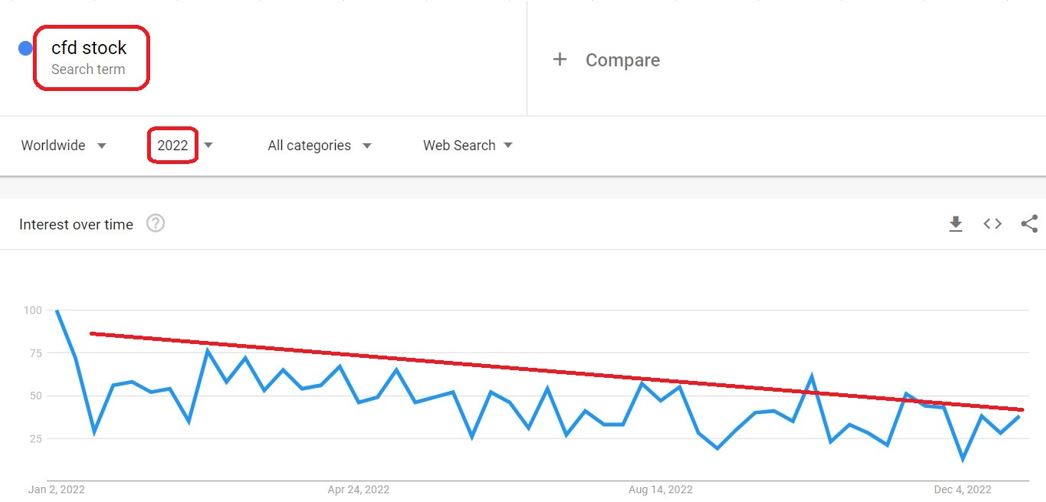
Interest in stock CFDs dropped significantly in 2022.
Brokers’ profits from this business line have fallen too.
Source: Ron Finberg
Although 2023 started on a solid foot, the stock market’s collapse in 2022 was
impossible not to notice. Substantial discounts on leading indices and a
continuously strengthening dollar have reduced retail investor activity on Wall
Street and almost every other stock trading floor worldwide.
Have
investment firms felt the decline in equities interest? Which instruments may
have proved more attractive last year? Finance Magnates delved into the
reports of publicly listed trading firms and spoke to industry representatives
for answers in the newest Quarterly Industry Report.
After over a decade of almost uninterrupted gains, global stock markets finished 2022
with the steepest declines since the Great Financial Crisis of 2008. The
S&P 500 index lost nearly 20%, the Nasdaq 100 technology index gave back as
much as 33%, and the MSCI World equity index was down 18%.
Filippo Ucchino, the Founder and CEO at InvestinGoal
As a
result, instead of betting on equities, investors looked for a place to hide in
the safe-haven dollar, which gained more than 8% to a basket of currencies. At
one moment in 2022, it rose by 20%, reaching record highs. Bond yields gained
along with the greenback: the US 10-year debt note yield rose 156% and tested
levels above 4.3%, which is the highest since 2007.
Filippo
Ucchino, the Founder and CEO at InvestinGoal, a trading research platform for
retail traders, states that Google Trends shows a visible slump in the popularity
of shares trading amongst CFD traders.
“The
decline in Big Tech stock prices in 2022 was indeed directly related to a loss
of user interest in Equity CFD trading. A keyword analysis on Google Trends
shows that interest in stock CFDs has dropped in a very similar way,” Ucchino
commented.
“While
interest in Big Tech stock price movements remained more or less in line, even
experiencing some spikes (for example, as a result of the various layoff news),
interest in stock CFD trading dropped about 50%, very similar to the -46%
decline by the Big Techs overall,” Ucchino added.
A decline in interest in CFDs in Google Search. Source: Google Trends
Publicly Listed Brokers
Show Lower Shares Trading Revenues
Looking at
the financial reports of IG Group, CMC Markets and XTB, there is an apparent
slowdown in revenue resulting from trading equities. According to the IG
Groups’ interim results report for the six months ended 30 November 2022, “Stock
trading and investments” accounted for the smallest share of the broker’s revenue,
recording a decline of 30% compared to the same period a year earlier. Total
revenue in H1 FY23 was £11.3 million, which is down from £15.9 million in 2021.
Net trading revenue in stock trading and investment per client also fell 29%
to £122.
The CMC
Markets report, published in November and covering the six months ended 30
September 2022, reached similar conclusions. The broker showed an overall
increase in net operating income of 21% YoY, to £153.5 million, but a 14% fall
in investing net revenue over the same period, to £20.8 million from £24.2
million.
Watch the recent FMLS22 panel discussion on: "What CFDs Traders Value Most & How They Choose Their Brokers."
We can look
for the most up-to-date information regarding the popularity of shares trading
amongst CFD traders in XTB’s 2022 initial financial report, published
in early February. The turnover of equity CFDs amounted to PLN 1.1 million in
the last quarter of 2022, falling by more than 90% compared to the PLN 11.5
million reported in the same period a year earlier. Thus, it is evident that
the trading activity bottomed out with the market itself.
After the Storm, the Sun Comes Out
In 2022,
equities were no longer the favorite instruments of retail investors, including
in the CFD industry. Commodities or currency pairs became way more popular due
to the almost continuously rising dollar.
However,
according to experts interviewed by Finance Magnates, the market storm should
calm down, and the first rays of sunshine will appear again in 2023.
To get
the full article and the bigger picture on equity market valuation and its
influence on CFDs trading popularity, get our Latest Quarterly
Intelligence Report.
Although 2023 started on a solid foot, the stock market’s collapse in 2022 was
impossible not to notice. Substantial discounts on leading indices and a
continuously strengthening dollar have reduced retail investor activity on Wall
Street and almost every other stock trading floor worldwide.
Have
investment firms felt the decline in equities interest? Which instruments may
have proved more attractive last year? Finance Magnates delved into the
reports of publicly listed trading firms and spoke to industry representatives
for answers in the newest Quarterly Industry Report.
After over a decade of almost uninterrupted gains, global stock markets finished 2022
with the steepest declines since the Great Financial Crisis of 2008. The
S&P 500 index lost nearly 20%, the Nasdaq 100 technology index gave back as
much as 33%, and the MSCI World equity index was down 18%.
Filippo Ucchino, the Founder and CEO at InvestinGoal
As a
result, instead of betting on equities, investors looked for a place to hide in
the safe-haven dollar, which gained more than 8% to a basket of currencies. At
one moment in 2022, it rose by 20%, reaching record highs. Bond yields gained
along with the greenback: the US 10-year debt note yield rose 156% and tested
levels above 4.3%, which is the highest since 2007.
Filippo
Ucchino, the Founder and CEO at InvestinGoal, a trading research platform for
retail traders, states that Google Trends shows a visible slump in the popularity
of shares trading amongst CFD traders.
“The
decline in Big Tech stock prices in 2022 was indeed directly related to a loss
of user interest in Equity CFD trading. A keyword analysis on Google Trends
shows that interest in stock CFDs has dropped in a very similar way,” Ucchino
commented.
“While
interest in Big Tech stock price movements remained more or less in line, even
experiencing some spikes (for example, as a result of the various layoff news),
interest in stock CFD trading dropped about 50%, very similar to the -46%
decline by the Big Techs overall,” Ucchino added.
A decline in interest in CFDs in Google Search. Source: Google Trends
Publicly Listed Brokers
Show Lower Shares Trading Revenues
Looking at
the financial reports of IG Group, CMC Markets and XTB, there is an apparent
slowdown in revenue resulting from trading equities. According to the IG
Groups’ interim results report for the six months ended 30 November 2022, “Stock
trading and investments” accounted for the smallest share of the broker’s revenue,
recording a decline of 30% compared to the same period a year earlier. Total
revenue in H1 FY23 was £11.3 million, which is down from £15.9 million in 2021.
Net trading revenue in stock trading and investment per client also fell 29%
to £122.
The CMC
Markets report, published in November and covering the six months ended 30
September 2022, reached similar conclusions. The broker showed an overall
increase in net operating income of 21% YoY, to £153.5 million, but a 14% fall
in investing net revenue over the same period, to £20.8 million from £24.2
million.
Watch the recent FMLS22 panel discussion on: "What CFDs Traders Value Most & How They Choose Their Brokers."
We can look
for the most up-to-date information regarding the popularity of shares trading
amongst CFD traders in XTB’s 2022 initial financial report, published
in early February. The turnover of equity CFDs amounted to PLN 1.1 million in
the last quarter of 2022, falling by more than 90% compared to the PLN 11.5
million reported in the same period a year earlier. Thus, it is evident that
the trading activity bottomed out with the market itself.
After the Storm, the Sun Comes Out
In 2022,
equities were no longer the favorite instruments of retail investors, including
in the CFD industry. Commodities or currency pairs became way more popular due
to the almost continuously rising dollar.
However,
according to experts interviewed by Finance Magnates, the market storm should
calm down, and the first rays of sunshine will appear again in 2023.
To get
the full article and the bigger picture on equity market valuation and its
influence on CFDs trading popularity, get our Latest Quarterly
Intelligence Report.
Damian Chmiel is a Senior Analyst & Editor at Finance Magnates with more than 15 years of experience in the CFD and online trading industry. Active as both a trader and journalist since 2010, he focuses on broker coverage, fintech innovation, and regulatory developments across Europe, the Middle East, and Asia.
His work includes interviews with C-level leaders at major brokerages and fintech platforms, as well as co-authoring Finance Magnates’ quarterly industry benchmarking reports. Damian’s reporting is data-driven, market-aware, and grounded in direct industry engagement. His analysis and commentary have also been cited by external media outlets, including Investing.com, Binance, The Asset, Stockhead, and Dispatch.
Education:
MA in Finance and Accounting, Cracow University of Economics
Retail Traders Can Now Access Prediction Markets Through Binance Wallet
FP Markets Winner Spotlight 🏆 | Global Broker of the Year 2025 #Trading #Broker #Innovation #Shorts
FP Markets Winner Spotlight 🏆 | Global Broker of the Year 2025 #Trading #Broker #Innovation #Shorts
FP Markets takes the spotlight as Global Broker of the Year 2025 at the Finance Magnates Awards.
Martin Stoilov, Head of Client Experience, shares that trust, innovation, and people played a key role in the company’s success, supported by a strong foundation of integrity and client-centricity.
Following this milestone, FP Markets continues to focus on growth, technology investment, and its core values of transparency and excellence.
👉 Be part of FM Awards 2026: https://awards.financemagnates.com/#nominate
FP Markets takes the spotlight as Global Broker of the Year 2025 at the Finance Magnates Awards.
Martin Stoilov, Head of Client Experience, shares that trust, innovation, and people played a key role in the company’s success, supported by a strong foundation of integrity and client-centricity.
Following this milestone, FP Markets continues to focus on growth, technology investment, and its core values of transparency and excellence.
👉 Be part of FM Awards 2026: https://awards.financemagnates.com/#nominate
In this video, we review @HolaPrimeMarketsOfficial, a multi-asset forex and CFDs broker offering different account types, trading platforms, and flexible trading conditions.
We cover the broker’s overall offering, including account options, trading environment, platforms like MT4 and MT5, and additional services such as managed accounts and fast withdrawals.
Watch the full video to see if Hola Prime Markets fits your trading needs.
📣 Stay up to date with the latest in finance and trading. Follow Finance Magnates for industry news, insights, and global event coverage.
Connect with us:
🔗 LinkedIn: /financemagnates
👍 Facebook: /financemagnates
📸 Instagram: https://www.instagram.com/financemagnates
🐦 X: https://x.com/financemagnates
🎥 TikTok: https://www.tiktok.com/tag/financemagnates
▶️ YouTube: /@financemagnates_official
#HolaPrime #ForexBroker #CFDTrading #FinanceMagnates #Trading #Forex #BrokerReview
In this video, we review @HolaPrimeMarketsOfficial, a multi-asset forex and CFDs broker offering different account types, trading platforms, and flexible trading conditions.
We cover the broker’s overall offering, including account options, trading environment, platforms like MT4 and MT5, and additional services such as managed accounts and fast withdrawals.
Watch the full video to see if Hola Prime Markets fits your trading needs.
📣 Stay up to date with the latest in finance and trading. Follow Finance Magnates for industry news, insights, and global event coverage.
Connect with us:
🔗 LinkedIn: /financemagnates
👍 Facebook: /financemagnates
📸 Instagram: https://www.instagram.com/financemagnates
🐦 X: https://x.com/financemagnates
🎥 TikTok: https://www.tiktok.com/tag/financemagnates
▶️ YouTube: /@financemagnates_official
#HolaPrime #ForexBroker #CFDTrading #FinanceMagnates #Trading #Forex #BrokerReview
Hola Prime Review: What You Need to Know | Full Breakdown by Finance Magnates
Hola Prime Review: What You Need to Know | Full Breakdown by Finance Magnates
In this video, we review @HolaPrime_Global, a proprietary trading firm offering evaluation programs and performance-based payouts in simulated market environments.
We cover how the challenge model works, including account types, profit splits (up to 95%), trading rules, and what it takes to reach a funded account. You’ll also learn about available platforms like MT4, MT5, cTrader, and more, along with insights into payouts, support, and trading conditions.
Watch the full video to see if Hola Prime fits your trading style.
📣 Stay up to date with the latest in finance and trading. Follow Finance Magnates for industry news, insights, and global event coverage.
Connect with us:
🔗 LinkedIn: /financemagnates
👍 Facebook: /financemagnates
📸 Instagram: https://www.instagram.com/financemagnates
🐦 X: https://x.com/financemagnates
🎥 TikTok: https://www.tiktok.com/tag/financemagnates
▶️ YouTube: /@financemagnates_official
#HolaPrime #PropFirm #Trading #FinanceMagnates #Forex #FuturesTrading #TradingReview #PropFirmReview
In this video, we review @HolaPrime_Global, a proprietary trading firm offering evaluation programs and performance-based payouts in simulated market environments.
We cover how the challenge model works, including account types, profit splits (up to 95%), trading rules, and what it takes to reach a funded account. You’ll also learn about available platforms like MT4, MT5, cTrader, and more, along with insights into payouts, support, and trading conditions.
Watch the full video to see if Hola Prime fits your trading style.
📣 Stay up to date with the latest in finance and trading. Follow Finance Magnates for industry news, insights, and global event coverage.
Connect with us:
🔗 LinkedIn: /financemagnates
👍 Facebook: /financemagnates
📸 Instagram: https://www.instagram.com/financemagnates
🐦 X: https://x.com/financemagnates
🎥 TikTok: https://www.tiktok.com/tag/financemagnates
▶️ YouTube: /@financemagnates_official
#HolaPrime #PropFirm #Trading #FinanceMagnates #Forex #FuturesTrading #TradingReview #PropFirmReview
Axi Winner Spotlight 🏆 | Global Most Innovative Broker 2025 #Innovation #Trading #Fintech #Broker
Axi Winner Spotlight 🏆 | Global Most Innovative Broker 2025 #Innovation #Trading #Fintech #Broker
Axi takes the spotlight at the Finance Magnates Awards, winning Global Most Innovative Broker 2025.
Olivia Xenofontos and Ivanna Openko share how the team will feel: proud, motivated, and ready to keep delivering.
They also describe the night as well-organized, focused, and enjoyable for all.
👉 Be part of FM Awards 2026.
Axi takes the spotlight at the Finance Magnates Awards, winning Global Most Innovative Broker 2025.
Olivia Xenofontos and Ivanna Openko share how the team will feel: proud, motivated, and ready to keep delivering.
They also describe the night as well-organized, focused, and enjoyable for all.
👉 Be part of FM Awards 2026.
Recognition that matters.
Built on transparency.
Driven by the industry.
The Finance Magnates Awards 2026.
Nominations are now open.
🔗 https://awards.financemagnates.com/?utm_source=SM&utm_medium=social&utm_campaign=recognition-matters
Recognition that matters.
Built on transparency.
Driven by the industry.
The Finance Magnates Awards 2026.
Nominations are now open.
🔗 https://awards.financemagnates.com/?utm_source=SM&utm_medium=social&utm_campaign=recognition-matters