10x Down to 2x: Has Europe Killed Crypto Perps Even before It Started?

Friday, 27/02/2026 | 08:06 GMT by Arnab Shome
  • ESMA recently issued a public statement noting that perpetual futures are likely to fall under the CFD category.
  • The European perp providers are currently offering up to 10x leverage, but if these products are categorised as CFDs, they can only offer 2x leverage.
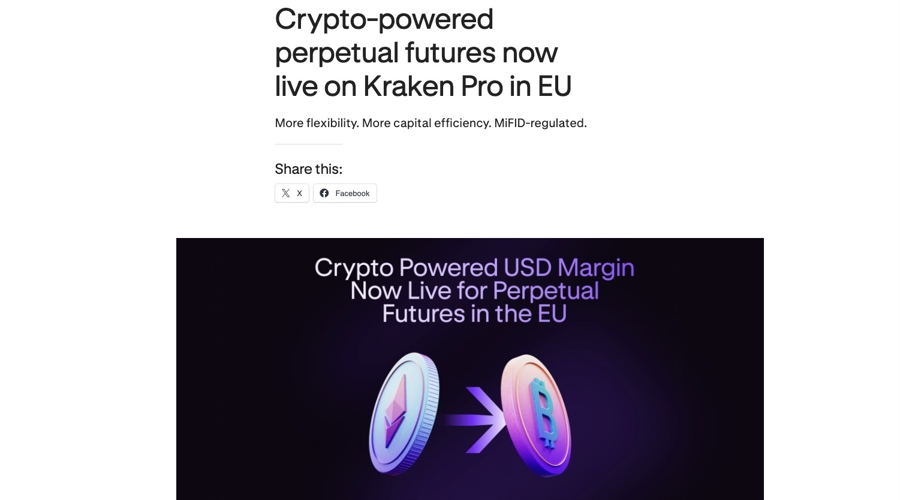
A screenshot of Kraken's announcement of perps launch in the EU

It has been only a few months since Kraken, One Trading and Backpack started offering crypto perpetual contracts, better known as perps, to European traders. Coinbase’s website for the same is also live, but it has yet to make any formal announcement about the launch.

Other major players in the pipeline to launch the same include Bitstamp, Gemini and Bybit.

Is Europe Stretching Its Regulatory Arm Too Much?

However, the pan-European regulator earlier this week might have spoiled the ambitious plans of crypto exchanges.

Regulators have observed “the increased offering of derivatives, often marketed as perpetual futures or perpetual contracts, that provide leveraged exposure to underlying values, including crypto-assets such as Bitcoin or Ethereum”, and these might fall under the classification of contracts for difference (CFD) instruments.

“This means that those derivatives that meet the definition of a CFD would be subject to measures including leverage limits, a mandatory risk warning, margin close-out and negative balance protection, and the prohibition of monetary and non-monetary benefits,” the European Securities and Markets Authority noted in its public statement last Tuesday.

Verena Ross, ESMA's Chair

The statement came months before Verena Ross's exit as ESMA's Chair. The tenure of her second term will end at the end of October this year.

Perpetual contracts are derivatives written similarly to regular futures. The primary difference between these contracts and a regular futures contract is that they do not have an expiration date. Their settlement, pricing and margin calculations are done on an ongoing basis, often multiple times a day.

These perps are particularly used to offer derivatives on volatile cryptocurrencies.

BitMEX, which operates largely from its offshore base, popularised crypto perps during the 2017–18 crypto boom, allowing traders to speculate on Bitcoin's price against the US dollar with up to 100x leverage. The goal was to eliminate traditional Bitcoin futures contracts’ roll positions and repeated fees, which made leveraged speculation cumbersome.

The adoption of these 100x leveraged perps was massive. BitMEX's daily transaction volume crossed $1 billion in 2018. According to CoinDesk data, monthly volumes of perps jumped from $35 billion in January 2018 to $6.4 trillion in May 2025.

Decentralised exchanges (DEXs) processed more than $1.2 trillion in perpetual futures each month by the end of 2025, with Hyperliquid maintaining a commanding presence among traders, according to Coinabse.

Although popularised by BitMEX, whose founders were criminally convicted in the US and later pardoned by Donald Trump, almost all other crypto giants started offering perps as demand soared.

Now, perps dominate across platforms when it comes to crypto derivatives trading.

Crypto Giants Want a Piece of the European Derivatives Market

Crypto perps were popularised and traded mostly on offshore platforms. The US and European markets largely remained off-limits to these offshore platforms.

Publicly listed Coinbase became the first to launch crypto perps in the US last year on its CFTC-regulated derivatives platform.

At the same time, exchange giants started to eye Europe, where they need a Markets in Financial Instruments Directive II (MiFID II) licence to offer derivatives instruments, including perps. Coinbase, Kraken and Backpack have opted to acquire existing MiFID II-licensed firms. While Coinbase and Kraken bought two Cyprus-based CFD-linked firms, Backpack bought the European unit of the now-collapsed FTX.

Read more: Coinbase to Use Cyprus License to Offer Crypto Perps and Futures, Closes BUX's CFD Accounts

Unlike their offshore counterparts, perp providers in Europe kept their ambitions in check, offering only up to 10x leverage. Coinbase, in the US, is also offering the same leverage limits.

Now, if ESMA and other financial regulators in European countries, known as National Competent Authorities (NCAs), categorise perps as CFDs, derivatives providers can offer only up to 2x leverage on crypto perps.

“While this public statement specifically mentions derivatives marketed as perpetual futures or perpetual contracts,” ESMA noted, “the assessment of whether the national product intervention measures apply should be conducted for all derivatives offered, irrespective of their commercial name.”

The regulator stressed that derivatives which are “not exclusively settled physically” would likely fall within the scope of CFDs.

Europe’s Push to Curb CFDs

The pan-European regulator brought in strict product intervention rules for CFD providers in 2018. Those rules limited the maximum offered leverage to 30x, which applies only to major forex pairs, while volatile crypto CFDs are allowed only 2x leverage, the lowest among all products.

CFD brokers in Europe must also display a clearly visible risk disclosure notice on their website, which must contain the percentage of loss-making traders. None of the current perp providers has these disclosures.

The strict rules, particularly for CFDs, are in place because these leveraged instruments are considered high risk, and the majority of traders lose money. For perps, however, accurate data on loss-making traders remains unknown.

Furthermore, if classified as CFDs, perps trading must include negative balance protection, meaning traders cannot lose more than they have pledged as margin.

There will also be marketing restrictions. For instance, Spain banned CFD advertisements in 2023, which recently drove Plus500 to halt new client onboarding in the country. France also has a CFD marketing ban, while Belgium is the only country where even the distribution of these high-risk products is completely banned.

Read more: Germany to Mandate CFD-Like Risk Warning for Turbos, Will Prohibit Bonuses

Perps, if treated as CFDs, will be subject to all these restrictions, which will significantly limit their market in Europe.

“The commercial name provided by firms (e.g. ‘perpetual futures’) is irrelevant for the categorisation under MiFID II,” ESMA added. “Firms must conduct a careful legal analysis of these products and their functioning to check whether they may fall within the scope of product intervention measures.”

The CFD market has already felt the impact of European regulations following the 2018 product intervention. Trading volumes dropped significantly on regulated platforms, and many firms set up bases on offshore islands.

It is also assumed that a significant portion of trading volume shifted from European venues to offshore markets, which offered higher leverage. Although offshore brokers are not allowed to market in Europe, multiple regulators have caught and fined regulated brokers for opening accounts for European traders through their offshore units.

Now, the question remains: will ESMA’s approach towards perps kill the segment before it can capture the European market?

It has been only a few months since Kraken, One Trading and Backpack started offering crypto perpetual contracts, better known as perps, to European traders. Coinbase’s website for the same is also live, but it has yet to make any formal announcement about the launch.

Other major players in the pipeline to launch the same include Bitstamp, Gemini and Bybit.

Is Europe Stretching Its Regulatory Arm Too Much?

However, the pan-European regulator earlier this week might have spoiled the ambitious plans of crypto exchanges.

Regulators have observed “the increased offering of derivatives, often marketed as perpetual futures or perpetual contracts, that provide leveraged exposure to underlying values, including crypto-assets such as Bitcoin or Ethereum”, and these might fall under the classification of contracts for difference (CFD) instruments.

“This means that those derivatives that meet the definition of a CFD would be subject to measures including leverage limits, a mandatory risk warning, margin close-out and negative balance protection, and the prohibition of monetary and non-monetary benefits,” the European Securities and Markets Authority noted in its public statement last Tuesday.

Verena Ross, ESMA's Chair

The statement came months before Verena Ross's exit as ESMA's Chair. The tenure of her second term will end at the end of October this year.

Perpetual contracts are derivatives written similarly to regular futures. The primary difference between these contracts and a regular futures contract is that they do not have an expiration date. Their settlement, pricing and margin calculations are done on an ongoing basis, often multiple times a day.

These perps are particularly used to offer derivatives on volatile cryptocurrencies.

BitMEX, which operates largely from its offshore base, popularised crypto perps during the 2017–18 crypto boom, allowing traders to speculate on Bitcoin's price against the US dollar with up to 100x leverage. The goal was to eliminate traditional Bitcoin futures contracts’ roll positions and repeated fees, which made leveraged speculation cumbersome.

The adoption of these 100x leveraged perps was massive. BitMEX's daily transaction volume crossed $1 billion in 2018. According to CoinDesk data, monthly volumes of perps jumped from $35 billion in January 2018 to $6.4 trillion in May 2025.

Decentralised exchanges (DEXs) processed more than $1.2 trillion in perpetual futures each month by the end of 2025, with Hyperliquid maintaining a commanding presence among traders, according to Coinabse.

Although popularised by BitMEX, whose founders were criminally convicted in the US and later pardoned by Donald Trump, almost all other crypto giants started offering perps as demand soared.

Now, perps dominate across platforms when it comes to crypto derivatives trading.

Crypto Giants Want a Piece of the European Derivatives Market

Crypto perps were popularised and traded mostly on offshore platforms. The US and European markets largely remained off-limits to these offshore platforms.

Publicly listed Coinbase became the first to launch crypto perps in the US last year on its CFTC-regulated derivatives platform.

At the same time, exchange giants started to eye Europe, where they need a Markets in Financial Instruments Directive II (MiFID II) licence to offer derivatives instruments, including perps. Coinbase, Kraken and Backpack have opted to acquire existing MiFID II-licensed firms. While Coinbase and Kraken bought two Cyprus-based CFD-linked firms, Backpack bought the European unit of the now-collapsed FTX.

Read more: Coinbase to Use Cyprus License to Offer Crypto Perps and Futures, Closes BUX's CFD Accounts

Unlike their offshore counterparts, perp providers in Europe kept their ambitions in check, offering only up to 10x leverage. Coinbase, in the US, is also offering the same leverage limits.

Now, if ESMA and other financial regulators in European countries, known as National Competent Authorities (NCAs), categorise perps as CFDs, derivatives providers can offer only up to 2x leverage on crypto perps.

“While this public statement specifically mentions derivatives marketed as perpetual futures or perpetual contracts,” ESMA noted, “the assessment of whether the national product intervention measures apply should be conducted for all derivatives offered, irrespective of their commercial name.”

The regulator stressed that derivatives which are “not exclusively settled physically” would likely fall within the scope of CFDs.

Europe’s Push to Curb CFDs

The pan-European regulator brought in strict product intervention rules for CFD providers in 2018. Those rules limited the maximum offered leverage to 30x, which applies only to major forex pairs, while volatile crypto CFDs are allowed only 2x leverage, the lowest among all products.

CFD brokers in Europe must also display a clearly visible risk disclosure notice on their website, which must contain the percentage of loss-making traders. None of the current perp providers has these disclosures.

The strict rules, particularly for CFDs, are in place because these leveraged instruments are considered high risk, and the majority of traders lose money. For perps, however, accurate data on loss-making traders remains unknown.

Furthermore, if classified as CFDs, perps trading must include negative balance protection, meaning traders cannot lose more than they have pledged as margin.

There will also be marketing restrictions. For instance, Spain banned CFD advertisements in 2023, which recently drove Plus500 to halt new client onboarding in the country. France also has a CFD marketing ban, while Belgium is the only country where even the distribution of these high-risk products is completely banned.

Read more: Germany to Mandate CFD-Like Risk Warning for Turbos, Will Prohibit Bonuses

Perps, if treated as CFDs, will be subject to all these restrictions, which will significantly limit their market in Europe.

“The commercial name provided by firms (e.g. ‘perpetual futures’) is irrelevant for the categorisation under MiFID II,” ESMA added. “Firms must conduct a careful legal analysis of these products and their functioning to check whether they may fall within the scope of product intervention measures.”

The CFD market has already felt the impact of European regulations following the 2018 product intervention. Trading volumes dropped significantly on regulated platforms, and many firms set up bases on offshore islands.

It is also assumed that a significant portion of trading volume shifted from European venues to offshore markets, which offered higher leverage. Although offshore brokers are not allowed to market in Europe, multiple regulators have caught and fined regulated brokers for opening accounts for European traders through their offshore units.

Now, the question remains: will ESMA’s approach towards perps kill the segment before it can capture the European market?

About the Author: Arnab Shome
Arnab Shome
  • 7299 Articles
  • 133 Followers
About the Author: Arnab Shome
Arnab is an electronics engineer-turned-financial editor. He entered the industry covering the cryptocurrency market for Finance Magnates and later expanded his reach to forex as well. He is passionate about the changing regulatory landscape on financial markets and keenly follows the disruptions in the industry with new-age technologies.
  • 7299 Articles
  • 133 Followers

More from the Author

Retail FX

!"#$%&'()*+,-./0123456789:;<=>?@ABCDEFGHIJKLMNOPQRSTUVWXYZ[\]^_`abcdefghijklmnopqrstuvwxyz{|} !"#$%&'()*+,-./0123456789:;<=>?@ABCDEFGHIJKLMNOPQRSTUVWXYZ[\]^_`abcdefghijklmnopqrstuvwxyz{|}