Risk management and cybersecurity roles drive recruitment boom as regulatory pressure mounts.
Despite challenging economic conditions and reduced venture capital funding, the sector is making strategic investments.
The UK's financial
technology sector is planning to boost professional hiring by 32% this year,
defying economic uncertainty and lackluster venture capital flows, according to
new data from recruitment firm Morgan McKinley and analytics company Vacancysoft.
UK Fintech Sector Plans 32% Hiring Surge Despite Market
Headwinds
The expansion comes as regulatory scrutiny
intensifies and cybersecurity threats proliferate across the industry.
While elevated market volatility continues to dampen investor confidence and
venture funding remains below historical averages, fintech companies are
pressing ahead with targeted recruitment strategies focused on compliance and
technology infrastructure.
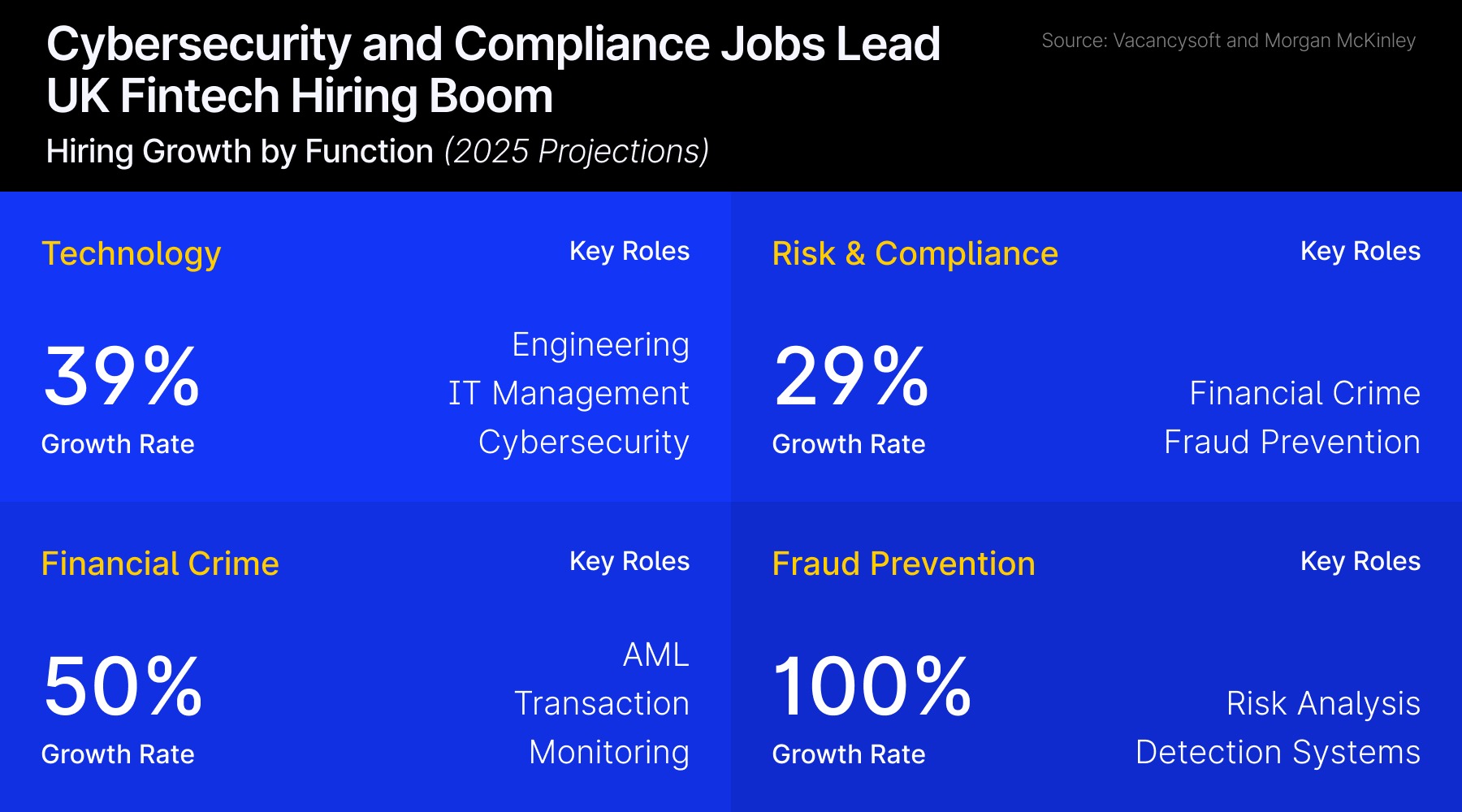
Risk and compliance positions are expected to grow by 29% in
2025, representing the third straight year of expansion in this area. Financial
crime roles face particularly acute demand, with hiring projected to jump
50% as firms grapple with increasingly complex regulatory requirements.
Source: Vacancysoft Analytics
Fraud prevention positions are set to double this
year as companies strengthen their defenses against sophisticated
threats. The surge reflects a broader shift in regulatory expectations from
basic compliance to active governance frameworks.
Mark Astbury, Director at Morgan McKinley UK
“The data tells a clear story: despite subdued venture
capital flows, demand for specialist talent remains robust,” said Mark
Astbury, Director at Morgan McKinley UK. “This isn't a hype-driven
rebound, it's a grounded response to real-world pressures.”
Technology hiring is forecast to expand by 39%, driven
primarily by engineering, IT management, and cybersecurity positions.
London maintains its dominance in this sector, with recruitment boosted by the
upcoming Cyber Security and Resilience Bill.
As fintech firms replace outdated systems and meet evolving
compliance standards, system resilience and threat mitigation
capabilities have become critical priorities. The emphasis on
infrastructure modernization reflects an industry transitioning from rapid
scaling to more deliberate expansion strategies.
Mixed Strategies Across Industry Players
Companies are adopting divergent approaches to workforce
expansion. Several major firms, including FNZ, Wise, Deel, and Ebury Partners, are increasing headcount by 40% to 120% as they capitalize on product momentum and international growth opportunities.
Conversely, other fintech companies are taking a more
conservative stance, scaling back recruitment due to cost pressures and
challenging fundraising conditions. However, even cautious firms are
maintaining investment in high-impact roles covering
compliance, product engineering, and IT security.
The hiring data reveals a sector maturing beyond its startup
phase. Deel leads vacancy projections with an estimated 675 professional
positions in 2025, up from 477 in 2024. Checkout and Wise follow with 660 and
600 projected vacancies, respectively.
Strategic Workforce Investment
The recruitment surge represents a fundamental shift
in fintech talent acquisition, moving from reactive hiring to strategic
workforce planning. Companies are channeling resources into specialized roles
that address regulatory requirements, security vulnerabilities, and operational
scaling needs.
“Fintech firms are hiring to meet rising regulatory
expectations as they grow, to counter increasingly sophisticated financial
threats, and to build more resilient digital infrastructure,” Astbury
explained.
While generalist positions remain stable or face cost
review, the emphasis on compliance and cybersecurity professionals signals an
industry responding to both market opportunities and regulatory
obligations. The recruitment trend suggests fintech companies are
prioritizing sustainable growth over rapid expansion as they navigate an
increasingly complex operating environment.
The hiring outlook reflects broader industry maturation as
fintech firms transition from startup status to established financial services
providers, requiring more sophisticated organizational structures and risk
management capabilities to support continued growth.
Fintech Investment Slumps to Seven-Year Low
The current hiring surge unfolds against the backdrop of fintech's most challenging investment climate since 2017. Global fintech funding collapsed to $95.6 billion in 2024, representing a dramatic retreat from the sector's peak years, when venture capital flowed freely into emerging financial technologies.
While activity declined throughout the year, falling from $51.7 billion in H1 to $43.9 billion in H2, Q4 showed signs of stabilization, with funding rising to $25.9 billion from $18 billion in Q3. Deal values in M&A nearly doubled quarter-over-quarter, and venture capital activity saw a modest uptick, reflecting cautious optimism among investors.
Regional data showed the Americas leading with $63.8 billion in investment, of which $50.7 billion came from the United States. The EMEA region attracted $20.3 billion, and the Asia-Pacific region reported $11.4 billion. The UK remained Europe’s top fintech hub, receiving more capital than all other European countries combined.
The UK's financial
technology sector is planning to boost professional hiring by 32% this year,
defying economic uncertainty and lackluster venture capital flows, according to
new data from recruitment firm Morgan McKinley and analytics company Vacancysoft.
UK Fintech Sector Plans 32% Hiring Surge Despite Market
Headwinds
The expansion comes as regulatory scrutiny
intensifies and cybersecurity threats proliferate across the industry.
While elevated market volatility continues to dampen investor confidence and
venture funding remains below historical averages, fintech companies are
pressing ahead with targeted recruitment strategies focused on compliance and
technology infrastructure.
Risk and compliance positions are expected to grow by 29% in
2025, representing the third straight year of expansion in this area. Financial
crime roles face particularly acute demand, with hiring projected to jump
50% as firms grapple with increasingly complex regulatory requirements.
Source: Vacancysoft Analytics
Fraud prevention positions are set to double this
year as companies strengthen their defenses against sophisticated
threats. The surge reflects a broader shift in regulatory expectations from
basic compliance to active governance frameworks.
Mark Astbury, Director at Morgan McKinley UK
“The data tells a clear story: despite subdued venture
capital flows, demand for specialist talent remains robust,” said Mark
Astbury, Director at Morgan McKinley UK. “This isn't a hype-driven
rebound, it's a grounded response to real-world pressures.”
Technology hiring is forecast to expand by 39%, driven
primarily by engineering, IT management, and cybersecurity positions.
London maintains its dominance in this sector, with recruitment boosted by the
upcoming Cyber Security and Resilience Bill.
As fintech firms replace outdated systems and meet evolving
compliance standards, system resilience and threat mitigation
capabilities have become critical priorities. The emphasis on
infrastructure modernization reflects an industry transitioning from rapid
scaling to more deliberate expansion strategies.
Mixed Strategies Across Industry Players
Companies are adopting divergent approaches to workforce
expansion. Several major firms, including FNZ, Wise, Deel, and Ebury Partners, are increasing headcount by 40% to 120% as they capitalize on product momentum and international growth opportunities.
Conversely, other fintech companies are taking a more
conservative stance, scaling back recruitment due to cost pressures and
challenging fundraising conditions. However, even cautious firms are
maintaining investment in high-impact roles covering
compliance, product engineering, and IT security.
The hiring data reveals a sector maturing beyond its startup
phase. Deel leads vacancy projections with an estimated 675 professional
positions in 2025, up from 477 in 2024. Checkout and Wise follow with 660 and
600 projected vacancies, respectively.
Strategic Workforce Investment
The recruitment surge represents a fundamental shift
in fintech talent acquisition, moving from reactive hiring to strategic
workforce planning. Companies are channeling resources into specialized roles
that address regulatory requirements, security vulnerabilities, and operational
scaling needs.
“Fintech firms are hiring to meet rising regulatory
expectations as they grow, to counter increasingly sophisticated financial
threats, and to build more resilient digital infrastructure,” Astbury
explained.
While generalist positions remain stable or face cost
review, the emphasis on compliance and cybersecurity professionals signals an
industry responding to both market opportunities and regulatory
obligations. The recruitment trend suggests fintech companies are
prioritizing sustainable growth over rapid expansion as they navigate an
increasingly complex operating environment.
The hiring outlook reflects broader industry maturation as
fintech firms transition from startup status to established financial services
providers, requiring more sophisticated organizational structures and risk
management capabilities to support continued growth.
Fintech Investment Slumps to Seven-Year Low
The current hiring surge unfolds against the backdrop of fintech's most challenging investment climate since 2017. Global fintech funding collapsed to $95.6 billion in 2024, representing a dramatic retreat from the sector's peak years, when venture capital flowed freely into emerging financial technologies.
While activity declined throughout the year, falling from $51.7 billion in H1 to $43.9 billion in H2, Q4 showed signs of stabilization, with funding rising to $25.9 billion from $18 billion in Q3. Deal values in M&A nearly doubled quarter-over-quarter, and venture capital activity saw a modest uptick, reflecting cautious optimism among investors.
Regional data showed the Americas leading with $63.8 billion in investment, of which $50.7 billion came from the United States. The EMEA region attracted $20.3 billion, and the Asia-Pacific region reported $11.4 billion. The UK remained Europe’s top fintech hub, receiving more capital than all other European countries combined.
Damian Chmiel is a Senior Analyst & Editor at Finance Magnates with more than 15 years of experience in the CFD and online trading industry. Active as both a trader and journalist since 2010, he focuses on broker coverage, fintech innovation, and regulatory developments across Europe, the Middle East, and Asia.
His work includes interviews with C-level leaders at major brokerages and fintech platforms, as well as co-authoring Finance Magnates’ quarterly industry benchmarking reports. Damian’s reporting is data-driven, market-aware, and grounded in direct industry engagement. His analysis and commentary have also been cited by external media outlets, including Investing.com, Binance, The Asset, Stockhead, and Dispatch.
Education:
MA in Finance and Accounting, Cracow University of Economics
Polymarket Replaces Bridged USDC Aiming for a U.S. Relaunch
FP Markets Winner Spotlight 🏆 | Global Broker of the Year 2025 #Trading #Broker #Innovation #Shorts
FP Markets Winner Spotlight 🏆 | Global Broker of the Year 2025 #Trading #Broker #Innovation #Shorts
FP Markets takes the spotlight as Global Broker of the Year 2025 at the Finance Magnates Awards.
Martin Stoilov, Head of Client Experience, shares that trust, innovation, and people played a key role in the company’s success, supported by a strong foundation of integrity and client-centricity.
Following this milestone, FP Markets continues to focus on growth, technology investment, and its core values of transparency and excellence.
👉 Be part of FM Awards 2026: https://awards.financemagnates.com/#nominate
FP Markets takes the spotlight as Global Broker of the Year 2025 at the Finance Magnates Awards.
Martin Stoilov, Head of Client Experience, shares that trust, innovation, and people played a key role in the company’s success, supported by a strong foundation of integrity and client-centricity.
Following this milestone, FP Markets continues to focus on growth, technology investment, and its core values of transparency and excellence.
👉 Be part of FM Awards 2026: https://awards.financemagnates.com/#nominate
In this video, we review @HolaPrimeMarketsOfficial, a multi-asset forex and CFDs broker offering different account types, trading platforms, and flexible trading conditions.
We cover the broker’s overall offering, including account options, trading environment, platforms like MT4 and MT5, and additional services such as managed accounts and fast withdrawals.
Watch the full video to see if Hola Prime Markets fits your trading needs.
📣 Stay up to date with the latest in finance and trading. Follow Finance Magnates for industry news, insights, and global event coverage.
Connect with us:
🔗 LinkedIn: /financemagnates
👍 Facebook: /financemagnates
📸 Instagram: https://www.instagram.com/financemagnates
🐦 X: https://x.com/financemagnates
🎥 TikTok: https://www.tiktok.com/tag/financemagnates
▶️ YouTube: /@financemagnates_official
#HolaPrime #ForexBroker #CFDTrading #FinanceMagnates #Trading #Forex #BrokerReview
In this video, we review @HolaPrimeMarketsOfficial, a multi-asset forex and CFDs broker offering different account types, trading platforms, and flexible trading conditions.
We cover the broker’s overall offering, including account options, trading environment, platforms like MT4 and MT5, and additional services such as managed accounts and fast withdrawals.
Watch the full video to see if Hola Prime Markets fits your trading needs.
📣 Stay up to date with the latest in finance and trading. Follow Finance Magnates for industry news, insights, and global event coverage.
Connect with us:
🔗 LinkedIn: /financemagnates
👍 Facebook: /financemagnates
📸 Instagram: https://www.instagram.com/financemagnates
🐦 X: https://x.com/financemagnates
🎥 TikTok: https://www.tiktok.com/tag/financemagnates
▶️ YouTube: /@financemagnates_official
#HolaPrime #ForexBroker #CFDTrading #FinanceMagnates #Trading #Forex #BrokerReview
Hola Prime Review: What You Need to Know | Full Breakdown by Finance Magnates
Hola Prime Review: What You Need to Know | Full Breakdown by Finance Magnates
In this video, we review @HolaPrime_Global, a proprietary trading firm offering evaluation programs and performance-based payouts in simulated market environments.
We cover how the challenge model works, including account types, profit splits (up to 95%), trading rules, and what it takes to reach a funded account. You’ll also learn about available platforms like MT4, MT5, cTrader, and more, along with insights into payouts, support, and trading conditions.
Watch the full video to see if Hola Prime fits your trading style.
📣 Stay up to date with the latest in finance and trading. Follow Finance Magnates for industry news, insights, and global event coverage.
Connect with us:
🔗 LinkedIn: /financemagnates
👍 Facebook: /financemagnates
📸 Instagram: https://www.instagram.com/financemagnates
🐦 X: https://x.com/financemagnates
🎥 TikTok: https://www.tiktok.com/tag/financemagnates
▶️ YouTube: /@financemagnates_official
#HolaPrime #PropFirm #Trading #FinanceMagnates #Forex #FuturesTrading #TradingReview #PropFirmReview
In this video, we review @HolaPrime_Global, a proprietary trading firm offering evaluation programs and performance-based payouts in simulated market environments.
We cover how the challenge model works, including account types, profit splits (up to 95%), trading rules, and what it takes to reach a funded account. You’ll also learn about available platforms like MT4, MT5, cTrader, and more, along with insights into payouts, support, and trading conditions.
Watch the full video to see if Hola Prime fits your trading style.
📣 Stay up to date with the latest in finance and trading. Follow Finance Magnates for industry news, insights, and global event coverage.
Connect with us:
🔗 LinkedIn: /financemagnates
👍 Facebook: /financemagnates
📸 Instagram: https://www.instagram.com/financemagnates
🐦 X: https://x.com/financemagnates
🎥 TikTok: https://www.tiktok.com/tag/financemagnates
▶️ YouTube: /@financemagnates_official
#HolaPrime #PropFirm #Trading #FinanceMagnates #Forex #FuturesTrading #TradingReview #PropFirmReview
Axi Winner Spotlight 🏆 | Global Most Innovative Broker 2025 #Innovation #Trading #Fintech #Broker
Axi Winner Spotlight 🏆 | Global Most Innovative Broker 2025 #Innovation #Trading #Fintech #Broker
Axi takes the spotlight at the Finance Magnates Awards, winning Global Most Innovative Broker 2025.
Olivia Xenofontos and Ivanna Openko share how the team will feel: proud, motivated, and ready to keep delivering.
They also describe the night as well-organized, focused, and enjoyable for all.
👉 Be part of FM Awards 2026.
Axi takes the spotlight at the Finance Magnates Awards, winning Global Most Innovative Broker 2025.
Olivia Xenofontos and Ivanna Openko share how the team will feel: proud, motivated, and ready to keep delivering.
They also describe the night as well-organized, focused, and enjoyable for all.
👉 Be part of FM Awards 2026.
Recognition that matters.
Built on transparency.
Driven by the industry.
The Finance Magnates Awards 2026.
Nominations are now open.
🔗 https://awards.financemagnates.com/?utm_source=SM&utm_medium=social&utm_campaign=recognition-matters
Recognition that matters.
Built on transparency.
Driven by the industry.
The Finance Magnates Awards 2026.
Nominations are now open.
🔗 https://awards.financemagnates.com/?utm_source=SM&utm_medium=social&utm_campaign=recognition-matters