Prediction markets kept moving this week. Trading continues, positions are opened and closed, and the machinery keeps running. On the surface, it still looks like business as usual, but it doesn't.
Singapore Summit: Meet the largest APAC brokers you know (and those you still don't!)
More attention is shifting to how these markets handle information. Questions around insider trading, new legislation, and changes in platform rules are starting to converge around the same point: who gets to act on information, and when.
Here’s what mattered this week.
What Moved the Prediction Markets This Week
Behind the $967K Trade
An investigation published by CNN this week pointed to a pattern that has been discussed for months, but rarely documented this clearly. Blockchain analytics firm Bubblemaps identified a cluster of linked accounts it believes are controlled by a single trader, who made nearly $967,000 on Polymarket by repeatedly betting on U.S. and Israeli military actions against Iran ahead of time.
The trader’s win rate on larger bets approached 90% — far above what would normally be expected in a market driven by uncertainty. The accounts remain anonymous, and some still held open positions as of Monday.
The analysis does not prove insider trading, but the pattern is hard to ignore. More importantly, it connects directly to the broader debate now playing out in Congress and among regulators: whether prediction markets reward access to information that is not yet public.
- Only $500K+ Traders Make Money on Prediction Markets, Report Finds
- FIS Adds Clearing for Prediction Market Contracts, Building on OTC Trading
- Pressure Builds on Sports Prediction Contracts as Indian Gaming Association Backs Senate Bill
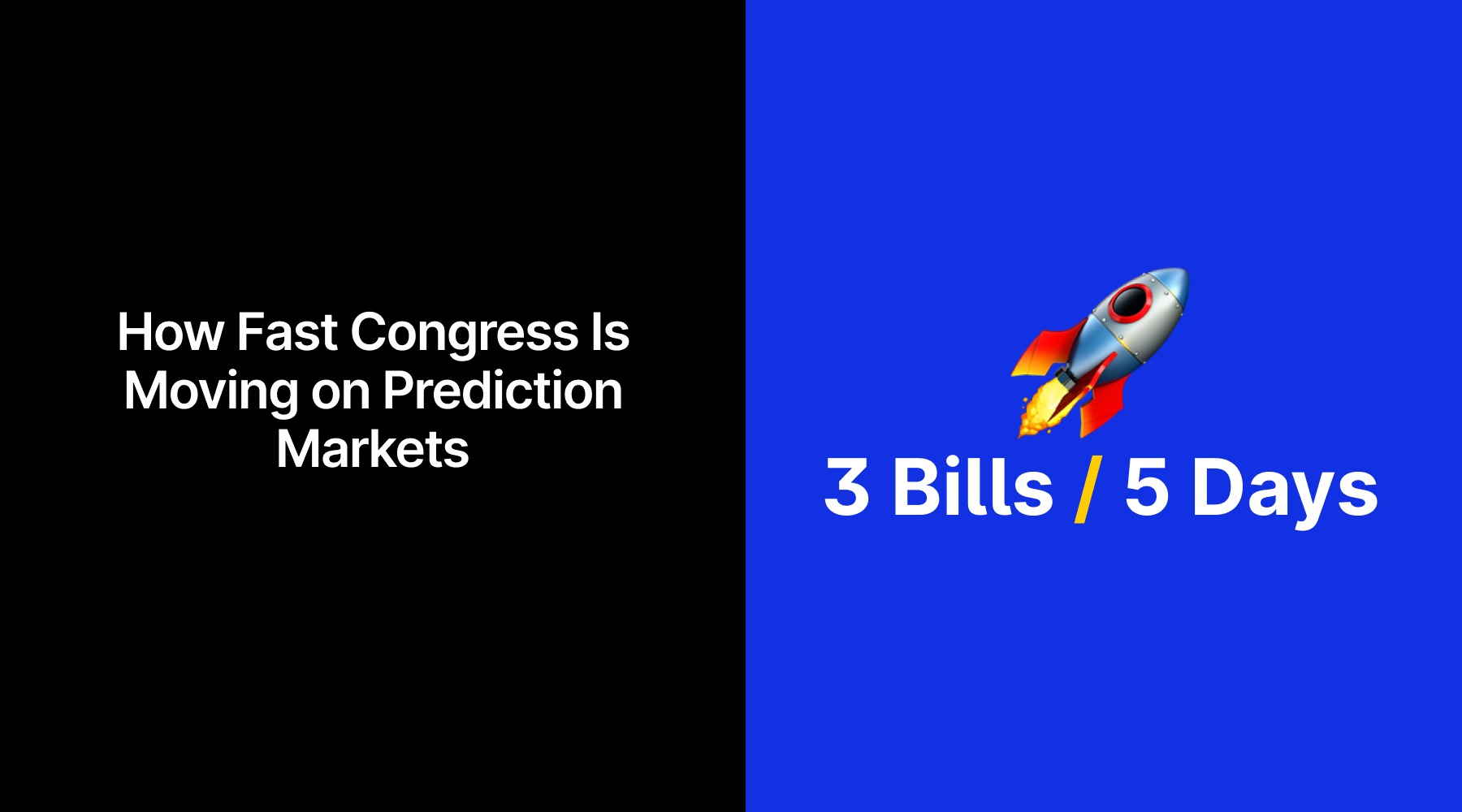
Three Bills in Five Days
Between March 23 and March 26, several legislative proposals targeting prediction markets were introduced in Congress.
On March 23, Senators Adam Schiff and John Curtis introduced the Prediction Markets Are Gambling Act, which would ban CFTC-registered platforms from offering sports and casino-style contracts. The bill has also been backed by the Indian Gaming Association.
“Public service should not be a pathway to private gain,” said Senator Curtis. “Our bipartisan legislation ensures that insider trading rules apply to prediction markets and removes any ambiguity in how those rules are enforced—underscoring a basic expectation that those entrusted with sensitive information cannot use it for personal profit.”
On March 25, a bipartisan House bill proposed banning members of Congress, the president, and executive branch officials from trading on political event contracts.
On March 26, a group led by Senators Jeff Merkley and Elizabeth Warren introduced the STOP Corrupt Bets Act. Representative Jamie Raskin joined the effort. The bill covers elections, government actions, military conflicts, and sports.
At the same time, more than 20 state-level lawsuits are running alongside the federal activity. Kalshi responded to the Schiff–Curtis bill by calling it an attempt to protect traditional gambling interests from competition.
A VC Fund, Two Rivals, One Cap Table
A new venture fund, 5(c) Capital, has raised $35 million to invest in prediction markets infrastructure. What stands out is who is backing it.
Kalshi CEO Tarek Mansour and Polymarket CEO Shayne Coplan — competitors — are both involved. So are investors tied to firms like Andreessen Horowitz and Ribbit Capital, two names closely associated with major fintech and crypto bets.
The fund is focused on building the underlying plumbing of the market — market-making, data, and index products — rather than consumer platforms. The signal is simple: even as platforms compete, capital is being deployed around the infrastructure that supports them.
Quote of the Week
Tarek Mansour, Kalshi CEO and co-founder, reacted on X to the Prediction Markets Are Gambling Act introduced by Senators Schiff and Curtis on March 23.
Number of the Week
$500,000 That’s the threshold above which prediction market traders start making money. According to a recent analysis, only the highest-volume participants — those with more than $500,000 in activity — recorded positive returns. Smaller accounts consistently lost money.
The Friction of the Week
On Monday March 23, Kalshi announced it would preemptively block athletes, coaches, political candidates, and sports officials from trading contracts related to their own events.
Polymarket published updated market integrity rules the same day, clarifying that users cannot trade on stolen confidential information, illegal tips, or contracts where they can influence the outcome. Neal Kumar, Polymarket's chief legal officer, described the changes as making "expectations abundantly clear."
Two days later, Senators Schiff and Curtis appeared on CNBC's Squawk Box and rejected these measures as insufficient. Schiff said the companies "cannot be relied upon to self-regulate" and pointed to the suspected insider trading around Iran war bets.
The disagreement is structural. Kalshi and Polymarket argue that existing CFTC oversight and their own rules already prohibit the conduct legislators are targeting. Legislators argue that enforcement is toothless, blockchain anonymity prevents tracing, and the platforms have a business incentive to look the other way.
Arizona filed 20 criminal counts against Kalshi on March 16. A Nevada court issued a 14-day temporary restraining order on Kalshi's sports contracts on March 20. The platforms are calling these state actions pre-empted by federal law.
Bottom Line
This week brought together several threads that have been building for some time. A trader with an unusually high win rate drew attention to how information moves through these markets. Congress responded with multiple bills. Platforms updated their rules. Courts in two states moved against Kalshi.
What becomes clear is that each part of the system is moving at its own pace. Platforms react in hours, rewriting rules as events unfold. Legislators move in weeks, introducing overlapping proposals. Regulators move in months, opening comment periods and building formal frameworks. Courts move case by case.
The market, meanwhile, doesn’t wait. Prediction markets were built to price uncertainty. Now they are being shaped by the rules that try to contain them.