Fintech funding has reached its lowest levels since 2017
Declines have spared virtually no region or industry.
Source: Ron Finberg
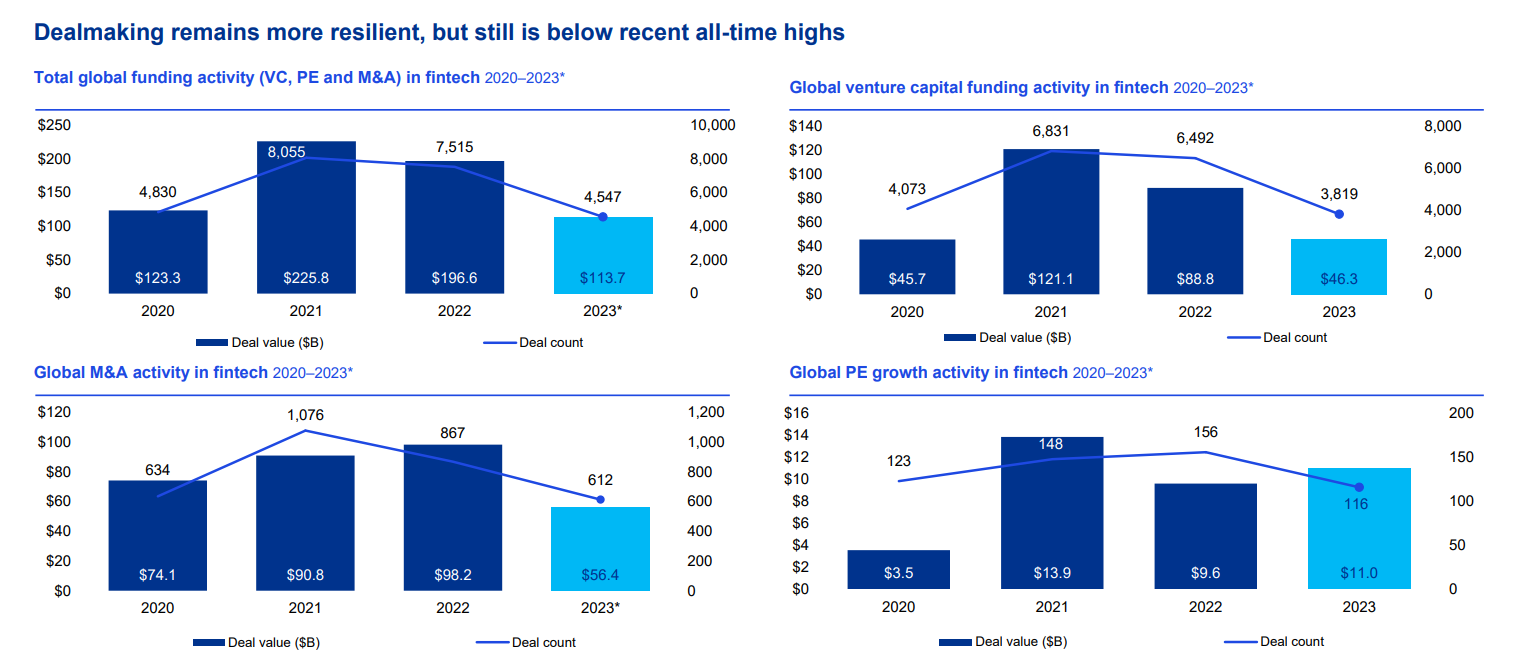
The latest Pulse of Fintech report by KPMG highlighted a notable downturn in fintech investment in 2023. Global fintech investment
fell to $113.7 billion in 2023, a significant drop from $196.3 billion in 2022. The number of
fintech deals also declined to 4,547, marking the lowest level since 2017.
Fintech Investment Drops
in 2023 amid Global Challenges
As
investment sentiment cooled significantly, global funding for fintech reached
its lowest point in five years, totaling $113.7 billion through 4,547
transactions in 2023. This pullback was influenced by concerns over high
interest rates that persisted, geopolitical tensions in Ukraine and the Middle
East, declining fintech valuations, and a challenging exit landscape.
“2023 was a
difficult year for the fintech market globally, with both total fintech
investments,” commented Anton Ruddenklau, the Global Head of Fintech and
Innovation at KPMG. “The year-over-year decline in fintech investment occurred
across all key regions.”
Source: KPMG
Global
fintech investment experienced a slight uptick between the first and second
halves of the year, climbing from $55.5 billion in H1 2023 to $58.2 billion in
H2. This increase was fueled by six blockbuster deals exceeding $1 billion each.
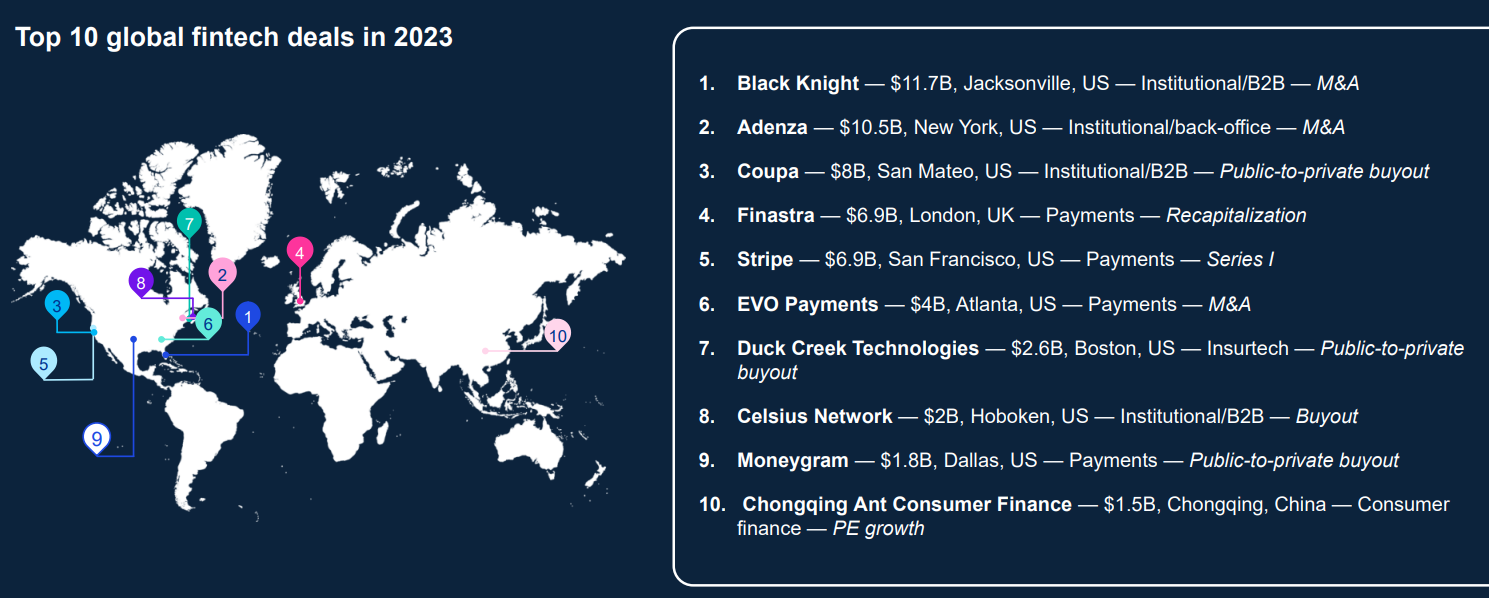
Notable
transactions included the acquisition of US-based Black Knight by
Intercontinental Exchange for $11.7 billion, the acquisition of US-based Adenza by
Nasdaq for $10.5 billion, a private equity raise of $6.9 billion by UK-based Finastra, the buyout of US-based Avantax by Cetera for $1.2
billion, the venture capital
raise by California-based Generate for $1 billion, and the acquisition of
Brazil-based Pismo by Visa for $1 billion.
Source: KPMG
Regional and Sector Trends
This drop
occurred across all major regions, with the steepest declines in Asia-Pacific
and Europe. Investment in the Americas showed the most resilience but still
fell 18% year-over-year. The US continued to lead, accounting for nearly
two-thirds of all fintech funding, securing $78.3 billion over 2,136
transactions.
These figures are confirmed by a separate report from Innovate Finance, which was presented earlier this year. It claims that the United Arab Emirates has managed to break free from the negative trend, with fintech funding nearly doubling, growing 92%.
Payments
remained the top sector by deal volume, despite funding falling 64% to $20.7
billion. Proptech and insurtech were rare bright spots, being the only
subsectors seeing rising investment.
Karim Haji, the Global Head of Financial Services at KPMG
“While the
investment numbers are soft now — due to broader market conditions — the next
year could be quite exciting for innovation in the fintech space,” added Karim
Haji, the Global Head of Financial Services at KPMG.
However, global
venture capital (VC) investment in fintech witnessed a significant decline
year-over-year and between the first and second halves of 2023. The total VC
investment plummeted from $88.8 billion in 2022 to $46.3 billion in 2023,
marking a substantial decrease. Similarly, the VC investment between H1 ($27.5
billion) and H2 ($18.8 billion) also experienced a sharp drop. Notably,
investment in later-stage deals decreased drastically from $37.4 billion in
2022 to $14.1 billion in 2023.
Fintech
investors grew more cautious amidst global instability, inflation concerns, and
doubts about valuations and exit opportunities. They increasingly focused on
profitability and sustainability, shunning risky bets. Partnerships and B2B
solutions attracted interest as did AI and embedded finance.
Murky Forecasts
Investment
is expected to stay soft in early 2024 before recovering later in the year as
rates potentially fall. M&A activity may also pick up as investors buy
distressed assets.
The report
highlighted one outlier to the trends: seed and early-stage funding hit record
highs in terms of deal numbers, indicating investors are still keen to test new
fintech models. Additionally, the report mentioned that AI would play an increasingly significant role in the fintech industry. This was also the topic of one of the recent panels during the Finance Magnates London Summit.
As the
report concluded, enhancing profitability and sustainability will be key for
fintech firms to thrive long-term amidst the current challenges.
The latest Pulse of Fintech report by KPMG highlighted a notable downturn in fintech investment in 2023. Global fintech investment
fell to $113.7 billion in 2023, a significant drop from $196.3 billion in 2022. The number of
fintech deals also declined to 4,547, marking the lowest level since 2017.
Fintech Investment Drops
in 2023 amid Global Challenges
As
investment sentiment cooled significantly, global funding for fintech reached
its lowest point in five years, totaling $113.7 billion through 4,547
transactions in 2023. This pullback was influenced by concerns over high
interest rates that persisted, geopolitical tensions in Ukraine and the Middle
East, declining fintech valuations, and a challenging exit landscape.
“2023 was a
difficult year for the fintech market globally, with both total fintech
investments,” commented Anton Ruddenklau, the Global Head of Fintech and
Innovation at KPMG. “The year-over-year decline in fintech investment occurred
across all key regions.”
Source: KPMG
Global
fintech investment experienced a slight uptick between the first and second
halves of the year, climbing from $55.5 billion in H1 2023 to $58.2 billion in
H2. This increase was fueled by six blockbuster deals exceeding $1 billion each.
Notable
transactions included the acquisition of US-based Black Knight by
Intercontinental Exchange for $11.7 billion, the acquisition of US-based Adenza by
Nasdaq for $10.5 billion, a private equity raise of $6.9 billion by UK-based Finastra, the buyout of US-based Avantax by Cetera for $1.2
billion, the venture capital
raise by California-based Generate for $1 billion, and the acquisition of
Brazil-based Pismo by Visa for $1 billion.
Source: KPMG
Regional and Sector Trends
This drop
occurred across all major regions, with the steepest declines in Asia-Pacific
and Europe. Investment in the Americas showed the most resilience but still
fell 18% year-over-year. The US continued to lead, accounting for nearly
two-thirds of all fintech funding, securing $78.3 billion over 2,136
transactions.
These figures are confirmed by a separate report from Innovate Finance, which was presented earlier this year. It claims that the United Arab Emirates has managed to break free from the negative trend, with fintech funding nearly doubling, growing 92%.
Payments
remained the top sector by deal volume, despite funding falling 64% to $20.7
billion. Proptech and insurtech were rare bright spots, being the only
subsectors seeing rising investment.
Karim Haji, the Global Head of Financial Services at KPMG
“While the
investment numbers are soft now — due to broader market conditions — the next
year could be quite exciting for innovation in the fintech space,” added Karim
Haji, the Global Head of Financial Services at KPMG.
However, global
venture capital (VC) investment in fintech witnessed a significant decline
year-over-year and between the first and second halves of 2023. The total VC
investment plummeted from $88.8 billion in 2022 to $46.3 billion in 2023,
marking a substantial decrease. Similarly, the VC investment between H1 ($27.5
billion) and H2 ($18.8 billion) also experienced a sharp drop. Notably,
investment in later-stage deals decreased drastically from $37.4 billion in
2022 to $14.1 billion in 2023.
Fintech
investors grew more cautious amidst global instability, inflation concerns, and
doubts about valuations and exit opportunities. They increasingly focused on
profitability and sustainability, shunning risky bets. Partnerships and B2B
solutions attracted interest as did AI and embedded finance.
Murky Forecasts
Investment
is expected to stay soft in early 2024 before recovering later in the year as
rates potentially fall. M&A activity may also pick up as investors buy
distressed assets.
The report
highlighted one outlier to the trends: seed and early-stage funding hit record
highs in terms of deal numbers, indicating investors are still keen to test new
fintech models. Additionally, the report mentioned that AI would play an increasingly significant role in the fintech industry. This was also the topic of one of the recent panels during the Finance Magnates London Summit.
As the
report concluded, enhancing profitability and sustainability will be key for
fintech firms to thrive long-term amidst the current challenges.
Damian Chmiel is a Senior Analyst & Editor at Finance Magnates with more than 15 years of experience in the CFD and online trading industry. Active as both a trader and journalist since 2010, he focuses on broker coverage, fintech innovation, and regulatory developments across Europe, the Middle East, and Asia.
His work includes interviews with C-level leaders at major brokerages and fintech platforms, as well as co-authoring Finance Magnates’ quarterly industry benchmarking reports. Damian’s reporting is data-driven, market-aware, and grounded in direct industry engagement. His analysis and commentary have also been cited by external media outlets, including Investing.com, Binance, The Asset, Stockhead, and Dispatch.
Education:
MA in Finance and Accounting, Cracow University of Economics
Polymarket Replaces Bridged USDC Aiming for a U.S. Relaunch
FP Markets Winner Spotlight 🏆 | Global Broker of the Year 2025 #Trading #Broker #Innovation #Shorts
FP Markets Winner Spotlight 🏆 | Global Broker of the Year 2025 #Trading #Broker #Innovation #Shorts
FP Markets takes the spotlight as Global Broker of the Year 2025 at the Finance Magnates Awards.
Martin Stoilov, Head of Client Experience, shares that trust, innovation, and people played a key role in the company’s success, supported by a strong foundation of integrity and client-centricity.
Following this milestone, FP Markets continues to focus on growth, technology investment, and its core values of transparency and excellence.
👉 Be part of FM Awards 2026: https://awards.financemagnates.com/#nominate
FP Markets takes the spotlight as Global Broker of the Year 2025 at the Finance Magnates Awards.
Martin Stoilov, Head of Client Experience, shares that trust, innovation, and people played a key role in the company’s success, supported by a strong foundation of integrity and client-centricity.
Following this milestone, FP Markets continues to focus on growth, technology investment, and its core values of transparency and excellence.
👉 Be part of FM Awards 2026: https://awards.financemagnates.com/#nominate
In this video, we review @HolaPrimeMarketsOfficial, a multi-asset forex and CFDs broker offering different account types, trading platforms, and flexible trading conditions.
We cover the broker’s overall offering, including account options, trading environment, platforms like MT4 and MT5, and additional services such as managed accounts and fast withdrawals.
Watch the full video to see if Hola Prime Markets fits your trading needs.
📣 Stay up to date with the latest in finance and trading. Follow Finance Magnates for industry news, insights, and global event coverage.
Connect with us:
🔗 LinkedIn: /financemagnates
👍 Facebook: /financemagnates
📸 Instagram: https://www.instagram.com/financemagnates
🐦 X: https://x.com/financemagnates
🎥 TikTok: https://www.tiktok.com/tag/financemagnates
▶️ YouTube: /@financemagnates_official
#HolaPrime #ForexBroker #CFDTrading #FinanceMagnates #Trading #Forex #BrokerReview
In this video, we review @HolaPrimeMarketsOfficial, a multi-asset forex and CFDs broker offering different account types, trading platforms, and flexible trading conditions.
We cover the broker’s overall offering, including account options, trading environment, platforms like MT4 and MT5, and additional services such as managed accounts and fast withdrawals.
Watch the full video to see if Hola Prime Markets fits your trading needs.
📣 Stay up to date with the latest in finance and trading. Follow Finance Magnates for industry news, insights, and global event coverage.
Connect with us:
🔗 LinkedIn: /financemagnates
👍 Facebook: /financemagnates
📸 Instagram: https://www.instagram.com/financemagnates
🐦 X: https://x.com/financemagnates
🎥 TikTok: https://www.tiktok.com/tag/financemagnates
▶️ YouTube: /@financemagnates_official
#HolaPrime #ForexBroker #CFDTrading #FinanceMagnates #Trading #Forex #BrokerReview
Hola Prime Review: What You Need to Know | Full Breakdown by Finance Magnates
Hola Prime Review: What You Need to Know | Full Breakdown by Finance Magnates
In this video, we review @HolaPrime_Global, a proprietary trading firm offering evaluation programs and performance-based payouts in simulated market environments.
We cover how the challenge model works, including account types, profit splits (up to 95%), trading rules, and what it takes to reach a funded account. You’ll also learn about available platforms like MT4, MT5, cTrader, and more, along with insights into payouts, support, and trading conditions.
Watch the full video to see if Hola Prime fits your trading style.
📣 Stay up to date with the latest in finance and trading. Follow Finance Magnates for industry news, insights, and global event coverage.
Connect with us:
🔗 LinkedIn: /financemagnates
👍 Facebook: /financemagnates
📸 Instagram: https://www.instagram.com/financemagnates
🐦 X: https://x.com/financemagnates
🎥 TikTok: https://www.tiktok.com/tag/financemagnates
▶️ YouTube: /@financemagnates_official
#HolaPrime #PropFirm #Trading #FinanceMagnates #Forex #FuturesTrading #TradingReview #PropFirmReview
In this video, we review @HolaPrime_Global, a proprietary trading firm offering evaluation programs and performance-based payouts in simulated market environments.
We cover how the challenge model works, including account types, profit splits (up to 95%), trading rules, and what it takes to reach a funded account. You’ll also learn about available platforms like MT4, MT5, cTrader, and more, along with insights into payouts, support, and trading conditions.
Watch the full video to see if Hola Prime fits your trading style.
📣 Stay up to date with the latest in finance and trading. Follow Finance Magnates for industry news, insights, and global event coverage.
Connect with us:
🔗 LinkedIn: /financemagnates
👍 Facebook: /financemagnates
📸 Instagram: https://www.instagram.com/financemagnates
🐦 X: https://x.com/financemagnates
🎥 TikTok: https://www.tiktok.com/tag/financemagnates
▶️ YouTube: /@financemagnates_official
#HolaPrime #PropFirm #Trading #FinanceMagnates #Forex #FuturesTrading #TradingReview #PropFirmReview
Axi Winner Spotlight 🏆 | Global Most Innovative Broker 2025 #Innovation #Trading #Fintech #Broker
Axi Winner Spotlight 🏆 | Global Most Innovative Broker 2025 #Innovation #Trading #Fintech #Broker
Axi takes the spotlight at the Finance Magnates Awards, winning Global Most Innovative Broker 2025.
Olivia Xenofontos and Ivanna Openko share how the team will feel: proud, motivated, and ready to keep delivering.
They also describe the night as well-organized, focused, and enjoyable for all.
👉 Be part of FM Awards 2026.
Axi takes the spotlight at the Finance Magnates Awards, winning Global Most Innovative Broker 2025.
Olivia Xenofontos and Ivanna Openko share how the team will feel: proud, motivated, and ready to keep delivering.
They also describe the night as well-organized, focused, and enjoyable for all.
👉 Be part of FM Awards 2026.
Recognition that matters.
Built on transparency.
Driven by the industry.
The Finance Magnates Awards 2026.
Nominations are now open.
🔗 https://awards.financemagnates.com/?utm_source=SM&utm_medium=social&utm_campaign=recognition-matters
Recognition that matters.
Built on transparency.
Driven by the industry.
The Finance Magnates Awards 2026.
Nominations are now open.
🔗 https://awards.financemagnates.com/?utm_source=SM&utm_medium=social&utm_campaign=recognition-matters