The fintech's shares fell 8.3% despite beating Q2 earnings expectations.
Moreover, the management warned that April's tariff-driven trading surge had normalized.
The situation was not helped even by BTC's ATH in July, which worried shareholders of a company whose 90% revenue is dependent on crypto.
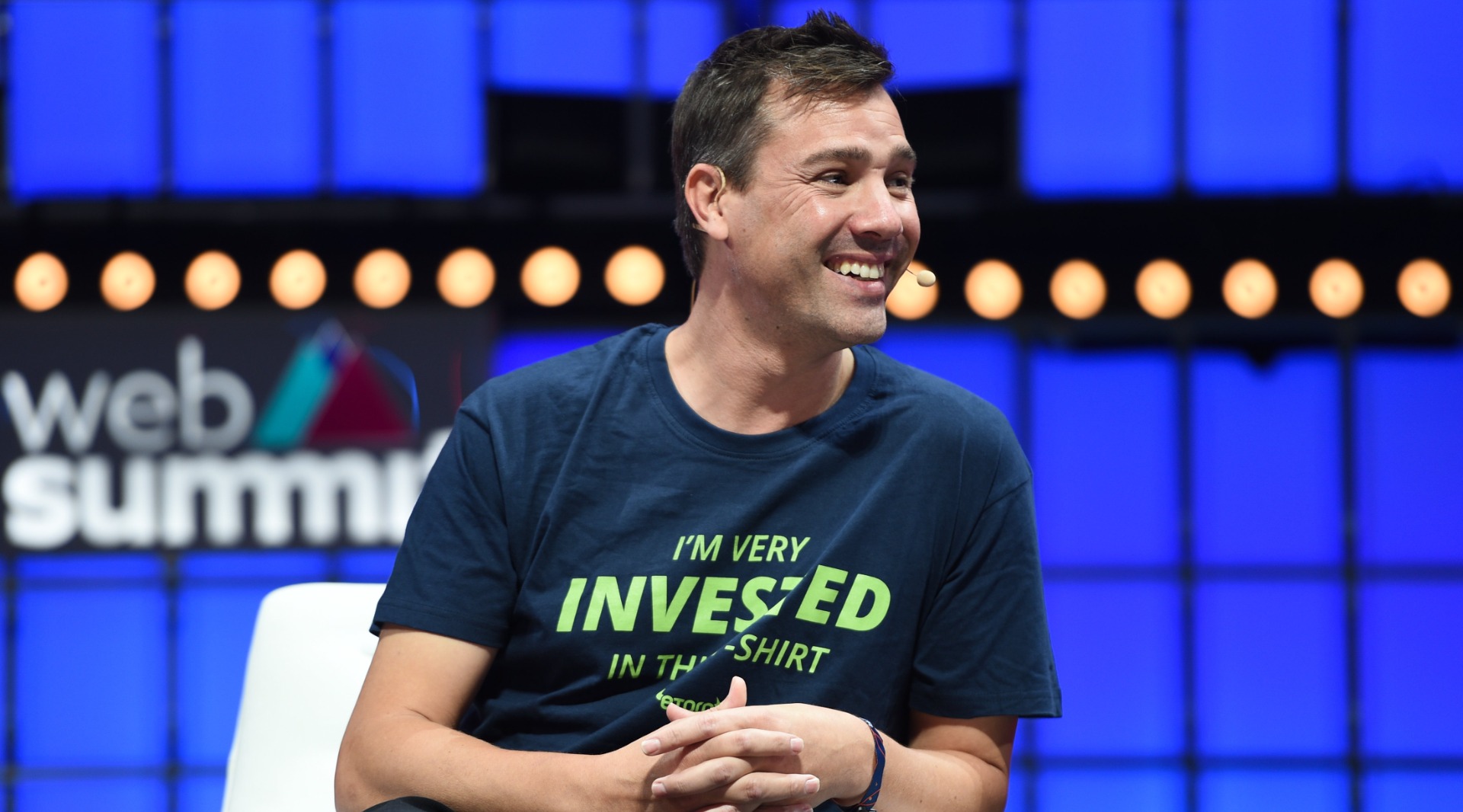
Yoni Assia, Co-Founder & CEO, eToro, at Web Summit 2021 in Portugal (photo: Wikimedia)
eToro
shares (NASDAQ: ETOR) dropped
8.3% yesterday (Tuesday) after the Israeli trading platform reported mixed
second-quarter results that beat analyst expectations but revealed concerning
underlying trends.
The stock
initially jumped nearly 6% in pre-market trading after the company posted adjusted
earnings of 56 cents per share, topping Wall Street estimates
of 50 cents. But shares quickly reversed course during regular trading
hours, closing at $50.74 and testing intraday lows of $50.
What was
the main reason for the decline? A nearly twofold drop in net profit compared
with the previous quarter, along with management guidance that dampened
investor enthusiasm.
eToro delivered
impressive top-line numbers that initially caught investors' attention. Net
contribution surged 26% year-over-year to $210 million, while assets under
administration jumped 54% to $17.5 billion. Crypto trading generated $1.9
billion in gross revenue during the quarter, up from $1.6 billion the previous
year.
Chief
Financial Officer Meron Shani warned analysts during the earnings call that the
elevated trading activity following April's tariff-induced market volatility
had "normalized throughout July." This suggested the strong
momentum that drove Q2 results might not continue into the third quarter.
32% Down from IPO Day High
As a
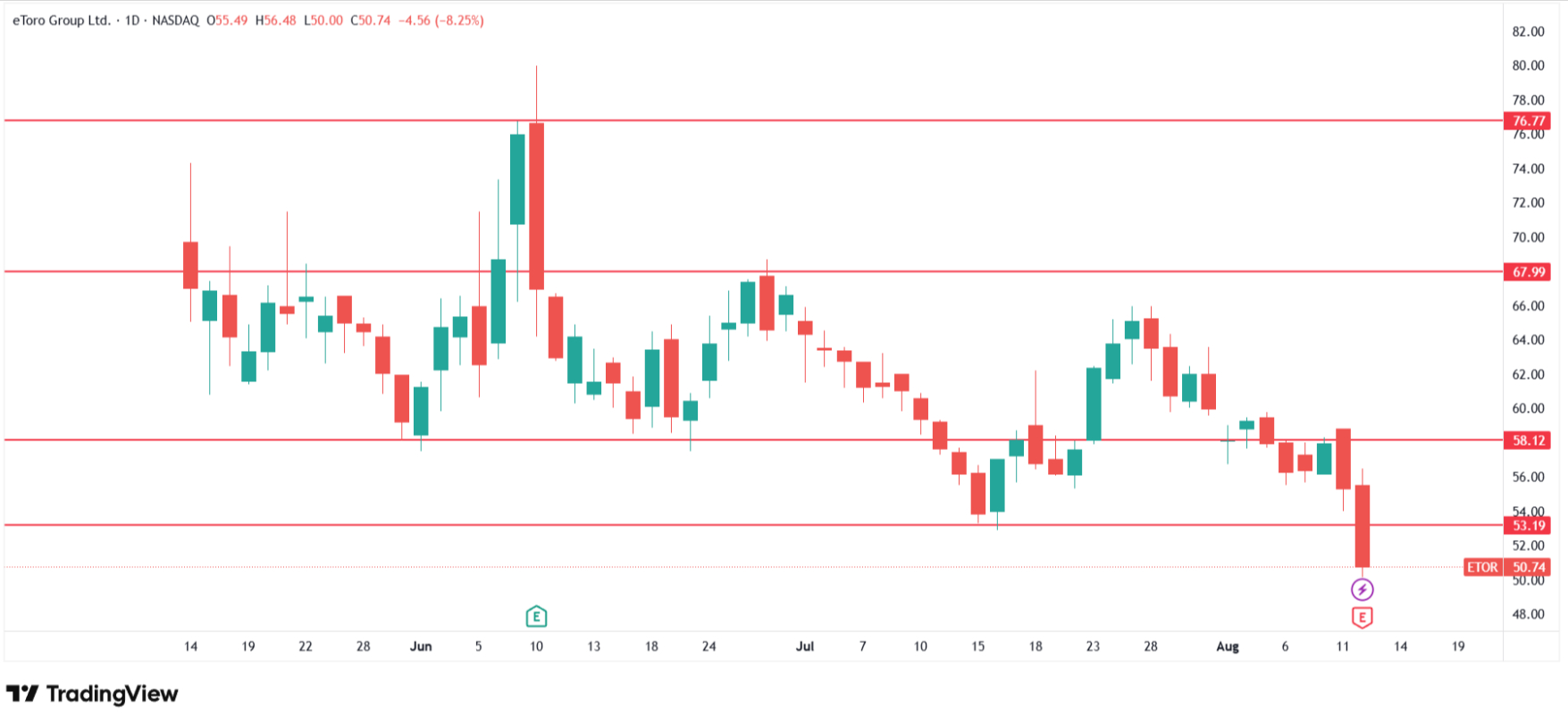
result, eToro’s share price fell more than 8% during Tuesday’s session, sliding
over 32% from the $74 level reached on its Wall Street debut in mid-May. At the
same time, ETOR has also broken below last month’s all-time lows, which were
around $53.
eToro is breaking through all previous support levels and hitting new lows. Source: Tradingview.com
By
comparison, Robinhood (NASDAQ: HOOD) is trading near
record highs, testing the $117.70 level on Tuesday and gaining more than 200% in
2025.
For eToro
shareholders, it may be little consolation that at least some competitors have
fared worse since May. For example, Poland’s XTB (WSE: XTB) has fallen 16% over
the period, Germany’s NAGA (XETR: N4G) which reported
preliminary H1 results today (Wednesday), is down more than 20%, and CMC
Markets (LSE: CMCX)
has slipped 22%.
Retail Trading Boom Loses
Steam
CEO Yoni
Assia highlighted how retail investors had
seized opportunities during April's market turbulence, particularly in
high-growth technology stocks. "We saw a lot of our retail investors
jumping in to scoop opportunities with Google, Nvidia and Tesla," Assia commented
during the earnings call, referring to the sharp declines that followed
President Trump's tariff announcements.
But that
surge appears to have faded. Trading volumes actually declined from
135 million trades in the prior-year quarter to 128 million in Q2 2025, despite
the overall revenue growth. The number of funded accounts grew a modest 14%
year-over-year to 3.63 million, which some investors deemed insufficient for
sustaining growth.
The
normalization of trading activity became apparent by July, just
as Bitcoin reached all-time highs that typically would have driven
increased crypto trading on eToro's platform.
Given that
more than 90% of eToro’s revenue currently comes from crypto trading, this
likely raised concerns among investors. And while Robinhood
also saw a decline in revenue from this segment in Q2, for the U.S. fintech
such revenue accounts for only about 16%, with more than 50%coming from
transaction-based revenue from payment for order flow (PFOF).
High Expectations Meet
Market Reality
eToro faced
heightened scrutiny following
its successful May IPO, which saw shares surge on their debut after pricing
above the marketed range. Just one day before earnings, 15 analysts had
initiated coverage with predominantly bullish ratings and price targets
ranging from $70 to $85.
Michael Ashley Schulman, partner and CIO at Running Point Capital Advisors
"Today's
initial eToro excitement gave way to a touch of disappointment," Michael
Ashley Schulman, partner and CIO at Running Point Capital Advisors, commented
for commented for Reuters. "Management admitted the April tariff‑shock
uptick in trading activity faded by July, so the beat didn't come with a
sustainably higher run‑rate."
The company
has been spending heavily to capitalize on its public market debut, with marketing
expenses surging over 60% as it ramps up promotional activities. This
aggressive spending strategy raised questions about long-term profitability
margins, even as revenues grew.
"Regulators
all around the world are also looking at what regulators in the U.S. are doing
and saying," Assia noted. "They're providing very sort of clear
messaging, which is, crypto is here to stay."
The company
plans to expand beyond its core retail trading roots by catering to more
sophisticated users and developing AI-powered
investment strategies. Founded in 2007, eToro operates a platform that
allows users to invest in stocks and cryptocurrencies while copying the
strategies of top-performing investors.
From its
IPO day highs, eToro stock has now fallen nearly 32%, reflecting the broader
challenges facing fintech companies as they transition from private growth
stories to public market scrutiny.
eToro
shares (NASDAQ: ETOR) dropped
8.3% yesterday (Tuesday) after the Israeli trading platform reported mixed
second-quarter results that beat analyst expectations but revealed concerning
underlying trends.
The stock
initially jumped nearly 6% in pre-market trading after the company posted adjusted
earnings of 56 cents per share, topping Wall Street estimates
of 50 cents. But shares quickly reversed course during regular trading
hours, closing at $50.74 and testing intraday lows of $50.
What was
the main reason for the decline? A nearly twofold drop in net profit compared
with the previous quarter, along with management guidance that dampened
investor enthusiasm.
eToro delivered
impressive top-line numbers that initially caught investors' attention. Net
contribution surged 26% year-over-year to $210 million, while assets under
administration jumped 54% to $17.5 billion. Crypto trading generated $1.9
billion in gross revenue during the quarter, up from $1.6 billion the previous
year.
Chief
Financial Officer Meron Shani warned analysts during the earnings call that the
elevated trading activity following April's tariff-induced market volatility
had "normalized throughout July." This suggested the strong
momentum that drove Q2 results might not continue into the third quarter.
32% Down from IPO Day High
As a
result, eToro’s share price fell more than 8% during Tuesday’s session, sliding
over 32% from the $74 level reached on its Wall Street debut in mid-May. At the
same time, ETOR has also broken below last month’s all-time lows, which were
around $53.
eToro is breaking through all previous support levels and hitting new lows. Source: Tradingview.com
By
comparison, Robinhood (NASDAQ: HOOD) is trading near
record highs, testing the $117.70 level on Tuesday and gaining more than 200% in
2025.
For eToro
shareholders, it may be little consolation that at least some competitors have
fared worse since May. For example, Poland’s XTB (WSE: XTB) has fallen 16% over
the period, Germany’s NAGA (XETR: N4G) which reported
preliminary H1 results today (Wednesday), is down more than 20%, and CMC
Markets (LSE: CMCX)
has slipped 22%.
Retail Trading Boom Loses
Steam
CEO Yoni
Assia highlighted how retail investors had
seized opportunities during April's market turbulence, particularly in
high-growth technology stocks. "We saw a lot of our retail investors
jumping in to scoop opportunities with Google, Nvidia and Tesla," Assia commented
during the earnings call, referring to the sharp declines that followed
President Trump's tariff announcements.
But that
surge appears to have faded. Trading volumes actually declined from
135 million trades in the prior-year quarter to 128 million in Q2 2025, despite
the overall revenue growth. The number of funded accounts grew a modest 14%
year-over-year to 3.63 million, which some investors deemed insufficient for
sustaining growth.
The
normalization of trading activity became apparent by July, just
as Bitcoin reached all-time highs that typically would have driven
increased crypto trading on eToro's platform.
Given that
more than 90% of eToro’s revenue currently comes from crypto trading, this
likely raised concerns among investors. And while Robinhood
also saw a decline in revenue from this segment in Q2, for the U.S. fintech
such revenue accounts for only about 16%, with more than 50%coming from
transaction-based revenue from payment for order flow (PFOF).
High Expectations Meet
Market Reality
eToro faced
heightened scrutiny following
its successful May IPO, which saw shares surge on their debut after pricing
above the marketed range. Just one day before earnings, 15 analysts had
initiated coverage with predominantly bullish ratings and price targets
ranging from $70 to $85.
Michael Ashley Schulman, partner and CIO at Running Point Capital Advisors
"Today's
initial eToro excitement gave way to a touch of disappointment," Michael
Ashley Schulman, partner and CIO at Running Point Capital Advisors, commented
for commented for Reuters. "Management admitted the April tariff‑shock
uptick in trading activity faded by July, so the beat didn't come with a
sustainably higher run‑rate."
The company
has been spending heavily to capitalize on its public market debut, with marketing
expenses surging over 60% as it ramps up promotional activities. This
aggressive spending strategy raised questions about long-term profitability
margins, even as revenues grew.
"Regulators
all around the world are also looking at what regulators in the U.S. are doing
and saying," Assia noted. "They're providing very sort of clear
messaging, which is, crypto is here to stay."
The company
plans to expand beyond its core retail trading roots by catering to more
sophisticated users and developing AI-powered
investment strategies. Founded in 2007, eToro operates a platform that
allows users to invest in stocks and cryptocurrencies while copying the
strategies of top-performing investors.
From its
IPO day highs, eToro stock has now fallen nearly 32%, reflecting the broader
challenges facing fintech companies as they transition from private growth
stories to public market scrutiny.
Damian Chmiel is a Senior Analyst & Editor at Finance Magnates with more than 15 years of experience in the CFD and online trading industry. Active as both a trader and journalist since 2010, he focuses on broker coverage, fintech innovation, and regulatory developments across Europe, the Middle East, and Asia.
His work includes interviews with C-level leaders at major brokerages and fintech platforms, as well as co-authoring Finance Magnates’ quarterly industry benchmarking reports. Damian’s reporting is data-driven, market-aware, and grounded in direct industry engagement. His analysis and commentary have also been cited by external media outlets, including Investing.com, Binance, The Asset, Stockhead, and Dispatch.
Education:
MA in Finance and Accounting, Cracow University of Economics
Polymarket Replaces Bridged USDC Aiming for a U.S. Relaunch
FP Markets Winner Spotlight 🏆 | Global Broker of the Year 2025 #Trading #Broker #Innovation #Shorts
FP Markets Winner Spotlight 🏆 | Global Broker of the Year 2025 #Trading #Broker #Innovation #Shorts
FP Markets takes the spotlight as Global Broker of the Year 2025 at the Finance Magnates Awards.
Martin Stoilov, Head of Client Experience, shares that trust, innovation, and people played a key role in the company’s success, supported by a strong foundation of integrity and client-centricity.
Following this milestone, FP Markets continues to focus on growth, technology investment, and its core values of transparency and excellence.
👉 Be part of FM Awards 2026: https://awards.financemagnates.com/#nominate
FP Markets takes the spotlight as Global Broker of the Year 2025 at the Finance Magnates Awards.
Martin Stoilov, Head of Client Experience, shares that trust, innovation, and people played a key role in the company’s success, supported by a strong foundation of integrity and client-centricity.
Following this milestone, FP Markets continues to focus on growth, technology investment, and its core values of transparency and excellence.
👉 Be part of FM Awards 2026: https://awards.financemagnates.com/#nominate
In this video, we review @HolaPrimeMarketsOfficial, a multi-asset forex and CFDs broker offering different account types, trading platforms, and flexible trading conditions.
We cover the broker’s overall offering, including account options, trading environment, platforms like MT4 and MT5, and additional services such as managed accounts and fast withdrawals.
Watch the full video to see if Hola Prime Markets fits your trading needs.
📣 Stay up to date with the latest in finance and trading. Follow Finance Magnates for industry news, insights, and global event coverage.
Connect with us:
🔗 LinkedIn: /financemagnates
👍 Facebook: /financemagnates
📸 Instagram: https://www.instagram.com/financemagnates
🐦 X: https://x.com/financemagnates
🎥 TikTok: https://www.tiktok.com/tag/financemagnates
▶️ YouTube: /@financemagnates_official
#HolaPrime #ForexBroker #CFDTrading #FinanceMagnates #Trading #Forex #BrokerReview
In this video, we review @HolaPrimeMarketsOfficial, a multi-asset forex and CFDs broker offering different account types, trading platforms, and flexible trading conditions.
We cover the broker’s overall offering, including account options, trading environment, platforms like MT4 and MT5, and additional services such as managed accounts and fast withdrawals.
Watch the full video to see if Hola Prime Markets fits your trading needs.
📣 Stay up to date with the latest in finance and trading. Follow Finance Magnates for industry news, insights, and global event coverage.
Connect with us:
🔗 LinkedIn: /financemagnates
👍 Facebook: /financemagnates
📸 Instagram: https://www.instagram.com/financemagnates
🐦 X: https://x.com/financemagnates
🎥 TikTok: https://www.tiktok.com/tag/financemagnates
▶️ YouTube: /@financemagnates_official
#HolaPrime #ForexBroker #CFDTrading #FinanceMagnates #Trading #Forex #BrokerReview
Hola Prime Review: What You Need to Know | Full Breakdown by Finance Magnates
Hola Prime Review: What You Need to Know | Full Breakdown by Finance Magnates
In this video, we review @HolaPrime_Global, a proprietary trading firm offering evaluation programs and performance-based payouts in simulated market environments.
We cover how the challenge model works, including account types, profit splits (up to 95%), trading rules, and what it takes to reach a funded account. You’ll also learn about available platforms like MT4, MT5, cTrader, and more, along with insights into payouts, support, and trading conditions.
Watch the full video to see if Hola Prime fits your trading style.
📣 Stay up to date with the latest in finance and trading. Follow Finance Magnates for industry news, insights, and global event coverage.
Connect with us:
🔗 LinkedIn: /financemagnates
👍 Facebook: /financemagnates
📸 Instagram: https://www.instagram.com/financemagnates
🐦 X: https://x.com/financemagnates
🎥 TikTok: https://www.tiktok.com/tag/financemagnates
▶️ YouTube: /@financemagnates_official
#HolaPrime #PropFirm #Trading #FinanceMagnates #Forex #FuturesTrading #TradingReview #PropFirmReview
In this video, we review @HolaPrime_Global, a proprietary trading firm offering evaluation programs and performance-based payouts in simulated market environments.
We cover how the challenge model works, including account types, profit splits (up to 95%), trading rules, and what it takes to reach a funded account. You’ll also learn about available platforms like MT4, MT5, cTrader, and more, along with insights into payouts, support, and trading conditions.
Watch the full video to see if Hola Prime fits your trading style.
📣 Stay up to date with the latest in finance and trading. Follow Finance Magnates for industry news, insights, and global event coverage.
Connect with us:
🔗 LinkedIn: /financemagnates
👍 Facebook: /financemagnates
📸 Instagram: https://www.instagram.com/financemagnates
🐦 X: https://x.com/financemagnates
🎥 TikTok: https://www.tiktok.com/tag/financemagnates
▶️ YouTube: /@financemagnates_official
#HolaPrime #PropFirm #Trading #FinanceMagnates #Forex #FuturesTrading #TradingReview #PropFirmReview
Axi Winner Spotlight 🏆 | Global Most Innovative Broker 2025 #Innovation #Trading #Fintech #Broker
Axi Winner Spotlight 🏆 | Global Most Innovative Broker 2025 #Innovation #Trading #Fintech #Broker
Axi takes the spotlight at the Finance Magnates Awards, winning Global Most Innovative Broker 2025.
Olivia Xenofontos and Ivanna Openko share how the team will feel: proud, motivated, and ready to keep delivering.
They also describe the night as well-organized, focused, and enjoyable for all.
👉 Be part of FM Awards 2026.
Axi takes the spotlight at the Finance Magnates Awards, winning Global Most Innovative Broker 2025.
Olivia Xenofontos and Ivanna Openko share how the team will feel: proud, motivated, and ready to keep delivering.
They also describe the night as well-organized, focused, and enjoyable for all.
👉 Be part of FM Awards 2026.
Recognition that matters.
Built on transparency.
Driven by the industry.
The Finance Magnates Awards 2026.
Nominations are now open.
🔗 https://awards.financemagnates.com/?utm_source=SM&utm_medium=social&utm_campaign=recognition-matters
Recognition that matters.
Built on transparency.
Driven by the industry.
The Finance Magnates Awards 2026.
Nominations are now open.
🔗 https://awards.financemagnates.com/?utm_source=SM&utm_medium=social&utm_campaign=recognition-matters