In today's Fintech Spotlight, we take a look at Oradian, and learn how their cloud-based software is helping increase financial inclusion.
Within the fintech lexicon, one term that often gets thrown around is ‘financial inclusion’. Loosely defined, financial inclusion is the mission to provide financial services to low-income demographics and countries. The term comes up most often in relation to providing financial services to regions such as Africa, where by far the majority of the population of many countries remains unbanked.
Oradian’s business is based on providing a cloud-based banking infrastructure to micro-finance institutions. A prominent sector in many parts of Africa, Latin America and Southeast Asia, micro-finance firms are lightly to non-regulated institutions that provide lending to sectors of the population being unmet by banks. Micro-finance firms tend to be mission driven, thereby providing loans in specific niches such as to merchants to acquire inventory or to carpenters to help them acquire new tools. Among lenders, loan sizes will vary from around $20 to $20,000. The vast majority of transactions are short-term financing, from as short as a week to a yearlong, with many loans using a daily repayment schedule.
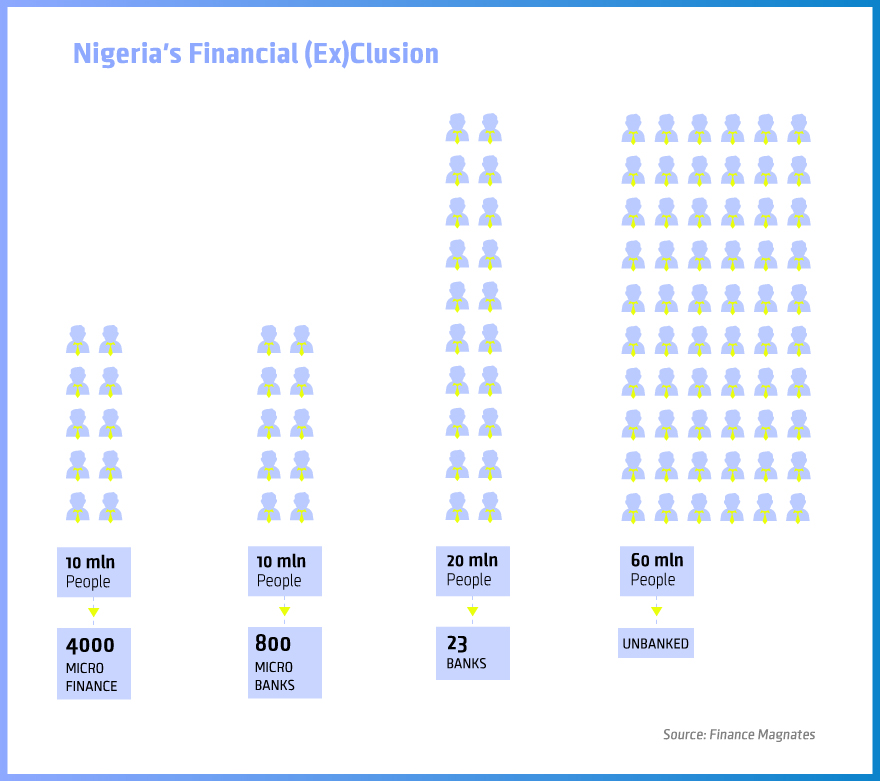
Speaking with Antonio Separovic, CEO at Oradian, he cited their largest market, Nigeria, as an example. Separovic explained that in total Nigeria has a population of around 180 million, with 100 million above 15 years of age and considered 'bankable'. Within the country, there are 23 banks that serve 20 million people. In addition, there are 800 smaller micro-finance banks that service another 10 million. On the lowest rung of financial institutions, and the fastest growing, are about 4000 micro-finance alternative finance firms that service 10 million people. However, even with the growth of micro-finance, it still leaves 60 million or 40% of the bankable population who are excluded from any forms of banking services.
Cloud-Based Banking Infrastructure
As a solution to boost the efforts of micro-finance firms, Oradian focuses on providing what it calls the ‘core banking infrastructure’. Separovic explained that at the bottom of the chain, many firms are using little to no banking or accounting software to help them monitor outstanding loans and real-time repayments of loans.
Within a country like Nigeria, the lack of product specific software creates a scenario that is prone to errors and fraud. Specifically, many micro-finance firms rely on loan officers who go out to their customers to both hand out and collect loans. In replace of banking software, much of the loan data from loan officers is collected on handwritten notes or manual updates to Excel sheets. The result of this fractured lending and repayment structure is the lack of real-time information due to gaps between loan officers handling loans and reporting changes to their central office.
First world technology at a fraction of the price
To provide a solution, Oradian’s software provides a unified system for loan officers to update information about their customers such as repayments and loans outstanding. As a cloud-based software, entries of information by loan officers then become available to the micro-finance firm in real-time to both monitor individual and aggregated lending. Separovic explained that the bottom line of their goal is to provide their micro-finance customers with “first world technology at a fraction of the price.”
Internet Requirements
As a cloud-based financial software firm, the foundation of Oradian’s model is the ability for individual loan officers to enter information that becomes available in real-time. However, that can only work where internet connectivity is available.
In this regard, Separovic explained that despite beliefs to the contrary, within emerging markets such as West Africa, internet connectivity is fairly reliable. Separovic described that due to internet infrastructure being newer than other technologies, basic necessities like electricity and water pumping are more likely to fail than internet connectivity. As a result, loan officers of Oradian’s customers work like any other distributed workforce, connecting remotely with laptops or tablets.
Credit Scoring and Looking Ahead
Within the alternative finance industry, big data has become an important technology to better understand customers and reduce lending risk. Specifically in marketplace lending, many firms are using non-credit score data such as their social presence, spending habits and university attended, in order to create customer risk profiles.
Currently, Separovic explained that he believes Oradian’s best value is that “in real-time, firms know what their loans are and who is late on their loans and this helps them collect better.”
Fintech Spotlight is a new column on Finance Magnates devoted to reviewing innovative financial technology companies and sector trends.
Within the fintech lexicon, one term that often gets thrown around is ‘financial inclusion’. Loosely defined, financial inclusion is the mission to provide financial services to low-income demographics and countries. The term comes up most often in relation to providing financial services to regions such as Africa, where by far the majority of the population of many countries remains unbanked.
Oradian’s business is based on providing a cloud-based banking infrastructure to micro-finance institutions. A prominent sector in many parts of Africa, Latin America and Southeast Asia, micro-finance firms are lightly to non-regulated institutions that provide lending to sectors of the population being unmet by banks. Micro-finance firms tend to be mission driven, thereby providing loans in specific niches such as to merchants to acquire inventory or to carpenters to help them acquire new tools. Among lenders, loan sizes will vary from around $20 to $20,000. The vast majority of transactions are short-term financing, from as short as a week to a yearlong, with many loans using a daily repayment schedule.
Speaking with Antonio Separovic, CEO at Oradian, he cited their largest market, Nigeria, as an example. Separovic explained that in total Nigeria has a population of around 180 million, with 100 million above 15 years of age and considered 'bankable'. Within the country, there are 23 banks that serve 20 million people. In addition, there are 800 smaller micro-finance banks that service another 10 million. On the lowest rung of financial institutions, and the fastest growing, are about 4000 micro-finance alternative finance firms that service 10 million people. However, even with the growth of micro-finance, it still leaves 60 million or 40% of the bankable population who are excluded from any forms of banking services.
Cloud-Based Banking Infrastructure
As a solution to boost the efforts of micro-finance firms, Oradian focuses on providing what it calls the ‘core banking infrastructure’. Separovic explained that at the bottom of the chain, many firms are using little to no banking or accounting software to help them monitor outstanding loans and real-time repayments of loans.
Within a country like Nigeria, the lack of product specific software creates a scenario that is prone to errors and fraud. Specifically, many micro-finance firms rely on loan officers who go out to their customers to both hand out and collect loans. In replace of banking software, much of the loan data from loan officers is collected on handwritten notes or manual updates to Excel sheets. The result of this fractured lending and repayment structure is the lack of real-time information due to gaps between loan officers handling loans and reporting changes to their central office.
First world technology at a fraction of the price
To provide a solution, Oradian’s software provides a unified system for loan officers to update information about their customers such as repayments and loans outstanding. As a cloud-based software, entries of information by loan officers then become available to the micro-finance firm in real-time to both monitor individual and aggregated lending. Separovic explained that the bottom line of their goal is to provide their micro-finance customers with “first world technology at a fraction of the price.”
Internet Requirements
As a cloud-based financial software firm, the foundation of Oradian’s model is the ability for individual loan officers to enter information that becomes available in real-time. However, that can only work where internet connectivity is available.
In this regard, Separovic explained that despite beliefs to the contrary, within emerging markets such as West Africa, internet connectivity is fairly reliable. Separovic described that due to internet infrastructure being newer than other technologies, basic necessities like electricity and water pumping are more likely to fail than internet connectivity. As a result, loan officers of Oradian’s customers work like any other distributed workforce, connecting remotely with laptops or tablets.
Credit Scoring and Looking Ahead
Within the alternative finance industry, big data has become an important technology to better understand customers and reduce lending risk. Specifically in marketplace lending, many firms are using non-credit score data such as their social presence, spending habits and university attended, in order to create customer risk profiles.
Currently, Separovic explained that he believes Oradian’s best value is that “in real-time, firms know what their loans are and who is late on their loans and this helps them collect better.”
Fintech Spotlight is a new column on Finance Magnates devoted to reviewing innovative financial technology companies and sector trends.
Finseta Swings to Full-Year Loss as Expansion Costs Outrun Revenue Growth
Featured Videos
FM Daily Brief – 9 June 2026
Today’s Tuesday, the 9th of June 2026, and these are our main stories: eToro’s customer assets climbed back above $20 billion, Prop trading model in prediction markets, and Leverate launched a new AI assistant for brokers and traders.
War Stories: Lessons from 20 Years in Markets (the pain, the pitfalls and the profits)
The trades that taught me the most aren't the ones that worked. They're the ones that didn't — or the ones I almost caught and didn't have the nerve to ride. In this session, I'll tell you about the Brexit miss, the SNB shocker that nearly handed me a 5400% return, the BoJ surprise that punched me in the gut, and a few wins along the way. Each story carries a lesson, but the lessons aren't the point. Everyone who trades long enough collects a portfolio of moments like these; what separates the people who stay in the game is what they do with them.
The Engine and the Fuel: How AI & Data Drives African Future
If AI is the engine, data is the fuel. Without quality, accessible data, AI cannot work well; and without the right mindset, data remains just numbers instead of insight. In this session, leading experts will explore how AI and data are democratizing opportunities for businesses and personal growth. Discover practical ways to make AI accessible today, anticipate its transformative impact on African markets, and learn actionable steps to prepare for what's next. Let's talk about:
-How AI and data drive business efficiency and innovation in trading and fintech
-AI tools to elevate trading or business strategies
-How to access and maximise the power of data and AI
-Emerging AI and data trends in Africa and their economic ripple effects
If AI is the engine, data is the fuel. Without quality, accessible data, AI cannot work well; and without the right mindset, data remains just numbers instead of insight. In this session, leading experts will explore how AI and data are democratizing opportunities for businesses and personal growth. Discover practical ways to make AI accessible today, anticipate its transformative impact on African markets, and learn actionable steps to prepare for what's next. Let's talk about:
-How AI and data drive business efficiency and innovation in trading and fintech
-AI tools to elevate trading or business strategies
-How to access and maximise the power of data and AI
-Emerging AI and data trends in Africa and their economic ripple effects
If AI is the engine, data is the fuel. Without quality, accessible data, AI cannot work well; and without the right mindset, data remains just numbers instead of insight. In this session, leading experts will explore how AI and data are democratizing opportunities for businesses and personal growth. Discover practical ways to make AI accessible today, anticipate its transformative impact on African markets, and learn actionable steps to prepare for what's next. Let's talk about:
-How AI and data drive business efficiency and innovation in trading and fintech
-AI tools to elevate trading or business strategies
-How to access and maximise the power of data and AI
-Emerging AI and data trends in Africa and their economic ripple effects
If AI is the engine, data is the fuel. Without quality, accessible data, AI cannot work well; and without the right mindset, data remains just numbers instead of insight. In this session, leading experts will explore how AI and data are democratizing opportunities for businesses and personal growth. Discover practical ways to make AI accessible today, anticipate its transformative impact on African markets, and learn actionable steps to prepare for what's next. Let's talk about:
-How AI and data drive business efficiency and innovation in trading and fintech
-AI tools to elevate trading or business strategies
-How to access and maximise the power of data and AI
-Emerging AI and data trends in Africa and their economic ripple effects
If AI is the engine, data is the fuel. Without quality, accessible data, AI cannot work well; and without the right mindset, data remains just numbers instead of insight. In this session, leading experts will explore how AI and data are democratizing opportunities for businesses and personal growth. Discover practical ways to make AI accessible today, anticipate its transformative impact on African markets, and learn actionable steps to prepare for what's next. Let's talk about:
-How AI and data drive business efficiency and innovation in trading and fintech
-AI tools to elevate trading or business strategies
-How to access and maximise the power of data and AI
-Emerging AI and data trends in Africa and their economic ripple effects
If AI is the engine, data is the fuel. Without quality, accessible data, AI cannot work well; and without the right mindset, data remains just numbers instead of insight. In this session, leading experts will explore how AI and data are democratizing opportunities for businesses and personal growth. Discover practical ways to make AI accessible today, anticipate its transformative impact on African markets, and learn actionable steps to prepare for what's next. Let's talk about:
-How AI and data drive business efficiency and innovation in trading and fintech
-AI tools to elevate trading or business strategies
-How to access and maximise the power of data and AI
-Emerging AI and data trends in Africa and their economic ripple effects
Inside My Best Trade with Jimmy Moyaha
Most market post-mortems describe what happened to prices. Few describe what happened in the trading room while the position was open: the entry conviction, the moments that tested it, and the exit decision that closed the book.
This session brings one seasoned trader to the stage for an unfiltered account of the position that still defines how they think about markets.
Attendees will walk away with:
-A first-hand account of how a conviction trade is built, from thesis and entry through position management and exit
-Understanding of what turns a market observation into a live position, and what holds it when conditions shift
-Insight into how timing, execution quality, and market structure shaped the final result
-Perspective on what the trade revealed about edge, risk tolerance, and when to hold through a position moving against you
-Clarity on what separates a well-built trade from a well-timed one
Most market post-mortems describe what happened to prices. Few describe what happened in the trading room while the position was open: the entry conviction, the moments that tested it, and the exit decision that closed the book.
This session brings one seasoned trader to the stage for an unfiltered account of the position that still defines how they think about markets.
Attendees will walk away with:
-A first-hand account of how a conviction trade is built, from thesis and entry through position management and exit
-Understanding of what turns a market observation into a live position, and what holds it when conditions shift
-Insight into how timing, execution quality, and market structure shaped the final result
-Perspective on what the trade revealed about edge, risk tolerance, and when to hold through a position moving against you
-Clarity on what separates a well-built trade from a well-timed one
Most market post-mortems describe what happened to prices. Few describe what happened in the trading room while the position was open: the entry conviction, the moments that tested it, and the exit decision that closed the book.
This session brings one seasoned trader to the stage for an unfiltered account of the position that still defines how they think about markets.
Attendees will walk away with:
-A first-hand account of how a conviction trade is built, from thesis and entry through position management and exit
-Understanding of what turns a market observation into a live position, and what holds it when conditions shift
-Insight into how timing, execution quality, and market structure shaped the final result
-Perspective on what the trade revealed about edge, risk tolerance, and when to hold through a position moving against you
-Clarity on what separates a well-built trade from a well-timed one
Most market post-mortems describe what happened to prices. Few describe what happened in the trading room while the position was open: the entry conviction, the moments that tested it, and the exit decision that closed the book.
This session brings one seasoned trader to the stage for an unfiltered account of the position that still defines how they think about markets.
Attendees will walk away with:
-A first-hand account of how a conviction trade is built, from thesis and entry through position management and exit
-Understanding of what turns a market observation into a live position, and what holds it when conditions shift
-Insight into how timing, execution quality, and market structure shaped the final result
-Perspective on what the trade revealed about edge, risk tolerance, and when to hold through a position moving against you
-Clarity on what separates a well-built trade from a well-timed one
Most market post-mortems describe what happened to prices. Few describe what happened in the trading room while the position was open: the entry conviction, the moments that tested it, and the exit decision that closed the book.
This session brings one seasoned trader to the stage for an unfiltered account of the position that still defines how they think about markets.
Attendees will walk away with:
-A first-hand account of how a conviction trade is built, from thesis and entry through position management and exit
-Understanding of what turns a market observation into a live position, and what holds it when conditions shift
-Insight into how timing, execution quality, and market structure shaped the final result
-Perspective on what the trade revealed about edge, risk tolerance, and when to hold through a position moving against you
-Clarity on what separates a well-built trade from a well-timed one
Most market post-mortems describe what happened to prices. Few describe what happened in the trading room while the position was open: the entry conviction, the moments that tested it, and the exit decision that closed the book.
This session brings one seasoned trader to the stage for an unfiltered account of the position that still defines how they think about markets.
Attendees will walk away with:
-A first-hand account of how a conviction trade is built, from thesis and entry through position management and exit
-Understanding of what turns a market observation into a live position, and what holds it when conditions shift
-Insight into how timing, execution quality, and market structure shaped the final result
-Perspective on what the trade revealed about edge, risk tolerance, and when to hold through a position moving against you
-Clarity on what separates a well-built trade from a well-timed one
Agentic Inequality: Democratizing Financial Access Through AI & Blockchain
As crypto and CFD trading continue to expand across Africa, access to advanced tools and market insights remains uneven. This session explores how AI and blockchain can bridge that gap by empowering informal traders and underserved communities to participate more effectively in digital financial markets. The discussion will focus on practical applications of technology to improve accessibility, education, and investment outcomes in both formal and informal sectors.
In this discussion, we will explore:
-The role of AI in democratizing access to trading tools, insights, and strategy development
-How crypto and blockchain can enable broader participation beyond traditional financial systems
-Addressing access barriers: infrastructure, education, and affordability in underserved communities
-Opportunities for brokers and platforms to tap into the informal trading economy
As crypto and CFD trading continue to expand across Africa, access to advanced tools and market insights remains uneven. This session explores how AI and blockchain can bridge that gap by empowering informal traders and underserved communities to participate more effectively in digital financial markets. The discussion will focus on practical applications of technology to improve accessibility, education, and investment outcomes in both formal and informal sectors.
In this discussion, we will explore:
-The role of AI in democratizing access to trading tools, insights, and strategy development
-How crypto and blockchain can enable broader participation beyond traditional financial systems
-Addressing access barriers: infrastructure, education, and affordability in underserved communities
-Opportunities for brokers and platforms to tap into the informal trading economy
As crypto and CFD trading continue to expand across Africa, access to advanced tools and market insights remains uneven. This session explores how AI and blockchain can bridge that gap by empowering informal traders and underserved communities to participate more effectively in digital financial markets. The discussion will focus on practical applications of technology to improve accessibility, education, and investment outcomes in both formal and informal sectors.
In this discussion, we will explore:
-The role of AI in democratizing access to trading tools, insights, and strategy development
-How crypto and blockchain can enable broader participation beyond traditional financial systems
-Addressing access barriers: infrastructure, education, and affordability in underserved communities
-Opportunities for brokers and platforms to tap into the informal trading economy
As crypto and CFD trading continue to expand across Africa, access to advanced tools and market insights remains uneven. This session explores how AI and blockchain can bridge that gap by empowering informal traders and underserved communities to participate more effectively in digital financial markets. The discussion will focus on practical applications of technology to improve accessibility, education, and investment outcomes in both formal and informal sectors.
In this discussion, we will explore:
-The role of AI in democratizing access to trading tools, insights, and strategy development
-How crypto and blockchain can enable broader participation beyond traditional financial systems
-Addressing access barriers: infrastructure, education, and affordability in underserved communities
-Opportunities for brokers and platforms to tap into the informal trading economy
As crypto and CFD trading continue to expand across Africa, access to advanced tools and market insights remains uneven. This session explores how AI and blockchain can bridge that gap by empowering informal traders and underserved communities to participate more effectively in digital financial markets. The discussion will focus on practical applications of technology to improve accessibility, education, and investment outcomes in both formal and informal sectors.
In this discussion, we will explore:
-The role of AI in democratizing access to trading tools, insights, and strategy development
-How crypto and blockchain can enable broader participation beyond traditional financial systems
-Addressing access barriers: infrastructure, education, and affordability in underserved communities
-Opportunities for brokers and platforms to tap into the informal trading economy
As crypto and CFD trading continue to expand across Africa, access to advanced tools and market insights remains uneven. This session explores how AI and blockchain can bridge that gap by empowering informal traders and underserved communities to participate more effectively in digital financial markets. The discussion will focus on practical applications of technology to improve accessibility, education, and investment outcomes in both formal and informal sectors.
In this discussion, we will explore:
-The role of AI in democratizing access to trading tools, insights, and strategy development
-How crypto and blockchain can enable broader participation beyond traditional financial systems
-Addressing access barriers: infrastructure, education, and affordability in underserved communities
-Opportunities for brokers and platforms to tap into the informal trading economy