Bridgewise’s CEO, Gaby Diamant, spoke with Finance Magnates after raising $21 million in funding elaborating on its use of AI for stock analysis reports.
"TipRanks is aggregating a lot of data from analysts, while Bridgewise is creating opinions."
“The stock research market is broken and highly concentrated,” Bridgewise’s CEO, Gaby Diamant, pointed out while speaking to Finance Magnates recently after raising $21 million, adding: “Only 20 percent of global companies are covered by analysts. While the situation is slightly better in the US, it is dire in Europe, Latin America, and Asia.”
Bridgewise is addressing this gap by generating stock analysis reports in over 22 languages across 15 countries. Founded in 2019, the Israeli company employs proprietary generative artificial intelligence (AI) models to produce analyses and reports.
Addressing the language gap in stock reports, Bridgewise’s CEO described it as an “amazing advantage” for the company.
While English remains dominant due to its reach, other top languages in demand are Portuguese and Hebrew, based on Bridgewise’s user data. The platform’s popularity in Brazil has led to increased usage of Portuguese. Interestingly, the company generates all reports directly in local languages and receives approximately 120 million API calls yearly.
“In Brazil, we have a significant market share, but I believe it will begin shifting towards Japan, where we see emerging interest. We are also targeting investors in Singapore and Hong Kong,” Bridgewise’s CEO said.
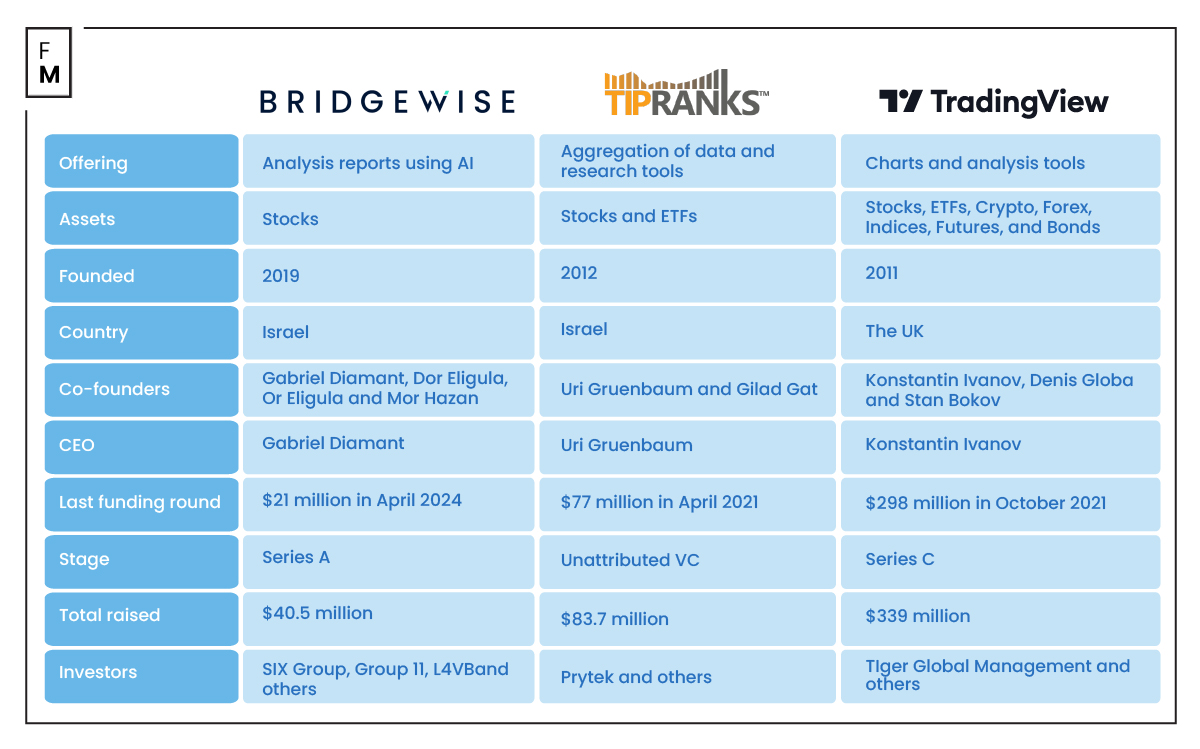
However, Bridgewise is not the only company offering stock research with AI. Its closest competitor is TipRanks, another Israeli company, uses natural language processing to analyze the performance of professional analysts for its services.
"The two companies are doing exactly the same thing, but the difference is an aggregation and opinion," Diamant elaborated. "TipRanks is aggregating a lot of data from analysts, while Bridgewise is creating opinions. We are actually acting as an analyst."
“Not for the Money”
Israel-headquartered Bridgewise, with offices in New York, London, Sao Paulo, Singapore, and Tokyo, recently secured $21 million in funding. Officially, the company stated it will use the funds “to accelerate market penetration and growth.”
However, Diamant revealed that money was not the primary motive for raising the funds.
“The main reason we pursued this funding round was not for the money,” Diamant said. “I know it sounds obnoxious,” he added, “What we did was bring global players. In this round, we attracted institutions from four different continents, including the United Emirates, the US, and Switzerland.”
Indeed, Switzerland’s SIX Group led Bridgewise’s latest funding round, with participation from Group11, L4 Venture Builder, and other global financial institutions.
As 2023 draws to a close, it's a moment to reflect on Bridgewise's journey. What a year it's been!
Our story is just beginning, and 2024 promises to be even more exciting. Here's to turning dreams into realities! 🚀🥂 pic.twitter.com/r1QQGcvLCo
One of the challenges AI companies face is copyright infringement with the training data. OpenAI, which revolutionized the AI industry by introducing ChatGPT, has been sued by a group of US newspapers over the allegations of misusing reporters' work to train their generative AI models.
AI is bullshit copywrite stealing machine good for plagerism for sure - mostly it’s a way for tech maniacs to steal more and make more money it was designed as capitalist AI when an ai comes out that says billionaires should exist - you may have something
Regarding niche companies like Bridgewise, such copyright infringement issues are minimal.
“We are highly focused on the reports we generate, resulting in less work when training AI models. Moreover, we made the strategic decision to have our analysts write our entire training data for the report,” Diamant said.
“Developing a micro language model with connected training data and putting it into practice provided us with a significant advantage over the rest of the market.”
In addition to reports, Bridgewise’s AI model scores individual stocks and predicts their future performance.
“One of our initial challenges was to establish a standardized approach because we did not want reports similar to those offered by other companies. Thus, we chose a different path,” Diamant explained.
“Our emphasis is on sector-specific features. For instance, we focus on marginal profit and interest in the banking industry. On the technological side, we place greater emphasis on revenues, which vary across different segments.”
Bridgewise’s CEO further disclosed that the company relies on “22 algorithms that segment the world region based on market cap and sectors,” rather than a single algorithm. The company is also generating all the reports in local languages rather then translating them from another language.
"We are not translating anything. We are building the report in the local language," Diamant said. "This makes the reports so much better, well. You can see that there is zero quality loss between the reports in English and the ones in other local languages."
Check it out: Two-thirds (65%) of peeps are already harnessing AI in financial reporting. That includes a chunk (36%) diving in deep and another quarter (29%) using it more selectively in 1-2 areas. #AI#FinancialReporting@KPMGpic.twitter.com/gsi9QlvoOi
— Priit @ Amperly AI productivity (@amperlycom) April 18, 2024
“The Trust Rate Is Not as High as You Imagine”
Generative AI has made significant strides in the financial sector, among others. Discussing AI’s use in finance, Diamant said: “AI excels at summarizing information, but it struggles with generating new ideas. This poses a challenge when the data is inaccurate.”
“We are already in discussions with industry giants like Goldman Sachs, Barclays, and Citibank. They recognise that AI is adept at summarizing data but should be used cautiously for generating ideas. The rest falls somewhere in between.”
“Currently, financial institutions trust and employ large summarization models. They use them to make data more engaging and create conversational gateways into their data sources, similar to what we are doing.”
However, there are other challenges, as he continued: “I think that the first thing financial institutions will do is to use AI-based services internally before releasing them to the public. This is because the trust rate is not as high as you imagine. I think there are a lot of things that need to be resolved right now regarding trust and responsibility.”
“The stock research market is broken and highly concentrated,” Bridgewise’s CEO, Gaby Diamant, pointed out while speaking to Finance Magnates recently after raising $21 million, adding: “Only 20 percent of global companies are covered by analysts. While the situation is slightly better in the US, it is dire in Europe, Latin America, and Asia.”
Bridgewise is addressing this gap by generating stock analysis reports in over 22 languages across 15 countries. Founded in 2019, the Israeli company employs proprietary generative artificial intelligence (AI) models to produce analyses and reports.
Addressing the language gap in stock reports, Bridgewise’s CEO described it as an “amazing advantage” for the company.
While English remains dominant due to its reach, other top languages in demand are Portuguese and Hebrew, based on Bridgewise’s user data. The platform’s popularity in Brazil has led to increased usage of Portuguese. Interestingly, the company generates all reports directly in local languages and receives approximately 120 million API calls yearly.
“In Brazil, we have a significant market share, but I believe it will begin shifting towards Japan, where we see emerging interest. We are also targeting investors in Singapore and Hong Kong,” Bridgewise’s CEO said.
However, Bridgewise is not the only company offering stock research with AI. Its closest competitor is TipRanks, another Israeli company, uses natural language processing to analyze the performance of professional analysts for its services.
"The two companies are doing exactly the same thing, but the difference is an aggregation and opinion," Diamant elaborated. "TipRanks is aggregating a lot of data from analysts, while Bridgewise is creating opinions. We are actually acting as an analyst."
“Not for the Money”
Israel-headquartered Bridgewise, with offices in New York, London, Sao Paulo, Singapore, and Tokyo, recently secured $21 million in funding. Officially, the company stated it will use the funds “to accelerate market penetration and growth.”
However, Diamant revealed that money was not the primary motive for raising the funds.
“The main reason we pursued this funding round was not for the money,” Diamant said. “I know it sounds obnoxious,” he added, “What we did was bring global players. In this round, we attracted institutions from four different continents, including the United Emirates, the US, and Switzerland.”
Indeed, Switzerland’s SIX Group led Bridgewise’s latest funding round, with participation from Group11, L4 Venture Builder, and other global financial institutions.
As 2023 draws to a close, it's a moment to reflect on Bridgewise's journey. What a year it's been!
Our story is just beginning, and 2024 promises to be even more exciting. Here's to turning dreams into realities! 🚀🥂 pic.twitter.com/r1QQGcvLCo
One of the challenges AI companies face is copyright infringement with the training data. OpenAI, which revolutionized the AI industry by introducing ChatGPT, has been sued by a group of US newspapers over the allegations of misusing reporters' work to train their generative AI models.
AI is bullshit copywrite stealing machine good for plagerism for sure - mostly it’s a way for tech maniacs to steal more and make more money it was designed as capitalist AI when an ai comes out that says billionaires should exist - you may have something
Regarding niche companies like Bridgewise, such copyright infringement issues are minimal.
“We are highly focused on the reports we generate, resulting in less work when training AI models. Moreover, we made the strategic decision to have our analysts write our entire training data for the report,” Diamant said.
“Developing a micro language model with connected training data and putting it into practice provided us with a significant advantage over the rest of the market.”
In addition to reports, Bridgewise’s AI model scores individual stocks and predicts their future performance.
“One of our initial challenges was to establish a standardized approach because we did not want reports similar to those offered by other companies. Thus, we chose a different path,” Diamant explained.
“Our emphasis is on sector-specific features. For instance, we focus on marginal profit and interest in the banking industry. On the technological side, we place greater emphasis on revenues, which vary across different segments.”
Bridgewise’s CEO further disclosed that the company relies on “22 algorithms that segment the world region based on market cap and sectors,” rather than a single algorithm. The company is also generating all the reports in local languages rather then translating them from another language.
"We are not translating anything. We are building the report in the local language," Diamant said. "This makes the reports so much better, well. You can see that there is zero quality loss between the reports in English and the ones in other local languages."
Check it out: Two-thirds (65%) of peeps are already harnessing AI in financial reporting. That includes a chunk (36%) diving in deep and another quarter (29%) using it more selectively in 1-2 areas. #AI#FinancialReporting@KPMGpic.twitter.com/gsi9QlvoOi
— Priit @ Amperly AI productivity (@amperlycom) April 18, 2024
“The Trust Rate Is Not as High as You Imagine”
Generative AI has made significant strides in the financial sector, among others. Discussing AI’s use in finance, Diamant said: “AI excels at summarizing information, but it struggles with generating new ideas. This poses a challenge when the data is inaccurate.”
“We are already in discussions with industry giants like Goldman Sachs, Barclays, and Citibank. They recognise that AI is adept at summarizing data but should be used cautiously for generating ideas. The rest falls somewhere in between.”
“Currently, financial institutions trust and employ large summarization models. They use them to make data more engaging and create conversational gateways into their data sources, similar to what we are doing.”
However, there are other challenges, as he continued: “I think that the first thing financial institutions will do is to use AI-based services internally before releasing them to the public. This is because the trust rate is not as high as you imagine. I think there are a lot of things that need to be resolved right now regarding trust and responsibility.”
Arnab Shome is an electronics engineer-turned-financial editor. He holds a Bachelor of Technology from the National Institute of Technology, Agartala. He entered the retail trading industry about a decade ago, covering the cryptocurrency market for Finance Magnates, and later expanded his coverage to include forex and CFDs as well.
His work at Finance Magnates includes C-level interviews, data-driven analysis, opinion pieces, and scoops of industry exclusives. He also contributes to Finance Magnates’ quarterly industry report.
Area of coverage:
1. CFD broker-related news
2. Industry-related Regulatory updates and developments
3. New retail trading trends
4. Prop trading industry updates
5. Executive interviews
Education:
Bachelor of Technology - National Institute of Technology, Agartala (India)
“You Want to Go to the Place That’s Got All the Liquidity”: Kalshi’s Andy Ross on Its Pitch to Brokers
Featured Videos
IG Seeks UK Gambling Licence; OANDA Japan Holds Withdrawals
IG Seeks UK Gambling Licence; OANDA Japan Holds Withdrawals
IG Seeks UK Gambling Licence; OANDA Japan Holds Withdrawals
IG Seeks UK Gambling Licence; OANDA Japan Holds Withdrawals
Today’s financial news recap covers IG's plans to enter prediction markets, OANDA Japan's withdrawal suspension after a server hack, a NAGA's falling earnings amid rising marketing costs
Finance Magnates Daily Recap brings you the latest news from forex and CFD brokers, fintech, payments, cryptocurrency, digital assets, trading platforms, financial regulation and global markets.
Get the key company news, executive moves, deals, regulatory updates and market developments of the day, in just a few minutes. New episodes published every weekday.
Read more: https://www.financemagnates.com
#FinanceMagnates #ForexNews #FintechNews
Today’s financial news recap covers IG's plans to enter prediction markets, OANDA Japan's withdrawal suspension after a server hack, a NAGA's falling earnings amid rising marketing costs
Finance Magnates Daily Recap brings you the latest news from forex and CFD brokers, fintech, payments, cryptocurrency, digital assets, trading platforms, financial regulation and global markets.
Get the key company news, executive moves, deals, regulatory updates and market developments of the day, in just a few minutes. New episodes published every weekday.
Read more: https://www.financemagnates.com
#FinanceMagnates #ForexNews #FintechNews
Today’s financial news recap covers IG's plans to enter prediction markets, OANDA Japan's withdrawal suspension after a server hack, a NAGA's falling earnings amid rising marketing costs
Finance Magnates Daily Recap brings you the latest news from forex and CFD brokers, fintech, payments, cryptocurrency, digital assets, trading platforms, financial regulation and global markets.
Get the key company news, executive moves, deals, regulatory updates and market developments of the day, in just a few minutes. New episodes published every weekday.
Read more: https://www.financemagnates.com
#FinanceMagnates #ForexNews #FintechNews
Today’s financial news recap covers IG's plans to enter prediction markets, OANDA Japan's withdrawal suspension after a server hack, a NAGA's falling earnings amid rising marketing costs
Finance Magnates Daily Recap brings you the latest news from forex and CFD brokers, fintech, payments, cryptocurrency, digital assets, trading platforms, financial regulation and global markets.
Get the key company news, executive moves, deals, regulatory updates and market developments of the day, in just a few minutes. New episodes published every weekday.
Read more: https://www.financemagnates.com
#FinanceMagnates #ForexNews #FintechNews
FMIQ: Get Verified Market Intelligence in Seconds | FM Intelligence
FMIQ: Get Verified Market Intelligence in Seconds | FM Intelligence
FMIQ: Get Verified Market Intelligence in Seconds | FM Intelligence
FMIQ: Get Verified Market Intelligence in Seconds | FM Intelligence
FMIQ: Get Verified Market Intelligence in Seconds | FM Intelligence
FMIQ: Get Verified Market Intelligence in Seconds | FM Intelligence
Meet FMIQ (FM Intelligence Quantitative), now available inside the FM Intelligence Portal.
Ask the market a question in plain language and get a sourced, verified answer in seconds. FMIQ gives you the figures, time periods, and sources you need to make informed decisions, without the need to work through dashboards, filters, or spreadsheet exports.
What makes FMIQ different?
✓ Ask questions in plain language, with no SQL or dashboard setup required.
✓ Get verified answers checked through an independent quality assurance step.
✓ Access sourced figures you can cite with confidence.
✓ Ask follow-up questions and build on the same conversation.
✓ Query seven datasets in one place, covering trading volumes, traffic, platforms, market movements, regulations, fines, and licences.
Built for professionals across the financial markets
- Editorial teams: Find reliable figures and support your reporting with clear sources.
- Commercial teams: Access the market data you need to prepare for client meetings and sales discussions.
- Research and analyst teams: Explore market trends and get answers to specific questions.
- Compliance teams: Access intelligence on regulations, fines, and licences.
Every query is run live, and answers go through an independent quality check. FMIQ is read-only, stays focused on your question, and does not alter the underlying data.
Built on Finance Magnates market intelligence, FMIQ helps professionals get the answers they need, when they need them.
Access FMIQ today: https://datalab.financemagnates.com/market?utm_source=youtube&utm_medium=video&utm_campaign=fmiq_phase1_mvp_launch
#FMIntelligence #FMIQ #MarketIntelligence #FinanceMagnates #FinancialMarkets #MarketResearch
Meet FMIQ (FM Intelligence Quantitative), now available inside the FM Intelligence Portal.
Ask the market a question in plain language and get a sourced, verified answer in seconds. FMIQ gives you the figures, time periods, and sources you need to make informed decisions, without the need to work through dashboards, filters, or spreadsheet exports.
What makes FMIQ different?
✓ Ask questions in plain language, with no SQL or dashboard setup required.
✓ Get verified answers checked through an independent quality assurance step.
✓ Access sourced figures you can cite with confidence.
✓ Ask follow-up questions and build on the same conversation.
✓ Query seven datasets in one place, covering trading volumes, traffic, platforms, market movements, regulations, fines, and licences.
Built for professionals across the financial markets
- Editorial teams: Find reliable figures and support your reporting with clear sources.
- Commercial teams: Access the market data you need to prepare for client meetings and sales discussions.
- Research and analyst teams: Explore market trends and get answers to specific questions.
- Compliance teams: Access intelligence on regulations, fines, and licences.
Every query is run live, and answers go through an independent quality check. FMIQ is read-only, stays focused on your question, and does not alter the underlying data.
Built on Finance Magnates market intelligence, FMIQ helps professionals get the answers they need, when they need them.
Access FMIQ today: https://datalab.financemagnates.com/market?utm_source=youtube&utm_medium=video&utm_campaign=fmiq_phase1_mvp_launch
#FMIntelligence #FMIQ #MarketIntelligence #FinanceMagnates #FinancialMarkets #MarketResearch
Meet FMIQ (FM Intelligence Quantitative), now available inside the FM Intelligence Portal.
Ask the market a question in plain language and get a sourced, verified answer in seconds. FMIQ gives you the figures, time periods, and sources you need to make informed decisions, without the need to work through dashboards, filters, or spreadsheet exports.
What makes FMIQ different?
✓ Ask questions in plain language, with no SQL or dashboard setup required.
✓ Get verified answers checked through an independent quality assurance step.
✓ Access sourced figures you can cite with confidence.
✓ Ask follow-up questions and build on the same conversation.
✓ Query seven datasets in one place, covering trading volumes, traffic, platforms, market movements, regulations, fines, and licences.
Built for professionals across the financial markets
- Editorial teams: Find reliable figures and support your reporting with clear sources.
- Commercial teams: Access the market data you need to prepare for client meetings and sales discussions.
- Research and analyst teams: Explore market trends and get answers to specific questions.
- Compliance teams: Access intelligence on regulations, fines, and licences.
Every query is run live, and answers go through an independent quality check. FMIQ is read-only, stays focused on your question, and does not alter the underlying data.
Built on Finance Magnates market intelligence, FMIQ helps professionals get the answers they need, when they need them.
Access FMIQ today: https://datalab.financemagnates.com/market?utm_source=youtube&utm_medium=video&utm_campaign=fmiq_phase1_mvp_launch
#FMIntelligence #FMIQ #MarketIntelligence #FinanceMagnates #FinancialMarkets #MarketResearch
Meet FMIQ (FM Intelligence Quantitative), now available inside the FM Intelligence Portal.
Ask the market a question in plain language and get a sourced, verified answer in seconds. FMIQ gives you the figures, time periods, and sources you need to make informed decisions, without the need to work through dashboards, filters, or spreadsheet exports.
What makes FMIQ different?
✓ Ask questions in plain language, with no SQL or dashboard setup required.
✓ Get verified answers checked through an independent quality assurance step.
✓ Access sourced figures you can cite with confidence.
✓ Ask follow-up questions and build on the same conversation.
✓ Query seven datasets in one place, covering trading volumes, traffic, platforms, market movements, regulations, fines, and licences.
Built for professionals across the financial markets
- Editorial teams: Find reliable figures and support your reporting with clear sources.
- Commercial teams: Access the market data you need to prepare for client meetings and sales discussions.
- Research and analyst teams: Explore market trends and get answers to specific questions.
- Compliance teams: Access intelligence on regulations, fines, and licences.
Every query is run live, and answers go through an independent quality check. FMIQ is read-only, stays focused on your question, and does not alter the underlying data.
Built on Finance Magnates market intelligence, FMIQ helps professionals get the answers they need, when they need them.
Access FMIQ today: https://datalab.financemagnates.com/market?utm_source=youtube&utm_medium=video&utm_campaign=fmiq_phase1_mvp_launch
#FMIntelligence #FMIQ #MarketIntelligence #FinanceMagnates #FinancialMarkets #MarketResearch
Meet FMIQ (FM Intelligence Quantitative), now available inside the FM Intelligence Portal.
Ask the market a question in plain language and get a sourced, verified answer in seconds. FMIQ gives you the figures, time periods, and sources you need to make informed decisions, without the need to work through dashboards, filters, or spreadsheet exports.
What makes FMIQ different?
✓ Ask questions in plain language, with no SQL or dashboard setup required.
✓ Get verified answers checked through an independent quality assurance step.
✓ Access sourced figures you can cite with confidence.
✓ Ask follow-up questions and build on the same conversation.
✓ Query seven datasets in one place, covering trading volumes, traffic, platforms, market movements, regulations, fines, and licences.
Built for professionals across the financial markets
- Editorial teams: Find reliable figures and support your reporting with clear sources.
- Commercial teams: Access the market data you need to prepare for client meetings and sales discussions.
- Research and analyst teams: Explore market trends and get answers to specific questions.
- Compliance teams: Access intelligence on regulations, fines, and licences.
Every query is run live, and answers go through an independent quality check. FMIQ is read-only, stays focused on your question, and does not alter the underlying data.
Built on Finance Magnates market intelligence, FMIQ helps professionals get the answers they need, when they need them.
Access FMIQ today: https://datalab.financemagnates.com/market?utm_source=youtube&utm_medium=video&utm_campaign=fmiq_phase1_mvp_launch
#FMIntelligence #FMIQ #MarketIntelligence #FinanceMagnates #FinancialMarkets #MarketResearch
Meet FMIQ (FM Intelligence Quantitative), now available inside the FM Intelligence Portal.
Ask the market a question in plain language and get a sourced, verified answer in seconds. FMIQ gives you the figures, time periods, and sources you need to make informed decisions, without the need to work through dashboards, filters, or spreadsheet exports.
What makes FMIQ different?
✓ Ask questions in plain language, with no SQL or dashboard setup required.
✓ Get verified answers checked through an independent quality assurance step.
✓ Access sourced figures you can cite with confidence.
✓ Ask follow-up questions and build on the same conversation.
✓ Query seven datasets in one place, covering trading volumes, traffic, platforms, market movements, regulations, fines, and licences.
Built for professionals across the financial markets
- Editorial teams: Find reliable figures and support your reporting with clear sources.
- Commercial teams: Access the market data you need to prepare for client meetings and sales discussions.
- Research and analyst teams: Explore market trends and get answers to specific questions.
- Compliance teams: Access intelligence on regulations, fines, and licences.
Every query is run live, and answers go through an independent quality check. FMIQ is read-only, stays focused on your question, and does not alter the underlying data.
Built on Finance Magnates market intelligence, FMIQ helps professionals get the answers they need, when they need them.
Access FMIQ today: https://datalab.financemagnates.com/market?utm_source=youtube&utm_medium=video&utm_campaign=fmiq_phase1_mvp_launch
#FMIntelligence #FMIQ #MarketIntelligence #FinanceMagnates #FinancialMarkets #MarketResearch
MyForexFunds Details No Conflict Model; UK Eyes iPhone Wallets
MyForexFunds Details No Conflict Model; UK Eyes iPhone Wallets
MyForexFunds Details No Conflict Model; UK Eyes iPhone Wallets
MyForexFunds Details No Conflict Model; UK Eyes iPhone Wallets
MyForexFunds Details No Conflict Model; UK Eyes iPhone Wallets
MyForexFunds Details No Conflict Model; UK Eyes iPhone Wallets
Today’s financial news recap covers MyForexFunds outlines its Evolution relaunch, UK brokers could get their own iPhone wallets, Goat Funded Trader reports $26 million in payouts, and Kalshi explains its pitch to brokers.
Finance Magnates Daily Recap brings you the latest news from forex and CFD brokers, fintech, payments, cryptocurrency, digital assets, trading platforms, financial regulation and global markets.
Get the key company news, executive moves, deals, regulatory updates and market developments of the day, in just a few minutes. New episodes published every weekday.
Read more: https://www.financemagnates.com
#FinanceMagnates #ForexNews #FintechNews
Today’s financial news recap covers MyForexFunds outlines its Evolution relaunch, UK brokers could get their own iPhone wallets, Goat Funded Trader reports $26 million in payouts, and Kalshi explains its pitch to brokers.
Finance Magnates Daily Recap brings you the latest news from forex and CFD brokers, fintech, payments, cryptocurrency, digital assets, trading platforms, financial regulation and global markets.
Get the key company news, executive moves, deals, regulatory updates and market developments of the day, in just a few minutes. New episodes published every weekday.
Read more: https://www.financemagnates.com
#FinanceMagnates #ForexNews #FintechNews
Today’s financial news recap covers MyForexFunds outlines its Evolution relaunch, UK brokers could get their own iPhone wallets, Goat Funded Trader reports $26 million in payouts, and Kalshi explains its pitch to brokers.
Finance Magnates Daily Recap brings you the latest news from forex and CFD brokers, fintech, payments, cryptocurrency, digital assets, trading platforms, financial regulation and global markets.
Get the key company news, executive moves, deals, regulatory updates and market developments of the day, in just a few minutes. New episodes published every weekday.
Read more: https://www.financemagnates.com
#FinanceMagnates #ForexNews #FintechNews
Today’s financial news recap covers MyForexFunds outlines its Evolution relaunch, UK brokers could get their own iPhone wallets, Goat Funded Trader reports $26 million in payouts, and Kalshi explains its pitch to brokers.
Finance Magnates Daily Recap brings you the latest news from forex and CFD brokers, fintech, payments, cryptocurrency, digital assets, trading platforms, financial regulation and global markets.
Get the key company news, executive moves, deals, regulatory updates and market developments of the day, in just a few minutes. New episodes published every weekday.
Read more: https://www.financemagnates.com
#FinanceMagnates #ForexNews #FintechNews
Today’s financial news recap covers MyForexFunds outlines its Evolution relaunch, UK brokers could get their own iPhone wallets, Goat Funded Trader reports $26 million in payouts, and Kalshi explains its pitch to brokers.
Finance Magnates Daily Recap brings you the latest news from forex and CFD brokers, fintech, payments, cryptocurrency, digital assets, trading platforms, financial regulation and global markets.
Get the key company news, executive moves, deals, regulatory updates and market developments of the day, in just a few minutes. New episodes published every weekday.
Read more: https://www.financemagnates.com
#FinanceMagnates #ForexNews #FintechNews
Today’s financial news recap covers MyForexFunds outlines its Evolution relaunch, UK brokers could get their own iPhone wallets, Goat Funded Trader reports $26 million in payouts, and Kalshi explains its pitch to brokers.
Finance Magnates Daily Recap brings you the latest news from forex and CFD brokers, fintech, payments, cryptocurrency, digital assets, trading platforms, financial regulation and global markets.
Get the key company news, executive moves, deals, regulatory updates and market developments of the day, in just a few minutes. New episodes published every weekday.
Read more: https://www.financemagnates.com
#FinanceMagnates #ForexNews #FintechNews
How Much Are CFD Industry Executives Making; Plus500 Buys Brazilian Broker
How Much Are CFD Industry Executives Making; Plus500 Buys Brazilian Broker
How Much Are CFD Industry Executives Making; Plus500 Buys Brazilian Broker
How Much Are CFD Industry Executives Making; Plus500 Buys Brazilian Broker
How Much Are CFD Industry Executives Making; Plus500 Buys Brazilian Broker
How Much Are CFD Industry Executives Making; Plus500 Buys Brazilian Broker
Today’s financial news recap covers FinTop Consulting shared its 2026 salary surveys for Dubai, London and Cyprus with Finance Magnates, Plus500 buys a Brazilian broker, and Google opens the door to CFD ads in Denmark and Chile.
Finance Magnates Daily Recap brings you the latest news from forex and CFD brokers, fintech, payments, cryptocurrency, digital assets, trading platforms, financial regulation and global markets.
Get the key company news, executive moves, deals, regulatory updates and market developments of the day, in just a few minutes. New episodes published every weekday.
Read more: https://www.financemagnates.com
#FinanceMagnates #ForexNews #FintechNews
Today’s financial news recap covers FinTop Consulting shared its 2026 salary surveys for Dubai, London and Cyprus with Finance Magnates, Plus500 buys a Brazilian broker, and Google opens the door to CFD ads in Denmark and Chile.
Finance Magnates Daily Recap brings you the latest news from forex and CFD brokers, fintech, payments, cryptocurrency, digital assets, trading platforms, financial regulation and global markets.
Get the key company news, executive moves, deals, regulatory updates and market developments of the day, in just a few minutes. New episodes published every weekday.
Read more: https://www.financemagnates.com
#FinanceMagnates #ForexNews #FintechNews
Today’s financial news recap covers FinTop Consulting shared its 2026 salary surveys for Dubai, London and Cyprus with Finance Magnates, Plus500 buys a Brazilian broker, and Google opens the door to CFD ads in Denmark and Chile.
Finance Magnates Daily Recap brings you the latest news from forex and CFD brokers, fintech, payments, cryptocurrency, digital assets, trading platforms, financial regulation and global markets.
Get the key company news, executive moves, deals, regulatory updates and market developments of the day, in just a few minutes. New episodes published every weekday.
Read more: https://www.financemagnates.com
#FinanceMagnates #ForexNews #FintechNews
Today’s financial news recap covers FinTop Consulting shared its 2026 salary surveys for Dubai, London and Cyprus with Finance Magnates, Plus500 buys a Brazilian broker, and Google opens the door to CFD ads in Denmark and Chile.
Finance Magnates Daily Recap brings you the latest news from forex and CFD brokers, fintech, payments, cryptocurrency, digital assets, trading platforms, financial regulation and global markets.
Get the key company news, executive moves, deals, regulatory updates and market developments of the day, in just a few minutes. New episodes published every weekday.
Read more: https://www.financemagnates.com
#FinanceMagnates #ForexNews #FintechNews
Today’s financial news recap covers FinTop Consulting shared its 2026 salary surveys for Dubai, London and Cyprus with Finance Magnates, Plus500 buys a Brazilian broker, and Google opens the door to CFD ads in Denmark and Chile.
Finance Magnates Daily Recap brings you the latest news from forex and CFD brokers, fintech, payments, cryptocurrency, digital assets, trading platforms, financial regulation and global markets.
Get the key company news, executive moves, deals, regulatory updates and market developments of the day, in just a few minutes. New episodes published every weekday.
Read more: https://www.financemagnates.com
#FinanceMagnates #ForexNews #FintechNews
Today’s financial news recap covers FinTop Consulting shared its 2026 salary surveys for Dubai, London and Cyprus with Finance Magnates, Plus500 buys a Brazilian broker, and Google opens the door to CFD ads in Denmark and Chile.
Finance Magnates Daily Recap brings you the latest news from forex and CFD brokers, fintech, payments, cryptocurrency, digital assets, trading platforms, financial regulation and global markets.
Get the key company news, executive moves, deals, regulatory updates and market developments of the day, in just a few minutes. New episodes published every weekday.
Read more: https://www.financemagnates.com
#FinanceMagnates #ForexNews #FintechNews
Capital.com UAE Clients Trade $1T in H1; Saxo Signs Nine Athletes
Capital.com UAE Clients Trade $1T in H1; Saxo Signs Nine Athletes
Capital.com UAE Clients Trade $1T in H1; Saxo Signs Nine Athletes
Capital.com UAE Clients Trade $1T in H1; Saxo Signs Nine Athletes
Capital.com UAE Clients Trade $1T in H1; Saxo Signs Nine Athletes
Capital.com UAE Clients Trade $1T in H1; Saxo Signs Nine Athletes
Today’s financial news recap covers Capital.com’s trading data, Saxo Bank’s athlete campaign, Revolut’s Gibraltar crypto licence, and eToro’s new desktop terminal.
Finance Magnates Daily Recap brings you the latest news from forex and CFD brokers, fintech, payments, cryptocurrency, digital assets, trading platforms, financial regulation and global markets.
Get the key company news, executive moves, deals, regulatory updates and market developments of the day, in just a few minutes. New episodes published every weekday.
Read more: https://www.financemagnates.com
#FinanceMagnates #ForexNews #FintechNews
Today’s financial news recap covers Capital.com’s trading data, Saxo Bank’s athlete campaign, Revolut’s Gibraltar crypto licence, and eToro’s new desktop terminal.
Finance Magnates Daily Recap brings you the latest news from forex and CFD brokers, fintech, payments, cryptocurrency, digital assets, trading platforms, financial regulation and global markets.
Get the key company news, executive moves, deals, regulatory updates and market developments of the day, in just a few minutes. New episodes published every weekday.
Read more: https://www.financemagnates.com
#FinanceMagnates #ForexNews #FintechNews
Today’s financial news recap covers Capital.com’s trading data, Saxo Bank’s athlete campaign, Revolut’s Gibraltar crypto licence, and eToro’s new desktop terminal.
Finance Magnates Daily Recap brings you the latest news from forex and CFD brokers, fintech, payments, cryptocurrency, digital assets, trading platforms, financial regulation and global markets.
Get the key company news, executive moves, deals, regulatory updates and market developments of the day, in just a few minutes. New episodes published every weekday.
Read more: https://www.financemagnates.com
#FinanceMagnates #ForexNews #FintechNews
Today’s financial news recap covers Capital.com’s trading data, Saxo Bank’s athlete campaign, Revolut’s Gibraltar crypto licence, and eToro’s new desktop terminal.
Finance Magnates Daily Recap brings you the latest news from forex and CFD brokers, fintech, payments, cryptocurrency, digital assets, trading platforms, financial regulation and global markets.
Get the key company news, executive moves, deals, regulatory updates and market developments of the day, in just a few minutes. New episodes published every weekday.
Read more: https://www.financemagnates.com
#FinanceMagnates #ForexNews #FintechNews
Today’s financial news recap covers Capital.com’s trading data, Saxo Bank’s athlete campaign, Revolut’s Gibraltar crypto licence, and eToro’s new desktop terminal.
Finance Magnates Daily Recap brings you the latest news from forex and CFD brokers, fintech, payments, cryptocurrency, digital assets, trading platforms, financial regulation and global markets.
Get the key company news, executive moves, deals, regulatory updates and market developments of the day, in just a few minutes. New episodes published every weekday.
Read more: https://www.financemagnates.com
#FinanceMagnates #ForexNews #FintechNews
Today’s financial news recap covers Capital.com’s trading data, Saxo Bank’s athlete campaign, Revolut’s Gibraltar crypto licence, and eToro’s new desktop terminal.
Finance Magnates Daily Recap brings you the latest news from forex and CFD brokers, fintech, payments, cryptocurrency, digital assets, trading platforms, financial regulation and global markets.
Get the key company news, executive moves, deals, regulatory updates and market developments of the day, in just a few minutes. New episodes published every weekday.
Read more: https://www.financemagnates.com
#FinanceMagnates #ForexNews #FintechNews