We caught up with Omar Arnaout, the CEO of XTB to put the broker’s results into perspective.
FM
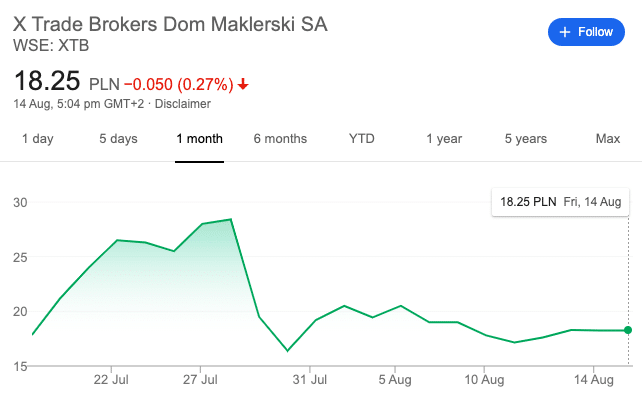
After reporting its financial results for the first half of 2020 towards the end of July, the share price of Polish brokerage XTB plummeted as market participants reacted negatively to a slow down in the second quarter.
As Finance Magnates reported, XTB’s share price fell more than 30 per cent from its peak on 28th July 2020. The broker’s share price has yet to recover and currently sits at PLN 18.25 at the time of publishing.
Even though the Polish broker reported stellar metrics for the first half of this year, there was a notable slowdown in the second quarter. This suggests that the boost provided by COVID-19 might be coming to an end.
In the second quarter, net profit was PLN 117.52 million, whereas the first quarter of 2020 recorded a net profit of PLN 175.97 million, a decline of 49.7 per cent. Additionally, net operating income also fell from PLN 306.7 million in the first three months of the year down to PLN 211.5 million (31.0 per cent drop).
Despite Slowdown, Q2 Was Still Strong for XTB
To put these figures into perspective, Finance Magnates caught up with Omar Arnaout, the Chief Executive Officer of XTB earlier this month.
“Even though the second quarter of 2020 did not generate a profit as high as the profit generated in the first quarter, it was the second best quarter in the history of the company in terms of net profit,” Arnaout explained.
“Additionally what is a key factor in our strategy is that we were able to achieve a record result in terms of new clients with over 30,000 new agreements signed in this period. What is more, the average number of active clients in the second quarter rose to the level of 58,508 from the level of 45,660 in the first quarter. Concluding, at XTB we are very happy with the results achieved in the second quarter, and we believe that it was a massive success.”
Commodity CFD Trading Drove Q1 Revenues on XTB
During the interview, XTB’s CEO pointed out that the broker expected to see a slowdown in the second quarter of 2020. This was mainly due to lower revenues generated from commodity contracts for differences (CFDs).
This is because in the first quarter of the year commodity CFDs represented more than 50 per cent of the company’s revenue, while in the second quarter, commodity CFDs contributed to only about 25 per cent.
“What is a key factor in our industry is that results are a derivative of both market movements and client base. We are aware that we are not able to have any control of the first, and that is why our main focus is the later, and like mentioned earlier we are very happy to have signed over 30,000 new agreements in the second quarter. Overall during 2020, we were able to sign more new agreements in two quarters than in the last previous years.”
Was Q1 a One-Off?
When asked whether he thought that the historical performance achieved in Q1 of 2020 was a one-off, Arnaout pointed out that the results were driven by two main factors: market movements and the number of active clients trading with XTB.
“What is crucial to us is that we continue to significantly grow our client base irrelevant of whether there is above average market volatility or not. We are confident that in the short term we are able to sign between 15,000 and 20,000 new agreements quarterly, and we hope to reach the level of 30000 new agreements quarterly as soon as possible,” he outlined.
“If we are able to achieve this goal, then I am certain that if markets are volatile once again then we will be able to reach similar levels of performance in the future.”
Looking to the Future
If volatility continues to lessen, then it could be expected that the second half of 2020 will be weaker than H1 of 2020. However, according to Arnaout, XTB is focusing on projects that it has been planning since the start of the year, instead of anticipating what is going to happen in the second half of 2020.
XTB is also planning on expanding its geographical reach. Namely, Arnaout revealed to Finance Magnates that the firm has applied for two new licences on two continents where it currently does not have a physical presence. At the time of the interview, the company was waiting to receive the licences.
“One of those countries is South Africa, and I will keep the other as a surprise for now. The current situation with COVID may slightly delay the opening of the branches, but I have high hopes that both new branches will still be opened this year,” Arnaout added.
After reporting its financial results for the first half of 2020 towards the end of July, the share price of Polish brokerage XTB plummeted as market participants reacted negatively to a slow down in the second quarter.
As Finance Magnates reported, XTB’s share price fell more than 30 per cent from its peak on 28th July 2020. The broker’s share price has yet to recover and currently sits at PLN 18.25 at the time of publishing.
Even though the Polish broker reported stellar metrics for the first half of this year, there was a notable slowdown in the second quarter. This suggests that the boost provided by COVID-19 might be coming to an end.
In the second quarter, net profit was PLN 117.52 million, whereas the first quarter of 2020 recorded a net profit of PLN 175.97 million, a decline of 49.7 per cent. Additionally, net operating income also fell from PLN 306.7 million in the first three months of the year down to PLN 211.5 million (31.0 per cent drop).
Despite Slowdown, Q2 Was Still Strong for XTB
To put these figures into perspective, Finance Magnates caught up with Omar Arnaout, the Chief Executive Officer of XTB earlier this month.
“Even though the second quarter of 2020 did not generate a profit as high as the profit generated in the first quarter, it was the second best quarter in the history of the company in terms of net profit,” Arnaout explained.
“Additionally what is a key factor in our strategy is that we were able to achieve a record result in terms of new clients with over 30,000 new agreements signed in this period. What is more, the average number of active clients in the second quarter rose to the level of 58,508 from the level of 45,660 in the first quarter. Concluding, at XTB we are very happy with the results achieved in the second quarter, and we believe that it was a massive success.”
Commodity CFD Trading Drove Q1 Revenues on XTB
During the interview, XTB’s CEO pointed out that the broker expected to see a slowdown in the second quarter of 2020. This was mainly due to lower revenues generated from commodity contracts for differences (CFDs).
This is because in the first quarter of the year commodity CFDs represented more than 50 per cent of the company’s revenue, while in the second quarter, commodity CFDs contributed to only about 25 per cent.
“What is a key factor in our industry is that results are a derivative of both market movements and client base. We are aware that we are not able to have any control of the first, and that is why our main focus is the later, and like mentioned earlier we are very happy to have signed over 30,000 new agreements in the second quarter. Overall during 2020, we were able to sign more new agreements in two quarters than in the last previous years.”
Was Q1 a One-Off?
When asked whether he thought that the historical performance achieved in Q1 of 2020 was a one-off, Arnaout pointed out that the results were driven by two main factors: market movements and the number of active clients trading with XTB.
“What is crucial to us is that we continue to significantly grow our client base irrelevant of whether there is above average market volatility or not. We are confident that in the short term we are able to sign between 15,000 and 20,000 new agreements quarterly, and we hope to reach the level of 30000 new agreements quarterly as soon as possible,” he outlined.
“If we are able to achieve this goal, then I am certain that if markets are volatile once again then we will be able to reach similar levels of performance in the future.”
Looking to the Future
If volatility continues to lessen, then it could be expected that the second half of 2020 will be weaker than H1 of 2020. However, according to Arnaout, XTB is focusing on projects that it has been planning since the start of the year, instead of anticipating what is going to happen in the second half of 2020.
XTB is also planning on expanding its geographical reach. Namely, Arnaout revealed to Finance Magnates that the firm has applied for two new licences on two continents where it currently does not have a physical presence. At the time of the interview, the company was waiting to receive the licences.
“One of those countries is South Africa, and I will keep the other as a surprise for now. The current situation with COVID may slightly delay the opening of the branches, but I have high hopes that both new branches will still be opened this year,” Arnaout added.
Mitrade Hires Former TD Ameritrade and Capital.com Singapore Chief as Markets Advisor
Featured Videos
AvaTrade to Acquire Most of FXCM; NAGA Raises $8M
AvaTrade to Acquire Most of FXCM; NAGA Raises $8M
AvaTrade to Acquire Most of FXCM; NAGA Raises $8M
AvaTrade to Acquire Most of FXCM; NAGA Raises $8M
Today’s financial news recap covers AvaTrade agrees to acquire most of FXCM, NAGA secures eight million dollars in new financing, and Wise seeks a tax settlement in the UK.
Finance Magnates Daily Recap brings you the latest news from forex and CFD brokers, fintech, payments, cryptocurrency, digital assets, trading platforms, financial regulation and global markets.
Get the key company news, executive moves, deals, regulatory updates and market developments of the day, in just a few minutes. New episodes published every weekday.
Read more: https://www.financemagnates.com
#FinanceMagnates #ForexNews #FintechNews
Today’s financial news recap covers AvaTrade agrees to acquire most of FXCM, NAGA secures eight million dollars in new financing, and Wise seeks a tax settlement in the UK.
Finance Magnates Daily Recap brings you the latest news from forex and CFD brokers, fintech, payments, cryptocurrency, digital assets, trading platforms, financial regulation and global markets.
Get the key company news, executive moves, deals, regulatory updates and market developments of the day, in just a few minutes. New episodes published every weekday.
Read more: https://www.financemagnates.com
#FinanceMagnates #ForexNews #FintechNews
Today’s financial news recap covers AvaTrade agrees to acquire most of FXCM, NAGA secures eight million dollars in new financing, and Wise seeks a tax settlement in the UK.
Finance Magnates Daily Recap brings you the latest news from forex and CFD brokers, fintech, payments, cryptocurrency, digital assets, trading platforms, financial regulation and global markets.
Get the key company news, executive moves, deals, regulatory updates and market developments of the day, in just a few minutes. New episodes published every weekday.
Read more: https://www.financemagnates.com
#FinanceMagnates #ForexNews #FintechNews
Today’s financial news recap covers AvaTrade agrees to acquire most of FXCM, NAGA secures eight million dollars in new financing, and Wise seeks a tax settlement in the UK.
Finance Magnates Daily Recap brings you the latest news from forex and CFD brokers, fintech, payments, cryptocurrency, digital assets, trading platforms, financial regulation and global markets.
Get the key company news, executive moves, deals, regulatory updates and market developments of the day, in just a few minutes. New episodes published every weekday.
Read more: https://www.financemagnates.com
#FinanceMagnates #ForexNews #FintechNews
XTB Adds Overnight US Stock Trading; Nasdaq Ventures Invests in One Trading
XTB Adds Overnight US Stock Trading; Nasdaq Ventures Invests in One Trading
XTB Adds Overnight US Stock Trading; Nasdaq Ventures Invests in One Trading
XTB Adds Overnight US Stock Trading; Nasdaq Ventures Invests in One Trading
XTB Adds Overnight US Stock Trading; Nasdaq Ventures Invests in One Trading
XTB Adds Overnight US Stock Trading; Nasdaq Ventures Invests in One Trading
Today’s financial news recap covers XTB expands overnight US stock trading, Fortrade reports higher revenue, Nasdaq backs One Trading, and Vest Labs raises 13 million dollars.
Finance Magnates Daily Recap brings you the latest news from forex and CFD brokers, fintech, payments, cryptocurrency, digital assets, trading platforms, financial regulation and global markets.
Get the key company news, executive moves, deals, regulatory updates and market developments of the day, in just a few minutes. New episodes published every weekday.
Read more: https://www.financemagnates.com
#FinanceMagnates #ForexNews #FintechNews
Today’s financial news recap covers XTB expands overnight US stock trading, Fortrade reports higher revenue, Nasdaq backs One Trading, and Vest Labs raises 13 million dollars.
Finance Magnates Daily Recap brings you the latest news from forex and CFD brokers, fintech, payments, cryptocurrency, digital assets, trading platforms, financial regulation and global markets.
Get the key company news, executive moves, deals, regulatory updates and market developments of the day, in just a few minutes. New episodes published every weekday.
Read more: https://www.financemagnates.com
#FinanceMagnates #ForexNews #FintechNews
Today’s financial news recap covers XTB expands overnight US stock trading, Fortrade reports higher revenue, Nasdaq backs One Trading, and Vest Labs raises 13 million dollars.
Finance Magnates Daily Recap brings you the latest news from forex and CFD brokers, fintech, payments, cryptocurrency, digital assets, trading platforms, financial regulation and global markets.
Get the key company news, executive moves, deals, regulatory updates and market developments of the day, in just a few minutes. New episodes published every weekday.
Read more: https://www.financemagnates.com
#FinanceMagnates #ForexNews #FintechNews
Today’s financial news recap covers XTB expands overnight US stock trading, Fortrade reports higher revenue, Nasdaq backs One Trading, and Vest Labs raises 13 million dollars.
Finance Magnates Daily Recap brings you the latest news from forex and CFD brokers, fintech, payments, cryptocurrency, digital assets, trading platforms, financial regulation and global markets.
Get the key company news, executive moves, deals, regulatory updates and market developments of the day, in just a few minutes. New episodes published every weekday.
Read more: https://www.financemagnates.com
#FinanceMagnates #ForexNews #FintechNews
Today’s financial news recap covers XTB expands overnight US stock trading, Fortrade reports higher revenue, Nasdaq backs One Trading, and Vest Labs raises 13 million dollars.
Finance Magnates Daily Recap brings you the latest news from forex and CFD brokers, fintech, payments, cryptocurrency, digital assets, trading platforms, financial regulation and global markets.
Get the key company news, executive moves, deals, regulatory updates and market developments of the day, in just a few minutes. New episodes published every weekday.
Read more: https://www.financemagnates.com
#FinanceMagnates #ForexNews #FintechNews
Today’s financial news recap covers XTB expands overnight US stock trading, Fortrade reports higher revenue, Nasdaq backs One Trading, and Vest Labs raises 13 million dollars.
Finance Magnates Daily Recap brings you the latest news from forex and CFD brokers, fintech, payments, cryptocurrency, digital assets, trading platforms, financial regulation and global markets.
Get the key company news, executive moves, deals, regulatory updates and market developments of the day, in just a few minutes. New episodes published every weekday.
Read more: https://www.financemagnates.com
#FinanceMagnates #ForexNews #FintechNews
CMC Founder Downplays Volatility Hit; Devexperts Names CEO
CMC Founder Downplays Volatility Hit; Devexperts Names CEO
CMC Founder Downplays Volatility Hit; Devexperts Names CEO
CMC Founder Downplays Volatility Hit; Devexperts Names CEO
CMC Founder Downplays Volatility Hit; Devexperts Names CEO
CMC Founder Downplays Volatility Hit; Devexperts Names CEO
Today’s financial news recap covers low volatility pressures brokers, Devexperts names a new CEO, Saxo cuts onboarding time, and OKX reaches a 25 billion dollar valuation.
Finance Magnates Daily Recap brings you the latest news from forex and CFD brokers, fintech, payments, cryptocurrency, digital assets, trading platforms, financial regulation and global markets.
Get the key company news, executive moves, deals, regulatory updates and market developments of the day, in just a few minutes. New episodes published every weekday.
Read more: https://www.financemagnates.com
#FinanceMagnates #ForexNews #FintechNews
Today’s financial news recap covers low volatility pressures brokers, Devexperts names a new CEO, Saxo cuts onboarding time, and OKX reaches a 25 billion dollar valuation.
Finance Magnates Daily Recap brings you the latest news from forex and CFD brokers, fintech, payments, cryptocurrency, digital assets, trading platforms, financial regulation and global markets.
Get the key company news, executive moves, deals, regulatory updates and market developments of the day, in just a few minutes. New episodes published every weekday.
Read more: https://www.financemagnates.com
#FinanceMagnates #ForexNews #FintechNews
Today’s financial news recap covers low volatility pressures brokers, Devexperts names a new CEO, Saxo cuts onboarding time, and OKX reaches a 25 billion dollar valuation.
Finance Magnates Daily Recap brings you the latest news from forex and CFD brokers, fintech, payments, cryptocurrency, digital assets, trading platforms, financial regulation and global markets.
Get the key company news, executive moves, deals, regulatory updates and market developments of the day, in just a few minutes. New episodes published every weekday.
Read more: https://www.financemagnates.com
#FinanceMagnates #ForexNews #FintechNews
Today’s financial news recap covers low volatility pressures brokers, Devexperts names a new CEO, Saxo cuts onboarding time, and OKX reaches a 25 billion dollar valuation.
Finance Magnates Daily Recap brings you the latest news from forex and CFD brokers, fintech, payments, cryptocurrency, digital assets, trading platforms, financial regulation and global markets.
Get the key company news, executive moves, deals, regulatory updates and market developments of the day, in just a few minutes. New episodes published every weekday.
Read more: https://www.financemagnates.com
#FinanceMagnates #ForexNews #FintechNews
Today’s financial news recap covers low volatility pressures brokers, Devexperts names a new CEO, Saxo cuts onboarding time, and OKX reaches a 25 billion dollar valuation.
Finance Magnates Daily Recap brings you the latest news from forex and CFD brokers, fintech, payments, cryptocurrency, digital assets, trading platforms, financial regulation and global markets.
Get the key company news, executive moves, deals, regulatory updates and market developments of the day, in just a few minutes. New episodes published every weekday.
Read more: https://www.financemagnates.com
#FinanceMagnates #ForexNews #FintechNews
Today’s financial news recap covers low volatility pressures brokers, Devexperts names a new CEO, Saxo cuts onboarding time, and OKX reaches a 25 billion dollar valuation.
Finance Magnates Daily Recap brings you the latest news from forex and CFD brokers, fintech, payments, cryptocurrency, digital assets, trading platforms, financial regulation and global markets.
Get the key company news, executive moves, deals, regulatory updates and market developments of the day, in just a few minutes. New episodes published every weekday.
Read more: https://www.financemagnates.com
#FinanceMagnates #ForexNews #FintechNews
Today’s financial news recap covers Trade Nation buys FXCM's UK client book, Trading 212 reports higher revenue, the CFTC's move to allow perpetual index futures.
Finance Magnates Daily Recap brings you the latest news from forex and CFD brokers, fintech, payments, cryptocurrency, digital assets, trading platforms, financial regulation and global markets.
Get the key company news, executive moves, deals, regulatory updates and market developments of the day, in just a few minutes. New episodes published every weekday.
Read more: https://www.financemagnates.com
#FinanceMagnates #ForexNews #FintechNews
Today’s financial news recap covers Trade Nation buys FXCM's UK client book, Trading 212 reports higher revenue, the CFTC's move to allow perpetual index futures.
Finance Magnates Daily Recap brings you the latest news from forex and CFD brokers, fintech, payments, cryptocurrency, digital assets, trading platforms, financial regulation and global markets.
Get the key company news, executive moves, deals, regulatory updates and market developments of the day, in just a few minutes. New episodes published every weekday.
Read more: https://www.financemagnates.com
#FinanceMagnates #ForexNews #FintechNews
Today’s financial news recap covers Trade Nation buys FXCM's UK client book, Trading 212 reports higher revenue, the CFTC's move to allow perpetual index futures.
Finance Magnates Daily Recap brings you the latest news from forex and CFD brokers, fintech, payments, cryptocurrency, digital assets, trading platforms, financial regulation and global markets.
Get the key company news, executive moves, deals, regulatory updates and market developments of the day, in just a few minutes. New episodes published every weekday.
Read more: https://www.financemagnates.com
#FinanceMagnates #ForexNews #FintechNews
Today’s financial news recap covers Trade Nation buys FXCM's UK client book, Trading 212 reports higher revenue, the CFTC's move to allow perpetual index futures.
Finance Magnates Daily Recap brings you the latest news from forex and CFD brokers, fintech, payments, cryptocurrency, digital assets, trading platforms, financial regulation and global markets.
Get the key company news, executive moves, deals, regulatory updates and market developments of the day, in just a few minutes. New episodes published every weekday.
Read more: https://www.financemagnates.com
#FinanceMagnates #ForexNews #FintechNews
Today’s financial news recap covers Trade Nation buys FXCM's UK client book, Trading 212 reports higher revenue, the CFTC's move to allow perpetual index futures.
Finance Magnates Daily Recap brings you the latest news from forex and CFD brokers, fintech, payments, cryptocurrency, digital assets, trading platforms, financial regulation and global markets.
Get the key company news, executive moves, deals, regulatory updates and market developments of the day, in just a few minutes. New episodes published every weekday.
Read more: https://www.financemagnates.com
#FinanceMagnates #ForexNews #FintechNews
Today’s financial news recap covers Trade Nation buys FXCM's UK client book, Trading 212 reports higher revenue, the CFTC's move to allow perpetual index futures.
Finance Magnates Daily Recap brings you the latest news from forex and CFD brokers, fintech, payments, cryptocurrency, digital assets, trading platforms, financial regulation and global markets.
Get the key company news, executive moves, deals, regulatory updates and market developments of the day, in just a few minutes. New episodes published every weekday.
Read more: https://www.financemagnates.com
#FinanceMagnates #ForexNews #FintechNews
Your career isn’t a linear path.
Your career isn’t a linear path.
Your career isn’t a linear path.
Your career isn’t a linear path.
Your career isn’t a linear path.
Your career isn’t a linear path.
Roles change. Career goals change. Sometimes you want a completely new challenge.
But the skills and knowledge you build along the way can stay with you and give you something to build on.
For Jeff Patterson, that continued growth is key to long-term career development.
You bring the skills. FM Academy helps you build the knowledge.
#FMAcademy #FinanceMagnates #FinanceCareers #ProfessionalDevelopment #Fintech
Roles change. Career goals change. Sometimes you want a completely new challenge.
But the skills and knowledge you build along the way can stay with you and give you something to build on.
For Jeff Patterson, that continued growth is key to long-term career development.
You bring the skills. FM Academy helps you build the knowledge.
#FMAcademy #FinanceMagnates #FinanceCareers #ProfessionalDevelopment #Fintech
Roles change. Career goals change. Sometimes you want a completely new challenge.
But the skills and knowledge you build along the way can stay with you and give you something to build on.
For Jeff Patterson, that continued growth is key to long-term career development.
You bring the skills. FM Academy helps you build the knowledge.
#FMAcademy #FinanceMagnates #FinanceCareers #ProfessionalDevelopment #Fintech
Roles change. Career goals change. Sometimes you want a completely new challenge.
But the skills and knowledge you build along the way can stay with you and give you something to build on.
For Jeff Patterson, that continued growth is key to long-term career development.
You bring the skills. FM Academy helps you build the knowledge.
#FMAcademy #FinanceMagnates #FinanceCareers #ProfessionalDevelopment #Fintech
Roles change. Career goals change. Sometimes you want a completely new challenge.
But the skills and knowledge you build along the way can stay with you and give you something to build on.
For Jeff Patterson, that continued growth is key to long-term career development.
You bring the skills. FM Academy helps you build the knowledge.
#FMAcademy #FinanceMagnates #FinanceCareers #ProfessionalDevelopment #Fintech
Roles change. Career goals change. Sometimes you want a completely new challenge.
But the skills and knowledge you build along the way can stay with you and give you something to build on.
For Jeff Patterson, that continued growth is key to long-term career development.
You bring the skills. FM Academy helps you build the knowledge.
#FMAcademy #FinanceMagnates #FinanceCareers #ProfessionalDevelopment #Fintech