Ethereum price drops to $2,000 amid market volatility, macro pressures, and whale liquidations.
If the psychological support breaks, ETH price may fall even 90%, according to the technical analysis of a double top pattern.
Ethereum drops 12.4% in 24 hours, Solana falls by 15%, and Cardano declines by 19%.
Why is Ethereum falling? Let's exmiane latest Ethereum price and predictions
Ethereum
(ETH), the second-largest cryptocurrency by market cap, has experienced
significant price fluctuations, leaving investors and enthusiasts asking, why
is Ethereum price down today? As of Tuesday, March 04, 2025, the crypto market
remains as volatile as ever, and Ethereum is no exception, falling to the
psychological support of $2,000.
Why Is Ethereum Falling? ETH
Price Test November 2023 Lows
At the time
of writing, Ethereum is changing hands at just under $2073, after previously
establishing a daily low at the $2000 level, testing its 16‑month lows from November 2023. This follows a highly volatile period: on
Sunday, the price rose by 14%, only to drop by 15% on Monday.
“News on a Strategic Reserve had been long anticipated. The timing on a
Sunday and at a 28 week cycle low may not be just a coincidence,” commented Paul Howard from Wincent. “The announcement makes
it likely that the US government will add to its existing holdings in a more
formal and strategic manner.”
“Throwback to what the world's largest asset manager (Blackrock) has
stated, hereby owning digital assets with 2–3% of your portfolio is now
effectively what the US government is doing. The question is which countries
will follow next and who is last on the sidelines with either an undiversified
portfolio or paying higher prices to move into the digital age.”
How Low Can Ethereum Go?
For now,
the $2000 level has been defended. However, should this support break—thus
invalidating the consolidation that has been forming since the beginning of
2024—the implications for ETH could be profoundly bearish.
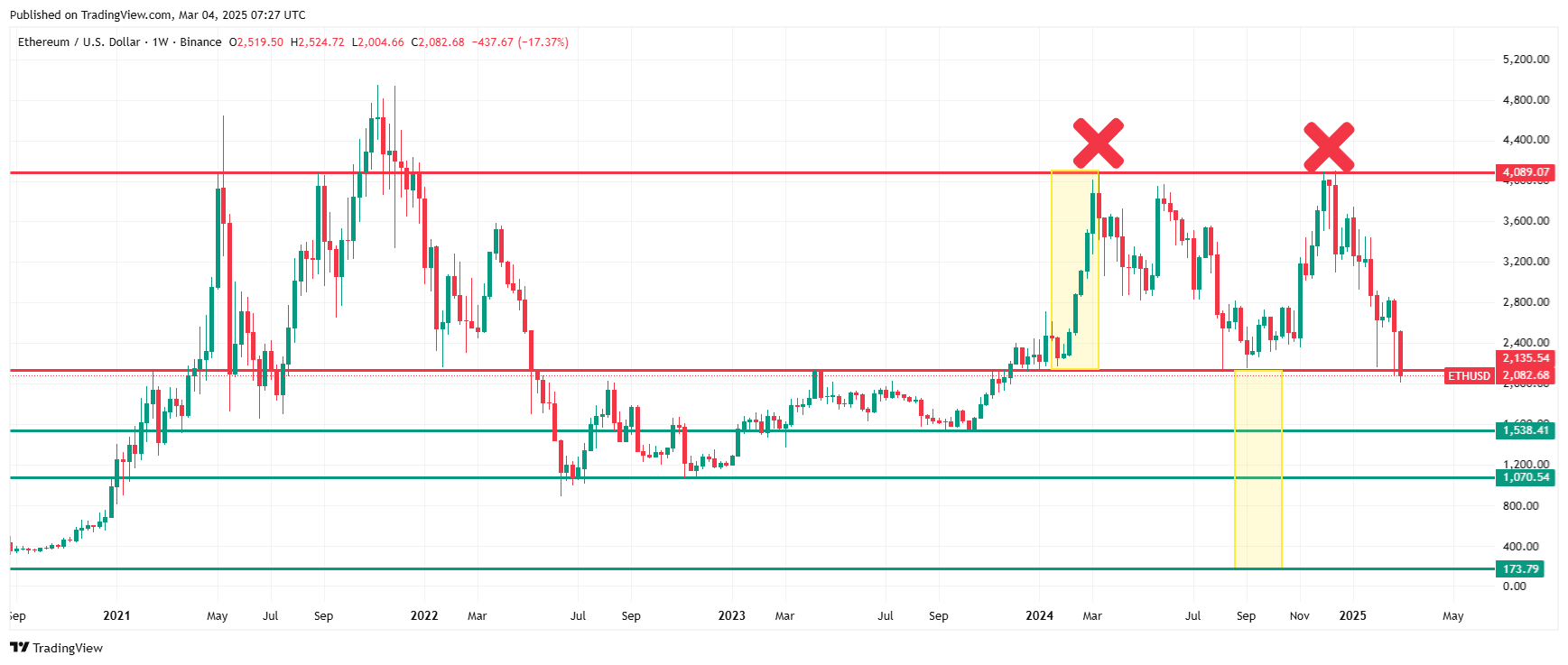
The first
support level I identified is $1540, corresponding to the lows from the second
half of 2023. The next level is around $1000–$1070, which represents the lows
from 2022 that were tested twice. The final level is the lows from 2020 at a
mere $174.
Where does
such a drastic projection—a drop of about 90% from current prices—come from? It
originates from a double-top pattern I identified on the weekly chart (with
peaks in 2024 exceeding $4000), whose lower boundary is precisely the $2000
level. Should this level break, the measured range of the pattern would be
around $174.
Will Ethereum crash? ETH/USDT technical analysis. Source: Tradingview.com
Although I
do not currently expect such a sudden crash in Ethereum—especially given its
anticipated role as a significant component of the United States’ reserves—it
is wise to keep this cautionary scenario in mind.
Ethereum Price Crash: 4 Reasons
Ethereum
has long been a cornerstone of the cryptocurrency world, known for its smart
contract functionality and decentralized applications (dApps). However, despite
its strong fundamentals, ETH has faced a series of challenges that have
contributed to its price decline. If you’ve been wondering why Ethereum is
going down, here are the primary reasons behind the slump.
1.
Macro-Economic
Pressures and Trade Tensions
One of the
biggest factors affecting Ethereum’s price today is the broader economic
climate. Global trade tensions, particularly stemming from U.S. policies under
President Trump, have rattled financial markets. Recent announcements of
tariffs on countries like Canada, Mexico, and China have sparked a risk-off
sentiment among investors. Cryptocurrencies, often viewed as high-risk assets,
tend to suffer when traditional markets turn bearish.
2.
Massive
Liquidations and Whale Activity
Another
critical reason why Ethereum is going down is the significant liquidation
events in the crypto space. Large holders, often referred to as “whales,” have
been offloading their ETH holdings, adding downward pressure on the price.
On-chain data indicates that Ethereum’s supply on centralized exchanges hit a
12-month high of 16.2 million ETH in early February, signaling heavy selling by
major players.
Furthermore,
there have been massive liquidations of long positions on leveraged markets
over the past 24 hours, amounting to $861 million in total. Of that, BTC longs
accounted for $310 million, while ETH longs were second, with $168 million.
Source: Coinglass
3.
Technical
Breakdowns and Bearish Indicators
Analysts
have pointed to bearish patterns, suggesting a potential further drop to
$1,945—or even as low as $1,200—if momentum doesn’t shift. The Moving Average
Convergence Divergence (MACD) and Relative Strength Index (RSI) also indicate
persistent bearish sentiment, providing a technical answer to Why Ethereum is
going down.
4.
Competition
and Network Challenges
Ethereum’s
dominance in the blockchain ecosystem is under threat from competitors like
Solana, which boasts faster transaction speeds and lower fees. The rise of
Layer-2 solutions, while beneficial for scaling, has also shifted activity away
from Ethereum’s base layer, reducing demand for ETH in some cases.
Moreover,
Ethereum’s shift to proof-of-stake with “The Merge” in 2022 was meant to create
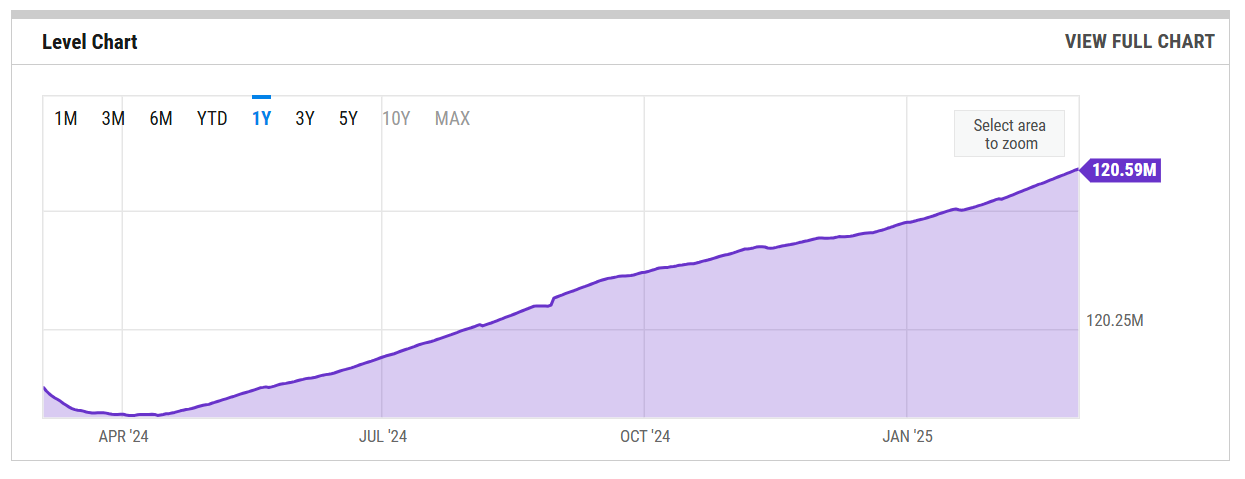
a deflationary model by burning transaction fees. However, since April 2024,
the supply has increased by 0.37%, reaching 120.59 million ETH. This
inflationary trend, coupled with lower network activity, has dampened investor
confidence.
Source: YCharts
Will Ethereum Go Up?
While
the reasons why Ethereum is going down are clear, the future isn’t
necessarily bleak. Several positive indicators suggest a potential
rebound:
Declining Exchange Reserves: Data from CryptoQuant shows a
drop in ETH held on exchanges, hinting at a shift to self-custody and
reduced selling pressure.
Institutional Interest: Despite short-term outflows,
long-term confidence in Ethereum remains, with some analysts predicting a
rally to $7,000 by the end of 2025 if adoption grows.
Proposed Upgrades: Solutions like EIP-7781 aim
to address network performance and restore Ethereum’s deflationary status,
potentially boosting sentiment.
However,
for Ethereum to recover, it must move back above critical resistance
levels—such as $2,800—and overcome macroeconomic headwinds. Investors should
keep an eye on market trends and global developments to gauge ETH’s next move.
Ethereum News, FAQ
What is happening to
Ethereum?
Ethereum is
experiencing significant volatility, with its price recently dropping to around
$2,000. This decline is influenced by macroeconomic pressures, market-wide
liquidations, and technical factors. While Ethereum briefly surged following an
announcement from former President Trump regarding a U.S. cryptocurrency
reserve, the excitement quickly faded, leading to renewed selling pressure.
Is there a future for ETH?
Yes,
Ethereum continues to have a strong future, given its role as the leading smart
contract platform. Despite short-term price fluctuations, Ethereum remains a
key player in decentralized finance (DeFi), non-fungible tokens (NFTs), and
enterprise blockchain solutions. Upcoming network upgrades, such as EIP-7781,
are expected to improve scalability and restore Ethereum’s deflationary nature,
potentially enhancing its long-term value proposition.
Can Ethereum reach
$100,000?
While
Ethereum reaching $100,000 is not impossible, it would require unprecedented
adoption and market expansion. Analysts predict more moderate targets, such as
$7,000 by the end of 2025, if institutional adoption increases and technical
improvements enhance network efficiency.
Is ETH going to recover?
Ethereum
has the potential to recover, but its price action depends on several factors,
including macroeconomic conditions, investor sentiment, and technical
resistance levels. A move above $2,800 would signal a stronger recovery, while
continued global uncertainty could keep prices suppressed.
Ethereum
(ETH), the second-largest cryptocurrency by market cap, has experienced
significant price fluctuations, leaving investors and enthusiasts asking, why
is Ethereum price down today? As of Tuesday, March 04, 2025, the crypto market
remains as volatile as ever, and Ethereum is no exception, falling to the
psychological support of $2,000.
Why Is Ethereum Falling? ETH
Price Test November 2023 Lows
At the time
of writing, Ethereum is changing hands at just under $2073, after previously
establishing a daily low at the $2000 level, testing its 16‑month lows from November 2023. This follows a highly volatile period: on
Sunday, the price rose by 14%, only to drop by 15% on Monday.
“News on a Strategic Reserve had been long anticipated. The timing on a
Sunday and at a 28 week cycle low may not be just a coincidence,” commented Paul Howard from Wincent. “The announcement makes
it likely that the US government will add to its existing holdings in a more
formal and strategic manner.”
“Throwback to what the world's largest asset manager (Blackrock) has
stated, hereby owning digital assets with 2–3% of your portfolio is now
effectively what the US government is doing. The question is which countries
will follow next and who is last on the sidelines with either an undiversified
portfolio or paying higher prices to move into the digital age.”
How Low Can Ethereum Go?
For now,
the $2000 level has been defended. However, should this support break—thus
invalidating the consolidation that has been forming since the beginning of
2024—the implications for ETH could be profoundly bearish.
The first
support level I identified is $1540, corresponding to the lows from the second
half of 2023. The next level is around $1000–$1070, which represents the lows
from 2022 that were tested twice. The final level is the lows from 2020 at a
mere $174.
Where does
such a drastic projection—a drop of about 90% from current prices—come from? It
originates from a double-top pattern I identified on the weekly chart (with
peaks in 2024 exceeding $4000), whose lower boundary is precisely the $2000
level. Should this level break, the measured range of the pattern would be
around $174.
Will Ethereum crash? ETH/USDT technical analysis. Source: Tradingview.com
Although I
do not currently expect such a sudden crash in Ethereum—especially given its
anticipated role as a significant component of the United States’ reserves—it
is wise to keep this cautionary scenario in mind.
Ethereum Price Crash: 4 Reasons
Ethereum
has long been a cornerstone of the cryptocurrency world, known for its smart
contract functionality and decentralized applications (dApps). However, despite
its strong fundamentals, ETH has faced a series of challenges that have
contributed to its price decline. If you’ve been wondering why Ethereum is
going down, here are the primary reasons behind the slump.
1.
Macro-Economic
Pressures and Trade Tensions
One of the
biggest factors affecting Ethereum’s price today is the broader economic
climate. Global trade tensions, particularly stemming from U.S. policies under
President Trump, have rattled financial markets. Recent announcements of
tariffs on countries like Canada, Mexico, and China have sparked a risk-off
sentiment among investors. Cryptocurrencies, often viewed as high-risk assets,
tend to suffer when traditional markets turn bearish.
2.
Massive
Liquidations and Whale Activity
Another
critical reason why Ethereum is going down is the significant liquidation
events in the crypto space. Large holders, often referred to as “whales,” have
been offloading their ETH holdings, adding downward pressure on the price.
On-chain data indicates that Ethereum’s supply on centralized exchanges hit a
12-month high of 16.2 million ETH in early February, signaling heavy selling by
major players.
Furthermore,
there have been massive liquidations of long positions on leveraged markets
over the past 24 hours, amounting to $861 million in total. Of that, BTC longs
accounted for $310 million, while ETH longs were second, with $168 million.
Source: Coinglass
3.
Technical
Breakdowns and Bearish Indicators
Analysts
have pointed to bearish patterns, suggesting a potential further drop to
$1,945—or even as low as $1,200—if momentum doesn’t shift. The Moving Average
Convergence Divergence (MACD) and Relative Strength Index (RSI) also indicate
persistent bearish sentiment, providing a technical answer to Why Ethereum is
going down.
4.
Competition
and Network Challenges
Ethereum’s
dominance in the blockchain ecosystem is under threat from competitors like
Solana, which boasts faster transaction speeds and lower fees. The rise of
Layer-2 solutions, while beneficial for scaling, has also shifted activity away
from Ethereum’s base layer, reducing demand for ETH in some cases.
Moreover,
Ethereum’s shift to proof-of-stake with “The Merge” in 2022 was meant to create
a deflationary model by burning transaction fees. However, since April 2024,
the supply has increased by 0.37%, reaching 120.59 million ETH. This
inflationary trend, coupled with lower network activity, has dampened investor
confidence.
Source: YCharts
Will Ethereum Go Up?
While
the reasons why Ethereum is going down are clear, the future isn’t
necessarily bleak. Several positive indicators suggest a potential
rebound:
Declining Exchange Reserves: Data from CryptoQuant shows a
drop in ETH held on exchanges, hinting at a shift to self-custody and
reduced selling pressure.
Institutional Interest: Despite short-term outflows,
long-term confidence in Ethereum remains, with some analysts predicting a
rally to $7,000 by the end of 2025 if adoption grows.
Proposed Upgrades: Solutions like EIP-7781 aim
to address network performance and restore Ethereum’s deflationary status,
potentially boosting sentiment.
However,
for Ethereum to recover, it must move back above critical resistance
levels—such as $2,800—and overcome macroeconomic headwinds. Investors should
keep an eye on market trends and global developments to gauge ETH’s next move.
Ethereum News, FAQ
What is happening to
Ethereum?
Ethereum is
experiencing significant volatility, with its price recently dropping to around
$2,000. This decline is influenced by macroeconomic pressures, market-wide
liquidations, and technical factors. While Ethereum briefly surged following an
announcement from former President Trump regarding a U.S. cryptocurrency
reserve, the excitement quickly faded, leading to renewed selling pressure.
Is there a future for ETH?
Yes,
Ethereum continues to have a strong future, given its role as the leading smart
contract platform. Despite short-term price fluctuations, Ethereum remains a
key player in decentralized finance (DeFi), non-fungible tokens (NFTs), and
enterprise blockchain solutions. Upcoming network upgrades, such as EIP-7781,
are expected to improve scalability and restore Ethereum’s deflationary nature,
potentially enhancing its long-term value proposition.
Can Ethereum reach
$100,000?
While
Ethereum reaching $100,000 is not impossible, it would require unprecedented
adoption and market expansion. Analysts predict more moderate targets, such as
$7,000 by the end of 2025, if institutional adoption increases and technical
improvements enhance network efficiency.
Is ETH going to recover?
Ethereum
has the potential to recover, but its price action depends on several factors,
including macroeconomic conditions, investor sentiment, and technical
resistance levels. A move above $2,800 would signal a stronger recovery, while
continued global uncertainty could keep prices suppressed.
Damian Chmiel is a Senior Analyst & Editor at Finance Magnates with more than 15 years of experience in the CFD and online trading industry. Active as both a trader and journalist since 2010, he focuses on broker coverage, fintech innovation, and regulatory developments across Europe, the Middle East, and Asia.
His work includes interviews with C-level leaders at major brokerages and fintech platforms, as well as co-authoring Finance Magnates’ quarterly industry benchmarking reports. Damian’s reporting is data-driven, market-aware, and grounded in direct industry engagement. His analysis and commentary have also been cited by external media outlets, including Investing.com, Binance, The Asset, Stockhead, and Dispatch.
Education:
MA in Finance and Accounting, Cracow University of Economics
Kraken Steps Up Speed Race with New Equinix Colocation Service for Crypto Traders
FP Markets Winner Spotlight 🏆 | Global Broker of the Year 2025 #Trading #Broker #Innovation #Shorts
FP Markets Winner Spotlight 🏆 | Global Broker of the Year 2025 #Trading #Broker #Innovation #Shorts
FP Markets takes the spotlight as Global Broker of the Year 2025 at the Finance Magnates Awards.
Martin Stoilov, Head of Client Experience, shares that trust, innovation, and people played a key role in the company’s success, supported by a strong foundation of integrity and client-centricity.
Following this milestone, FP Markets continues to focus on growth, technology investment, and its core values of transparency and excellence.
👉 Be part of FM Awards 2026: https://awards.financemagnates.com/#nominate
FP Markets takes the spotlight as Global Broker of the Year 2025 at the Finance Magnates Awards.
Martin Stoilov, Head of Client Experience, shares that trust, innovation, and people played a key role in the company’s success, supported by a strong foundation of integrity and client-centricity.
Following this milestone, FP Markets continues to focus on growth, technology investment, and its core values of transparency and excellence.
👉 Be part of FM Awards 2026: https://awards.financemagnates.com/#nominate
In this video, we review @HolaPrimeMarketsOfficial, a multi-asset forex and CFDs broker offering different account types, trading platforms, and flexible trading conditions.
We cover the broker’s overall offering, including account options, trading environment, platforms like MT4 and MT5, and additional services such as managed accounts and fast withdrawals.
Watch the full video to see if Hola Prime Markets fits your trading needs.
📣 Stay up to date with the latest in finance and trading. Follow Finance Magnates for industry news, insights, and global event coverage.
Connect with us:
🔗 LinkedIn: /financemagnates
👍 Facebook: /financemagnates
📸 Instagram: https://www.instagram.com/financemagnates
🐦 X: https://x.com/financemagnates
🎥 TikTok: https://www.tiktok.com/tag/financemagnates
▶️ YouTube: /@financemagnates_official
#HolaPrime #ForexBroker #CFDTrading #FinanceMagnates #Trading #Forex #BrokerReview
In this video, we review @HolaPrimeMarketsOfficial, a multi-asset forex and CFDs broker offering different account types, trading platforms, and flexible trading conditions.
We cover the broker’s overall offering, including account options, trading environment, platforms like MT4 and MT5, and additional services such as managed accounts and fast withdrawals.
Watch the full video to see if Hola Prime Markets fits your trading needs.
📣 Stay up to date with the latest in finance and trading. Follow Finance Magnates for industry news, insights, and global event coverage.
Connect with us:
🔗 LinkedIn: /financemagnates
👍 Facebook: /financemagnates
📸 Instagram: https://www.instagram.com/financemagnates
🐦 X: https://x.com/financemagnates
🎥 TikTok: https://www.tiktok.com/tag/financemagnates
▶️ YouTube: /@financemagnates_official
#HolaPrime #ForexBroker #CFDTrading #FinanceMagnates #Trading #Forex #BrokerReview
Hola Prime Review: What You Need to Know | Full Breakdown by Finance Magnates
Hola Prime Review: What You Need to Know | Full Breakdown by Finance Magnates
In this video, we review @HolaPrime_Global, a proprietary trading firm offering evaluation programs and performance-based payouts in simulated market environments.
We cover how the challenge model works, including account types, profit splits (up to 95%), trading rules, and what it takes to reach a funded account. You’ll also learn about available platforms like MT4, MT5, cTrader, and more, along with insights into payouts, support, and trading conditions.
Watch the full video to see if Hola Prime fits your trading style.
📣 Stay up to date with the latest in finance and trading. Follow Finance Magnates for industry news, insights, and global event coverage.
Connect with us:
🔗 LinkedIn: /financemagnates
👍 Facebook: /financemagnates
📸 Instagram: https://www.instagram.com/financemagnates
🐦 X: https://x.com/financemagnates
🎥 TikTok: https://www.tiktok.com/tag/financemagnates
▶️ YouTube: /@financemagnates_official
#HolaPrime #PropFirm #Trading #FinanceMagnates #Forex #FuturesTrading #TradingReview #PropFirmReview
In this video, we review @HolaPrime_Global, a proprietary trading firm offering evaluation programs and performance-based payouts in simulated market environments.
We cover how the challenge model works, including account types, profit splits (up to 95%), trading rules, and what it takes to reach a funded account. You’ll also learn about available platforms like MT4, MT5, cTrader, and more, along with insights into payouts, support, and trading conditions.
Watch the full video to see if Hola Prime fits your trading style.
📣 Stay up to date with the latest in finance and trading. Follow Finance Magnates for industry news, insights, and global event coverage.
Connect with us:
🔗 LinkedIn: /financemagnates
👍 Facebook: /financemagnates
📸 Instagram: https://www.instagram.com/financemagnates
🐦 X: https://x.com/financemagnates
🎥 TikTok: https://www.tiktok.com/tag/financemagnates
▶️ YouTube: /@financemagnates_official
#HolaPrime #PropFirm #Trading #FinanceMagnates #Forex #FuturesTrading #TradingReview #PropFirmReview
Axi Winner Spotlight 🏆 | Global Most Innovative Broker 2025 #Innovation #Trading #Fintech #Broker
Axi Winner Spotlight 🏆 | Global Most Innovative Broker 2025 #Innovation #Trading #Fintech #Broker
Axi takes the spotlight at the Finance Magnates Awards, winning Global Most Innovative Broker 2025.
Olivia Xenofontos and Ivanna Openko share how the team will feel: proud, motivated, and ready to keep delivering.
They also describe the night as well-organized, focused, and enjoyable for all.
👉 Be part of FM Awards 2026.
Axi takes the spotlight at the Finance Magnates Awards, winning Global Most Innovative Broker 2025.
Olivia Xenofontos and Ivanna Openko share how the team will feel: proud, motivated, and ready to keep delivering.
They also describe the night as well-organized, focused, and enjoyable for all.
👉 Be part of FM Awards 2026.
Recognition that matters.
Built on transparency.
Driven by the industry.
The Finance Magnates Awards 2026.
Nominations are now open.
🔗 https://awards.financemagnates.com/?utm_source=SM&utm_medium=social&utm_campaign=recognition-matters
Recognition that matters.
Built on transparency.
Driven by the industry.
The Finance Magnates Awards 2026.
Nominations are now open.
🔗 https://awards.financemagnates.com/?utm_source=SM&utm_medium=social&utm_campaign=recognition-matters