Double-digit declines to multi-month lows hit all miners, with the worst performer losing 30%.
This is driven by weaker 2024 financial results but, more importantly, Bitcoin’s falling price.
BTC dropped to just $86,000, breaking key support levels. Analysts predict a further decline may occur soon.
Why is Bitcoin going down?
Shares of
major publicly listed Bitcoin (BTC) mining companies tumbled this week as the
oldest cryptocurrency continued its retreat below the critical $90,000
threshold. Widening net losses and increasing competition led the worst-performing stock to lose nearly 30% in a single day.
Industry
leaders were also unable to resist the negative trend, as the index tracking
the condition of BTC
mining stocks dropped to its lowest levels since September 2024.
Wall Street Bitcoin Miners
Net Losses Intensify
Cipher
Mining Inc. (NASDAQ: CIFR) shares declined despite reporting fourth-quarter net
earnings of $18 million, or $0.05 per diluted share. The company's adjusted
earnings reached $51 million ($0.14 per diluted share), but investors appeared
more focused on longer-term concerns about profitability as Bitcoin's price
fluctuations continue to impact mining economics.
Tyler Page, CEO of of Ciper Mining
“We
had an extremely productive fourth quarter at Cipher, as we continued the
on-time execution of our growth and expansion plans,” said Tyler Page, CEO
of Cipher Mining, highlighting the company's increased hashrate to
approximately 13.5 EH/s following upgrades to its Odessa fleet.
However,
the net result interests shareholders the most, which turned out to be worse
than last year. The loss deepened to nearly $45 million, up from just under $26
million reported a year earlier.
Meanwhile,
Bitdeer Technologies Group (NASDAQ: BTDR) faced steeper declines after
reporting more disappointing numbers. The Singapore-based blockchain and
high-performance computing company posted a substantial net loss of $599.2
million for 2024, compared to $56,7 million. Total revenue dropped to $349.8
million from $368.5 million year-over-year.
Matt Kong, Chief Business Officer at Bitdeer
“Last
year, we strategically prioritized resources to the development of our
proprietary ASIC technology, which temporarily limited our hashrate growth and
impacted our financial performance,” Matt Kong, Chief Business Officer at
Bitdeer, commented.
Wall Street Reacts with
Declines to Miners' Earnings and Bitcoin Price
In stark
investors' reaction, Bitdeer shares dropped 29% on Nasdaq during Tuesday’s
session, closing at $9.26 and testing their lowest levels in three months.
Cipher Mining fell more than 17% in response to its latest report, declining to
$4.10 and reaching a four-month low.
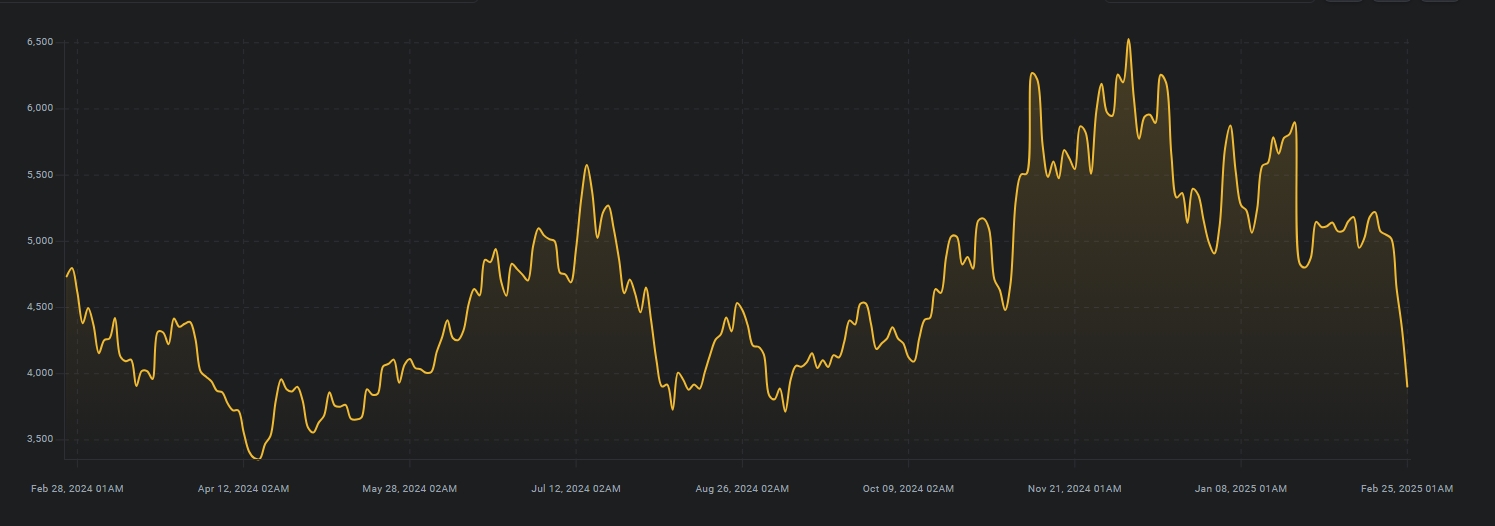
BITDR vs. CIFR vs. BTC price. Source: Tradingview.com
The decline
extended across the entire sector, not just companies releasing new financial
results. A notable example is MARA (NASDAQ: MARA), the largest publicly traded
miner on Wall Street by market cap, whose shares fell 11% to $12.42, their
lowest since November 2023.
Among the
steepest decliners were Canaan (NASDAQ: CAN), which dropped 17% to $1.29, and
IREN (NASDAQ: IREN), down 13.6% to $8.78.
This
highlights that, for many investors, mining stocks remain an indirect way to
gain exposure to Bitcoin on regulated exchanges, with their prices closely
tracking Bitcoin’s movements.
Shares of
major publicly listed Bitcoin (BTC) mining companies tumbled this week as the
oldest cryptocurrency continued its retreat below the critical $90,000
threshold. Widening net losses and increasing competition led the worst-performing stock to lose nearly 30% in a single day.
Industry
leaders were also unable to resist the negative trend, as the index tracking
the condition of BTC
mining stocks dropped to its lowest levels since September 2024.
Wall Street Bitcoin Miners
Net Losses Intensify
Cipher
Mining Inc. (NASDAQ: CIFR) shares declined despite reporting fourth-quarter net
earnings of $18 million, or $0.05 per diluted share. The company's adjusted
earnings reached $51 million ($0.14 per diluted share), but investors appeared
more focused on longer-term concerns about profitability as Bitcoin's price
fluctuations continue to impact mining economics.
Tyler Page, CEO of of Ciper Mining
“We
had an extremely productive fourth quarter at Cipher, as we continued the
on-time execution of our growth and expansion plans,” said Tyler Page, CEO
of Cipher Mining, highlighting the company's increased hashrate to
approximately 13.5 EH/s following upgrades to its Odessa fleet.
However,
the net result interests shareholders the most, which turned out to be worse
than last year. The loss deepened to nearly $45 million, up from just under $26
million reported a year earlier.
Meanwhile,
Bitdeer Technologies Group (NASDAQ: BTDR) faced steeper declines after
reporting more disappointing numbers. The Singapore-based blockchain and
high-performance computing company posted a substantial net loss of $599.2
million for 2024, compared to $56,7 million. Total revenue dropped to $349.8
million from $368.5 million year-over-year.
Matt Kong, Chief Business Officer at Bitdeer
“Last
year, we strategically prioritized resources to the development of our
proprietary ASIC technology, which temporarily limited our hashrate growth and
impacted our financial performance,” Matt Kong, Chief Business Officer at
Bitdeer, commented.
Wall Street Reacts with
Declines to Miners' Earnings and Bitcoin Price
In stark
investors' reaction, Bitdeer shares dropped 29% on Nasdaq during Tuesday’s
session, closing at $9.26 and testing their lowest levels in three months.
Cipher Mining fell more than 17% in response to its latest report, declining to
$4.10 and reaching a four-month low.
BITDR vs. CIFR vs. BTC price. Source: Tradingview.com
The decline
extended across the entire sector, not just companies releasing new financial
results. A notable example is MARA (NASDAQ: MARA), the largest publicly traded
miner on Wall Street by market cap, whose shares fell 11% to $12.42, their
lowest since November 2023.
Among the
steepest decliners were Canaan (NASDAQ: CAN), which dropped 17% to $1.29, and
IREN (NASDAQ: IREN), down 13.6% to $8.78.
This
highlights that, for many investors, mining stocks remain an indirect way to
gain exposure to Bitcoin on regulated exchanges, with their prices closely
tracking Bitcoin’s movements.
Damian Chmiel is a Senior Analyst & Editor at Finance Magnates with more than 15 years of experience in the CFD and online trading industry. Active as both a trader and journalist since 2010, he focuses on broker coverage, fintech innovation, and regulatory developments across Europe, the Middle East, and Asia.
His work includes interviews with C-level leaders at major brokerages and fintech platforms, as well as co-authoring Finance Magnates’ quarterly industry benchmarking reports. Damian’s reporting is data-driven, market-aware, and grounded in direct industry engagement. His analysis and commentary have also been cited by external media outlets, including Investing.com, Binance, The Asset, Stockhead, and Dispatch.
Education:
MA in Finance and Accounting, Cracow University of Economics
Kraken Steps Up Speed Race with New Equinix Colocation Service for Crypto Traders
FP Markets Winner Spotlight 🏆 | Global Broker of the Year 2025 #Trading #Broker #Innovation #Shorts
FP Markets Winner Spotlight 🏆 | Global Broker of the Year 2025 #Trading #Broker #Innovation #Shorts
FP Markets takes the spotlight as Global Broker of the Year 2025 at the Finance Magnates Awards.
Martin Stoilov, Head of Client Experience, shares that trust, innovation, and people played a key role in the company’s success, supported by a strong foundation of integrity and client-centricity.
Following this milestone, FP Markets continues to focus on growth, technology investment, and its core values of transparency and excellence.
👉 Be part of FM Awards 2026: https://awards.financemagnates.com/#nominate
FP Markets takes the spotlight as Global Broker of the Year 2025 at the Finance Magnates Awards.
Martin Stoilov, Head of Client Experience, shares that trust, innovation, and people played a key role in the company’s success, supported by a strong foundation of integrity and client-centricity.
Following this milestone, FP Markets continues to focus on growth, technology investment, and its core values of transparency and excellence.
👉 Be part of FM Awards 2026: https://awards.financemagnates.com/#nominate
In this video, we review @HolaPrimeMarketsOfficial, a multi-asset forex and CFDs broker offering different account types, trading platforms, and flexible trading conditions.
We cover the broker’s overall offering, including account options, trading environment, platforms like MT4 and MT5, and additional services such as managed accounts and fast withdrawals.
Watch the full video to see if Hola Prime Markets fits your trading needs.
📣 Stay up to date with the latest in finance and trading. Follow Finance Magnates for industry news, insights, and global event coverage.
Connect with us:
🔗 LinkedIn: /financemagnates
👍 Facebook: /financemagnates
📸 Instagram: https://www.instagram.com/financemagnates
🐦 X: https://x.com/financemagnates
🎥 TikTok: https://www.tiktok.com/tag/financemagnates
▶️ YouTube: /@financemagnates_official
#HolaPrime #ForexBroker #CFDTrading #FinanceMagnates #Trading #Forex #BrokerReview
In this video, we review @HolaPrimeMarketsOfficial, a multi-asset forex and CFDs broker offering different account types, trading platforms, and flexible trading conditions.
We cover the broker’s overall offering, including account options, trading environment, platforms like MT4 and MT5, and additional services such as managed accounts and fast withdrawals.
Watch the full video to see if Hola Prime Markets fits your trading needs.
📣 Stay up to date with the latest in finance and trading. Follow Finance Magnates for industry news, insights, and global event coverage.
Connect with us:
🔗 LinkedIn: /financemagnates
👍 Facebook: /financemagnates
📸 Instagram: https://www.instagram.com/financemagnates
🐦 X: https://x.com/financemagnates
🎥 TikTok: https://www.tiktok.com/tag/financemagnates
▶️ YouTube: /@financemagnates_official
#HolaPrime #ForexBroker #CFDTrading #FinanceMagnates #Trading #Forex #BrokerReview
Hola Prime Review: What You Need to Know | Full Breakdown by Finance Magnates
Hola Prime Review: What You Need to Know | Full Breakdown by Finance Magnates
In this video, we review @HolaPrime_Global, a proprietary trading firm offering evaluation programs and performance-based payouts in simulated market environments.
We cover how the challenge model works, including account types, profit splits (up to 95%), trading rules, and what it takes to reach a funded account. You’ll also learn about available platforms like MT4, MT5, cTrader, and more, along with insights into payouts, support, and trading conditions.
Watch the full video to see if Hola Prime fits your trading style.
📣 Stay up to date with the latest in finance and trading. Follow Finance Magnates for industry news, insights, and global event coverage.
Connect with us:
🔗 LinkedIn: /financemagnates
👍 Facebook: /financemagnates
📸 Instagram: https://www.instagram.com/financemagnates
🐦 X: https://x.com/financemagnates
🎥 TikTok: https://www.tiktok.com/tag/financemagnates
▶️ YouTube: /@financemagnates_official
#HolaPrime #PropFirm #Trading #FinanceMagnates #Forex #FuturesTrading #TradingReview #PropFirmReview
In this video, we review @HolaPrime_Global, a proprietary trading firm offering evaluation programs and performance-based payouts in simulated market environments.
We cover how the challenge model works, including account types, profit splits (up to 95%), trading rules, and what it takes to reach a funded account. You’ll also learn about available platforms like MT4, MT5, cTrader, and more, along with insights into payouts, support, and trading conditions.
Watch the full video to see if Hola Prime fits your trading style.
📣 Stay up to date with the latest in finance and trading. Follow Finance Magnates for industry news, insights, and global event coverage.
Connect with us:
🔗 LinkedIn: /financemagnates
👍 Facebook: /financemagnates
📸 Instagram: https://www.instagram.com/financemagnates
🐦 X: https://x.com/financemagnates
🎥 TikTok: https://www.tiktok.com/tag/financemagnates
▶️ YouTube: /@financemagnates_official
#HolaPrime #PropFirm #Trading #FinanceMagnates #Forex #FuturesTrading #TradingReview #PropFirmReview
Axi Winner Spotlight 🏆 | Global Most Innovative Broker 2025 #Innovation #Trading #Fintech #Broker
Axi Winner Spotlight 🏆 | Global Most Innovative Broker 2025 #Innovation #Trading #Fintech #Broker
Axi takes the spotlight at the Finance Magnates Awards, winning Global Most Innovative Broker 2025.
Olivia Xenofontos and Ivanna Openko share how the team will feel: proud, motivated, and ready to keep delivering.
They also describe the night as well-organized, focused, and enjoyable for all.
👉 Be part of FM Awards 2026.
Axi takes the spotlight at the Finance Magnates Awards, winning Global Most Innovative Broker 2025.
Olivia Xenofontos and Ivanna Openko share how the team will feel: proud, motivated, and ready to keep delivering.
They also describe the night as well-organized, focused, and enjoyable for all.
👉 Be part of FM Awards 2026.
Recognition that matters.
Built on transparency.
Driven by the industry.
The Finance Magnates Awards 2026.
Nominations are now open.
🔗 https://awards.financemagnates.com/?utm_source=SM&utm_medium=social&utm_campaign=recognition-matters
Recognition that matters.
Built on transparency.
Driven by the industry.
The Finance Magnates Awards 2026.
Nominations are now open.
🔗 https://awards.financemagnates.com/?utm_source=SM&utm_medium=social&utm_campaign=recognition-matters