Iris Energy faces a class action lawsuit for allegedly misrepresenting its data center capabilities for high-performance computing.
The lawsuit claims the company overstated its prospects and facilities' suitability for AI applications.
Iris Energy
Limited, the publicly listed Wall Street Bitcoin (BTC) mining company (NASDAQ:
IREN) that recently pivoted to promoting itself as a high-performance computing
(HPC) data center operator, is facing a class action lawsuit alleging it
misrepresented its capabilities and prospects to investors.
Wall Street Bitcoin Miner Faces
Lawsuit over Alleged Misrepresentation of Data Center Capabilities
The
lawsuit, filed
in the United States District Court for the Eastern District of New York,
claims that Iris Energy and its executives made false and misleading statements
about the company's ability to transition its facilities from Bitcoin mining to
HPC and artificial intelligence applications.
According
to the complaint, Iris Energy's Childress, Texas facility, which the company
touted as a key asset for its HPC strategy, lacks critical features necessary
for such operations. The lawsuit alleges that the site has inadequate power
redundancy, cooling systems, and fiber connectivity.
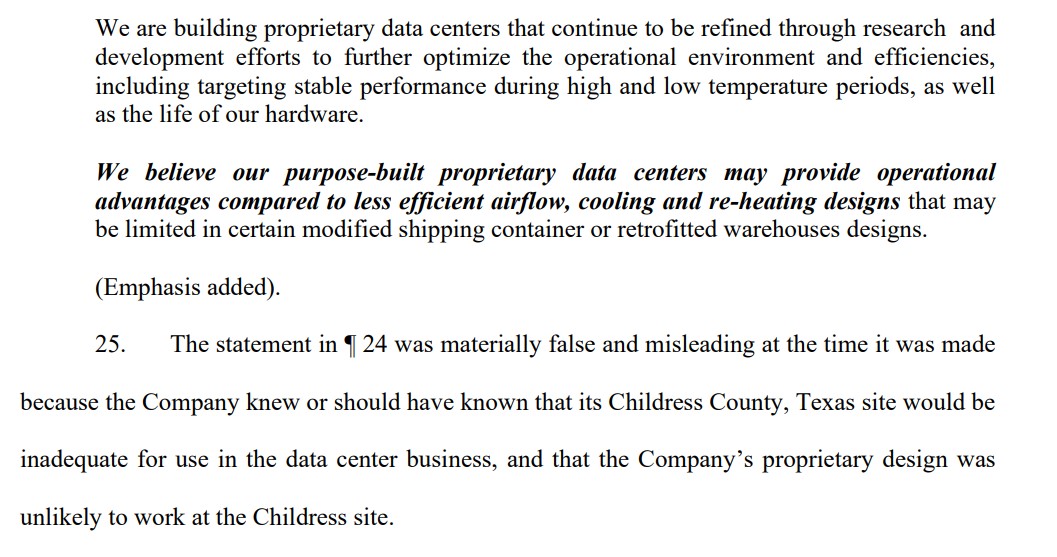
The accusers suggest that Iren's statements were allegedly untrue. Source: Courtlistener.com
The lawsuit
also cites statements made by Iris Energy's co-CEO, Daniel Roberts, who claimed
the company had “built this base layer, this bedrock of high-performance
data centers that can do any high-performance compute.” The plaintiffs
argue that these statements were materially false and misleading, “because the
Company overstated the capabilities of its data center business and its
overall prospects.”
Iris
Energy's stock price fell approximately 15% following the publication of a
critical report by Culper Research, which raised concerns about the company's
HPC claims and the suitability of its facilities for such applications.
“Culper
further stated that it was ‘short IREN because we believe the Company has
dramatically misrepresented the strength and potential of its assets for HPC/AI
Applications’,” the lawsuit commented.
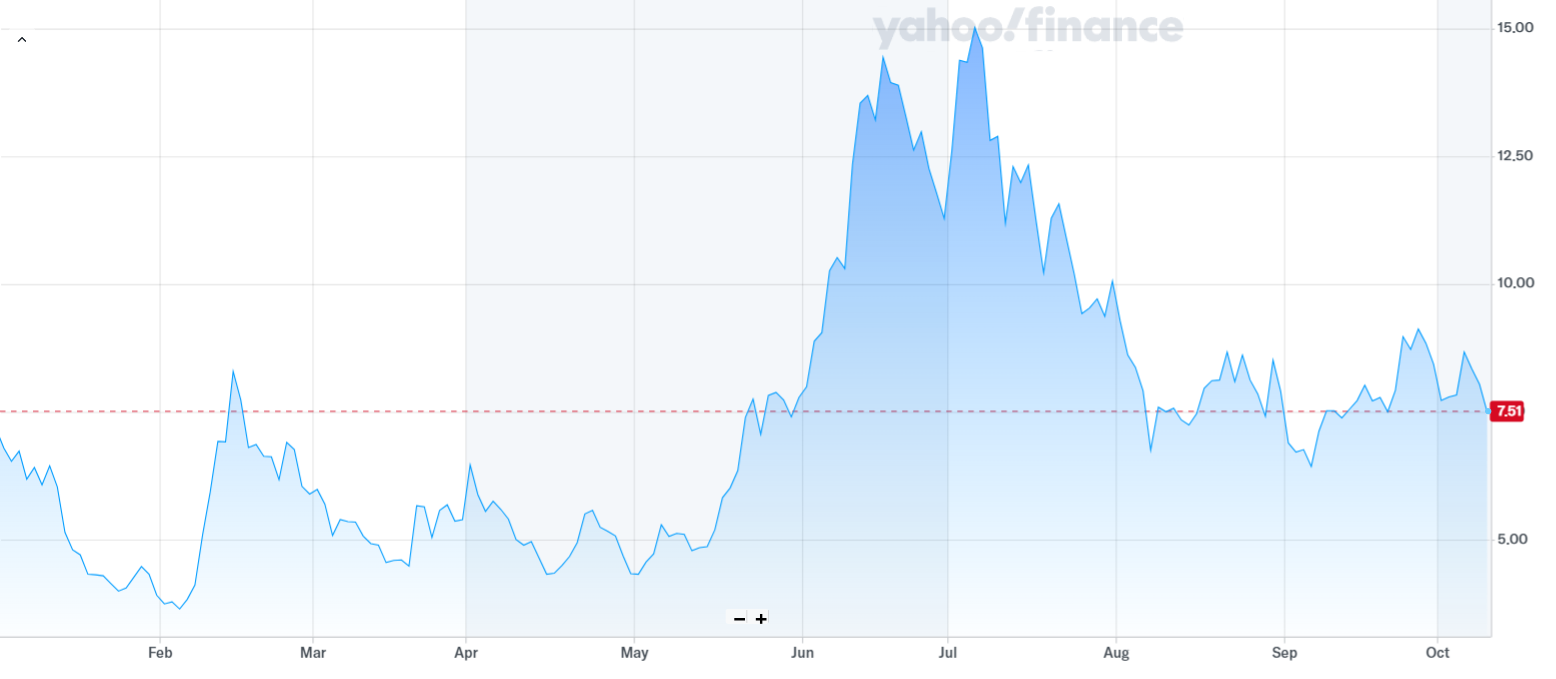
IREN shares are falling more than 50% from the July 2024 highs. Source: Yahoo Finance
The class
action seeks to recover damages on behalf of investors who purchased Iris
Energy securities between June 20, 2023, and July 11, 2024, alleging violations
of federal securities laws.
Bitcoin Miners from Wall
Street Pivot to AI
IREN's
shift towards AI is driven by increasingly challenging conditions in the
cryptocurrency mining market. The company's latest fiscal year 2024 report
revealed that by adding AI industry support services to its offerings, IREN
managed to secure new revenue streams. Although the net loss still amounted to
$29 million, it was six times smaller than the previous year.
Finance
Magnatesreported in
2023 that after a tough 2022, cryptocurrency miners began seriously looking
towards AI and HPC, which are highly energy-intensive industries.
VanEck's head of digital assets research, Matthew Sigel
An August report from VanEck this year confirmed this trend. According to Matthew Sigel,
VanEck's head of digital assets research, the pivot from BTC to HPC/AI could
unlock $38 billion in value for mining companies by 2027.
“AI
companies need energy, and Bitcoin miners have it,” Sigel commented.
“As the market values the growing AI/HPC data center market, access to
power—especially in the near term—is commanding a premium.”
Examples of
such moves have been visible since last year. For instance, HIVE Blockchain
changed its name to HIVE Digital to better reflect the evolving nature of its
business, which now focuses not only on BTC mining but also on supporting HPC
and AI industries. The company expects this new venture to double its revenue
and has announced the construction of a new hydroelectric data center to
support this goal.
Iris Energy
Limited, the publicly listed Wall Street Bitcoin (BTC) mining company (NASDAQ:
IREN) that recently pivoted to promoting itself as a high-performance computing
(HPC) data center operator, is facing a class action lawsuit alleging it
misrepresented its capabilities and prospects to investors.
Wall Street Bitcoin Miner Faces
Lawsuit over Alleged Misrepresentation of Data Center Capabilities
The
lawsuit, filed
in the United States District Court for the Eastern District of New York,
claims that Iris Energy and its executives made false and misleading statements
about the company's ability to transition its facilities from Bitcoin mining to
HPC and artificial intelligence applications.
According
to the complaint, Iris Energy's Childress, Texas facility, which the company
touted as a key asset for its HPC strategy, lacks critical features necessary
for such operations. The lawsuit alleges that the site has inadequate power
redundancy, cooling systems, and fiber connectivity.
The accusers suggest that Iren's statements were allegedly untrue. Source: Courtlistener.com
The lawsuit
also cites statements made by Iris Energy's co-CEO, Daniel Roberts, who claimed
the company had “built this base layer, this bedrock of high-performance
data centers that can do any high-performance compute.” The plaintiffs
argue that these statements were materially false and misleading, “because the
Company overstated the capabilities of its data center business and its
overall prospects.”
Iris
Energy's stock price fell approximately 15% following the publication of a
critical report by Culper Research, which raised concerns about the company's
HPC claims and the suitability of its facilities for such applications.
“Culper
further stated that it was ‘short IREN because we believe the Company has
dramatically misrepresented the strength and potential of its assets for HPC/AI
Applications’,” the lawsuit commented.
IREN shares are falling more than 50% from the July 2024 highs. Source: Yahoo Finance
The class
action seeks to recover damages on behalf of investors who purchased Iris
Energy securities between June 20, 2023, and July 11, 2024, alleging violations
of federal securities laws.
Bitcoin Miners from Wall
Street Pivot to AI
IREN's
shift towards AI is driven by increasingly challenging conditions in the
cryptocurrency mining market. The company's latest fiscal year 2024 report
revealed that by adding AI industry support services to its offerings, IREN
managed to secure new revenue streams. Although the net loss still amounted to
$29 million, it was six times smaller than the previous year.
Finance
Magnatesreported in
2023 that after a tough 2022, cryptocurrency miners began seriously looking
towards AI and HPC, which are highly energy-intensive industries.
VanEck's head of digital assets research, Matthew Sigel
An August report from VanEck this year confirmed this trend. According to Matthew Sigel,
VanEck's head of digital assets research, the pivot from BTC to HPC/AI could
unlock $38 billion in value for mining companies by 2027.
“AI
companies need energy, and Bitcoin miners have it,” Sigel commented.
“As the market values the growing AI/HPC data center market, access to
power—especially in the near term—is commanding a premium.”
Examples of
such moves have been visible since last year. For instance, HIVE Blockchain
changed its name to HIVE Digital to better reflect the evolving nature of its
business, which now focuses not only on BTC mining but also on supporting HPC
and AI industries. The company expects this new venture to double its revenue
and has announced the construction of a new hydroelectric data center to
support this goal.
Damian Chmiel is a Senior Analyst & Editor at Finance Magnates with more than 15 years of experience in the CFD and online trading industry. Active as both a trader and journalist since 2010, he focuses on broker coverage, fintech innovation, and regulatory developments across Europe, the Middle East, and Asia.
His work includes interviews with C-level leaders at major brokerages and fintech platforms, as well as co-authoring Finance Magnates’ quarterly industry benchmarking reports. Damian’s reporting is data-driven, market-aware, and grounded in direct industry engagement. His analysis and commentary have also been cited by external media outlets, including Investing.com, Binance, The Asset, Stockhead, and Dispatch.
Education:
MA in Finance and Accounting, Cracow University of Economics
CMC Markets’ Artur Delijergijevs on Metals Demand, Volatility, & Stable Execution
CMC Markets’ Artur Delijergijevs on Metals Demand, Volatility, & Stable Execution
In this exclusive Executive Interview, Finance Magnates speaks with Artur Delijergijevs, Head of Systematic Market Making at CMC Markets, about the current state of metals demand and market volatility.
Delijergijevs offers a desk-level view on:
- Metals Demand: Why metals are seeing the strongest demand from both retail and institutional clients right now.
- The Safe-Haven Debate: Questioning whether gold still fits the classic safe-haven definition given large daily price movements.
- Volatile Market Prep: How a market-making desk prepares its systems and pricing for stressed market conditions and high-impact economic events.
- Hybrid Execution: Why the best execution model combines electronic speed with human relationship support, especially during volatility.
- AI in Workflow: Where CMC Markets is integrating machine learning for risk management and pricing, and the limitations of AI during stressed markets.
- Dubai's Role: The strategic importance of Dubai’s location for covering global trading sessions across Asia, Europe, and the US.
Watch to understand how CMC Markets maintains stable pricing and reliable execution quality in high-volatility environments.
#CMCmarkets #forex #metals #gold #trading #volatility #MarketMaking #iFXDubai #FinanceMagnates #Finance #Fintech #Execution #AlgorithmicTrading #RiskManagement
In this exclusive Executive Interview, Finance Magnates speaks with Artur Delijergijevs, Head of Systematic Market Making at CMC Markets, about the current state of metals demand and market volatility.
Delijergijevs offers a desk-level view on:
- Metals Demand: Why metals are seeing the strongest demand from both retail and institutional clients right now.
- The Safe-Haven Debate: Questioning whether gold still fits the classic safe-haven definition given large daily price movements.
- Volatile Market Prep: How a market-making desk prepares its systems and pricing for stressed market conditions and high-impact economic events.
- Hybrid Execution: Why the best execution model combines electronic speed with human relationship support, especially during volatility.
- AI in Workflow: Where CMC Markets is integrating machine learning for risk management and pricing, and the limitations of AI during stressed markets.
- Dubai's Role: The strategic importance of Dubai’s location for covering global trading sessions across Asia, Europe, and the US.
Watch to understand how CMC Markets maintains stable pricing and reliable execution quality in high-volatility environments.
#CMCmarkets #forex #metals #gold #trading #volatility #MarketMaking #iFXDubai #FinanceMagnates #Finance #Fintech #Execution #AlgorithmicTrading #RiskManagement
Finance Magnates Awards 2026 – Nominations Now Open
Finance Magnates Awards 2026 – Nominations Now Open
The Finance Magnates Awards 2026 nominations are now open. 🏆
From fintech innovators to leading brokers, this is where the finance industry celebrates its biggest achievements.
Winners will be announced at the Cyprus Gala Dinner on November 6, 2026.
Nominate your brand now.
https://awards.financemagnates.com/?utm_source=linkedin&utm_medium=video&utm_campaign=nominations-open
#FMAwards #FinanceMagnates #FintechAwards #Fintech #FinanceIndustry
The Finance Magnates Awards 2026 nominations are now open. 🏆
From fintech innovators to leading brokers, this is where the finance industry celebrates its biggest achievements.
Winners will be announced at the Cyprus Gala Dinner on November 6, 2026.
Nominate your brand now.
https://awards.financemagnates.com/?utm_source=linkedin&utm_medium=video&utm_campaign=nominations-open
#FMAwards #FinanceMagnates #FintechAwards #Fintech #FinanceIndustry
Finance Magnates Awards 2026 | Nominations Now Open 🏆#Fintech #FMAwards #TradingIndustry
Finance Magnates Awards 2026 | Nominations Now Open 🏆#Fintech #FMAwards #TradingIndustry
Lights on. Cameras ready. 🎬
Finance Magnates Awards 2026 nominations are now open. 🏆
#FMAwards #FinanceMagnates #FintechAwards #Fintech
Lights on. Cameras ready. 🎬
Finance Magnates Awards 2026 nominations are now open. 🏆
#FMAwards #FinanceMagnates #FintechAwards #Fintech
Exness sees trust as the key theme for growth in MENA Trading Growth for 2026
Exness sees trust as the key theme for growth in MENA Trading Growth for 2026
Mohammad Amer, Regional Commercial Director at Exness, sits down to discuss the booming MENA financial trading market. Find out why Dubai is key to the company's growth strategy, how a mobile-first generation is changing expectations, and why trust will be the defining theme for traders in 2026.
In this interview, you'll learn:
* Why Dubai and the MENA region are critical growth markets for fintech and online trading.
* How Exness is addressing the demands of mobile-first, younger traders through engineering, platform stability, and transparent conditions.
* The essential role local talent plays in providing a culturally relevant and compliant user experience.
* Mohammad Amer's outlook on the future of the online trading industry and why stronger controls and systems are necessary.
* Why "trust" isn't just a brand value, but has commercial value—and why he predicts 2026 will be the "Year of Trust."
Key Takeaways:
➡️ The MENA region is rapidly shaping global financial markets.
➡️ New traders expect stability, precise execution, and transparency.
➡️ Local expertise is key to regulatory compliance and user experience.
➡️ Future success belongs to firms capable of meeting rising standards across regulation and platform consistency.
Read the full article at: https://www.financemagnates.com/thought-leadership/exness-sees-trust-as-the-key-theme-for-growth-in-mena-trading-growth-for-2026/
#Exness #MENA #Trading #FinTech #Dubai #OnlineTrading #FinanceMagnates #MohammadAmer #Trust #MobileTrading
Mohammad Amer, Regional Commercial Director at Exness, sits down to discuss the booming MENA financial trading market. Find out why Dubai is key to the company's growth strategy, how a mobile-first generation is changing expectations, and why trust will be the defining theme for traders in 2026.
In this interview, you'll learn:
* Why Dubai and the MENA region are critical growth markets for fintech and online trading.
* How Exness is addressing the demands of mobile-first, younger traders through engineering, platform stability, and transparent conditions.
* The essential role local talent plays in providing a culturally relevant and compliant user experience.
* Mohammad Amer's outlook on the future of the online trading industry and why stronger controls and systems are necessary.
* Why "trust" isn't just a brand value, but has commercial value—and why he predicts 2026 will be the "Year of Trust."
Key Takeaways:
➡️ The MENA region is rapidly shaping global financial markets.
➡️ New traders expect stability, precise execution, and transparency.
➡️ Local expertise is key to regulatory compliance and user experience.
➡️ Future success belongs to firms capable of meeting rising standards across regulation and platform consistency.
Read the full article at: https://www.financemagnates.com/thought-leadership/exness-sees-trust-as-the-key-theme-for-growth-in-mena-trading-growth-for-2026/
#Exness #MENA #Trading #FinTech #Dubai #OnlineTrading #FinanceMagnates #MohammadAmer #Trust #MobileTrading
Paytiko CEO Razi Salih on Why Payment Orchestration is a MUST-HAVE for Brokers in 2026
Paytiko CEO Razi Salih on Why Payment Orchestration is a MUST-HAVE for Brokers in 2026
At iFX Expo Dubai, Finance Magnates spoke with Razi Salih, CEO at Paytiko, about the evolution of the payments ecosystem and why payment orchestration has shifted from an option to a necessity for brokers, prop firms, and exchanges.
Mr. Salih explains how global expansion, the need for deep localisation, and the sheer number of new payment methods, from instant banking to stablecoins, are driving this critical infrastructure shift.
#PaymentOrchestration #Fintech #Brokerage #TradingPayments #RaziSalih #Paytiko #iFXExpoDubai #Stablecoins #AIinFintech
At iFX Expo Dubai, Finance Magnates spoke with Razi Salih, CEO at Paytiko, about the evolution of the payments ecosystem and why payment orchestration has shifted from an option to a necessity for brokers, prop firms, and exchanges.
Mr. Salih explains how global expansion, the need for deep localisation, and the sheer number of new payment methods, from instant banking to stablecoins, are driving this critical infrastructure shift.
#PaymentOrchestration #Fintech #Brokerage #TradingPayments #RaziSalih #Paytiko #iFXExpoDubai #Stablecoins #AIinFintech