The FCA has expanded its crypto workforce to over 100, but according to Quant, its policy team remains understaffed.
The company forecasts, that this staffing imbalance poses challenges for effective crypto regulation in the UK.
The
Financial Conduct Authority (FCA) has significantly expanded its cryptocurrency
workforce to over 100 staff members, yet its policy team remains understaffed,
according to data obtained by blockchain finance provider Quant through a
Freedom of Information request. The regulator claims that it is doing everything in its power to support the cryptocurrency industry, with members of the other FCA teams also working on the approach to digital assets.
FCA Crypto Staff Surges,
But Policy Team Lags Behind
The FCA now
employs 109 staff dedicated to crypto assets, a huge increase from just 9 in
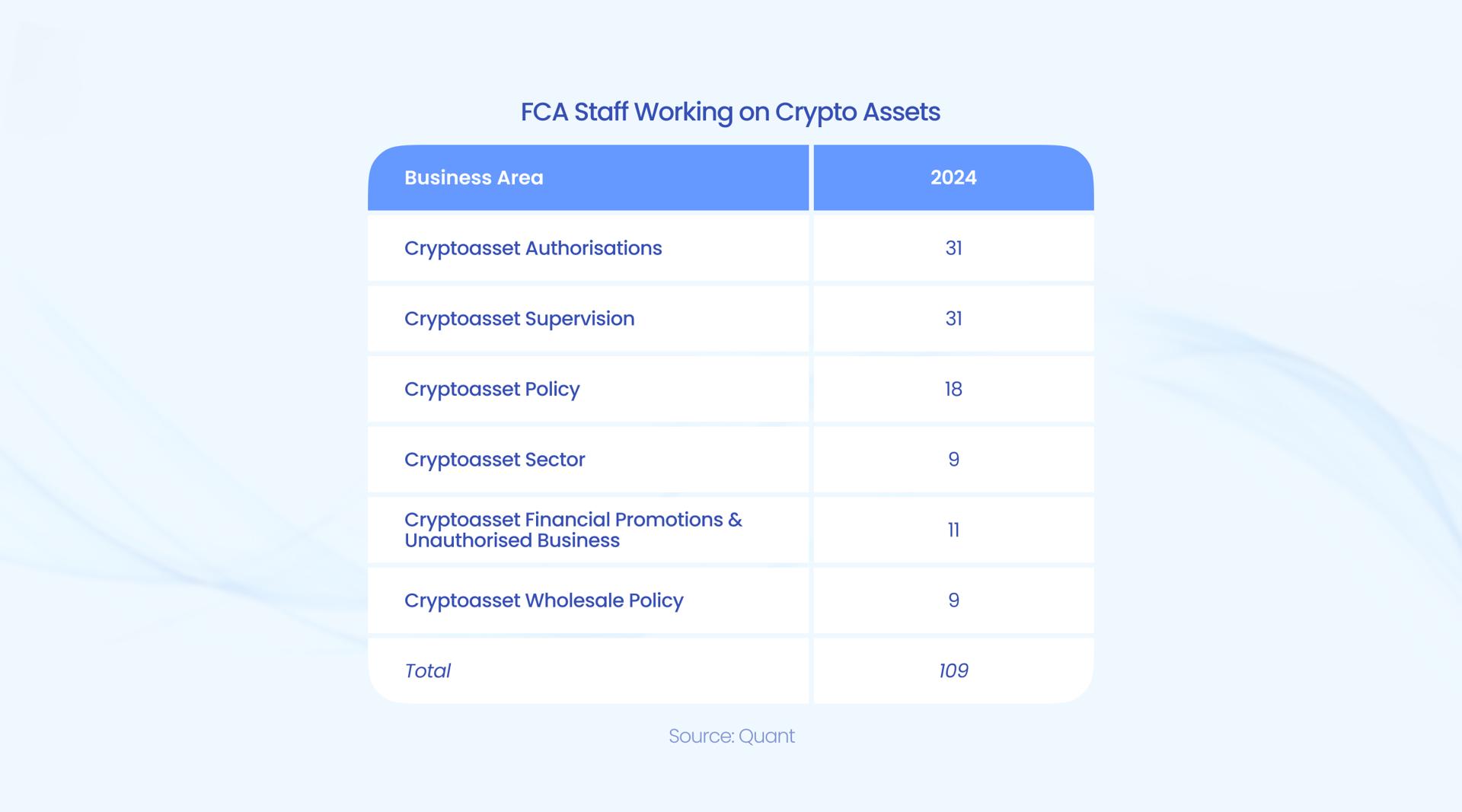
2019. However, only 18 of these employees work in the policy department,
responsible for drafting and implementing market regulations. Adding nine representatives from the wholesale policy department, the total increases to 27, accounting for about 25% of the overall employment.
The data
reveals that most of the FCA's crypto workforce is split between authorization
(31 staff members) and supervision (31 staff members). They focus on granting regulatory
permissions and monitoring compliance respectively. Even though the policy team has grown from 11 members in 2023 to 18 in 2024, it still lags behind other
departments.
Gilbert Verdian, Founder and CEO of Quant
“There
is now widespread recognition that the unregulated crypto experiment has
failed,” said Gilbert Verdian, Founder and CEO of Quant. “But digital
assets and tokenization improve many areas within financial services. The issue
is that the UK lacks a body which can drive forward responsible and innovative
regulation to govern all of this.”
The
findings come as the new Labour government has pledged to “streamline the
regulatory rulebook” under its Plan for Financial Services. This
commitment puts pressure on the ruling officials to provide clearer regulatory
guidance for the crypto sector or risk losing firms to other jurisdictions.
“Properly
regulated crypto assets have the potential to transform our economy and the
financial services sector,” Tulip Siddiq, the new City Minister,
previously commented. Quant argues, however, that if only 18 employees are
responsible for creating cryptocurrency regulations, the UK could face a
“crypto catastrophe.”
What is the FCA's opinion on the matter? In an email sent to Finance Magnates, a spokesperson for the regulator stated, "Crypto is an area of work that spans the entire FCA, and our increased staffing levels reflect our investment in these priorities."
"We’re making sure crypto companies have the right protections against financial crime, supporting innovative crypto firms via our Innovation Hub, and working with government and industry to design the future regulatory regime for cryptoassets," the spokeperson added.
FCA Needs “Digital Finance
Agency”
Notably,
the data also highlights a significant resource gap in crypto asset wholesale
policy, with only 9 employees in this crucial area. This shortage could pose
challenges to Labour's stated goal of “embracing securities tokenization
and a central bank digital currency.”
Verdian
suggests a potential solution: “A separate 'Digital Finance Agency'
dedicated entirely to digital assets can help the UK stay ahead of the pack
when it comes to the future of finance.”
“Digital
assets can bring major efficiency benefits to wholesale financial markets and
to realise this potential at scale, we need a new regulatory approach,” Quant’s
CEO concluded.
However, the FCA emphasized that beyond its dedicated crypto teams, it employs specialists across the organization who work on crypto assets alongside other sectors. Moreover, the regulator told Finance Magnates that it is also "actively supporting innovative firms that are using crypto and its underlying technology for the potential benefit of consumers, markets, and regulated firms." For example, as of April 2024, the FCA supports 58 firms with DLT-based innovations within the Regulatory Sandbox and 81 through Innovation Pathways.
In
February, the UK government announced its intention to implement the
much-anticipated cryptocurrency regulations over the next six months.
Subsequently, in April, Economic Secretary Bim Afolami predicted that these
regulations would be introduced by June or July. However, the industry is still
awaiting their implementation. This development follows the passing of the
Financial Services and Markets Act in June 2023, which classified
cryptocurrencies as regulated financial activities.
The article was updated on Thursday, July 18, and supplemented with comments provided by the FCA.
The
Financial Conduct Authority (FCA) has significantly expanded its cryptocurrency
workforce to over 100 staff members, yet its policy team remains understaffed,
according to data obtained by blockchain finance provider Quant through a
Freedom of Information request. The regulator claims that it is doing everything in its power to support the cryptocurrency industry, with members of the other FCA teams also working on the approach to digital assets.
FCA Crypto Staff Surges,
But Policy Team Lags Behind
The FCA now
employs 109 staff dedicated to crypto assets, a huge increase from just 9 in
2019. However, only 18 of these employees work in the policy department,
responsible for drafting and implementing market regulations. Adding nine representatives from the wholesale policy department, the total increases to 27, accounting for about 25% of the overall employment.
The data
reveals that most of the FCA's crypto workforce is split between authorization
(31 staff members) and supervision (31 staff members). They focus on granting regulatory
permissions and monitoring compliance respectively. Even though the policy team has grown from 11 members in 2023 to 18 in 2024, it still lags behind other
departments.
Gilbert Verdian, Founder and CEO of Quant
“There
is now widespread recognition that the unregulated crypto experiment has
failed,” said Gilbert Verdian, Founder and CEO of Quant. “But digital
assets and tokenization improve many areas within financial services. The issue
is that the UK lacks a body which can drive forward responsible and innovative
regulation to govern all of this.”
The
findings come as the new Labour government has pledged to “streamline the
regulatory rulebook” under its Plan for Financial Services. This
commitment puts pressure on the ruling officials to provide clearer regulatory
guidance for the crypto sector or risk losing firms to other jurisdictions.
“Properly
regulated crypto assets have the potential to transform our economy and the
financial services sector,” Tulip Siddiq, the new City Minister,
previously commented. Quant argues, however, that if only 18 employees are
responsible for creating cryptocurrency regulations, the UK could face a
“crypto catastrophe.”
What is the FCA's opinion on the matter? In an email sent to Finance Magnates, a spokesperson for the regulator stated, "Crypto is an area of work that spans the entire FCA, and our increased staffing levels reflect our investment in these priorities."
"We’re making sure crypto companies have the right protections against financial crime, supporting innovative crypto firms via our Innovation Hub, and working with government and industry to design the future regulatory regime for cryptoassets," the spokeperson added.
FCA Needs “Digital Finance
Agency”
Notably,
the data also highlights a significant resource gap in crypto asset wholesale
policy, with only 9 employees in this crucial area. This shortage could pose
challenges to Labour's stated goal of “embracing securities tokenization
and a central bank digital currency.”
Verdian
suggests a potential solution: “A separate 'Digital Finance Agency'
dedicated entirely to digital assets can help the UK stay ahead of the pack
when it comes to the future of finance.”
“Digital
assets can bring major efficiency benefits to wholesale financial markets and
to realise this potential at scale, we need a new regulatory approach,” Quant’s
CEO concluded.
However, the FCA emphasized that beyond its dedicated crypto teams, it employs specialists across the organization who work on crypto assets alongside other sectors. Moreover, the regulator told Finance Magnates that it is also "actively supporting innovative firms that are using crypto and its underlying technology for the potential benefit of consumers, markets, and regulated firms." For example, as of April 2024, the FCA supports 58 firms with DLT-based innovations within the Regulatory Sandbox and 81 through Innovation Pathways.
In
February, the UK government announced its intention to implement the
much-anticipated cryptocurrency regulations over the next six months.
Subsequently, in April, Economic Secretary Bim Afolami predicted that these
regulations would be introduced by June or July. However, the industry is still
awaiting their implementation. This development follows the passing of the
Financial Services and Markets Act in June 2023, which classified
cryptocurrencies as regulated financial activities.
The article was updated on Thursday, July 18, and supplemented with comments provided by the FCA.
Damian Chmiel is a Senior Analyst & Editor at Finance Magnates with more than 15 years of experience in the CFD and online trading industry. Active as both a trader and journalist since 2010, he focuses on broker coverage, fintech innovation, and regulatory developments across Europe, the Middle East, and Asia.
His work includes interviews with C-level leaders at major brokerages and fintech platforms, as well as co-authoring Finance Magnates’ quarterly industry benchmarking reports. Damian’s reporting is data-driven, market-aware, and grounded in direct industry engagement. His analysis and commentary have also been cited by external media outlets, including Investing.com, Binance, The Asset, Stockhead, and Dispatch.
Education:
MA in Finance and Accounting, Cracow University of Economics
Kraken Steps Up Speed Race with New Equinix Colocation Service for Crypto Traders
FP Markets Winner Spotlight 🏆 | Global Broker of the Year 2025 #Trading #Broker #Innovation #Shorts
FP Markets Winner Spotlight 🏆 | Global Broker of the Year 2025 #Trading #Broker #Innovation #Shorts
FP Markets takes the spotlight as Global Broker of the Year 2025 at the Finance Magnates Awards.
Martin Stoilov, Head of Client Experience, shares that trust, innovation, and people played a key role in the company’s success, supported by a strong foundation of integrity and client-centricity.
Following this milestone, FP Markets continues to focus on growth, technology investment, and its core values of transparency and excellence.
👉 Be part of FM Awards 2026: https://awards.financemagnates.com/#nominate
FP Markets takes the spotlight as Global Broker of the Year 2025 at the Finance Magnates Awards.
Martin Stoilov, Head of Client Experience, shares that trust, innovation, and people played a key role in the company’s success, supported by a strong foundation of integrity and client-centricity.
Following this milestone, FP Markets continues to focus on growth, technology investment, and its core values of transparency and excellence.
👉 Be part of FM Awards 2026: https://awards.financemagnates.com/#nominate
In this video, we review @HolaPrimeMarketsOfficial, a multi-asset forex and CFDs broker offering different account types, trading platforms, and flexible trading conditions.
We cover the broker’s overall offering, including account options, trading environment, platforms like MT4 and MT5, and additional services such as managed accounts and fast withdrawals.
Watch the full video to see if Hola Prime Markets fits your trading needs.
📣 Stay up to date with the latest in finance and trading. Follow Finance Magnates for industry news, insights, and global event coverage.
Connect with us:
🔗 LinkedIn: /financemagnates
👍 Facebook: /financemagnates
📸 Instagram: https://www.instagram.com/financemagnates
🐦 X: https://x.com/financemagnates
🎥 TikTok: https://www.tiktok.com/tag/financemagnates
▶️ YouTube: /@financemagnates_official
#HolaPrime #ForexBroker #CFDTrading #FinanceMagnates #Trading #Forex #BrokerReview
In this video, we review @HolaPrimeMarketsOfficial, a multi-asset forex and CFDs broker offering different account types, trading platforms, and flexible trading conditions.
We cover the broker’s overall offering, including account options, trading environment, platforms like MT4 and MT5, and additional services such as managed accounts and fast withdrawals.
Watch the full video to see if Hola Prime Markets fits your trading needs.
📣 Stay up to date with the latest in finance and trading. Follow Finance Magnates for industry news, insights, and global event coverage.
Connect with us:
🔗 LinkedIn: /financemagnates
👍 Facebook: /financemagnates
📸 Instagram: https://www.instagram.com/financemagnates
🐦 X: https://x.com/financemagnates
🎥 TikTok: https://www.tiktok.com/tag/financemagnates
▶️ YouTube: /@financemagnates_official
#HolaPrime #ForexBroker #CFDTrading #FinanceMagnates #Trading #Forex #BrokerReview
Hola Prime Review: What You Need to Know | Full Breakdown by Finance Magnates
Hola Prime Review: What You Need to Know | Full Breakdown by Finance Magnates
In this video, we review @HolaPrime_Global, a proprietary trading firm offering evaluation programs and performance-based payouts in simulated market environments.
We cover how the challenge model works, including account types, profit splits (up to 95%), trading rules, and what it takes to reach a funded account. You’ll also learn about available platforms like MT4, MT5, cTrader, and more, along with insights into payouts, support, and trading conditions.
Watch the full video to see if Hola Prime fits your trading style.
📣 Stay up to date with the latest in finance and trading. Follow Finance Magnates for industry news, insights, and global event coverage.
Connect with us:
🔗 LinkedIn: /financemagnates
👍 Facebook: /financemagnates
📸 Instagram: https://www.instagram.com/financemagnates
🐦 X: https://x.com/financemagnates
🎥 TikTok: https://www.tiktok.com/tag/financemagnates
▶️ YouTube: /@financemagnates_official
#HolaPrime #PropFirm #Trading #FinanceMagnates #Forex #FuturesTrading #TradingReview #PropFirmReview
In this video, we review @HolaPrime_Global, a proprietary trading firm offering evaluation programs and performance-based payouts in simulated market environments.
We cover how the challenge model works, including account types, profit splits (up to 95%), trading rules, and what it takes to reach a funded account. You’ll also learn about available platforms like MT4, MT5, cTrader, and more, along with insights into payouts, support, and trading conditions.
Watch the full video to see if Hola Prime fits your trading style.
📣 Stay up to date with the latest in finance and trading. Follow Finance Magnates for industry news, insights, and global event coverage.
Connect with us:
🔗 LinkedIn: /financemagnates
👍 Facebook: /financemagnates
📸 Instagram: https://www.instagram.com/financemagnates
🐦 X: https://x.com/financemagnates
🎥 TikTok: https://www.tiktok.com/tag/financemagnates
▶️ YouTube: /@financemagnates_official
#HolaPrime #PropFirm #Trading #FinanceMagnates #Forex #FuturesTrading #TradingReview #PropFirmReview
Axi Winner Spotlight 🏆 | Global Most Innovative Broker 2025 #Innovation #Trading #Fintech #Broker
Axi Winner Spotlight 🏆 | Global Most Innovative Broker 2025 #Innovation #Trading #Fintech #Broker
Axi takes the spotlight at the Finance Magnates Awards, winning Global Most Innovative Broker 2025.
Olivia Xenofontos and Ivanna Openko share how the team will feel: proud, motivated, and ready to keep delivering.
They also describe the night as well-organized, focused, and enjoyable for all.
👉 Be part of FM Awards 2026.
Axi takes the spotlight at the Finance Magnates Awards, winning Global Most Innovative Broker 2025.
Olivia Xenofontos and Ivanna Openko share how the team will feel: proud, motivated, and ready to keep delivering.
They also describe the night as well-organized, focused, and enjoyable for all.
👉 Be part of FM Awards 2026.
Recognition that matters.
Built on transparency.
Driven by the industry.
The Finance Magnates Awards 2026.
Nominations are now open.
🔗 https://awards.financemagnates.com/?utm_source=SM&utm_medium=social&utm_campaign=recognition-matters
Recognition that matters.
Built on transparency.
Driven by the industry.
The Finance Magnates Awards 2026.
Nominations are now open.
🔗 https://awards.financemagnates.com/?utm_source=SM&utm_medium=social&utm_campaign=recognition-matters