2018 may not have been a "good" year for crypto, but it was certainly eventful.
FM
By many accounts, it’s been a long, hard year for cryptocurrency.
Markets have shed billions, confirming suspicions that the crypto boom near the end of 2017 was the product of a speculative bubble. Public perception of crypto has suffered for this reason, and for many others.
On the other hand, the strength that crypto markets have managed to hold on to could be considered as a sign of maturation: a market fueled almost entirely by practical usage and long-term investments, and not by speculators.
One thing’s for sure: this year is shaping up to be quite different from the last. How did we get here?
Bitcoin’s Epic Downhill Slide
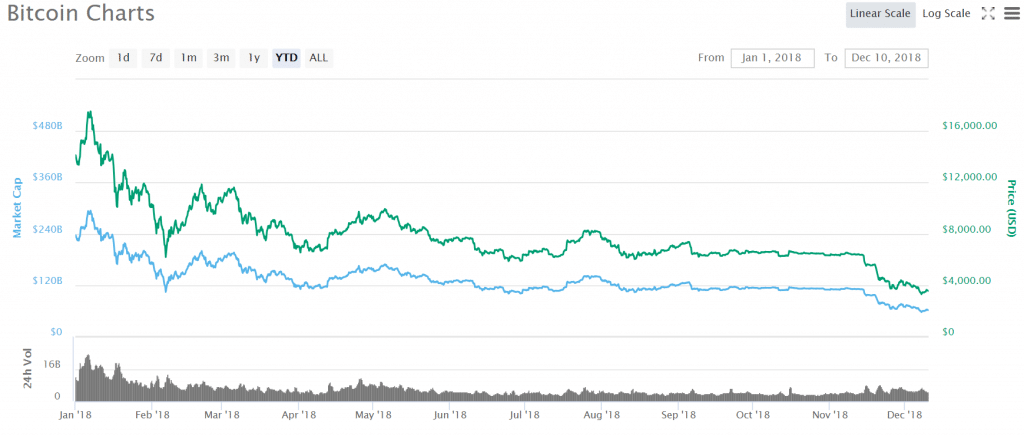
“Clearly the most defining moment of the year for Bitcoin was its incredible rise to nearly $20,000 in December 2017 and its subsequent plummet to today’s levels below $4,000,” said longtime consumer tech journalist and co-host of the new Globalive Media series “Beyond Innovation” Michael Bancroft to Finance Magnates.
Bitcoin's valuation has dropped considerably this year.
Indeed, what started off as a bad year for Bitcoin seems to be ending as an even worse year. “Many investors were burned badly by the collapse of Bitcoin’s price over the past six months, and that will have consequences for any hopes of a Bitcoin bull market,” Bancroft said.
Is a Bitcoin bull market even a possibility? Maybe--but it probably won’t be driven by speculation. Bancroft believes that the long-term effects of the sliding valuation will include a market that is “driven by concrete applications for the cryptocurrency as well as improvements to the transaction times and energy required.”
Michael Bancroft
In other words, “2019 will be Bitcoin’s year of the true believers, not the speculators!”
The Reversal of Ad Bans by Google and Facebook
In the face of a serious lack of regulation in the cryptosphere, the year 2018 started off with some unexpected efforts to self-regulate. Within the first several months of the year, Facebook, Google, Snapchat, MailChimp, Twitter, and a number of other social media platforms had banned cryptocurrency-related advertisements from their platforms.
However, come mid-year, some of the platforms began to relax their bans. It started with Facebook in June; Google rolled its own ban back in September.
“This was less about the ability to advertise for participants and organizations in the landscape than it was about two of the largest media organizations finding an ability to move forward with cryptocurrencies in a manner that could be smart, strategic and compliant, leading a path for other organizations to do the same,” said Zachary Weiner, CEO of Emerging Insider Communications, to Finance Magnates.
The denial didn’t exactly come as a surprise--the SEC had smacked down a number of proposals from a number of different sources, never coming close to an approval. However, there was quite a bit of evidence to show that investors believed that the Winklevoss’ second attempt would finally bring an approval.
The strongest piece of evidence to suggest that this was the case was the rise and fall of the price of Bitcoin surrounding the date of the decision. In the weeks preceding the decision, the price of Bitcoin rallied from $6300 to roughly $8200. However, after the denial was made public, the price of Bitcoin quickly sank back to around $6000.
If there were so many denials both before and after this event, why is this one so iconic? No other application has brought about price movements as significant as this one did-prior to this particular application and its denial, public faith in the possibility of a Bitcoin ETF approval was low, and media attention on such applications was minimal.
If price movement is any indicator, however, hopes were high for the second Winklevoss application--and when the denial came, they were dashed.
Indeed, no decision on any other application for a Bitcoin ETF has caused prices to move the way that the Winklevoss application did--even though many analysts have predicted that it is much more likely that the application submitted by VanEck and SolidX is much more likely to receive an approval for a number of reasons.
Here’s why a bitcoin ETF matters:
With the release of an ETF, this allows investors to add bitcoin to their retirement portfolio.
Global Pensions Market: $41.3T
If bitcoin captures just 1% of global pensions, that would create $413,000,000,000 of exposure for cryptocurrencies.
— Nicholas Merten (@Nicholas_Merten) July 24, 2018
A number of delays put forth on the decision regarding the approval of the VanEck-SolidX Bitcoin ETF may have also caused a lack of public faith that a Bitcoin ETF is on the horizon anytime in the immediate future.
“The SEC’s decision to deny many Bitcoin ETF applications was a clear signal to the public that cryptocurrency is still very much in its ‘Wild Wild West’ phase of development and that regulators will have a big say in both its present and future in order for it to gain more widespread acceptance,” Michael Bancroft explained.
“That ‘institutional taming’ in many ways runs counter to the very purpose some of cryptocurrency’s earliest boosters saw in digital currencies to begin with and will surely have an impact on grassroots involvement in the sector.”
A Gajillion Hacks
Cybersecurity--or a lack thereof--was a major theme in the cryptosphere this year. The Coincheck hack in January resulted in the theft of $534 million worth of NEM coins. Weeks later, the BitGrail hack saw nearly $200 million lost.
Then, there was Coinrail, Bithumb, and Bancor--three separate hacks that rang in at $40 million, $31 million, and $23 million, respectively. Each of these resulted in pressure from governments and other members of the cryptocurrency industry to raise security standards.
As a growing number of investors continued to enter the markets, the need for impeccable security practices has grown eve more pressing. “The crypto asset space has evolved and expanded to include a plethora of retail investors, funds, and institutional investors—and thus more risk—so the need for infrastructure providers to ensure that failures are mitigated has increased dramatically,” said Raymond Zenkich, COO and Co-Founder of BlockRe, to Finance Magnates.
Raymond Zenkich.
“Making matters even more alarming is how most infrastructure providers offer limited insurance protection or none at all. And sometimes providers may not understand (or misrepresent) the insurance they possess.”
Zenkich argued that “the creation of a first-of-its-kind insurance product to protect [digital] assets” was one of the most important moments of the year.
“The need for increasingly comprehensive crypto insurance policies, consulting services, and the accompanying insurance infrastructure that can bring institutions that suffered a breach back to whole,” he said.
“New advances in InsureTech ensure that crypto assets are far easier to insure, thereby preventing loss and providing confidence in the minds of retail investors and institutions alike. All these efforts are necessary milestones on the way to universal acceptance of cryptocurrency as a competitive, thriving medium of exchange.”
The Epic Battle Between Bitcoin Cash SV and Bitcoin ABC
The hash war between the group of developers known as Bitcoin ABC and Craig S. Wright, the self-proclaimed creator of Bitcoin, was an epically embarrassing battle of egos that the world won’t soon forget.
It all started with a ‘fork’--a proposed software update for the Bitcoin Cash network. Bitcoin ABC developed an update that would maintain the 32mb block size of the BCH network while “[removing] immediate implementation bottlenecks to increasing the block size limit” and “[laying] the technical groundwork for massive future on-chain scaling.”
Craig Wright’s software update, however, proposed a number of radical changes to the Bitcoin Cash protocol, including a block size increase from 32mb to 128mb.
However, the road to the finish line was far from smooth. Things turned ugly between the two campaigns (and their leaders) along the way--”the story, unfortunately, developed based on personalities and rhetoric rather than the technology,” Nick Spanos, founder of Bitcoin Center NYC, told Finance Magnates. “The ‘Hash War’ lost focus on the facts and the story turned puerile.”
Nick Spanos
Indeed, individuals on both sides tweeted brash statements and threats. Perhaps none were more bombastic than those sent out by Craig Wright himself, who tweeted: “To all BTC miners…If you switch to mine BCH, we may need to fund this with BTC, if we do, we sell for USD and, well… we think BTC market has no room… it tanks. Think about it. We will sell A Lot! Consider that…. And, have a nice day (BTC to 1000 does not phase me).” (Wright’s account was made private at the time of writing.)
The US SEC Gives Clarity on Crypto’s Status as a Security...Sort Of
The United States has remained famously ambiguous on cryptocurrency regulations. Despite many calls for regulation from across the industry, unanswerable legal questions around the legal status of some cryptocurrencies and ICO tokens remain.
Indeed, no new regulations have been formed to specifically address the cryptocurrency. However, the SEC and some other financial regulators have taken action against certain companies that has helped to establish some legal precedence within the field.
Kyle Asman, co-founder of BX3 Capital, told Finance Magnates that perhaps the most significant actions that the SEC took against cryptocurrency companies this year were those against Paragon Coin and Airfox. “[These] marked the first [instances] of the SEC going after issuers for issuing what they considered to be a security, not a case of fraud,” he said.
Asman also noted that this year, the SEC and the CFTC officially stated that Bitcoin could not legally be considered as a security. ”This gave a number of people in the ecosystem much-needed clarity on the topic,” he said.
Kyle Asman, partner at BX3 Capital.
Maduro’s Crypto Games
Venezuela unexpectedly became a major player in the cryptosphere in 2018 for several reasons. For one thing, the Venezuelan Bolivar (the country’s native currency) was so unstable that many Venezuelans turned to Bitcoin as a safe haven for their savings; some Venezuelans relied on money earned from mining cryptocurrency to purchase basic essentials, like food and clean water. Several countries will similar economic situations saw similar trends.
Venezuela will sell oil exclusively in exchange for Petro. The president of Venezuela Nicolas Maduro announced on Twitter that his country will sell oil exclusively in exchange for Petro- the new Venezuelan national cryptocurrency.https://t.co/8Kp6vx7rSS
In addition to Venezuela’s unprecedented entanglement with the Bitcoin network, Venezuelan President Nicolas Maduro shocked the world with the launch of the Petro, a national cryptocurrency that was allegedly backed by real-world assets, such as oil. However, there were a number of suspicions that the assets didn’t really exist, and that the cryptocurrency was nothing more than a thinly-veiled attempt to evade international sanctions.
“If this scheme is even moderately successful, other maligned governments such as Iran and North Korea may also start to experiment with similar efforts and this could tarnish the public perception of cryptocurrencies and discourage their adoption by legitimate enterprises,” Michael Bancroft said. Indeed, similar plans have been explored in Iran and Russia, for similarly dubious reasons.
That's All, Folks
As eventful as this year has been, it's unlikely that anything major will happen in the next couple of weeks as it draws to a close. Then again, you never know...
What were your favorite crypto moments of 2018? Leave a comment below and let us know.
By many accounts, it’s been a long, hard year for cryptocurrency.
Markets have shed billions, confirming suspicions that the crypto boom near the end of 2017 was the product of a speculative bubble. Public perception of crypto has suffered for this reason, and for many others.
On the other hand, the strength that crypto markets have managed to hold on to could be considered as a sign of maturation: a market fueled almost entirely by practical usage and long-term investments, and not by speculators.
One thing’s for sure: this year is shaping up to be quite different from the last. How did we get here?
Bitcoin’s Epic Downhill Slide
“Clearly the most defining moment of the year for Bitcoin was its incredible rise to nearly $20,000 in December 2017 and its subsequent plummet to today’s levels below $4,000,” said longtime consumer tech journalist and co-host of the new Globalive Media series “Beyond Innovation” Michael Bancroft to Finance Magnates.
Bitcoin's valuation has dropped considerably this year.
Indeed, what started off as a bad year for Bitcoin seems to be ending as an even worse year. “Many investors were burned badly by the collapse of Bitcoin’s price over the past six months, and that will have consequences for any hopes of a Bitcoin bull market,” Bancroft said.
Is a Bitcoin bull market even a possibility? Maybe--but it probably won’t be driven by speculation. Bancroft believes that the long-term effects of the sliding valuation will include a market that is “driven by concrete applications for the cryptocurrency as well as improvements to the transaction times and energy required.”
Michael Bancroft
In other words, “2019 will be Bitcoin’s year of the true believers, not the speculators!”
The Reversal of Ad Bans by Google and Facebook
In the face of a serious lack of regulation in the cryptosphere, the year 2018 started off with some unexpected efforts to self-regulate. Within the first several months of the year, Facebook, Google, Snapchat, MailChimp, Twitter, and a number of other social media platforms had banned cryptocurrency-related advertisements from their platforms.
However, come mid-year, some of the platforms began to relax their bans. It started with Facebook in June; Google rolled its own ban back in September.
“This was less about the ability to advertise for participants and organizations in the landscape than it was about two of the largest media organizations finding an ability to move forward with cryptocurrencies in a manner that could be smart, strategic and compliant, leading a path for other organizations to do the same,” said Zachary Weiner, CEO of Emerging Insider Communications, to Finance Magnates.
The denial didn’t exactly come as a surprise--the SEC had smacked down a number of proposals from a number of different sources, never coming close to an approval. However, there was quite a bit of evidence to show that investors believed that the Winklevoss’ second attempt would finally bring an approval.
The strongest piece of evidence to suggest that this was the case was the rise and fall of the price of Bitcoin surrounding the date of the decision. In the weeks preceding the decision, the price of Bitcoin rallied from $6300 to roughly $8200. However, after the denial was made public, the price of Bitcoin quickly sank back to around $6000.
If there were so many denials both before and after this event, why is this one so iconic? No other application has brought about price movements as significant as this one did-prior to this particular application and its denial, public faith in the possibility of a Bitcoin ETF approval was low, and media attention on such applications was minimal.
If price movement is any indicator, however, hopes were high for the second Winklevoss application--and when the denial came, they were dashed.
Indeed, no decision on any other application for a Bitcoin ETF has caused prices to move the way that the Winklevoss application did--even though many analysts have predicted that it is much more likely that the application submitted by VanEck and SolidX is much more likely to receive an approval for a number of reasons.
Here’s why a bitcoin ETF matters:
With the release of an ETF, this allows investors to add bitcoin to their retirement portfolio.
Global Pensions Market: $41.3T
If bitcoin captures just 1% of global pensions, that would create $413,000,000,000 of exposure for cryptocurrencies.
— Nicholas Merten (@Nicholas_Merten) July 24, 2018
A number of delays put forth on the decision regarding the approval of the VanEck-SolidX Bitcoin ETF may have also caused a lack of public faith that a Bitcoin ETF is on the horizon anytime in the immediate future.
“The SEC’s decision to deny many Bitcoin ETF applications was a clear signal to the public that cryptocurrency is still very much in its ‘Wild Wild West’ phase of development and that regulators will have a big say in both its present and future in order for it to gain more widespread acceptance,” Michael Bancroft explained.
“That ‘institutional taming’ in many ways runs counter to the very purpose some of cryptocurrency’s earliest boosters saw in digital currencies to begin with and will surely have an impact on grassroots involvement in the sector.”
A Gajillion Hacks
Cybersecurity--or a lack thereof--was a major theme in the cryptosphere this year. The Coincheck hack in January resulted in the theft of $534 million worth of NEM coins. Weeks later, the BitGrail hack saw nearly $200 million lost.
Then, there was Coinrail, Bithumb, and Bancor--three separate hacks that rang in at $40 million, $31 million, and $23 million, respectively. Each of these resulted in pressure from governments and other members of the cryptocurrency industry to raise security standards.
As a growing number of investors continued to enter the markets, the need for impeccable security practices has grown eve more pressing. “The crypto asset space has evolved and expanded to include a plethora of retail investors, funds, and institutional investors—and thus more risk—so the need for infrastructure providers to ensure that failures are mitigated has increased dramatically,” said Raymond Zenkich, COO and Co-Founder of BlockRe, to Finance Magnates.
Raymond Zenkich.
“Making matters even more alarming is how most infrastructure providers offer limited insurance protection or none at all. And sometimes providers may not understand (or misrepresent) the insurance they possess.”
Zenkich argued that “the creation of a first-of-its-kind insurance product to protect [digital] assets” was one of the most important moments of the year.
“The need for increasingly comprehensive crypto insurance policies, consulting services, and the accompanying insurance infrastructure that can bring institutions that suffered a breach back to whole,” he said.
“New advances in InsureTech ensure that crypto assets are far easier to insure, thereby preventing loss and providing confidence in the minds of retail investors and institutions alike. All these efforts are necessary milestones on the way to universal acceptance of cryptocurrency as a competitive, thriving medium of exchange.”
The Epic Battle Between Bitcoin Cash SV and Bitcoin ABC
The hash war between the group of developers known as Bitcoin ABC and Craig S. Wright, the self-proclaimed creator of Bitcoin, was an epically embarrassing battle of egos that the world won’t soon forget.
It all started with a ‘fork’--a proposed software update for the Bitcoin Cash network. Bitcoin ABC developed an update that would maintain the 32mb block size of the BCH network while “[removing] immediate implementation bottlenecks to increasing the block size limit” and “[laying] the technical groundwork for massive future on-chain scaling.”
Craig Wright’s software update, however, proposed a number of radical changes to the Bitcoin Cash protocol, including a block size increase from 32mb to 128mb.
However, the road to the finish line was far from smooth. Things turned ugly between the two campaigns (and their leaders) along the way--”the story, unfortunately, developed based on personalities and rhetoric rather than the technology,” Nick Spanos, founder of Bitcoin Center NYC, told Finance Magnates. “The ‘Hash War’ lost focus on the facts and the story turned puerile.”
Nick Spanos
Indeed, individuals on both sides tweeted brash statements and threats. Perhaps none were more bombastic than those sent out by Craig Wright himself, who tweeted: “To all BTC miners…If you switch to mine BCH, we may need to fund this with BTC, if we do, we sell for USD and, well… we think BTC market has no room… it tanks. Think about it. We will sell A Lot! Consider that…. And, have a nice day (BTC to 1000 does not phase me).” (Wright’s account was made private at the time of writing.)
The US SEC Gives Clarity on Crypto’s Status as a Security...Sort Of
The United States has remained famously ambiguous on cryptocurrency regulations. Despite many calls for regulation from across the industry, unanswerable legal questions around the legal status of some cryptocurrencies and ICO tokens remain.
Indeed, no new regulations have been formed to specifically address the cryptocurrency. However, the SEC and some other financial regulators have taken action against certain companies that has helped to establish some legal precedence within the field.
Kyle Asman, co-founder of BX3 Capital, told Finance Magnates that perhaps the most significant actions that the SEC took against cryptocurrency companies this year were those against Paragon Coin and Airfox. “[These] marked the first [instances] of the SEC going after issuers for issuing what they considered to be a security, not a case of fraud,” he said.
Asman also noted that this year, the SEC and the CFTC officially stated that Bitcoin could not legally be considered as a security. ”This gave a number of people in the ecosystem much-needed clarity on the topic,” he said.
Kyle Asman, partner at BX3 Capital.
Maduro’s Crypto Games
Venezuela unexpectedly became a major player in the cryptosphere in 2018 for several reasons. For one thing, the Venezuelan Bolivar (the country’s native currency) was so unstable that many Venezuelans turned to Bitcoin as a safe haven for their savings; some Venezuelans relied on money earned from mining cryptocurrency to purchase basic essentials, like food and clean water. Several countries will similar economic situations saw similar trends.
Venezuela will sell oil exclusively in exchange for Petro. The president of Venezuela Nicolas Maduro announced on Twitter that his country will sell oil exclusively in exchange for Petro- the new Venezuelan national cryptocurrency.https://t.co/8Kp6vx7rSS
In addition to Venezuela’s unprecedented entanglement with the Bitcoin network, Venezuelan President Nicolas Maduro shocked the world with the launch of the Petro, a national cryptocurrency that was allegedly backed by real-world assets, such as oil. However, there were a number of suspicions that the assets didn’t really exist, and that the cryptocurrency was nothing more than a thinly-veiled attempt to evade international sanctions.
“If this scheme is even moderately successful, other maligned governments such as Iran and North Korea may also start to experiment with similar efforts and this could tarnish the public perception of cryptocurrencies and discourage their adoption by legitimate enterprises,” Michael Bancroft said. Indeed, similar plans have been explored in Iran and Russia, for similarly dubious reasons.
That's All, Folks
As eventful as this year has been, it's unlikely that anything major will happen in the next couple of weeks as it draws to a close. Then again, you never know...
What were your favorite crypto moments of 2018? Leave a comment below and let us know.
Rachel is a self-taught crypto geek and a passionate writer. She believes in the power that the written word has to educate, connect and empower individuals to make positive and powerful financial choices. She is the Podcast Host and a Cryptocurrency Editor at Finance Magnates.
Crypto Built More Rails, but the Next Battle Is Over How Much Work a Dollar Can Do
Featured Videos
FP Markets Winner Spotlight 🏆 | Global Broker of the Year 2025 #Trading #Broker #Innovation #Shorts
FP Markets Winner Spotlight 🏆 | Global Broker of the Year 2025 #Trading #Broker #Innovation #Shorts
FP Markets Winner Spotlight 🏆 | Global Broker of the Year 2025 #Trading #Broker #Innovation #Shorts
FP Markets Winner Spotlight 🏆 | Global Broker of the Year 2025 #Trading #Broker #Innovation #Shorts
FP Markets takes the spotlight as Global Broker of the Year 2025 at the Finance Magnates Awards.
Martin Stoilov, Head of Client Experience, shares that trust, innovation, and people played a key role in the company’s success, supported by a strong foundation of integrity and client-centricity.
Following this milestone, FP Markets continues to focus on growth, technology investment, and its core values of transparency and excellence.
👉 Be part of FM Awards 2026: https://awards.financemagnates.com/#nominate
FP Markets takes the spotlight as Global Broker of the Year 2025 at the Finance Magnates Awards.
Martin Stoilov, Head of Client Experience, shares that trust, innovation, and people played a key role in the company’s success, supported by a strong foundation of integrity and client-centricity.
Following this milestone, FP Markets continues to focus on growth, technology investment, and its core values of transparency and excellence.
👉 Be part of FM Awards 2026: https://awards.financemagnates.com/#nominate
FP Markets takes the spotlight as Global Broker of the Year 2025 at the Finance Magnates Awards.
Martin Stoilov, Head of Client Experience, shares that trust, innovation, and people played a key role in the company’s success, supported by a strong foundation of integrity and client-centricity.
Following this milestone, FP Markets continues to focus on growth, technology investment, and its core values of transparency and excellence.
👉 Be part of FM Awards 2026: https://awards.financemagnates.com/#nominate
FP Markets takes the spotlight as Global Broker of the Year 2025 at the Finance Magnates Awards.
Martin Stoilov, Head of Client Experience, shares that trust, innovation, and people played a key role in the company’s success, supported by a strong foundation of integrity and client-centricity.
Following this milestone, FP Markets continues to focus on growth, technology investment, and its core values of transparency and excellence.
👉 Be part of FM Awards 2026: https://awards.financemagnates.com/#nominate
In this video, we review @HolaPrimeMarketsOfficial, a multi-asset forex and CFDs broker offering different account types, trading platforms, and flexible trading conditions.
We cover the broker’s overall offering, including account options, trading environment, platforms like MT4 and MT5, and additional services such as managed accounts and fast withdrawals.
Watch the full video to see if Hola Prime Markets fits your trading needs.
📣 Stay up to date with the latest in finance and trading. Follow Finance Magnates for industry news, insights, and global event coverage.
Connect with us:
🔗 LinkedIn: /financemagnates
👍 Facebook: /financemagnates
📸 Instagram: https://www.instagram.com/financemagnates
🐦 X: https://x.com/financemagnates
🎥 TikTok: https://www.tiktok.com/tag/financemagnates
▶️ YouTube: /@financemagnates_official
#HolaPrime #ForexBroker #CFDTrading #FinanceMagnates #Trading #Forex #BrokerReview
In this video, we review @HolaPrimeMarketsOfficial, a multi-asset forex and CFDs broker offering different account types, trading platforms, and flexible trading conditions.
We cover the broker’s overall offering, including account options, trading environment, platforms like MT4 and MT5, and additional services such as managed accounts and fast withdrawals.
Watch the full video to see if Hola Prime Markets fits your trading needs.
📣 Stay up to date with the latest in finance and trading. Follow Finance Magnates for industry news, insights, and global event coverage.
Connect with us:
🔗 LinkedIn: /financemagnates
👍 Facebook: /financemagnates
📸 Instagram: https://www.instagram.com/financemagnates
🐦 X: https://x.com/financemagnates
🎥 TikTok: https://www.tiktok.com/tag/financemagnates
▶️ YouTube: /@financemagnates_official
#HolaPrime #ForexBroker #CFDTrading #FinanceMagnates #Trading #Forex #BrokerReview
In this video, we review @HolaPrimeMarketsOfficial, a multi-asset forex and CFDs broker offering different account types, trading platforms, and flexible trading conditions.
We cover the broker’s overall offering, including account options, trading environment, platforms like MT4 and MT5, and additional services such as managed accounts and fast withdrawals.
Watch the full video to see if Hola Prime Markets fits your trading needs.
📣 Stay up to date with the latest in finance and trading. Follow Finance Magnates for industry news, insights, and global event coverage.
Connect with us:
🔗 LinkedIn: /financemagnates
👍 Facebook: /financemagnates
📸 Instagram: https://www.instagram.com/financemagnates
🐦 X: https://x.com/financemagnates
🎥 TikTok: https://www.tiktok.com/tag/financemagnates
▶️ YouTube: /@financemagnates_official
#HolaPrime #ForexBroker #CFDTrading #FinanceMagnates #Trading #Forex #BrokerReview
In this video, we review @HolaPrimeMarketsOfficial, a multi-asset forex and CFDs broker offering different account types, trading platforms, and flexible trading conditions.
We cover the broker’s overall offering, including account options, trading environment, platforms like MT4 and MT5, and additional services such as managed accounts and fast withdrawals.
Watch the full video to see if Hola Prime Markets fits your trading needs.
📣 Stay up to date with the latest in finance and trading. Follow Finance Magnates for industry news, insights, and global event coverage.
Connect with us:
🔗 LinkedIn: /financemagnates
👍 Facebook: /financemagnates
📸 Instagram: https://www.instagram.com/financemagnates
🐦 X: https://x.com/financemagnates
🎥 TikTok: https://www.tiktok.com/tag/financemagnates
▶️ YouTube: /@financemagnates_official
#HolaPrime #ForexBroker #CFDTrading #FinanceMagnates #Trading #Forex #BrokerReview
In this video, we review @HolaPrimeMarketsOfficial, a multi-asset forex and CFDs broker offering different account types, trading platforms, and flexible trading conditions.
We cover the broker’s overall offering, including account options, trading environment, platforms like MT4 and MT5, and additional services such as managed accounts and fast withdrawals.
Watch the full video to see if Hola Prime Markets fits your trading needs.
📣 Stay up to date with the latest in finance and trading. Follow Finance Magnates for industry news, insights, and global event coverage.
Connect with us:
🔗 LinkedIn: /financemagnates
👍 Facebook: /financemagnates
📸 Instagram: https://www.instagram.com/financemagnates
🐦 X: https://x.com/financemagnates
🎥 TikTok: https://www.tiktok.com/tag/financemagnates
▶️ YouTube: /@financemagnates_official
#HolaPrime #ForexBroker #CFDTrading #FinanceMagnates #Trading #Forex #BrokerReview
In this video, we review @HolaPrimeMarketsOfficial, a multi-asset forex and CFDs broker offering different account types, trading platforms, and flexible trading conditions.
We cover the broker’s overall offering, including account options, trading environment, platforms like MT4 and MT5, and additional services such as managed accounts and fast withdrawals.
Watch the full video to see if Hola Prime Markets fits your trading needs.
📣 Stay up to date with the latest in finance and trading. Follow Finance Magnates for industry news, insights, and global event coverage.
Connect with us:
🔗 LinkedIn: /financemagnates
👍 Facebook: /financemagnates
📸 Instagram: https://www.instagram.com/financemagnates
🐦 X: https://x.com/financemagnates
🎥 TikTok: https://www.tiktok.com/tag/financemagnates
▶️ YouTube: /@financemagnates_official
#HolaPrime #ForexBroker #CFDTrading #FinanceMagnates #Trading #Forex #BrokerReview
Hola Prime Review: What You Need to Know | Full Breakdown by Finance Magnates
Hola Prime Review: What You Need to Know | Full Breakdown by Finance Magnates
Hola Prime Review: What You Need to Know | Full Breakdown by Finance Magnates
Hola Prime Review: What You Need to Know | Full Breakdown by Finance Magnates
Hola Prime Review: What You Need to Know | Full Breakdown by Finance Magnates
Hola Prime Review: What You Need to Know | Full Breakdown by Finance Magnates
In this video, we review @HolaPrime_Global, a proprietary trading firm offering evaluation programs and performance-based payouts in simulated market environments.
We cover how the challenge model works, including account types, profit splits (up to 95%), trading rules, and what it takes to reach a funded account. You’ll also learn about available platforms like MT4, MT5, cTrader, and more, along with insights into payouts, support, and trading conditions.
Watch the full video to see if Hola Prime fits your trading style.
📣 Stay up to date with the latest in finance and trading. Follow Finance Magnates for industry news, insights, and global event coverage.
Connect with us:
🔗 LinkedIn: /financemagnates
👍 Facebook: /financemagnates
📸 Instagram: https://www.instagram.com/financemagnates
🐦 X: https://x.com/financemagnates
🎥 TikTok: https://www.tiktok.com/tag/financemagnates
▶️ YouTube: /@financemagnates_official
#HolaPrime #PropFirm #Trading #FinanceMagnates #Forex #FuturesTrading #TradingReview #PropFirmReview
In this video, we review @HolaPrime_Global, a proprietary trading firm offering evaluation programs and performance-based payouts in simulated market environments.
We cover how the challenge model works, including account types, profit splits (up to 95%), trading rules, and what it takes to reach a funded account. You’ll also learn about available platforms like MT4, MT5, cTrader, and more, along with insights into payouts, support, and trading conditions.
Watch the full video to see if Hola Prime fits your trading style.
📣 Stay up to date with the latest in finance and trading. Follow Finance Magnates for industry news, insights, and global event coverage.
Connect with us:
🔗 LinkedIn: /financemagnates
👍 Facebook: /financemagnates
📸 Instagram: https://www.instagram.com/financemagnates
🐦 X: https://x.com/financemagnates
🎥 TikTok: https://www.tiktok.com/tag/financemagnates
▶️ YouTube: /@financemagnates_official
#HolaPrime #PropFirm #Trading #FinanceMagnates #Forex #FuturesTrading #TradingReview #PropFirmReview
In this video, we review @HolaPrime_Global, a proprietary trading firm offering evaluation programs and performance-based payouts in simulated market environments.
We cover how the challenge model works, including account types, profit splits (up to 95%), trading rules, and what it takes to reach a funded account. You’ll also learn about available platforms like MT4, MT5, cTrader, and more, along with insights into payouts, support, and trading conditions.
Watch the full video to see if Hola Prime fits your trading style.
📣 Stay up to date with the latest in finance and trading. Follow Finance Magnates for industry news, insights, and global event coverage.
Connect with us:
🔗 LinkedIn: /financemagnates
👍 Facebook: /financemagnates
📸 Instagram: https://www.instagram.com/financemagnates
🐦 X: https://x.com/financemagnates
🎥 TikTok: https://www.tiktok.com/tag/financemagnates
▶️ YouTube: /@financemagnates_official
#HolaPrime #PropFirm #Trading #FinanceMagnates #Forex #FuturesTrading #TradingReview #PropFirmReview
In this video, we review @HolaPrime_Global, a proprietary trading firm offering evaluation programs and performance-based payouts in simulated market environments.
We cover how the challenge model works, including account types, profit splits (up to 95%), trading rules, and what it takes to reach a funded account. You’ll also learn about available platforms like MT4, MT5, cTrader, and more, along with insights into payouts, support, and trading conditions.
Watch the full video to see if Hola Prime fits your trading style.
📣 Stay up to date with the latest in finance and trading. Follow Finance Magnates for industry news, insights, and global event coverage.
Connect with us:
🔗 LinkedIn: /financemagnates
👍 Facebook: /financemagnates
📸 Instagram: https://www.instagram.com/financemagnates
🐦 X: https://x.com/financemagnates
🎥 TikTok: https://www.tiktok.com/tag/financemagnates
▶️ YouTube: /@financemagnates_official
#HolaPrime #PropFirm #Trading #FinanceMagnates #Forex #FuturesTrading #TradingReview #PropFirmReview
In this video, we review @HolaPrime_Global, a proprietary trading firm offering evaluation programs and performance-based payouts in simulated market environments.
We cover how the challenge model works, including account types, profit splits (up to 95%), trading rules, and what it takes to reach a funded account. You’ll also learn about available platforms like MT4, MT5, cTrader, and more, along with insights into payouts, support, and trading conditions.
Watch the full video to see if Hola Prime fits your trading style.
📣 Stay up to date with the latest in finance and trading. Follow Finance Magnates for industry news, insights, and global event coverage.
Connect with us:
🔗 LinkedIn: /financemagnates
👍 Facebook: /financemagnates
📸 Instagram: https://www.instagram.com/financemagnates
🐦 X: https://x.com/financemagnates
🎥 TikTok: https://www.tiktok.com/tag/financemagnates
▶️ YouTube: /@financemagnates_official
#HolaPrime #PropFirm #Trading #FinanceMagnates #Forex #FuturesTrading #TradingReview #PropFirmReview
In this video, we review @HolaPrime_Global, a proprietary trading firm offering evaluation programs and performance-based payouts in simulated market environments.
We cover how the challenge model works, including account types, profit splits (up to 95%), trading rules, and what it takes to reach a funded account. You’ll also learn about available platforms like MT4, MT5, cTrader, and more, along with insights into payouts, support, and trading conditions.
Watch the full video to see if Hola Prime fits your trading style.
📣 Stay up to date with the latest in finance and trading. Follow Finance Magnates for industry news, insights, and global event coverage.
Connect with us:
🔗 LinkedIn: /financemagnates
👍 Facebook: /financemagnates
📸 Instagram: https://www.instagram.com/financemagnates
🐦 X: https://x.com/financemagnates
🎥 TikTok: https://www.tiktok.com/tag/financemagnates
▶️ YouTube: /@financemagnates_official
#HolaPrime #PropFirm #Trading #FinanceMagnates #Forex #FuturesTrading #TradingReview #PropFirmReview
Axi Winner Spotlight 🏆 | Global Most Innovative Broker 2025 #Innovation #Trading #Fintech #Broker
Axi Winner Spotlight 🏆 | Global Most Innovative Broker 2025 #Innovation #Trading #Fintech #Broker
Axi Winner Spotlight 🏆 | Global Most Innovative Broker 2025 #Innovation #Trading #Fintech #Broker
Axi Winner Spotlight 🏆 | Global Most Innovative Broker 2025 #Innovation #Trading #Fintech #Broker
Axi Winner Spotlight 🏆 | Global Most Innovative Broker 2025 #Innovation #Trading #Fintech #Broker
Axi Winner Spotlight 🏆 | Global Most Innovative Broker 2025 #Innovation #Trading #Fintech #Broker
Axi takes the spotlight at the Finance Magnates Awards, winning Global Most Innovative Broker 2025.
Olivia Xenofontos and Ivanna Openko share how the team will feel: proud, motivated, and ready to keep delivering.
They also describe the night as well-organized, focused, and enjoyable for all.
👉 Be part of FM Awards 2026.
Axi takes the spotlight at the Finance Magnates Awards, winning Global Most Innovative Broker 2025.
Olivia Xenofontos and Ivanna Openko share how the team will feel: proud, motivated, and ready to keep delivering.
They also describe the night as well-organized, focused, and enjoyable for all.
👉 Be part of FM Awards 2026.
Axi takes the spotlight at the Finance Magnates Awards, winning Global Most Innovative Broker 2025.
Olivia Xenofontos and Ivanna Openko share how the team will feel: proud, motivated, and ready to keep delivering.
They also describe the night as well-organized, focused, and enjoyable for all.
👉 Be part of FM Awards 2026.
Axi takes the spotlight at the Finance Magnates Awards, winning Global Most Innovative Broker 2025.
Olivia Xenofontos and Ivanna Openko share how the team will feel: proud, motivated, and ready to keep delivering.
They also describe the night as well-organized, focused, and enjoyable for all.
👉 Be part of FM Awards 2026.
Axi takes the spotlight at the Finance Magnates Awards, winning Global Most Innovative Broker 2025.
Olivia Xenofontos and Ivanna Openko share how the team will feel: proud, motivated, and ready to keep delivering.
They also describe the night as well-organized, focused, and enjoyable for all.
👉 Be part of FM Awards 2026.
Axi takes the spotlight at the Finance Magnates Awards, winning Global Most Innovative Broker 2025.
Olivia Xenofontos and Ivanna Openko share how the team will feel: proud, motivated, and ready to keep delivering.
They also describe the night as well-organized, focused, and enjoyable for all.
👉 Be part of FM Awards 2026.
Recognition that matters.
Built on transparency.
Driven by the industry.
The Finance Magnates Awards 2026.
Nominations are now open.
🔗 https://awards.financemagnates.com/?utm_source=SM&utm_medium=social&utm_campaign=recognition-matters
Recognition that matters.
Built on transparency.
Driven by the industry.
The Finance Magnates Awards 2026.
Nominations are now open.
🔗 https://awards.financemagnates.com/?utm_source=SM&utm_medium=social&utm_campaign=recognition-matters
Recognition that matters.
Built on transparency.
Driven by the industry.
The Finance Magnates Awards 2026.
Nominations are now open.
🔗 https://awards.financemagnates.com/?utm_source=SM&utm_medium=social&utm_campaign=recognition-matters
Recognition that matters.
Built on transparency.
Driven by the industry.
The Finance Magnates Awards 2026.
Nominations are now open.
🔗 https://awards.financemagnates.com/?utm_source=SM&utm_medium=social&utm_campaign=recognition-matters
Recognition that matters.
Built on transparency.
Driven by the industry.
The Finance Magnates Awards 2026.
Nominations are now open.
🔗 https://awards.financemagnates.com/?utm_source=SM&utm_medium=social&utm_campaign=recognition-matters
Recognition that matters.
Built on transparency.
Driven by the industry.
The Finance Magnates Awards 2026.
Nominations are now open.
🔗 https://awards.financemagnates.com/?utm_source=SM&utm_medium=social&utm_campaign=recognition-matters