
NFTs did not escape May's crypto market crashes. Was the correction healthy for NFT markets?
FM
After several weeks of price crashes and doldrums, the cryptocurrency market at large is showing signs of recovery. However, the non-fungible token (NFT) sector of the market may be a different story.
Over the last 24 hours, several headlines have reported that the NFT market has more or less 'officially crashed': for example, Gizmodo reported that: “The current answer to the question ‘What is the value of an NFT’ appears to be ‘not much and dwindling fast.’”
And, indeed, there was a steep drop in non-fungible token transaction volume over the course of May. Data from NonFungible.com shows that the week-long period surrounding the NFT market peak at the beginning of May saw $170 million in transactions. However, as reported by Protos, that figure has collapsed to just $19.4 million in NFT sales, a decrease of roughly 90%.
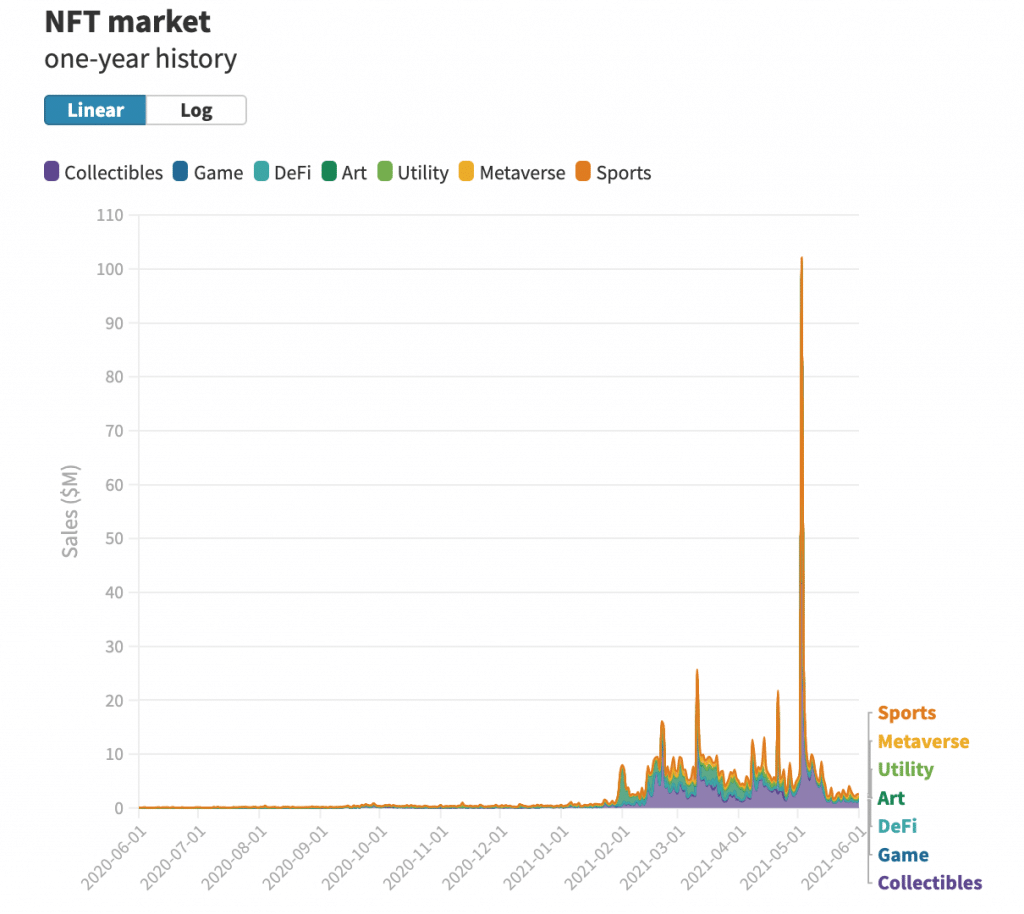
Source: NonFungible.com, via Protos
This steep drop in NFT sales could represent the confirmation of what many non-fungible token skeptics have been saying for months: that the boom in NFT markets earlier this year was nothing more than a hype-driven bubble.
However, proponents of these unique digital objects have a different point of view: that the NFT landscape is shifting, and, like the crypto market before it, many times over, that the crash is a healthy correction on the pathway to a more robust non-fungible token industry.
Which is true? Perhaps both.
May’s Crypto Market Crashes May Have Had an Outsized Effect on NFTs
And indeed, some analysts have connected the dots between the BTC drop and the decline in non-fungible token markets throughout the month of May: that as leverage was rinsed out of Bitcoin markets, much of the capital that had flowed into altcoin and NFT markets based on speculation and hype was similarly sent down the drain.
As a result, each of these markets was left bare, BTC with its diamond-handed die-hards, altcoins with their hopeful tech believers, and NFTs with a small, core group of serious collectors and artistic fans. In other words, the investors who stayed in each of these markets were a slimmer group of core believers in the technology and use cases that each of these crypto-asset sub-classes has.
NFTs may have been disproportionately affected by the cryptocurrency market crash last month because their use cases have not been as well-defined as the use cases of Bitcoin and altcoins. Andrew Miller, Head of Product Marketing at Oasis Labs, told Finance Magnates that: “Current use cases of NFTs are limited to assets such as digital art, where buyers speculate on the piece's potential value when marking their purchase.”
“This speculation is largely predicated on a belief that they will have social and historical value,” Miller told Finance Magnates. And indeed, the NFTs that have fetched large dollar amounts as of late have been associated with images or works of art that have penetrated the zeitgeist in some way, for example, Zoe Roth, also known as the 'disaster girl', fetched nearly $500K for the 'original' copy of the meme in which her face is featured.
However, over time Miller expects that NFT use cases will continue to expand, and, as such, that investments in NFTs will be less based on speculation. “As the technology surrounding NFTs matures, we expect to see them represent assets that are more sophisticated and have higher intrinsic value,” he said.
Miller pointed specifically to an NFT project that his own company, Oasis Labs, recently initiated. “Take, for example, our recent partnership with Nebula Genomics & Akoin to mint an NFT that represented Harvard professor George Church's sequenced genome data.”
Addressing the NFT Industry’s Ongoing Environmental Issues Will Take Time and Education
In the meantime, the NFT industry has some important issues to address.
Perhaps the largest PR problem that the NFT industry has been dealing with so far is the narrative that NFTs are bad for the environment. Non-fungible token creators have faced intense backlash over beliefs that the tokens they mint have hefty carbon footprints.
“The dominant narrative surrounding non-fungible tokens continues to be that they have an outsized carbon footprint, but this story is too narrow to accurately encompass the entire NFT space,” Blu said. “It incorrectly assumes that all NFTs are minted on Ethereum, which does consume a lot of electricity via its current deployment of proof-of-work consensus, but many other blockchains have emerged and are being utilized for NFT mints, including WAX, a proof-of-stake blockchain.”

Michael Blu, Co-Founder of LGND, an eco-conscious NFT platform.
Indeed, NFT proponents argue that there is not a direct relationship between the creation of a non-fungible token on the Ethereum blockchain and Ethereum’s total carbon footprint; others are in favour of using less carbon-intensive blockchains. Others still are holding off from creating NFTs until Ethereum completes its switch from a Proof-of-Work to a Proof-of-Stake consensus algorithm, which is slated to drastically reduce the amount of electricity it uses.
In spite of the non-fungible token industry’s carbon controversy, “I think the public is more aware of the potential for NFTs to transform the creative economy,” Blu said.
̧“Many people are living through the digital transformation that all aspects of society is undergoing, and so understanding the digital art revolution, and the need for artists to verify the authenticity of digital works is more intuitive.”
The Concept of NFT 'Ownership' Still Has a Few Kinks to Work Out
For example, Joanne Eberhardt, the Marketing Communications at Ton Labs, pointed to a major problem in the way that NFT 'ownership' currently operates: that while it is possible to own an NFT that corresponds to any kind of digital 'object', the permanence of that object is not guaranteed.
“There is no real NFT market and there never was one,” she said. “It’s make-believe.”
What does this mean? According to Eberhardt, until Web 3.0 is achieved, and, by extension, “true NFTs that are created on decentralized servers with decentralized backends,” any existing NFTs are “little more than something that can be removed from existence at the whim of the owner of the server or site, or at the behest of a third party with authority,” Eberhardt explained.
Indeed, earlier this year, Vice reported on the mysterious case of 'vanishing' NFTs. The article explained that: “̌When you buy an NFT...in most cases, you're not purchasing artwork or even an image file. Instead, you are buying a little bit of code that references a piece of media located somewhere else on the internet.” As such, if that file is taken down by The Powers That Be, there is no guarantee that it will ever reappear.
Eberhardt explained that therefore, true NFT 'ownership' will not be possible until the web is truly decentralized; only then will truly permanent and immutable digital file storage be possible.

Joanne Eberhardt, the Marketing Communications at Ton Labs.
The Future of the NFT Industry
Still, in spite of the issues that this nascent market has yet to resolve, many analysts and technologists believe that the non-fungible token market of the future will be a resilient, diverse landscape, filled with myriad use cases.
“NFTs were born around things like kitties and punks, and as a result, people still tend to go to that place of photos or music when thinking about NFTs,” Eberhardt told Finance Magnates. Earlier this year, this gave way to a ‘pop movement’ of “celebrities selling their own NFTs, popularizing adoption as a matter of both endorsement as well as new business ideas through collectables.”
As such, “I think we have only seen the first drops into what will inevitably become an ocean of honey,” she said, referring to investor interest in NFTs over the long term. “The market will explode once NFTs can be guaranteed to exist outside of centralized environments and without the need to belong to any elitist clubs or foundations or to have to register anything. Have an idea? Make an NFT. Sell it. That will break open the flood gates and change the game forever.”
After several weeks of price crashes and doldrums, the cryptocurrency market at large is showing signs of recovery. However, the non-fungible token (NFT) sector of the market may be a different story.
Over the last 24 hours, several headlines have reported that the NFT market has more or less 'officially crashed': for example, Gizmodo reported that: “The current answer to the question ‘What is the value of an NFT’ appears to be ‘not much and dwindling fast.’”
And, indeed, there was a steep drop in non-fungible token transaction volume over the course of May. Data from NonFungible.com shows that the week-long period surrounding the NFT market peak at the beginning of May saw $170 million in transactions. However, as reported by Protos, that figure has collapsed to just $19.4 million in NFT sales, a decrease of roughly 90%.
Source: NonFungible.com, via Protos
This steep drop in NFT sales could represent the confirmation of what many non-fungible token skeptics have been saying for months: that the boom in NFT markets earlier this year was nothing more than a hype-driven bubble.
However, proponents of these unique digital objects have a different point of view: that the NFT landscape is shifting, and, like the crypto market before it, many times over, that the crash is a healthy correction on the pathway to a more robust non-fungible token industry.
Which is true? Perhaps both.
May’s Crypto Market Crashes May Have Had an Outsized Effect on NFTs
And indeed, some analysts have connected the dots between the BTC drop and the decline in non-fungible token markets throughout the month of May: that as leverage was rinsed out of Bitcoin markets, much of the capital that had flowed into altcoin and NFT markets based on speculation and hype was similarly sent down the drain.
As a result, each of these markets was left bare, BTC with its diamond-handed die-hards, altcoins with their hopeful tech believers, and NFTs with a small, core group of serious collectors and artistic fans. In other words, the investors who stayed in each of these markets were a slimmer group of core believers in the technology and use cases that each of these crypto-asset sub-classes has.
NFTs may have been disproportionately affected by the cryptocurrency market crash last month because their use cases have not been as well-defined as the use cases of Bitcoin and altcoins. Andrew Miller, Head of Product Marketing at Oasis Labs, told Finance Magnates that: “Current use cases of NFTs are limited to assets such as digital art, where buyers speculate on the piece's potential value when marking their purchase.”
“This speculation is largely predicated on a belief that they will have social and historical value,” Miller told Finance Magnates. And indeed, the NFTs that have fetched large dollar amounts as of late have been associated with images or works of art that have penetrated the zeitgeist in some way, for example, Zoe Roth, also known as the 'disaster girl', fetched nearly $500K for the 'original' copy of the meme in which her face is featured.
However, over time Miller expects that NFT use cases will continue to expand, and, as such, that investments in NFTs will be less based on speculation. “As the technology surrounding NFTs matures, we expect to see them represent assets that are more sophisticated and have higher intrinsic value,” he said.
Miller pointed specifically to an NFT project that his own company, Oasis Labs, recently initiated. “Take, for example, our recent partnership with Nebula Genomics & Akoin to mint an NFT that represented Harvard professor George Church's sequenced genome data.”
Addressing the NFT Industry’s Ongoing Environmental Issues Will Take Time and Education
In the meantime, the NFT industry has some important issues to address.
Perhaps the largest PR problem that the NFT industry has been dealing with so far is the narrative that NFTs are bad for the environment. Non-fungible token creators have faced intense backlash over beliefs that the tokens they mint have hefty carbon footprints.
“The dominant narrative surrounding non-fungible tokens continues to be that they have an outsized carbon footprint, but this story is too narrow to accurately encompass the entire NFT space,” Blu said. “It incorrectly assumes that all NFTs are minted on Ethereum, which does consume a lot of electricity via its current deployment of proof-of-work consensus, but many other blockchains have emerged and are being utilized for NFT mints, including WAX, a proof-of-stake blockchain.”
Michael Blu, Co-Founder of LGND, an eco-conscious NFT platform.
Indeed, NFT proponents argue that there is not a direct relationship between the creation of a non-fungible token on the Ethereum blockchain and Ethereum’s total carbon footprint; others are in favour of using less carbon-intensive blockchains. Others still are holding off from creating NFTs until Ethereum completes its switch from a Proof-of-Work to a Proof-of-Stake consensus algorithm, which is slated to drastically reduce the amount of electricity it uses.
In spite of the non-fungible token industry’s carbon controversy, “I think the public is more aware of the potential for NFTs to transform the creative economy,” Blu said.
̧“Many people are living through the digital transformation that all aspects of society is undergoing, and so understanding the digital art revolution, and the need for artists to verify the authenticity of digital works is more intuitive.”
The Concept of NFT 'Ownership' Still Has a Few Kinks to Work Out
For example, Joanne Eberhardt, the Marketing Communications at Ton Labs, pointed to a major problem in the way that NFT 'ownership' currently operates: that while it is possible to own an NFT that corresponds to any kind of digital 'object', the permanence of that object is not guaranteed.
“There is no real NFT market and there never was one,” she said. “It’s make-believe.”
What does this mean? According to Eberhardt, until Web 3.0 is achieved, and, by extension, “true NFTs that are created on decentralized servers with decentralized backends,” any existing NFTs are “little more than something that can be removed from existence at the whim of the owner of the server or site, or at the behest of a third party with authority,” Eberhardt explained.
Indeed, earlier this year, Vice reported on the mysterious case of 'vanishing' NFTs. The article explained that: “̌When you buy an NFT...in most cases, you're not purchasing artwork or even an image file. Instead, you are buying a little bit of code that references a piece of media located somewhere else on the internet.” As such, if that file is taken down by The Powers That Be, there is no guarantee that it will ever reappear.
Eberhardt explained that therefore, true NFT 'ownership' will not be possible until the web is truly decentralized; only then will truly permanent and immutable digital file storage be possible.
Joanne Eberhardt, the Marketing Communications at Ton Labs.
The Future of the NFT Industry
Still, in spite of the issues that this nascent market has yet to resolve, many analysts and technologists believe that the non-fungible token market of the future will be a resilient, diverse landscape, filled with myriad use cases.
“NFTs were born around things like kitties and punks, and as a result, people still tend to go to that place of photos or music when thinking about NFTs,” Eberhardt told Finance Magnates. Earlier this year, this gave way to a ‘pop movement’ of “celebrities selling their own NFTs, popularizing adoption as a matter of both endorsement as well as new business ideas through collectables.”
As such, “I think we have only seen the first drops into what will inevitably become an ocean of honey,” she said, referring to investor interest in NFTs over the long term. “The market will explode once NFTs can be guaranteed to exist outside of centralized environments and without the need to belong to any elitist clubs or foundations or to have to register anything. Have an idea? Make an NFT. Sell it. That will break open the flood gates and change the game forever.”
Rachel is a self-taught crypto geek and a passionate writer. She believes in the power that the written word has to educate, connect and empower individuals to make positive and powerful financial choices. She is the Podcast Host and a Cryptocurrency Editor at Finance Magnates.
How Ripple Pulled Off the Year’s Biggest Crypto Raise While XRP Tumbled 40%
Featured Videos
Exness expands its presence in Africa: Inside our interview with Paul Margarites in Cape Town
Finance Magnates met with Paul Margarites, Exness regional commercial director for Sub-Saharan Africa, during a visit to the firm’s office opening in Cape Town. In this talk, led by Andrea Badiola Mateos, Co-CEO at Finance Magnates, Paul shares views on the South African trading space, local user behavior, mobile trends, regulation, team growth, and how Exness plans to grow in more markets across the region. @Exness
Read the article at: https://www.financemagnates.com/thought-leadership/exness-expands-its-presence-in-africa-inside-our-interview-with-paul-margarites/
#exness #financemagnates #exnesstrading #CFDtrading #tradeonline #africanews #capetown
Finance Magnates met with Paul Margarites, Exness regional commercial director for Sub-Saharan Africa, during a visit to the firm’s office opening in Cape Town. In this talk, led by Andrea Badiola Mateos, Co-CEO at Finance Magnates, Paul shares views on the South African trading space, local user behavior, mobile trends, regulation, team growth, and how Exness plans to grow in more markets across the region. @Exness
Read the article at: https://www.financemagnates.com/thought-leadership/exness-expands-its-presence-in-africa-inside-our-interview-with-paul-margarites/
#exness #financemagnates #exnesstrading #CFDtrading #tradeonline #africanews #capetown
Finance Magnates met with Paul Margarites, Exness regional commercial director for Sub-Saharan Africa, during a visit to the firm’s office opening in Cape Town. In this talk, led by Andrea Badiola Mateos, Co-CEO at Finance Magnates, Paul shares views on the South African trading space, local user behavior, mobile trends, regulation, team growth, and how Exness plans to grow in more markets across the region. @Exness
Read the article at: https://www.financemagnates.com/thought-leadership/exness-expands-its-presence-in-africa-inside-our-interview-with-paul-margarites/
#exness #financemagnates #exnesstrading #CFDtrading #tradeonline #africanews #capetown
Finance Magnates met with Paul Margarites, Exness regional commercial director for Sub-Saharan Africa, during a visit to the firm’s office opening in Cape Town. In this talk, led by Andrea Badiola Mateos, Co-CEO at Finance Magnates, Paul shares views on the South African trading space, local user behavior, mobile trends, regulation, team growth, and how Exness plans to grow in more markets across the region. @Exness
Read the article at: https://www.financemagnates.com/thought-leadership/exness-expands-its-presence-in-africa-inside-our-interview-with-paul-margarites/
#exness #financemagnates #exnesstrading #CFDtrading #tradeonline #africanews #capetown
Interview with Jas Shah
Builder | Adviser | Fintech Writer | Product Strategist
In this episode, Jonathan Fine sat down with Jas Shah, one of the most thoughtful voices in global fintech. Known for his work across advisory, product, stablecoins, and his widely read writing, Jas brings a rare combination of industry insight and plain-spoken clarity.
We talk about his first impression of the Summit, the projects that keep him busy today, and how they connect to the stablecoin panel he joined. Jas shares his view on the link between fintech, wealthtech and retail brokers, especially as firms like Revolut, eToro and Trading212 blur long-standing lines in the market.
We also explore what stablecoin adoption might look like for retail investment platforms, including a few product and UX angles that are not obvious at first glance.
To close, Jas explains how he thinks about writing, and how he approaches “shipping” pieces that spark debate across the industry.
Interview with Jas Shah
Builder | Adviser | Fintech Writer | Product Strategist
In this episode, Jonathan Fine sat down with Jas Shah, one of the most thoughtful voices in global fintech. Known for his work across advisory, product, stablecoins, and his widely read writing, Jas brings a rare combination of industry insight and plain-spoken clarity.
We talk about his first impression of the Summit, the projects that keep him busy today, and how they connect to the stablecoin panel he joined. Jas shares his view on the link between fintech, wealthtech and retail brokers, especially as firms like Revolut, eToro and Trading212 blur long-standing lines in the market.
We also explore what stablecoin adoption might look like for retail investment platforms, including a few product and UX angles that are not obvious at first glance.
To close, Jas explains how he thinks about writing, and how he approaches “shipping” pieces that spark debate across the industry.
Interview with Jas Shah
Builder | Adviser | Fintech Writer | Product Strategist
In this episode, Jonathan Fine sat down with Jas Shah, one of the most thoughtful voices in global fintech. Known for his work across advisory, product, stablecoins, and his widely read writing, Jas brings a rare combination of industry insight and plain-spoken clarity.
We talk about his first impression of the Summit, the projects that keep him busy today, and how they connect to the stablecoin panel he joined. Jas shares his view on the link between fintech, wealthtech and retail brokers, especially as firms like Revolut, eToro and Trading212 blur long-standing lines in the market.
We also explore what stablecoin adoption might look like for retail investment platforms, including a few product and UX angles that are not obvious at first glance.
To close, Jas explains how he thinks about writing, and how he approaches “shipping” pieces that spark debate across the industry.
Interview with Jas Shah
Builder | Adviser | Fintech Writer | Product Strategist
In this episode, Jonathan Fine sat down with Jas Shah, one of the most thoughtful voices in global fintech. Known for his work across advisory, product, stablecoins, and his widely read writing, Jas brings a rare combination of industry insight and plain-spoken clarity.
We talk about his first impression of the Summit, the projects that keep him busy today, and how they connect to the stablecoin panel he joined. Jas shares his view on the link between fintech, wealthtech and retail brokers, especially as firms like Revolut, eToro and Trading212 blur long-standing lines in the market.
We also explore what stablecoin adoption might look like for retail investment platforms, including a few product and UX angles that are not obvious at first glance.
To close, Jas explains how he thinks about writing, and how he approaches “shipping” pieces that spark debate across the industry.
Interview with Jas Shah
Builder | Adviser | Fintech Writer | Product Strategist
In this episode, Jonathan Fine sat down with Jas Shah, one of the most thoughtful voices in global fintech. Known for his work across advisory, product, stablecoins, and his widely read writing, Jas brings a rare combination of industry insight and plain-spoken clarity.
We talk about his first impression of the Summit, the projects that keep him busy today, and how they connect to the stablecoin panel he joined. Jas shares his view on the link between fintech, wealthtech and retail brokers, especially as firms like Revolut, eToro and Trading212 blur long-standing lines in the market.
We also explore what stablecoin adoption might look like for retail investment platforms, including a few product and UX angles that are not obvious at first glance.
To close, Jas explains how he thinks about writing, and how he approaches “shipping” pieces that spark debate across the industry.
Interview with Jas Shah
Builder | Adviser | Fintech Writer | Product Strategist
In this episode, Jonathan Fine sat down with Jas Shah, one of the most thoughtful voices in global fintech. Known for his work across advisory, product, stablecoins, and his widely read writing, Jas brings a rare combination of industry insight and plain-spoken clarity.
We talk about his first impression of the Summit, the projects that keep him busy today, and how they connect to the stablecoin panel he joined. Jas shares his view on the link between fintech, wealthtech and retail brokers, especially as firms like Revolut, eToro and Trading212 blur long-standing lines in the market.
We also explore what stablecoin adoption might look like for retail investment platforms, including a few product and UX angles that are not obvious at first glance.
To close, Jas explains how he thinks about writing, and how he approaches “shipping” pieces that spark debate across the industry.
Vitalii Bulynin Talks About Versus Trade, New Pairs, and Big Plans
In this interview, Versus Trade Co-Founder Vitalii Bulynin explains how the company got its license fast, why its trading pairs are fresh and fun, and what the team will build next.
He also discusses the most active pairs, the IB and MIB plans, and hiring needs for new markets.
Watch the whole talk to learn more about how Versus Trade works and where it is heading.
#financemagnates #VersusTrade #TradingPairs #BTCvsGold #goldtrading #innovation
In this interview, Versus Trade Co-Founder Vitalii Bulynin explains how the company got its license fast, why its trading pairs are fresh and fun, and what the team will build next.
He also discusses the most active pairs, the IB and MIB plans, and hiring needs for new markets.
Watch the whole talk to learn more about how Versus Trade works and where it is heading.
#financemagnates #VersusTrade #TradingPairs #BTCvsGold #goldtrading #innovation
In this interview, Versus Trade Co-Founder Vitalii Bulynin explains how the company got its license fast, why its trading pairs are fresh and fun, and what the team will build next.
He also discusses the most active pairs, the IB and MIB plans, and hiring needs for new markets.
Watch the whole talk to learn more about how Versus Trade works and where it is heading.
#financemagnates #VersusTrade #TradingPairs #BTCvsGold #goldtrading #innovation
In this interview, Versus Trade Co-Founder Vitalii Bulynin explains how the company got its license fast, why its trading pairs are fresh and fun, and what the team will build next.
He also discusses the most active pairs, the IB and MIB plans, and hiring needs for new markets.
Watch the whole talk to learn more about how Versus Trade works and where it is heading.
#financemagnates #VersusTrade #TradingPairs #BTCvsGold #goldtrading #innovation
In this interview, Versus Trade Co-Founder Vitalii Bulynin explains how the company got its license fast, why its trading pairs are fresh and fun, and what the team will build next.
He also discusses the most active pairs, the IB and MIB plans, and hiring needs for new markets.
Watch the whole talk to learn more about how Versus Trade works and where it is heading.
#financemagnates #VersusTrade #TradingPairs #BTCvsGold #goldtrading #innovation
In this interview, Versus Trade Co-Founder Vitalii Bulynin explains how the company got its license fast, why its trading pairs are fresh and fun, and what the team will build next.
He also discusses the most active pairs, the IB and MIB plans, and hiring needs for new markets.
Watch the whole talk to learn more about how Versus Trade works and where it is heading.
#financemagnates #VersusTrade #TradingPairs #BTCvsGold #goldtrading #innovation
Marketing in 2026 Audiences, Costs, and Smarter AI
As brokers eye B2B business and compete with fintechs and crypto exchanges alike, marketers need to act wisely with often limited budgets. AI can offer scalable solutions, but only if used properly.
Join seasoned marketing executives and specialists as they discuss the main challenges they identify in financial services in 2026 and how they address them.
Attendees of this session will walk away with:
- A nuts-and-bolts account of acquisition costs across platforms and geos
- Analysis of today’s multi-layered audience segments and differences in behaviour
- First-hand account of how global brokers balance consistency and local flavour
- Notes from the field about intelligently using AI and automation in marketing
Speakers:
-Yam Yehoshua, Editor-In-Chief at Finance Magnates
-Federico Paderni, Managing Director for Growth Markets in Europe at X
-Jo Benton, Chief Marketing Officer, Consulting | Fractional CMO
-Itai Levitan, Head of Strategy at investingLive
-Roberto Napolitano, CMO at Innovate Finance
-Tony Cross, Director at Monk Communications
#fmls #fmls25 #fmevents #FintechMarketing #AI #DigitalStrategy #Fintech #Innovation
Connect with us at:
🔗 LinkedIn: / financemagnates-events
👍 Facebook: / financemagnatesevents
📸 Instagram: / fmevents_official
🐦 Twitter: / f_m_events
🎥 TikTok: / fmevents_official
As brokers eye B2B business and compete with fintechs and crypto exchanges alike, marketers need to act wisely with often limited budgets. AI can offer scalable solutions, but only if used properly.
Join seasoned marketing executives and specialists as they discuss the main challenges they identify in financial services in 2026 and how they address them.
Attendees of this session will walk away with:
- A nuts-and-bolts account of acquisition costs across platforms and geos
- Analysis of today’s multi-layered audience segments and differences in behaviour
- First-hand account of how global brokers balance consistency and local flavour
- Notes from the field about intelligently using AI and automation in marketing
Speakers:
-Yam Yehoshua, Editor-In-Chief at Finance Magnates
-Federico Paderni, Managing Director for Growth Markets in Europe at X
-Jo Benton, Chief Marketing Officer, Consulting | Fractional CMO
-Itai Levitan, Head of Strategy at investingLive
-Roberto Napolitano, CMO at Innovate Finance
-Tony Cross, Director at Monk Communications
#fmls #fmls25 #fmevents #FintechMarketing #AI #DigitalStrategy #Fintech #Innovation
Connect with us at:
🔗 LinkedIn: / financemagnates-events
👍 Facebook: / financemagnatesevents
📸 Instagram: / fmevents_official
🐦 Twitter: / f_m_events
🎥 TikTok: / fmevents_official
As brokers eye B2B business and compete with fintechs and crypto exchanges alike, marketers need to act wisely with often limited budgets. AI can offer scalable solutions, but only if used properly.
Join seasoned marketing executives and specialists as they discuss the main challenges they identify in financial services in 2026 and how they address them.
Attendees of this session will walk away with:
- A nuts-and-bolts account of acquisition costs across platforms and geos
- Analysis of today’s multi-layered audience segments and differences in behaviour
- First-hand account of how global brokers balance consistency and local flavour
- Notes from the field about intelligently using AI and automation in marketing
Speakers:
-Yam Yehoshua, Editor-In-Chief at Finance Magnates
-Federico Paderni, Managing Director for Growth Markets in Europe at X
-Jo Benton, Chief Marketing Officer, Consulting | Fractional CMO
-Itai Levitan, Head of Strategy at investingLive
-Roberto Napolitano, CMO at Innovate Finance
-Tony Cross, Director at Monk Communications
#fmls #fmls25 #fmevents #FintechMarketing #AI #DigitalStrategy #Fintech #Innovation
Connect with us at:
🔗 LinkedIn: / financemagnates-events
👍 Facebook: / financemagnatesevents
📸 Instagram: / fmevents_official
🐦 Twitter: / f_m_events
🎥 TikTok: / fmevents_official
As brokers eye B2B business and compete with fintechs and crypto exchanges alike, marketers need to act wisely with often limited budgets. AI can offer scalable solutions, but only if used properly.
Join seasoned marketing executives and specialists as they discuss the main challenges they identify in financial services in 2026 and how they address them.
Attendees of this session will walk away with:
- A nuts-and-bolts account of acquisition costs across platforms and geos
- Analysis of today’s multi-layered audience segments and differences in behaviour
- First-hand account of how global brokers balance consistency and local flavour
- Notes from the field about intelligently using AI and automation in marketing
Speakers:
-Yam Yehoshua, Editor-In-Chief at Finance Magnates
-Federico Paderni, Managing Director for Growth Markets in Europe at X
-Jo Benton, Chief Marketing Officer, Consulting | Fractional CMO
-Itai Levitan, Head of Strategy at investingLive
-Roberto Napolitano, CMO at Innovate Finance
-Tony Cross, Director at Monk Communications
#fmls #fmls25 #fmevents #FintechMarketing #AI #DigitalStrategy #Fintech #Innovation
Connect with us at:
🔗 LinkedIn: / financemagnates-events
👍 Facebook: / financemagnatesevents
📸 Instagram: / fmevents_official
🐦 Twitter: / f_m_events
🎥 TikTok: / fmevents_official
As brokers eye B2B business and compete with fintechs and crypto exchanges alike, marketers need to act wisely with often limited budgets. AI can offer scalable solutions, but only if used properly.
Join seasoned marketing executives and specialists as they discuss the main challenges they identify in financial services in 2026 and how they address them.
Attendees of this session will walk away with:
- A nuts-and-bolts account of acquisition costs across platforms and geos
- Analysis of today’s multi-layered audience segments and differences in behaviour
- First-hand account of how global brokers balance consistency and local flavour
- Notes from the field about intelligently using AI and automation in marketing
Speakers:
-Yam Yehoshua, Editor-In-Chief at Finance Magnates
-Federico Paderni, Managing Director for Growth Markets in Europe at X
-Jo Benton, Chief Marketing Officer, Consulting | Fractional CMO
-Itai Levitan, Head of Strategy at investingLive
-Roberto Napolitano, CMO at Innovate Finance
-Tony Cross, Director at Monk Communications
#fmls #fmls25 #fmevents #FintechMarketing #AI #DigitalStrategy #Fintech #Innovation
Connect with us at:
🔗 LinkedIn: / financemagnates-events
👍 Facebook: / financemagnatesevents
📸 Instagram: / fmevents_official
🐦 Twitter: / f_m_events
🎥 TikTok: / fmevents_official
As brokers eye B2B business and compete with fintechs and crypto exchanges alike, marketers need to act wisely with often limited budgets. AI can offer scalable solutions, but only if used properly.
Join seasoned marketing executives and specialists as they discuss the main challenges they identify in financial services in 2026 and how they address them.
Attendees of this session will walk away with:
- A nuts-and-bolts account of acquisition costs across platforms and geos
- Analysis of today’s multi-layered audience segments and differences in behaviour
- First-hand account of how global brokers balance consistency and local flavour
- Notes from the field about intelligently using AI and automation in marketing
Speakers:
-Yam Yehoshua, Editor-In-Chief at Finance Magnates
-Federico Paderni, Managing Director for Growth Markets in Europe at X
-Jo Benton, Chief Marketing Officer, Consulting | Fractional CMO
-Itai Levitan, Head of Strategy at investingLive
-Roberto Napolitano, CMO at Innovate Finance
-Tony Cross, Director at Monk Communications
#fmls #fmls25 #fmevents #FintechMarketing #AI #DigitalStrategy #Fintech #Innovation
Connect with us at:
🔗 LinkedIn: / financemagnates-events
👍 Facebook: / financemagnatesevents
📸 Instagram: / fmevents_official
🐦 Twitter: / f_m_events
🎥 TikTok: / fmevents_official
Fail Better Trading Tech to Tackle Industry Risks
Much like their traders in the market, brokers must diversify to manage risk and stay resilient. But that can get costly, clunky, and lengthy.
This candid panel brings together builders across the trading infrastructure space to uncover the shifting dynamics behind tools, interfaces, and full-stack ambitions.
Attendees will hear:
-Why platform dependency has become one of the most overlooked risks in the trading business?
-Buy vs. build: What do hybrid models look like, and why are industry graveyards filled with failed ‘killer apps’?
-How AI is already changing execution, risk, and reporting—and what’s next?
-Which features, assets, and tools gain the most traction, and where brokers should look for tech-driven retention?
Speakers:
-Stephen Miles, Chief Revenue Officer at FYNXT
-John Morris, Co-Founder at FXBlue
-Matthew Smith, Group Chair & CEO at EC Markets
-Tom Higgins, Founder & CEO at Gold-i
-Gil Ben Hur, Founder at 5% Group
#fmls #fmls25 #fmevents #Brokers #Trading #Fintech #FintechInnovation #TradingTechnology #Innovation
Connect with us at:
🔗 LinkedIn: / financemagnates-events
👍 Facebook: / financemagnatesevents
📸 Instagram: / fmevents_official
🐦 Twitter: / f_m_events
🎥 TikTok: / fmevents_official
Much like their traders in the market, brokers must diversify to manage risk and stay resilient. But that can get costly, clunky, and lengthy.
This candid panel brings together builders across the trading infrastructure space to uncover the shifting dynamics behind tools, interfaces, and full-stack ambitions.
Attendees will hear:
-Why platform dependency has become one of the most overlooked risks in the trading business?
-Buy vs. build: What do hybrid models look like, and why are industry graveyards filled with failed ‘killer apps’?
-How AI is already changing execution, risk, and reporting—and what’s next?
-Which features, assets, and tools gain the most traction, and where brokers should look for tech-driven retention?
Speakers:
-Stephen Miles, Chief Revenue Officer at FYNXT
-John Morris, Co-Founder at FXBlue
-Matthew Smith, Group Chair & CEO at EC Markets
-Tom Higgins, Founder & CEO at Gold-i
-Gil Ben Hur, Founder at 5% Group
#fmls #fmls25 #fmevents #Brokers #Trading #Fintech #FintechInnovation #TradingTechnology #Innovation
Connect with us at:
🔗 LinkedIn: / financemagnates-events
👍 Facebook: / financemagnatesevents
📸 Instagram: / fmevents_official
🐦 Twitter: / f_m_events
🎥 TikTok: / fmevents_official
Much like their traders in the market, brokers must diversify to manage risk and stay resilient. But that can get costly, clunky, and lengthy.
This candid panel brings together builders across the trading infrastructure space to uncover the shifting dynamics behind tools, interfaces, and full-stack ambitions.
Attendees will hear:
-Why platform dependency has become one of the most overlooked risks in the trading business?
-Buy vs. build: What do hybrid models look like, and why are industry graveyards filled with failed ‘killer apps’?
-How AI is already changing execution, risk, and reporting—and what’s next?
-Which features, assets, and tools gain the most traction, and where brokers should look for tech-driven retention?
Speakers:
-Stephen Miles, Chief Revenue Officer at FYNXT
-John Morris, Co-Founder at FXBlue
-Matthew Smith, Group Chair & CEO at EC Markets
-Tom Higgins, Founder & CEO at Gold-i
-Gil Ben Hur, Founder at 5% Group
#fmls #fmls25 #fmevents #Brokers #Trading #Fintech #FintechInnovation #TradingTechnology #Innovation
Connect with us at:
🔗 LinkedIn: / financemagnates-events
👍 Facebook: / financemagnatesevents
📸 Instagram: / fmevents_official
🐦 Twitter: / f_m_events
🎥 TikTok: / fmevents_official
Much like their traders in the market, brokers must diversify to manage risk and stay resilient. But that can get costly, clunky, and lengthy.
This candid panel brings together builders across the trading infrastructure space to uncover the shifting dynamics behind tools, interfaces, and full-stack ambitions.
Attendees will hear:
-Why platform dependency has become one of the most overlooked risks in the trading business?
-Buy vs. build: What do hybrid models look like, and why are industry graveyards filled with failed ‘killer apps’?
-How AI is already changing execution, risk, and reporting—and what’s next?
-Which features, assets, and tools gain the most traction, and where brokers should look for tech-driven retention?
Speakers:
-Stephen Miles, Chief Revenue Officer at FYNXT
-John Morris, Co-Founder at FXBlue
-Matthew Smith, Group Chair & CEO at EC Markets
-Tom Higgins, Founder & CEO at Gold-i
-Gil Ben Hur, Founder at 5% Group
#fmls #fmls25 #fmevents #Brokers #Trading #Fintech #FintechInnovation #TradingTechnology #Innovation
Connect with us at:
🔗 LinkedIn: / financemagnates-events
👍 Facebook: / financemagnatesevents
📸 Instagram: / fmevents_official
🐦 Twitter: / f_m_events
🎥 TikTok: / fmevents_official
Much like their traders in the market, brokers must diversify to manage risk and stay resilient. But that can get costly, clunky, and lengthy.
This candid panel brings together builders across the trading infrastructure space to uncover the shifting dynamics behind tools, interfaces, and full-stack ambitions.
Attendees will hear:
-Why platform dependency has become one of the most overlooked risks in the trading business?
-Buy vs. build: What do hybrid models look like, and why are industry graveyards filled with failed ‘killer apps’?
-How AI is already changing execution, risk, and reporting—and what’s next?
-Which features, assets, and tools gain the most traction, and where brokers should look for tech-driven retention?
Speakers:
-Stephen Miles, Chief Revenue Officer at FYNXT
-John Morris, Co-Founder at FXBlue
-Matthew Smith, Group Chair & CEO at EC Markets
-Tom Higgins, Founder & CEO at Gold-i
-Gil Ben Hur, Founder at 5% Group
#fmls #fmls25 #fmevents #Brokers #Trading #Fintech #FintechInnovation #TradingTechnology #Innovation
Connect with us at:
🔗 LinkedIn: / financemagnates-events
👍 Facebook: / financemagnatesevents
📸 Instagram: / fmevents_official
🐦 Twitter: / f_m_events
🎥 TikTok: / fmevents_official
Much like their traders in the market, brokers must diversify to manage risk and stay resilient. But that can get costly, clunky, and lengthy.
This candid panel brings together builders across the trading infrastructure space to uncover the shifting dynamics behind tools, interfaces, and full-stack ambitions.
Attendees will hear:
-Why platform dependency has become one of the most overlooked risks in the trading business?
-Buy vs. build: What do hybrid models look like, and why are industry graveyards filled with failed ‘killer apps’?
-How AI is already changing execution, risk, and reporting—and what’s next?
-Which features, assets, and tools gain the most traction, and where brokers should look for tech-driven retention?
Speakers:
-Stephen Miles, Chief Revenue Officer at FYNXT
-John Morris, Co-Founder at FXBlue
-Matthew Smith, Group Chair & CEO at EC Markets
-Tom Higgins, Founder & CEO at Gold-i
-Gil Ben Hur, Founder at 5% Group
#fmls #fmls25 #fmevents #Brokers #Trading #Fintech #FintechInnovation #TradingTechnology #Innovation
Connect with us at:
🔗 LinkedIn: / financemagnates-events
👍 Facebook: / financemagnatesevents
📸 Instagram: / fmevents_official
🐦 Twitter: / f_m_events
🎥 TikTok: / fmevents_official