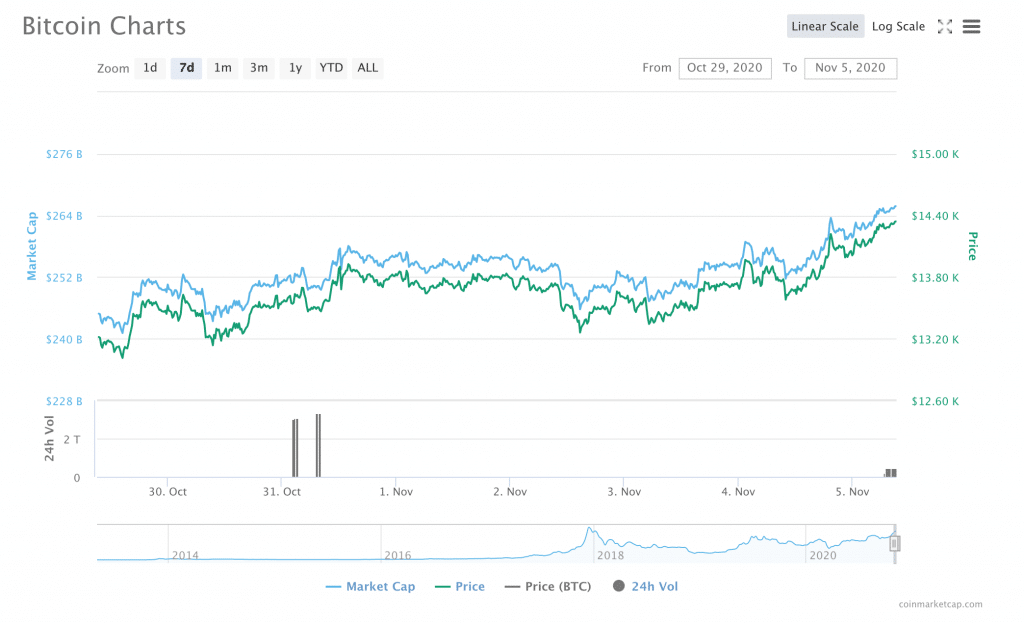
As the election drama continues, Bitcoin has surpassed $14,000.
What a week it has been.
While parties on both sides of the aisle were confident that the US Presidential election would be a landslide in either direction, this week saw the election transform into a real nail-biter: while Joe Biden was ahead at press time, Donald Trump still had a path to victory.
At the same time, the Trump campaign has already made it clear that the current President will not accept a loss without a fight.
The Trump campaign has already demanded a recount in the state of Wisconsin, which Joe Biden won by less than a percentage point; the campaign further said that it would file suit in Michigan to halt vote counting there.
Is the 2020 Election a 'Constitutional Crisis' in the Making?
The state of Pennsylvania has also been targeted by the Trump campaign with a lawsuit to stop ballot-counting filed Wednesday. Additionally, Before any official results were announced, the president’s campaign also intervened at the Supreme Court in a case that challenged Pennsylvania’s plan to count ballots received until up to three days after Election Day.
Also on Wednesday evening, the New York Times reported: “Mr. Trump’s team added Georgia to its list of legal targets” with requests for a court order that would enforce strict deadlines in Chatham County. The request follows allegations by a Republican poll observer that a small number of ineligible ballots might be counted in one location.
As the election drama continues, the number of lawsuits and other attempts to halt vote counting is likely to grow. In other words, we are in for a wild ride.
Indeed, Kadan Stadelmann, Chief Technology Officer of Komodo, told Finance Magnates that “given that there’s still a handful of states that are undecided in the presidential race, tensions are certainly high.
Kadan Stadelmann, Chief Technology Officer of Komodo.
“The continuous counting of mail-in ballots and possible lawsuits in key swing states could stretch to days or weeks, making for a constitutional crisis. Subsequently, there’s a good chance that neither party will accept the outcome if they are not in favor of the results.”
What does this mean for crypto?
“Political Uncertainty and Economic Uncertainty Go Hand in Hand.”
Kadan Stadelmann said that generally speaking, “political uncertainty and economic uncertainty go hand in hand.”
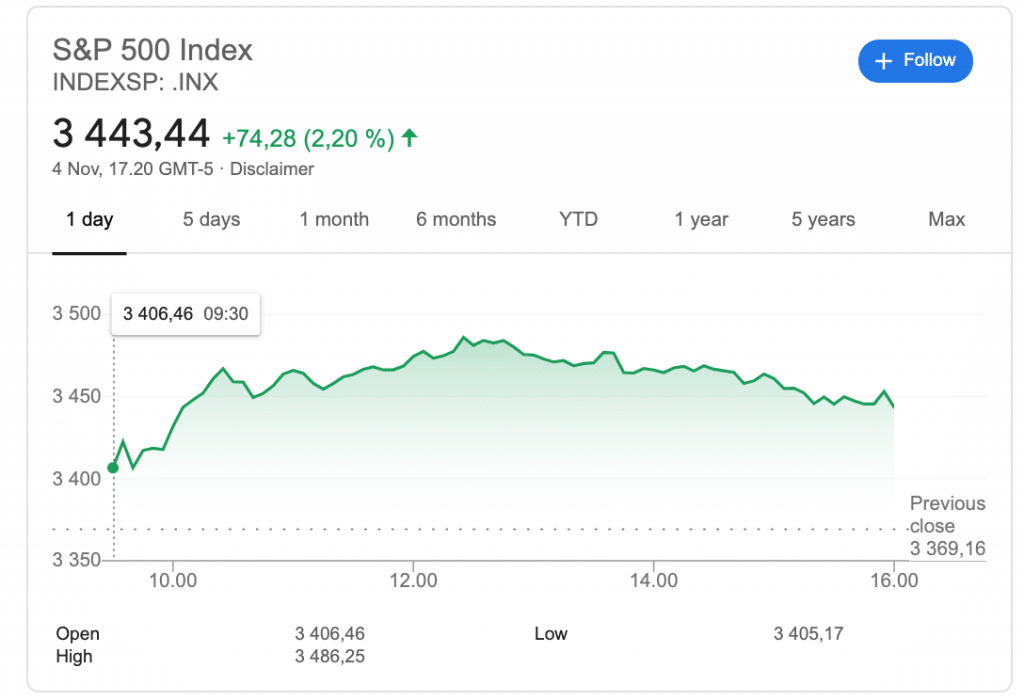
This time around, though, “it’s difficult to determine with certainty that there will be a negative effect on financial markets,” Stadelmann said. “Historically, S&P 500 volatility has been higher following an election as markets frequently reprice the probability of the future administration’s policies.”
So far this week, the election drama does not seem to have affected stock prices negatively, in fact, the opposite seems to be the case. A number of analysts have said that the upward movement in stock prices is due in large part to an apparent increase in the likelihood that Joe Biden will receive the 270 electoral votes needed to become the President-elect.
“At This Point, You Could Elect a Martian President and Risk Assets Would Rally.”
However, it is unclear whether Bitcoin and other cryptocurrencies are being fueled by Biden’s current lead in the presidential race, or if the threat of a deeply contested election (and possible civil unrest to follow) could be what is propelling Bitcoin forward.
Jeff Dorman, Chief Investment Officer at Arca, believes that BTC’s upward journey is most likely due to the former.
Jeff Dorman, chief investment officer at Arca.
“Markets hate uncertainty,” he said, particularly when it comes to risk assets. “Therefore, anything that clears up uncertainty is viewed positively by markets. Most investors can deal with negative outcomes, but they struggle to deal with uncertain outcomes.”
Therefore, “now that the election is (mostly) over and (seems) to be a victory for Biden, that uncertainty cloud is removed and people put money back to work.”
Arca published a report about this very phenomenon last month: "it appears that any news that clears up uncertainty will be met positively by market participants,” the report reads. “At this point, you could elect a Martian president and risk assets would rally simply because the uncertainty discount would be removed."
"More Stimulus Is Coming Regardless of Who Is Elected."
Therefore, the price of Bitcoin and other cryptocurrencies may have actually been held back in recent weeks and months because of the seeming uncertainty of the election. Now that things seem to be a bit more clear, BTC could continue to rise out of the veil of uncertainty and into new heights.
“Once uncertainty is removed, reality sets in that more stimulus is coming regardless of who is elected, and that brings USD weakness,” Jeff Dorman told Finance Magnates. “This is bullish for BTC.”
Indeed, Meltem Demirors, Chief Strategy Officer at CoinShares, told Finance Magnates that “partisan narratives aside, whether they are delivered in the form of tax cuts for corporations and the wealthy (Republicans) or in the form of government spending programs (Democrats), deficits are inevitable regardless of the outcome.”
In other words, “more stimulus is inevitable. Under any party, the spending and money printing orgy must continue. The realities facing investors are only different in the margins and the details. Rates remain at zero for the foreseeable future. Inflation continues not in CPI but in asset prices.”
Meltem Demirors, chief strategy officer of CoinShares.
Therefore, “Bitcoin has responded and will continue to respond not to the election, but to two continued quarters of economic and GDP contraction and rapid financialization as seen in dramatic increases in asset prices, especially in equities and housing stock.”
What Would a Trump or Biden Victory Mean for Crypto in a Practical Sense?
Beyond uncertainty, what would the election of either candidate mean for crypto in a practical sense?
Daniel Dabek, the Founder of SafeX, told Finance Magnates that a Biden victory could be positive for the mining sector of the crypto industry: “Joe Biden has been vocal about tariff removal between USA and China, which is essential for the miners operating in the United States.”
“This would lead to a competitive advantage to miners once again I believe increasing the uptake and marketing of cryptos,” Dabek said. “Not to mention, Biden was the Vice President during Bitcoin’s inception when it did rally from $0.01 to $1,200.00.”
Daniel Dabek added that as Bitcoin was propelling upward during the Trump years, “the whole crypto market grew from an aggregate market cap of $13 B peaking at $900 Billion.”
“So, there is precedent to Trump leadership and fabulous growth in the altcoins and cryptocurrency markets,” Dabek said.
In Either Scenario, the USA’s Policy Gridlock Is Likely to Continue
Meltem Demirors pointed out that “the presidential election doesn’t really matter so much from a policy perspective, since the GOP retained its hold on the Senate, the Dems maintained control of the House, and the gridlock will continue.”
Garrick Hileman, the Head of Research at Blockchain..com, also pointed out the continuation of the policy-making gridlock that has plagued the United States for years: “a Biden win and Republicans continuing to hold the Senate, as appears likely, means the government will remain divided,” he said.
At the same time, though, “crypto has performed well during the current environment of divided government and I would expect crypto to continue performing well under this scenario.”
How Much of an Impact Will the Election Actually Have on Bitcoin?
And indeed, policy gridlocks and partisan political narratives aside, there are still forces in the world that are bigger than the American government: for example, as these words are being written, the COVID-19 pandemic is still raging around much of the world.
In other words, the future of Bitcoin and other cryptocurrencies will not be wholly determined by who takes office next.
Therefore, Bitcoin’s next moves will largely be determined by the course it has already been set on.
For example, BTC has certainly moved in tandem with stock markets during various periods of its history, Bitcoin has also been increasingly described as a 'safe-haven' asset that grows in strength and usage when fiat currencies fail.
Indeed, Komodo’s Kadan Stadelmann said that “we’re seeing this election affect the cryptocurrency markets in a positive way.”
“If anything, the younger generations are beginning to take notice of the fact that Bitcoin has decoupled from the traditional markets,” he added.
“In addition to younger generations, even large corporations are jumping on the Bitcoin train. History has shown us that when uncertainty arises around these traditional economic and monetary systems, and they become harder to trust, investors and other big institutional players view crypto as a safe haven. We’ve recently seen large institutional investors like Grayscale begin to make this shift towards crypto.”
“The World Has Tons of Cash, but the Investment Opportunity Set Is Slimming by the Day.”
Arca CIO, Jeff Dorman also pointed out that beyond Bitcoin, “the rest of the digital assets space is more akin to small cap technology companies, and even though FB, GOOG, AAPL and other large tech stocks are rallying today, the election doesn't really move the needle much for small companies or emerging technologies,” he added. “So, [for altcoins, the rally] has little to no impact.”
Still, Dorman believes that “ultimately, the world has tons of cash, but the investment opportunity set is slimming by the day.”
“Government bonds are worthless. Equities are expensive. Commercial real estate is being threatened by COVID. So when you want to put cash to work, but the investment opportunity set is shrinking, you have to look elsewhere. And digital assets is one of a few areas of emerging technology growth that is not well understood or overly invested.”
“This is great for asset growth, which in turn, will lead to more investments in projects, which will lead to greater returns.”
What a week it has been.
While parties on both sides of the aisle were confident that the US Presidential election would be a landslide in either direction, this week saw the election transform into a real nail-biter: while Joe Biden was ahead at press time, Donald Trump still had a path to victory.
At the same time, the Trump campaign has already made it clear that the current President will not accept a loss without a fight.
The Trump campaign has already demanded a recount in the state of Wisconsin, which Joe Biden won by less than a percentage point; the campaign further said that it would file suit in Michigan to halt vote counting there.
Is the 2020 Election a 'Constitutional Crisis' in the Making?
The state of Pennsylvania has also been targeted by the Trump campaign with a lawsuit to stop ballot-counting filed Wednesday. Additionally, Before any official results were announced, the president’s campaign also intervened at the Supreme Court in a case that challenged Pennsylvania’s plan to count ballots received until up to three days after Election Day.
Also on Wednesday evening, the New York Times reported: “Mr. Trump’s team added Georgia to its list of legal targets” with requests for a court order that would enforce strict deadlines in Chatham County. The request follows allegations by a Republican poll observer that a small number of ineligible ballots might be counted in one location.
As the election drama continues, the number of lawsuits and other attempts to halt vote counting is likely to grow. In other words, we are in for a wild ride.
Indeed, Kadan Stadelmann, Chief Technology Officer of Komodo, told Finance Magnates that “given that there’s still a handful of states that are undecided in the presidential race, tensions are certainly high.
Kadan Stadelmann, Chief Technology Officer of Komodo.
“The continuous counting of mail-in ballots and possible lawsuits in key swing states could stretch to days or weeks, making for a constitutional crisis. Subsequently, there’s a good chance that neither party will accept the outcome if they are not in favor of the results.”
What does this mean for crypto?
“Political Uncertainty and Economic Uncertainty Go Hand in Hand.”
Kadan Stadelmann said that generally speaking, “political uncertainty and economic uncertainty go hand in hand.”
This time around, though, “it’s difficult to determine with certainty that there will be a negative effect on financial markets,” Stadelmann said. “Historically, S&P 500 volatility has been higher following an election as markets frequently reprice the probability of the future administration’s policies.”
So far this week, the election drama does not seem to have affected stock prices negatively, in fact, the opposite seems to be the case. A number of analysts have said that the upward movement in stock prices is due in large part to an apparent increase in the likelihood that Joe Biden will receive the 270 electoral votes needed to become the President-elect.
“At This Point, You Could Elect a Martian President and Risk Assets Would Rally.”
However, it is unclear whether Bitcoin and other cryptocurrencies are being fueled by Biden’s current lead in the presidential race, or if the threat of a deeply contested election (and possible civil unrest to follow) could be what is propelling Bitcoin forward.
Jeff Dorman, Chief Investment Officer at Arca, believes that BTC’s upward journey is most likely due to the former.
Jeff Dorman, chief investment officer at Arca.
“Markets hate uncertainty,” he said, particularly when it comes to risk assets. “Therefore, anything that clears up uncertainty is viewed positively by markets. Most investors can deal with negative outcomes, but they struggle to deal with uncertain outcomes.”
Therefore, “now that the election is (mostly) over and (seems) to be a victory for Biden, that uncertainty cloud is removed and people put money back to work.”
Arca published a report about this very phenomenon last month: "it appears that any news that clears up uncertainty will be met positively by market participants,” the report reads. “At this point, you could elect a Martian president and risk assets would rally simply because the uncertainty discount would be removed."
"More Stimulus Is Coming Regardless of Who Is Elected."
Therefore, the price of Bitcoin and other cryptocurrencies may have actually been held back in recent weeks and months because of the seeming uncertainty of the election. Now that things seem to be a bit more clear, BTC could continue to rise out of the veil of uncertainty and into new heights.
“Once uncertainty is removed, reality sets in that more stimulus is coming regardless of who is elected, and that brings USD weakness,” Jeff Dorman told Finance Magnates. “This is bullish for BTC.”
Indeed, Meltem Demirors, Chief Strategy Officer at CoinShares, told Finance Magnates that “partisan narratives aside, whether they are delivered in the form of tax cuts for corporations and the wealthy (Republicans) or in the form of government spending programs (Democrats), deficits are inevitable regardless of the outcome.”
In other words, “more stimulus is inevitable. Under any party, the spending and money printing orgy must continue. The realities facing investors are only different in the margins and the details. Rates remain at zero for the foreseeable future. Inflation continues not in CPI but in asset prices.”
Meltem Demirors, chief strategy officer of CoinShares.
Therefore, “Bitcoin has responded and will continue to respond not to the election, but to two continued quarters of economic and GDP contraction and rapid financialization as seen in dramatic increases in asset prices, especially in equities and housing stock.”
What Would a Trump or Biden Victory Mean for Crypto in a Practical Sense?
Beyond uncertainty, what would the election of either candidate mean for crypto in a practical sense?
Daniel Dabek, the Founder of SafeX, told Finance Magnates that a Biden victory could be positive for the mining sector of the crypto industry: “Joe Biden has been vocal about tariff removal between USA and China, which is essential for the miners operating in the United States.”
“This would lead to a competitive advantage to miners once again I believe increasing the uptake and marketing of cryptos,” Dabek said. “Not to mention, Biden was the Vice President during Bitcoin’s inception when it did rally from $0.01 to $1,200.00.”
Daniel Dabek added that as Bitcoin was propelling upward during the Trump years, “the whole crypto market grew from an aggregate market cap of $13 B peaking at $900 Billion.”
“So, there is precedent to Trump leadership and fabulous growth in the altcoins and cryptocurrency markets,” Dabek said.
In Either Scenario, the USA’s Policy Gridlock Is Likely to Continue
Meltem Demirors pointed out that “the presidential election doesn’t really matter so much from a policy perspective, since the GOP retained its hold on the Senate, the Dems maintained control of the House, and the gridlock will continue.”
Garrick Hileman, the Head of Research at Blockchain..com, also pointed out the continuation of the policy-making gridlock that has plagued the United States for years: “a Biden win and Republicans continuing to hold the Senate, as appears likely, means the government will remain divided,” he said.
At the same time, though, “crypto has performed well during the current environment of divided government and I would expect crypto to continue performing well under this scenario.”
How Much of an Impact Will the Election Actually Have on Bitcoin?
And indeed, policy gridlocks and partisan political narratives aside, there are still forces in the world that are bigger than the American government: for example, as these words are being written, the COVID-19 pandemic is still raging around much of the world.
In other words, the future of Bitcoin and other cryptocurrencies will not be wholly determined by who takes office next.
Therefore, Bitcoin’s next moves will largely be determined by the course it has already been set on.
For example, BTC has certainly moved in tandem with stock markets during various periods of its history, Bitcoin has also been increasingly described as a 'safe-haven' asset that grows in strength and usage when fiat currencies fail.
Indeed, Komodo’s Kadan Stadelmann said that “we’re seeing this election affect the cryptocurrency markets in a positive way.”
“If anything, the younger generations are beginning to take notice of the fact that Bitcoin has decoupled from the traditional markets,” he added.
“In addition to younger generations, even large corporations are jumping on the Bitcoin train. History has shown us that when uncertainty arises around these traditional economic and monetary systems, and they become harder to trust, investors and other big institutional players view crypto as a safe haven. We’ve recently seen large institutional investors like Grayscale begin to make this shift towards crypto.”
“The World Has Tons of Cash, but the Investment Opportunity Set Is Slimming by the Day.”
Arca CIO, Jeff Dorman also pointed out that beyond Bitcoin, “the rest of the digital assets space is more akin to small cap technology companies, and even though FB, GOOG, AAPL and other large tech stocks are rallying today, the election doesn't really move the needle much for small companies or emerging technologies,” he added. “So, [for altcoins, the rally] has little to no impact.”
Still, Dorman believes that “ultimately, the world has tons of cash, but the investment opportunity set is slimming by the day.”
“Government bonds are worthless. Equities are expensive. Commercial real estate is being threatened by COVID. So when you want to put cash to work, but the investment opportunity set is shrinking, you have to look elsewhere. And digital assets is one of a few areas of emerging technology growth that is not well understood or overly invested.”
“This is great for asset growth, which in turn, will lead to more investments in projects, which will lead to greater returns.”
Rachel is a self-taught crypto geek and a passionate writer. She believes in the power that the written word has to educate, connect and empower individuals to make positive and powerful financial choices. She is the Podcast Host and a Cryptocurrency Editor at Finance Magnates.
Australia's Digital Asset License Deadline Nears with 10% Turnover Penalty Looming
Featured Videos
FM Daily Brief - 8 May 2026
FM Daily Brief - 8 May 2026
FM Daily Brief - 8 May 2026
FM Daily Brief - 8 May 2026
Today's lead: Are brokers and prop firms wasting marketing budgets by confusing finfluencer reach with trust? Also ahead: an AWS outage impacting Coinbase, and Flutter reveals its real revenue strategy in prediction markets. It's Friday, the eighth of May 2026. You're listening to the Finance Magnates Daily Brief.
Today's lead: Are brokers and prop firms wasting marketing budgets by confusing finfluencer reach with trust? Also ahead: an AWS outage impacting Coinbase, and Flutter reveals its real revenue strategy in prediction markets. It's Friday, the eighth of May 2026. You're listening to the Finance Magnates Daily Brief.
Today's lead: Are brokers and prop firms wasting marketing budgets by confusing finfluencer reach with trust? Also ahead: an AWS outage impacting Coinbase, and Flutter reveals its real revenue strategy in prediction markets. It's Friday, the eighth of May 2026. You're listening to the Finance Magnates Daily Brief.
Today's lead: Are brokers and prop firms wasting marketing budgets by confusing finfluencer reach with trust? Also ahead: an AWS outage impacting Coinbase, and Flutter reveals its real revenue strategy in prediction markets. It's Friday, the eighth of May 2026. You're listening to the Finance Magnates Daily Brief.
Today’s lead: Colombia is emerging as a key hub for global retail brokers as CFI expands its footprint in Bogotá. Also ahead: a decade review of listed CFD brokers shows sharply diverging performance, and UK retail investing debates highlight a widening gap between policy design and younger investors. It’s Thursday, the seventh of May 2026. You’re listening to the Finance Magnates Daily Brief.
Today’s lead: Colombia is emerging as a key hub for global retail brokers as CFI expands its footprint in Bogotá. Also ahead: a decade review of listed CFD brokers shows sharply diverging performance, and UK retail investing debates highlight a widening gap between policy design and younger investors. It’s Thursday, the seventh of May 2026. You’re listening to the Finance Magnates Daily Brief.
Today’s lead: Colombia is emerging as a key hub for global retail brokers as CFI expands its footprint in Bogotá. Also ahead: a decade review of listed CFD brokers shows sharply diverging performance, and UK retail investing debates highlight a widening gap between policy design and younger investors. It’s Thursday, the seventh of May 2026. You’re listening to the Finance Magnates Daily Brief.
Today’s lead: Colombia is emerging as a key hub for global retail brokers as CFI expands its footprint in Bogotá. Also ahead: a decade review of listed CFD brokers shows sharply diverging performance, and UK retail investing debates highlight a widening gap between policy design and younger investors. It’s Thursday, the seventh of May 2026. You’re listening to the Finance Magnates Daily Brief.
Today’s lead: Colombia is emerging as a key hub for global retail brokers as CFI expands its footprint in Bogotá. Also ahead: a decade review of listed CFD brokers shows sharply diverging performance, and UK retail investing debates highlight a widening gap between policy design and younger investors. It’s Thursday, the seventh of May 2026. You’re listening to the Finance Magnates Daily Brief.
Today’s lead: Colombia is emerging as a key hub for global retail brokers as CFI expands its footprint in Bogotá. Also ahead: a decade review of listed CFD brokers shows sharply diverging performance, and UK retail investing debates highlight a widening gap between policy design and younger investors. It’s Thursday, the seventh of May 2026. You’re listening to the Finance Magnates Daily Brief.
FM Daily Brief - 6 May 2026
FM Daily Brief - 6 May 2026
FM Daily Brief - 6 May 2026
FM Daily Brief - 6 May 2026
FM Daily Brief - 6 May 2026
FM Daily Brief - 6 May 2026
Today’s lead: brokers are doubling down on Singapore, with Saxo launching a premium tier and CMC restructuring ahead of a multi-asset push. Also ahead: the UAE licensing race heats up, and a deeper shift in broker business models. It’s Wednesday, the sixth of May 2026. You’re listening to the Finance Magnates Daily Brief.
Today’s lead: brokers are doubling down on Singapore, with Saxo launching a premium tier and CMC restructuring ahead of a multi-asset push. Also ahead: the UAE licensing race heats up, and a deeper shift in broker business models. It’s Wednesday, the sixth of May 2026. You’re listening to the Finance Magnates Daily Brief.
Today’s lead: brokers are doubling down on Singapore, with Saxo launching a premium tier and CMC restructuring ahead of a multi-asset push. Also ahead: the UAE licensing race heats up, and a deeper shift in broker business models. It’s Wednesday, the sixth of May 2026. You’re listening to the Finance Magnates Daily Brief.
Today’s lead: brokers are doubling down on Singapore, with Saxo launching a premium tier and CMC restructuring ahead of a multi-asset push. Also ahead: the UAE licensing race heats up, and a deeper shift in broker business models. It’s Wednesday, the sixth of May 2026. You’re listening to the Finance Magnates Daily Brief.
Today’s lead: brokers are doubling down on Singapore, with Saxo launching a premium tier and CMC restructuring ahead of a multi-asset push. Also ahead: the UAE licensing race heats up, and a deeper shift in broker business models. It’s Wednesday, the sixth of May 2026. You’re listening to the Finance Magnates Daily Brief.
Today’s lead: brokers are doubling down on Singapore, with Saxo launching a premium tier and CMC restructuring ahead of a multi-asset push. Also ahead: the UAE licensing race heats up, and a deeper shift in broker business models. It’s Wednesday, the sixth of May 2026. You’re listening to the Finance Magnates Daily Brief.
FM Daily Brief - 5 May 2026
FM Daily Brief - 5 May 2026
FM Daily Brief - 5 May 2026
FM Daily Brief - 5 May 2026
FM Daily Brief - 5 May 2026
FM Daily Brief - 5 May 2026
Today's lead: the Middle East prop trading surge in Deloitte's tech rankings. Also ahead, Plus500 says full-year performance is tracking above forecasts. It's Tuesday, the fifth of May 2026. You're listening to the Finance Magnates Daily Brief.
Today's lead: the Middle East prop trading surge in Deloitte's tech rankings. Also ahead, Plus500 says full-year performance is tracking above forecasts. It's Tuesday, the fifth of May 2026. You're listening to the Finance Magnates Daily Brief.
Today's lead: the Middle East prop trading surge in Deloitte's tech rankings. Also ahead, Plus500 says full-year performance is tracking above forecasts. It's Tuesday, the fifth of May 2026. You're listening to the Finance Magnates Daily Brief.
Today's lead: the Middle East prop trading surge in Deloitte's tech rankings. Also ahead, Plus500 says full-year performance is tracking above forecasts. It's Tuesday, the fifth of May 2026. You're listening to the Finance Magnates Daily Brief.
Today's lead: the Middle East prop trading surge in Deloitte's tech rankings. Also ahead, Plus500 says full-year performance is tracking above forecasts. It's Tuesday, the fifth of May 2026. You're listening to the Finance Magnates Daily Brief.
Today's lead: the Middle East prop trading surge in Deloitte's tech rankings. Also ahead, Plus500 says full-year performance is tracking above forecasts. It's Tuesday, the fifth of May 2026. You're listening to the Finance Magnates Daily Brief.
FM Daily Brief - 4 May 2026
FM Daily Brief - 4 May 2026
FM Daily Brief - 4 May 2026
FM Daily Brief - 4 May 2026
FM Daily Brief - 4 May 2026
FM Daily Brief - 4 May 2026
Today's lead: spot FX volumes are retreating from March's war-driven peaks as the Iran ceasefire cools dollar trade. Also ahead: a Dubai-based broker sets out its gold volume targets for the rest of H1, and Australia's crypto licensing deadline moves closer with a 10% turnover penalty in play. It's Monday, the fourth of May 2026. You're listening to the Finance Magnates Daily Brief.
Today's lead: spot FX volumes are retreating from March's war-driven peaks as the Iran ceasefire cools dollar trade. Also ahead: a Dubai-based broker sets out its gold volume targets for the rest of H1, and Australia's crypto licensing deadline moves closer with a 10% turnover penalty in play. It's Monday, the fourth of May 2026. You're listening to the Finance Magnates Daily Brief.
Today's lead: spot FX volumes are retreating from March's war-driven peaks as the Iran ceasefire cools dollar trade. Also ahead: a Dubai-based broker sets out its gold volume targets for the rest of H1, and Australia's crypto licensing deadline moves closer with a 10% turnover penalty in play. It's Monday, the fourth of May 2026. You're listening to the Finance Magnates Daily Brief.
Today's lead: spot FX volumes are retreating from March's war-driven peaks as the Iran ceasefire cools dollar trade. Also ahead: a Dubai-based broker sets out its gold volume targets for the rest of H1, and Australia's crypto licensing deadline moves closer with a 10% turnover penalty in play. It's Monday, the fourth of May 2026. You're listening to the Finance Magnates Daily Brief.
Today's lead: spot FX volumes are retreating from March's war-driven peaks as the Iran ceasefire cools dollar trade. Also ahead: a Dubai-based broker sets out its gold volume targets for the rest of H1, and Australia's crypto licensing deadline moves closer with a 10% turnover penalty in play. It's Monday, the fourth of May 2026. You're listening to the Finance Magnates Daily Brief.
Today's lead: spot FX volumes are retreating from March's war-driven peaks as the Iran ceasefire cools dollar trade. Also ahead: a Dubai-based broker sets out its gold volume targets for the rest of H1, and Australia's crypto licensing deadline moves closer with a 10% turnover penalty in play. It's Monday, the fourth of May 2026. You're listening to the Finance Magnates Daily Brief.