Last week, BTC's price dropped more than 20 percent. Is the market crash over? What's next?
FM
After a veritable bloodbath last week, it appears that the price of Bitcoin may be stabilizing.
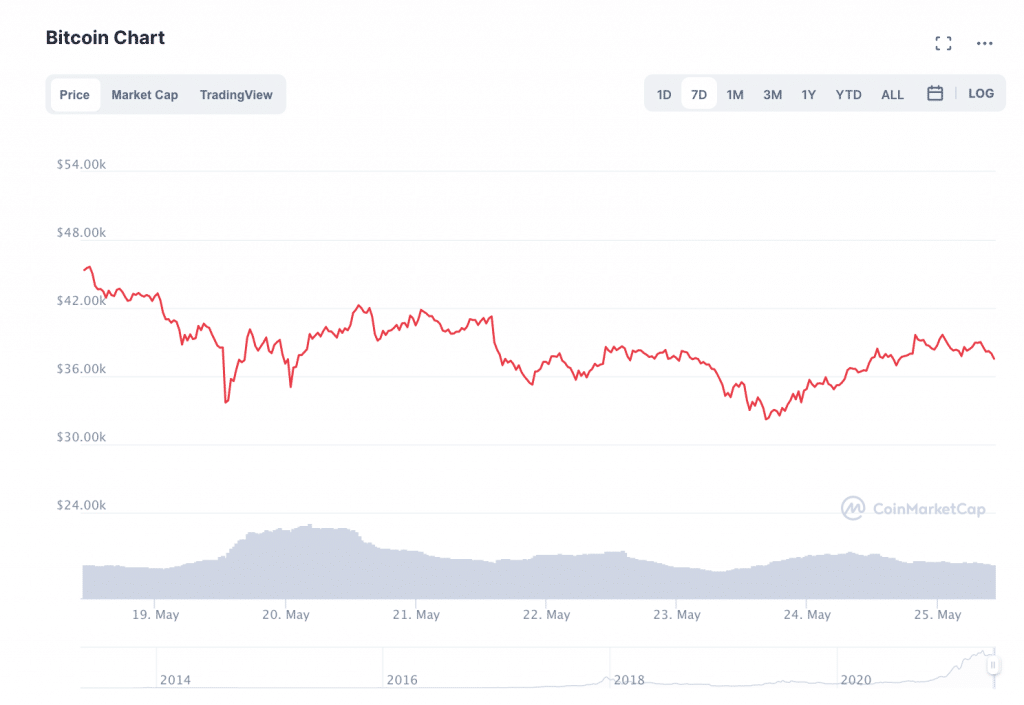
Indeed, BTC’s price over the last seven days is still down on the order of 15 percent. However, the 24-hour charts show something a bit more optimistic: Bitcoin is up more than 5 percent, having steadily climbed from $36.3K yesterday to roughly $38.5K at press time.
Additionally, Bitcoin’s stabilization appears to be reflected in Ether (ETH) and altcoin markets more generally. ETH is down 25 percent in seven days, but up 15 percent in 24 hours; Binance Coin (BNB) is down nearly 34 percent in seven days but is up roughly 20 percent in 24 hours. Similarly, XRP’s week-long decline of 35 percent is met with a 24-hour increase of nearly 20 percent. The charts of DogeCoin (DOGE), Cardano (ADA) and Polkadot (DOT) all tell similar stories.
It is almost enough to make one think that rays of hopeful light could be penetrating the doom and gloom that plagued crypto markets last week. But, is this reprieve from dropping crypto prices really the end of the nightmare? Or is this just the beginning of a long, dark night?
What Caused Bitcoin to Drop?
The causes behind Bitcoin’s massive drop seem to be fairly clear. The big news that broke last week was a joint note issued by the China Internet Finance Association, China Banking Association and China Payment and Clearing Association. The note made clear that China is planning on cracking down on cryptocurrency.
Specifically, the statement forbade financial institutions from working with crypto companies: “Financial and payment member institutions shall not provide services that relate to virtual currencies or directly and indirectly offer crypto-related services for their clients, including crypto trading, custody, lending and settlement; accepting virtual currencies as a payment tool; exchanging virtual currencies with the RMB.”
Moreover, the note stated that: “Virtual currency’s prices have soared and plummeted recently, resulting [in] a rebound of speculative trading activities of virtual currency. It has seriously damaged the safety of the people’s investment and damaged the normal economic and financial orders.”
Further, analysts have pointed out that the negative effects of both pieces of news were magnified by the liquidations of a high number of over-leveraged positions. The Twitter account of stock screening platform StockstoTrade pointed out that: “This Wednesday when #Bitcoin and #cryptocurrency crashed, 775,000 over-leveraged accounts were liquidated (completely wiped out) resulting in $8,000,000,000+ in total losses.”
This Wednesday, when #Bitcoin and #cryptocurrency crashed, 775,000 over-leveraged accounts were liquidated (completely wiped out) resulting in $8,000,000,000+ in total losses. Let this be a lesson to NEVER oversize and ALWAYS take gains into strength. Anything is possible.
Together, these three factors contributed to a sort of 'perfect storm' of bad news for Bitcoin. However, while the long-term effects of each of these pieces of news may not yet be fully realized, the short-term crash may have come to an end.
“There has been a series of recycled FUD (fear, uncertainty, and doubt) about Bitcoin which has scared new investors, but most have already sold in a panic,” he explained. “At this point, seasoned investors and HODLers have been steadily buying the dip — it just takes time for dollars to reach exchange accounts and for the buy pressure to overcome the panic selling.”
The term 'recycled FUD' refers to the fact that the problems that Bitcoin is currently facing seem to be reiterations of problems that it has faced before. After all, this is not the first time that the Chinese government has come out against crypto: in 2017, Bitcoin saw a serious price drop when China banned domestic cryptocurrency exchanges and ICOs.
“Media Narratives Have Had a Stronger Impact on the Bitcoin Price than Vice Versa.”
As for Tesla’s decision to drop BTC payments because of environmental concerns, many analysts agree that Bitcoin’s environmental problems are a moot point. Yes, BTC does have a heavy carbon footprint, but so does the traditional financial system, they say; others argue that the majority of electricity used to mine Bitcoin is generated from renewable sources.
In any case, the bottom line is that these issues are not new, they have been present in BTC markets for years, and discussions about their impact have been ongoing. However, with so many new investors in the Bitcoin market this year, these pieces of news, which have appeared in various forms in the past, may fall on fresh ears.
As a result, “Media narratives have had a stronger impact on the Bitcoin price than vice versa,” Mow said.
Samson Mow, CEO of Pixelmatic and CSO of Blockstream.
Additionally, “Many reputable outlets have been picking up poorly researched reports and multiplied their impact through sensational headlines,” he argued. “Paired with the ‘Elon Musk Effect’, this sent the market tumbling and led to cascading futures liquidations, which in turn stirred up panic among many investors.”
“But, just like the impact from Elon's Tweets is noticeably wearing off, the current narratives will become old news soon, and their effect on the price will be negligible — until the next cycle, that is.”
How Low Will Bitcoin Go?
For now, the 'Elon Musk effect' on Bitcoin’s price is palpable. Paul Sundin, who is the Founder, CPA, and Tax Strategist of Emparion, told Finance Magnates that: “When a prominent Bitcoin influencer like Elon Musk publicly announced that Tesla would no longer accept Bitcoin currency for purchasing their vehicles, it's like announcing to the public that you have withdrawn your confidence and trust as an investor.”
Thus, “panic selling ensues” from “newbie and dependent investors who only mirror their investment strategy from the likes of Elon Musk.”
But, how low could this Musk effect drive the price of Bitcoin? “While I cannot specify when it stabilizes, the decline will only be for the short term,” Sundin told Finance Magnates.
“It will most likely go back to its 200-day moving average...to $40,000 compared to just below $44,000 currently,” he said. “The decline, in my opinion, is a way for this highly volatile market to make corrections, and the market will most likely rebound even before the prices can get any lower.”
Paul Sundin, the Founder, CPA, and Tax Strategist of Emparion.
Doug Schwenk, Chairman of Digital Asset Research (DAR), believes that Bitcoin’s price drop may have bottomed out.
“Bitcoin trades largely on sentiment, which can lead to almost any outcome, but the psychological benchmarks of previous stable levels or round numbers are often telling,” he said. To that end, “$30k seems to have been a natural support level with the price rallying back toward $40k from the low $30k's this past week.”
Doug Schwenk, Chairman and Chief Executive of Digital Assets Research (DAR).
“If the news does not contain further surprises (and Elon keeps his comments in check), we likely won't see further drops in the near term. There have been net positive institutional buyers who have seen this as a buying opportunity and that helps support the price.”
(So far, Elon seems to be behaving. On Monday, he tweeted that he “Spoke with North American Bitcoin miners. They committed to publish current & planned renewable usage & to ask miners WW to do so. Potentially promising (sic).”)
“$100,000 Is Still in Play This Year” for BTC: Samson Mow
Even with the price drama of the last two weeks, Mow believes that: “$100,000 is still in play this year.”
“None of the current events have had any impact on Bitcoin's fundamentals — in fact, none of the ‘concerns’ are actually new,” he said. “Bitcoin is still the best form of money we have ever seen, and it still serves as a powerful hedge in times of uncontrolled monetary stimulus.”
Still, while the most recent round of price drama may have come to some kind of a conclusion, this probably will not be the last time that BTC sees high levels of volatility.
After a veritable bloodbath last week, it appears that the price of Bitcoin may be stabilizing.
Indeed, BTC’s price over the last seven days is still down on the order of 15 percent. However, the 24-hour charts show something a bit more optimistic: Bitcoin is up more than 5 percent, having steadily climbed from $36.3K yesterday to roughly $38.5K at press time.
Additionally, Bitcoin’s stabilization appears to be reflected in Ether (ETH) and altcoin markets more generally. ETH is down 25 percent in seven days, but up 15 percent in 24 hours; Binance Coin (BNB) is down nearly 34 percent in seven days but is up roughly 20 percent in 24 hours. Similarly, XRP’s week-long decline of 35 percent is met with a 24-hour increase of nearly 20 percent. The charts of DogeCoin (DOGE), Cardano (ADA) and Polkadot (DOT) all tell similar stories.
It is almost enough to make one think that rays of hopeful light could be penetrating the doom and gloom that plagued crypto markets last week. But, is this reprieve from dropping crypto prices really the end of the nightmare? Or is this just the beginning of a long, dark night?
What Caused Bitcoin to Drop?
The causes behind Bitcoin’s massive drop seem to be fairly clear. The big news that broke last week was a joint note issued by the China Internet Finance Association, China Banking Association and China Payment and Clearing Association. The note made clear that China is planning on cracking down on cryptocurrency.
Specifically, the statement forbade financial institutions from working with crypto companies: “Financial and payment member institutions shall not provide services that relate to virtual currencies or directly and indirectly offer crypto-related services for their clients, including crypto trading, custody, lending and settlement; accepting virtual currencies as a payment tool; exchanging virtual currencies with the RMB.”
Moreover, the note stated that: “Virtual currency’s prices have soared and plummeted recently, resulting [in] a rebound of speculative trading activities of virtual currency. It has seriously damaged the safety of the people’s investment and damaged the normal economic and financial orders.”
Further, analysts have pointed out that the negative effects of both pieces of news were magnified by the liquidations of a high number of over-leveraged positions. The Twitter account of stock screening platform StockstoTrade pointed out that: “This Wednesday when #Bitcoin and #cryptocurrency crashed, 775,000 over-leveraged accounts were liquidated (completely wiped out) resulting in $8,000,000,000+ in total losses.”
This Wednesday, when #Bitcoin and #cryptocurrency crashed, 775,000 over-leveraged accounts were liquidated (completely wiped out) resulting in $8,000,000,000+ in total losses. Let this be a lesson to NEVER oversize and ALWAYS take gains into strength. Anything is possible.
Together, these three factors contributed to a sort of 'perfect storm' of bad news for Bitcoin. However, while the long-term effects of each of these pieces of news may not yet be fully realized, the short-term crash may have come to an end.
“There has been a series of recycled FUD (fear, uncertainty, and doubt) about Bitcoin which has scared new investors, but most have already sold in a panic,” he explained. “At this point, seasoned investors and HODLers have been steadily buying the dip — it just takes time for dollars to reach exchange accounts and for the buy pressure to overcome the panic selling.”
The term 'recycled FUD' refers to the fact that the problems that Bitcoin is currently facing seem to be reiterations of problems that it has faced before. After all, this is not the first time that the Chinese government has come out against crypto: in 2017, Bitcoin saw a serious price drop when China banned domestic cryptocurrency exchanges and ICOs.
“Media Narratives Have Had a Stronger Impact on the Bitcoin Price than Vice Versa.”
As for Tesla’s decision to drop BTC payments because of environmental concerns, many analysts agree that Bitcoin’s environmental problems are a moot point. Yes, BTC does have a heavy carbon footprint, but so does the traditional financial system, they say; others argue that the majority of electricity used to mine Bitcoin is generated from renewable sources.
In any case, the bottom line is that these issues are not new, they have been present in BTC markets for years, and discussions about their impact have been ongoing. However, with so many new investors in the Bitcoin market this year, these pieces of news, which have appeared in various forms in the past, may fall on fresh ears.
As a result, “Media narratives have had a stronger impact on the Bitcoin price than vice versa,” Mow said.
Samson Mow, CEO of Pixelmatic and CSO of Blockstream.
Additionally, “Many reputable outlets have been picking up poorly researched reports and multiplied their impact through sensational headlines,” he argued. “Paired with the ‘Elon Musk Effect’, this sent the market tumbling and led to cascading futures liquidations, which in turn stirred up panic among many investors.”
“But, just like the impact from Elon's Tweets is noticeably wearing off, the current narratives will become old news soon, and their effect on the price will be negligible — until the next cycle, that is.”
How Low Will Bitcoin Go?
For now, the 'Elon Musk effect' on Bitcoin’s price is palpable. Paul Sundin, who is the Founder, CPA, and Tax Strategist of Emparion, told Finance Magnates that: “When a prominent Bitcoin influencer like Elon Musk publicly announced that Tesla would no longer accept Bitcoin currency for purchasing their vehicles, it's like announcing to the public that you have withdrawn your confidence and trust as an investor.”
Thus, “panic selling ensues” from “newbie and dependent investors who only mirror their investment strategy from the likes of Elon Musk.”
But, how low could this Musk effect drive the price of Bitcoin? “While I cannot specify when it stabilizes, the decline will only be for the short term,” Sundin told Finance Magnates.
“It will most likely go back to its 200-day moving average...to $40,000 compared to just below $44,000 currently,” he said. “The decline, in my opinion, is a way for this highly volatile market to make corrections, and the market will most likely rebound even before the prices can get any lower.”
Paul Sundin, the Founder, CPA, and Tax Strategist of Emparion.
Doug Schwenk, Chairman of Digital Asset Research (DAR), believes that Bitcoin’s price drop may have bottomed out.
“Bitcoin trades largely on sentiment, which can lead to almost any outcome, but the psychological benchmarks of previous stable levels or round numbers are often telling,” he said. To that end, “$30k seems to have been a natural support level with the price rallying back toward $40k from the low $30k's this past week.”
Doug Schwenk, Chairman and Chief Executive of Digital Assets Research (DAR).
“If the news does not contain further surprises (and Elon keeps his comments in check), we likely won't see further drops in the near term. There have been net positive institutional buyers who have seen this as a buying opportunity and that helps support the price.”
(So far, Elon seems to be behaving. On Monday, he tweeted that he “Spoke with North American Bitcoin miners. They committed to publish current & planned renewable usage & to ask miners WW to do so. Potentially promising (sic).”)
“$100,000 Is Still in Play This Year” for BTC: Samson Mow
Even with the price drama of the last two weeks, Mow believes that: “$100,000 is still in play this year.”
“None of the current events have had any impact on Bitcoin's fundamentals — in fact, none of the ‘concerns’ are actually new,” he said. “Bitcoin is still the best form of money we have ever seen, and it still serves as a powerful hedge in times of uncontrolled monetary stimulus.”
Still, while the most recent round of price drama may have come to some kind of a conclusion, this probably will not be the last time that BTC sees high levels of volatility.
Rachel is a self-taught crypto geek and a passionate writer. She believes in the power that the written word has to educate, connect and empower individuals to make positive and powerful financial choices. She is the Podcast Host and a Cryptocurrency Editor at Finance Magnates.
Binance Launches Retail AI Assistant, Repackages Existing Trading Tools
Featured Videos
AvaTrade to Acquire Most of FXCM; NAGA Raises $8M
AvaTrade to Acquire Most of FXCM; NAGA Raises $8M
AvaTrade to Acquire Most of FXCM; NAGA Raises $8M
AvaTrade to Acquire Most of FXCM; NAGA Raises $8M
Today’s financial news recap covers AvaTrade agrees to acquire most of FXCM, NAGA secures eight million dollars in new financing, and Wise seeks a tax settlement in the UK.
Finance Magnates Daily Recap brings you the latest news from forex and CFD brokers, fintech, payments, cryptocurrency, digital assets, trading platforms, financial regulation and global markets.
Get the key company news, executive moves, deals, regulatory updates and market developments of the day, in just a few minutes. New episodes published every weekday.
Read more: https://www.financemagnates.com
#FinanceMagnates #ForexNews #FintechNews
Today’s financial news recap covers AvaTrade agrees to acquire most of FXCM, NAGA secures eight million dollars in new financing, and Wise seeks a tax settlement in the UK.
Finance Magnates Daily Recap brings you the latest news from forex and CFD brokers, fintech, payments, cryptocurrency, digital assets, trading platforms, financial regulation and global markets.
Get the key company news, executive moves, deals, regulatory updates and market developments of the day, in just a few minutes. New episodes published every weekday.
Read more: https://www.financemagnates.com
#FinanceMagnates #ForexNews #FintechNews
Today’s financial news recap covers AvaTrade agrees to acquire most of FXCM, NAGA secures eight million dollars in new financing, and Wise seeks a tax settlement in the UK.
Finance Magnates Daily Recap brings you the latest news from forex and CFD brokers, fintech, payments, cryptocurrency, digital assets, trading platforms, financial regulation and global markets.
Get the key company news, executive moves, deals, regulatory updates and market developments of the day, in just a few minutes. New episodes published every weekday.
Read more: https://www.financemagnates.com
#FinanceMagnates #ForexNews #FintechNews
Today’s financial news recap covers AvaTrade agrees to acquire most of FXCM, NAGA secures eight million dollars in new financing, and Wise seeks a tax settlement in the UK.
Finance Magnates Daily Recap brings you the latest news from forex and CFD brokers, fintech, payments, cryptocurrency, digital assets, trading platforms, financial regulation and global markets.
Get the key company news, executive moves, deals, regulatory updates and market developments of the day, in just a few minutes. New episodes published every weekday.
Read more: https://www.financemagnates.com
#FinanceMagnates #ForexNews #FintechNews
XTB Adds Overnight US Stock Trading; Nasdaq Ventures Invests in One Trading
XTB Adds Overnight US Stock Trading; Nasdaq Ventures Invests in One Trading
XTB Adds Overnight US Stock Trading; Nasdaq Ventures Invests in One Trading
XTB Adds Overnight US Stock Trading; Nasdaq Ventures Invests in One Trading
XTB Adds Overnight US Stock Trading; Nasdaq Ventures Invests in One Trading
XTB Adds Overnight US Stock Trading; Nasdaq Ventures Invests in One Trading
Today’s financial news recap covers XTB expands overnight US stock trading, Fortrade reports higher revenue, Nasdaq backs One Trading, and Vest Labs raises 13 million dollars.
Finance Magnates Daily Recap brings you the latest news from forex and CFD brokers, fintech, payments, cryptocurrency, digital assets, trading platforms, financial regulation and global markets.
Get the key company news, executive moves, deals, regulatory updates and market developments of the day, in just a few minutes. New episodes published every weekday.
Read more: https://www.financemagnates.com
#FinanceMagnates #ForexNews #FintechNews
Today’s financial news recap covers XTB expands overnight US stock trading, Fortrade reports higher revenue, Nasdaq backs One Trading, and Vest Labs raises 13 million dollars.
Finance Magnates Daily Recap brings you the latest news from forex and CFD brokers, fintech, payments, cryptocurrency, digital assets, trading platforms, financial regulation and global markets.
Get the key company news, executive moves, deals, regulatory updates and market developments of the day, in just a few minutes. New episodes published every weekday.
Read more: https://www.financemagnates.com
#FinanceMagnates #ForexNews #FintechNews
Today’s financial news recap covers XTB expands overnight US stock trading, Fortrade reports higher revenue, Nasdaq backs One Trading, and Vest Labs raises 13 million dollars.
Finance Magnates Daily Recap brings you the latest news from forex and CFD brokers, fintech, payments, cryptocurrency, digital assets, trading platforms, financial regulation and global markets.
Get the key company news, executive moves, deals, regulatory updates and market developments of the day, in just a few minutes. New episodes published every weekday.
Read more: https://www.financemagnates.com
#FinanceMagnates #ForexNews #FintechNews
Today’s financial news recap covers XTB expands overnight US stock trading, Fortrade reports higher revenue, Nasdaq backs One Trading, and Vest Labs raises 13 million dollars.
Finance Magnates Daily Recap brings you the latest news from forex and CFD brokers, fintech, payments, cryptocurrency, digital assets, trading platforms, financial regulation and global markets.
Get the key company news, executive moves, deals, regulatory updates and market developments of the day, in just a few minutes. New episodes published every weekday.
Read more: https://www.financemagnates.com
#FinanceMagnates #ForexNews #FintechNews
Today’s financial news recap covers XTB expands overnight US stock trading, Fortrade reports higher revenue, Nasdaq backs One Trading, and Vest Labs raises 13 million dollars.
Finance Magnates Daily Recap brings you the latest news from forex and CFD brokers, fintech, payments, cryptocurrency, digital assets, trading platforms, financial regulation and global markets.
Get the key company news, executive moves, deals, regulatory updates and market developments of the day, in just a few minutes. New episodes published every weekday.
Read more: https://www.financemagnates.com
#FinanceMagnates #ForexNews #FintechNews
Today’s financial news recap covers XTB expands overnight US stock trading, Fortrade reports higher revenue, Nasdaq backs One Trading, and Vest Labs raises 13 million dollars.
Finance Magnates Daily Recap brings you the latest news from forex and CFD brokers, fintech, payments, cryptocurrency, digital assets, trading platforms, financial regulation and global markets.
Get the key company news, executive moves, deals, regulatory updates and market developments of the day, in just a few minutes. New episodes published every weekday.
Read more: https://www.financemagnates.com
#FinanceMagnates #ForexNews #FintechNews
CMC Founder Downplays Volatility Hit; Devexperts Names CEO
CMC Founder Downplays Volatility Hit; Devexperts Names CEO
CMC Founder Downplays Volatility Hit; Devexperts Names CEO
CMC Founder Downplays Volatility Hit; Devexperts Names CEO
CMC Founder Downplays Volatility Hit; Devexperts Names CEO
CMC Founder Downplays Volatility Hit; Devexperts Names CEO
Today’s financial news recap covers low volatility pressures brokers, Devexperts names a new CEO, Saxo cuts onboarding time, and OKX reaches a 25 billion dollar valuation.
Finance Magnates Daily Recap brings you the latest news from forex and CFD brokers, fintech, payments, cryptocurrency, digital assets, trading platforms, financial regulation and global markets.
Get the key company news, executive moves, deals, regulatory updates and market developments of the day, in just a few minutes. New episodes published every weekday.
Read more: https://www.financemagnates.com
#FinanceMagnates #ForexNews #FintechNews
Today’s financial news recap covers low volatility pressures brokers, Devexperts names a new CEO, Saxo cuts onboarding time, and OKX reaches a 25 billion dollar valuation.
Finance Magnates Daily Recap brings you the latest news from forex and CFD brokers, fintech, payments, cryptocurrency, digital assets, trading platforms, financial regulation and global markets.
Get the key company news, executive moves, deals, regulatory updates and market developments of the day, in just a few minutes. New episodes published every weekday.
Read more: https://www.financemagnates.com
#FinanceMagnates #ForexNews #FintechNews
Today’s financial news recap covers low volatility pressures brokers, Devexperts names a new CEO, Saxo cuts onboarding time, and OKX reaches a 25 billion dollar valuation.
Finance Magnates Daily Recap brings you the latest news from forex and CFD brokers, fintech, payments, cryptocurrency, digital assets, trading platforms, financial regulation and global markets.
Get the key company news, executive moves, deals, regulatory updates and market developments of the day, in just a few minutes. New episodes published every weekday.
Read more: https://www.financemagnates.com
#FinanceMagnates #ForexNews #FintechNews
Today’s financial news recap covers low volatility pressures brokers, Devexperts names a new CEO, Saxo cuts onboarding time, and OKX reaches a 25 billion dollar valuation.
Finance Magnates Daily Recap brings you the latest news from forex and CFD brokers, fintech, payments, cryptocurrency, digital assets, trading platforms, financial regulation and global markets.
Get the key company news, executive moves, deals, regulatory updates and market developments of the day, in just a few minutes. New episodes published every weekday.
Read more: https://www.financemagnates.com
#FinanceMagnates #ForexNews #FintechNews
Today’s financial news recap covers low volatility pressures brokers, Devexperts names a new CEO, Saxo cuts onboarding time, and OKX reaches a 25 billion dollar valuation.
Finance Magnates Daily Recap brings you the latest news from forex and CFD brokers, fintech, payments, cryptocurrency, digital assets, trading platforms, financial regulation and global markets.
Get the key company news, executive moves, deals, regulatory updates and market developments of the day, in just a few minutes. New episodes published every weekday.
Read more: https://www.financemagnates.com
#FinanceMagnates #ForexNews #FintechNews
Today’s financial news recap covers low volatility pressures brokers, Devexperts names a new CEO, Saxo cuts onboarding time, and OKX reaches a 25 billion dollar valuation.
Finance Magnates Daily Recap brings you the latest news from forex and CFD brokers, fintech, payments, cryptocurrency, digital assets, trading platforms, financial regulation and global markets.
Get the key company news, executive moves, deals, regulatory updates and market developments of the day, in just a few minutes. New episodes published every weekday.
Read more: https://www.financemagnates.com
#FinanceMagnates #ForexNews #FintechNews
Today’s financial news recap covers Trade Nation buys FXCM's UK client book, Trading 212 reports higher revenue, the CFTC's move to allow perpetual index futures.
Finance Magnates Daily Recap brings you the latest news from forex and CFD brokers, fintech, payments, cryptocurrency, digital assets, trading platforms, financial regulation and global markets.
Get the key company news, executive moves, deals, regulatory updates and market developments of the day, in just a few minutes. New episodes published every weekday.
Read more: https://www.financemagnates.com
#FinanceMagnates #ForexNews #FintechNews
Today’s financial news recap covers Trade Nation buys FXCM's UK client book, Trading 212 reports higher revenue, the CFTC's move to allow perpetual index futures.
Finance Magnates Daily Recap brings you the latest news from forex and CFD brokers, fintech, payments, cryptocurrency, digital assets, trading platforms, financial regulation and global markets.
Get the key company news, executive moves, deals, regulatory updates and market developments of the day, in just a few minutes. New episodes published every weekday.
Read more: https://www.financemagnates.com
#FinanceMagnates #ForexNews #FintechNews
Today’s financial news recap covers Trade Nation buys FXCM's UK client book, Trading 212 reports higher revenue, the CFTC's move to allow perpetual index futures.
Finance Magnates Daily Recap brings you the latest news from forex and CFD brokers, fintech, payments, cryptocurrency, digital assets, trading platforms, financial regulation and global markets.
Get the key company news, executive moves, deals, regulatory updates and market developments of the day, in just a few minutes. New episodes published every weekday.
Read more: https://www.financemagnates.com
#FinanceMagnates #ForexNews #FintechNews
Today’s financial news recap covers Trade Nation buys FXCM's UK client book, Trading 212 reports higher revenue, the CFTC's move to allow perpetual index futures.
Finance Magnates Daily Recap brings you the latest news from forex and CFD brokers, fintech, payments, cryptocurrency, digital assets, trading platforms, financial regulation and global markets.
Get the key company news, executive moves, deals, regulatory updates and market developments of the day, in just a few minutes. New episodes published every weekday.
Read more: https://www.financemagnates.com
#FinanceMagnates #ForexNews #FintechNews
Today’s financial news recap covers Trade Nation buys FXCM's UK client book, Trading 212 reports higher revenue, the CFTC's move to allow perpetual index futures.
Finance Magnates Daily Recap brings you the latest news from forex and CFD brokers, fintech, payments, cryptocurrency, digital assets, trading platforms, financial regulation and global markets.
Get the key company news, executive moves, deals, regulatory updates and market developments of the day, in just a few minutes. New episodes published every weekday.
Read more: https://www.financemagnates.com
#FinanceMagnates #ForexNews #FintechNews
Today’s financial news recap covers Trade Nation buys FXCM's UK client book, Trading 212 reports higher revenue, the CFTC's move to allow perpetual index futures.
Finance Magnates Daily Recap brings you the latest news from forex and CFD brokers, fintech, payments, cryptocurrency, digital assets, trading platforms, financial regulation and global markets.
Get the key company news, executive moves, deals, regulatory updates and market developments of the day, in just a few minutes. New episodes published every weekday.
Read more: https://www.financemagnates.com
#FinanceMagnates #ForexNews #FintechNews
Your career isn’t a linear path.
Your career isn’t a linear path.
Your career isn’t a linear path.
Your career isn’t a linear path.
Your career isn’t a linear path.
Your career isn’t a linear path.
Roles change. Career goals change. Sometimes you want a completely new challenge.
But the skills and knowledge you build along the way can stay with you and give you something to build on.
For Jeff Patterson, that continued growth is key to long-term career development.
You bring the skills. FM Academy helps you build the knowledge.
#FMAcademy #FinanceMagnates #FinanceCareers #ProfessionalDevelopment #Fintech
Roles change. Career goals change. Sometimes you want a completely new challenge.
But the skills and knowledge you build along the way can stay with you and give you something to build on.
For Jeff Patterson, that continued growth is key to long-term career development.
You bring the skills. FM Academy helps you build the knowledge.
#FMAcademy #FinanceMagnates #FinanceCareers #ProfessionalDevelopment #Fintech
Roles change. Career goals change. Sometimes you want a completely new challenge.
But the skills and knowledge you build along the way can stay with you and give you something to build on.
For Jeff Patterson, that continued growth is key to long-term career development.
You bring the skills. FM Academy helps you build the knowledge.
#FMAcademy #FinanceMagnates #FinanceCareers #ProfessionalDevelopment #Fintech
Roles change. Career goals change. Sometimes you want a completely new challenge.
But the skills and knowledge you build along the way can stay with you and give you something to build on.
For Jeff Patterson, that continued growth is key to long-term career development.
You bring the skills. FM Academy helps you build the knowledge.
#FMAcademy #FinanceMagnates #FinanceCareers #ProfessionalDevelopment #Fintech
Roles change. Career goals change. Sometimes you want a completely new challenge.
But the skills and knowledge you build along the way can stay with you and give you something to build on.
For Jeff Patterson, that continued growth is key to long-term career development.
You bring the skills. FM Academy helps you build the knowledge.
#FMAcademy #FinanceMagnates #FinanceCareers #ProfessionalDevelopment #Fintech
Roles change. Career goals change. Sometimes you want a completely new challenge.
But the skills and knowledge you build along the way can stay with you and give you something to build on.
For Jeff Patterson, that continued growth is key to long-term career development.
You bring the skills. FM Academy helps you build the knowledge.
#FMAcademy #FinanceMagnates #FinanceCareers #ProfessionalDevelopment #Fintech