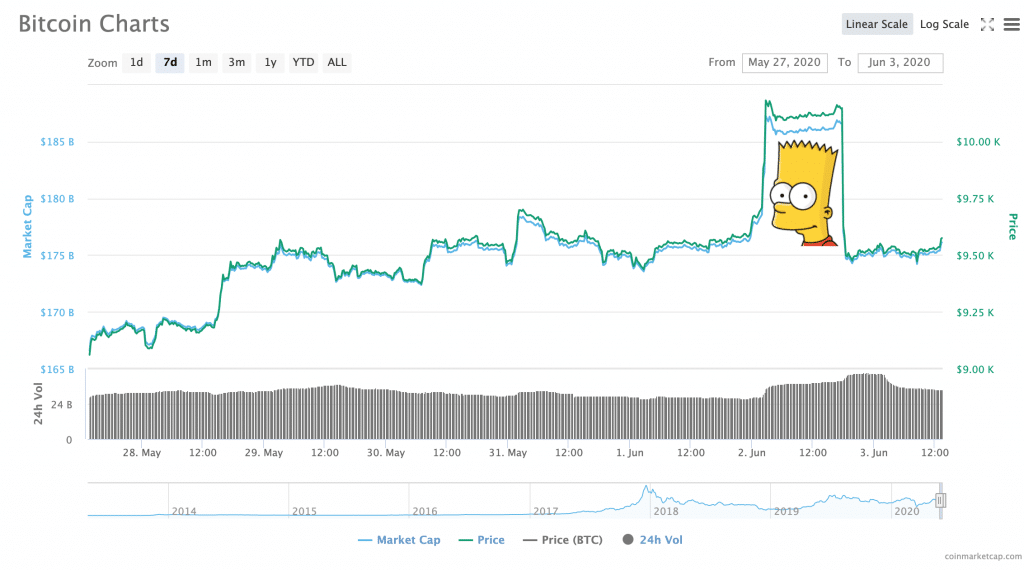
As described by user ‘JamesRKaye’ in a post on Trading View, a Bart pattern is “characterized by its sudden rise in price, sideways movement, then sudden drop,” forming a line that resembles the hairline of Homer Simpson’s only son.
However, before the latter half of the pattern was formed, Bitcoin enthusiasts across Twitter started making their predictions that this time--surely this time--would be the end of Bitcoin below $10k forever.
“I don't usually make predictions. But this is too obvious not to call. We will never see Bitcoin below $10k again,” wrote Twitter user @hodlonaut around 10.30 CEST on June 2nd.
I don't usually make predictions. But this is too obvious not to call.
Not quite as bullish, Mati Greenspan, market analyst and founder of Quantum Economics, also tweeted that “this MIGHT be your last chance to buy Bitcoin under $10k.”
This MIGHT be your last chance to buy Bitcoin under $10k. 🔥🚀🌛
— Mati Greenspan (tweets ≠ financial advice) (@MatiGreenspan) June 2, 2020
(It wasn’t.)
$10k is still a sticking point for BTC
Still, BTC’s brief and most recent foray over the $10,000 mark and back again begs the question: why does this keep happening?
Indeed, Bitcoin has been on a trajectory to sustain a pass over $10k for quite some time; however, each time Bitcoin does make it over the $10,000 mark, a similar pattern of events seems to follow: there’s a bit of hullabaloo about how this time is the time that Bitcoin will stay over $10k, and then Bitcoin falls back under $10k (where it stays for weeks, or even months.)
Alex Mashinsky, founder and chief executive of Celsius Network, told Finance Magnates that this pattern of rising and falling around the $10k mark is par for the course--we could be in for a longer period of false starts: “I flagged several times [that] we will ‘kiss’ $10k and go back,” he said.
However, Mashinsky said that in the greater scheme of things, the crypto world has never had such polarized views about where Bitcoin is headed next: “in the past four years, I have [never] seen more contradicting views betting all they have with such conviction [than now],” he said. “At Celsius, we see record borrowing of both dollars to go long and BTC to go short, as the bulls and the bears battle it out.”
Did political unrest briefly drive the price of Bitcoin past $10,000?
However, there is little evidence to show that the world’s major fiat currencies--the USD, in particular--will enter crisis mode anytime soon; and thereby, little evidence that people will be buying Bitcoin en masse as a result of the political unrest in America or elsewhere in the world (in spite of what this guy might think.)
In fact, in the most economically perilous moments of the coronavirus fallout, the USD was temporarily driven to highs that haven’t been seen in several years as a result of the effects of the coronavirus, though it seems to be returning to pre-corona levels.
In a statement shared with Finance Magnates, Mathew Ficke, head of market development at cryptocurrency exchange OkCoin, also noted that “BTC's move back above $10,000 coincides with civil and economic unrest throughout the US.”
“Some argue the environment reminds the market that BTC can act as a hedge against excessive government influence. As equities are near pre-shelter-in-place levels, many seem to view crypto as relatively attractive."
BTC hodlers hope to profit off of short-term BTC gains during times of political unrest
And even if the political unrest isn’t a strong motivating factor for buying coins in and of itself, the belief that more people will be buying coins as a result of the protests can be a powerful incentivizing force for investors hoping to profit off of short-term gains.
Matthew Ficke, Head of Market Development at OKCoin.
A similar phenomenon occurred when tensions arose between the United States and Iran at the beginning of 2020. In addition to an increase in the price of BTC, data from Google Trends during the week ending on January 8th showed that the search term “Bitcoin Iran” had spiked several times--by the end of the week, searches for “Bitcoin Iran” had risen a total of roughly 4,450%.
Similarly, this time around, the number of searches for “Bitcoin protests” has risen significantly in the last week.
Collin Plume, chief executive and founder of Noble Gold Investments, told Finance Magnates that many investors still see Bitcoin as a place to make fast income, and as economic and political unrest continues, the need for ‘quick’ income increases: therefore, he believes that Investors’ short term interest in the currency causes the rapid increase and decline in its cost: “when you have something that can move so quickly and the return can be so high for a short period of time, people sell,” he said.
Regardless of whether the protests in America or elsewhere in the world are having any kind of direct effect on the price of BTC, Alex Mashinsky pointed out that the role that news plays in Bitcoin prices should not be underestimated.
Any news--good or bad--moves the whole market in an exaggerated way,” Mashinsky said. For example, in addition to the riots in America, “recently, coin movement in an old dormant BTC account spooked the longs.”
Collin Plume, chief executive and founder of Noble Gold Investments.
However, when it comes to BTC buying and selling behavior, the news may have a larger effect on institutional investors--and those concerned with the opinions of institutions: “a bad review from Goldman Sachs tanks the market, and [the entrance of] new fund managers like Paul Tudor Jones lifts it,” Mashinsky said.
$10k could be a “psychological barrier” for crypto investors
However, if the unrest in America was indeed the primary reason for the short push past $10k, why couldn’t Bitcoin sustain the move past $10k this time?
Collin Plume told Finance Magnates that in the greater scheme of things, one of the factors keeping BTC under $10k could have to do with investor psychology.
The number 10,000 has also been observed as a psychological barrier in other financial markets as well.
Indeed, in an article for Business Insider, CNBC Senior Editor John Carney wrote of “The Curse Of Dow 10,000”. This phenomenon describes the way that from 1999-2003, every time the Dow seemed to have reached the 10,000 level, it would “succumb to a bear market and fall below it every time.”
While it’s possible that something about the way that ‘$10,000’--a “big round number”--looks on the page could be somehow intimidating to investors, the curse of 10,000 seems to have more to do with $10,000 being a marker at which BTC (and other financial markets) tend to have stalled out in the past.
“If the markets have in the past displayed a tendency to pull back at a certain level, rational investors can anticipate this and begin selling at that level,” Carney wrote.
Therefore, if $10,000 seems to be the place where BTC has stalled out before, then investors may plan to sell once $10,000 is reached in order to avoid a loss; this could be the reason that Bitcoin seems to dance around the 10,000-mark before falling back down.
Carney called these investors ‘psychological arbitrageurs’, or ‘Psych Arbs’: these traders “[reinforce] what otherwise might be an irrational market behavior, as the traders try to make money by betting that the market will gyrate when it hits key psychological points.”
What’s next?
Still, while the tendency to get stuck around $10,000 may be frustrating, Mashinsky argues that it could be good for the industry in the longer term: that every time BTC hits $10k, more traders and miners could enter into the Bitcoin ecosystem for the first time.
“When BTC spikes to recent highs (like $10,500) it gives a good entry point to shorts and mining guys who want to lock in gains,” he said.
Therefore, eventually, “we will break the $10k levels”--but this is only the first in a long line of upward movements.
“Then we need to get through $12k and $14k, which represent further resistance. After that, we are good to test new highs,” he said, adding that he believes that “it will come faster than anyone thinks, as violence and anarchy escalates with over 40 million Americans out of a job.”
As described by user ‘JamesRKaye’ in a post on Trading View, a Bart pattern is “characterized by its sudden rise in price, sideways movement, then sudden drop,” forming a line that resembles the hairline of Homer Simpson’s only son.
However, before the latter half of the pattern was formed, Bitcoin enthusiasts across Twitter started making their predictions that this time--surely this time--would be the end of Bitcoin below $10k forever.
“I don't usually make predictions. But this is too obvious not to call. We will never see Bitcoin below $10k again,” wrote Twitter user @hodlonaut around 10.30 CEST on June 2nd.
I don't usually make predictions. But this is too obvious not to call.
Not quite as bullish, Mati Greenspan, market analyst and founder of Quantum Economics, also tweeted that “this MIGHT be your last chance to buy Bitcoin under $10k.”
This MIGHT be your last chance to buy Bitcoin under $10k. 🔥🚀🌛
— Mati Greenspan (tweets ≠ financial advice) (@MatiGreenspan) June 2, 2020
(It wasn’t.)
$10k is still a sticking point for BTC
Still, BTC’s brief and most recent foray over the $10,000 mark and back again begs the question: why does this keep happening?
Indeed, Bitcoin has been on a trajectory to sustain a pass over $10k for quite some time; however, each time Bitcoin does make it over the $10,000 mark, a similar pattern of events seems to follow: there’s a bit of hullabaloo about how this time is the time that Bitcoin will stay over $10k, and then Bitcoin falls back under $10k (where it stays for weeks, or even months.)
Alex Mashinsky, founder and chief executive of Celsius Network, told Finance Magnates that this pattern of rising and falling around the $10k mark is par for the course--we could be in for a longer period of false starts: “I flagged several times [that] we will ‘kiss’ $10k and go back,” he said.
However, Mashinsky said that in the greater scheme of things, the crypto world has never had such polarized views about where Bitcoin is headed next: “in the past four years, I have [never] seen more contradicting views betting all they have with such conviction [than now],” he said. “At Celsius, we see record borrowing of both dollars to go long and BTC to go short, as the bulls and the bears battle it out.”
Did political unrest briefly drive the price of Bitcoin past $10,000?
However, there is little evidence to show that the world’s major fiat currencies--the USD, in particular--will enter crisis mode anytime soon; and thereby, little evidence that people will be buying Bitcoin en masse as a result of the political unrest in America or elsewhere in the world (in spite of what this guy might think.)
In fact, in the most economically perilous moments of the coronavirus fallout, the USD was temporarily driven to highs that haven’t been seen in several years as a result of the effects of the coronavirus, though it seems to be returning to pre-corona levels.
In a statement shared with Finance Magnates, Mathew Ficke, head of market development at cryptocurrency exchange OkCoin, also noted that “BTC's move back above $10,000 coincides with civil and economic unrest throughout the US.”
“Some argue the environment reminds the market that BTC can act as a hedge against excessive government influence. As equities are near pre-shelter-in-place levels, many seem to view crypto as relatively attractive."
BTC hodlers hope to profit off of short-term BTC gains during times of political unrest
And even if the political unrest isn’t a strong motivating factor for buying coins in and of itself, the belief that more people will be buying coins as a result of the protests can be a powerful incentivizing force for investors hoping to profit off of short-term gains.
Matthew Ficke, Head of Market Development at OKCoin.
A similar phenomenon occurred when tensions arose between the United States and Iran at the beginning of 2020. In addition to an increase in the price of BTC, data from Google Trends during the week ending on January 8th showed that the search term “Bitcoin Iran” had spiked several times--by the end of the week, searches for “Bitcoin Iran” had risen a total of roughly 4,450%.
Similarly, this time around, the number of searches for “Bitcoin protests” has risen significantly in the last week.
Collin Plume, chief executive and founder of Noble Gold Investments, told Finance Magnates that many investors still see Bitcoin as a place to make fast income, and as economic and political unrest continues, the need for ‘quick’ income increases: therefore, he believes that Investors’ short term interest in the currency causes the rapid increase and decline in its cost: “when you have something that can move so quickly and the return can be so high for a short period of time, people sell,” he said.
Regardless of whether the protests in America or elsewhere in the world are having any kind of direct effect on the price of BTC, Alex Mashinsky pointed out that the role that news plays in Bitcoin prices should not be underestimated.
Any news--good or bad--moves the whole market in an exaggerated way,” Mashinsky said. For example, in addition to the riots in America, “recently, coin movement in an old dormant BTC account spooked the longs.”
Collin Plume, chief executive and founder of Noble Gold Investments.
However, when it comes to BTC buying and selling behavior, the news may have a larger effect on institutional investors--and those concerned with the opinions of institutions: “a bad review from Goldman Sachs tanks the market, and [the entrance of] new fund managers like Paul Tudor Jones lifts it,” Mashinsky said.
$10k could be a “psychological barrier” for crypto investors
However, if the unrest in America was indeed the primary reason for the short push past $10k, why couldn’t Bitcoin sustain the move past $10k this time?
Collin Plume told Finance Magnates that in the greater scheme of things, one of the factors keeping BTC under $10k could have to do with investor psychology.
The number 10,000 has also been observed as a psychological barrier in other financial markets as well.
Indeed, in an article for Business Insider, CNBC Senior Editor John Carney wrote of “The Curse Of Dow 10,000”. This phenomenon describes the way that from 1999-2003, every time the Dow seemed to have reached the 10,000 level, it would “succumb to a bear market and fall below it every time.”
While it’s possible that something about the way that ‘$10,000’--a “big round number”--looks on the page could be somehow intimidating to investors, the curse of 10,000 seems to have more to do with $10,000 being a marker at which BTC (and other financial markets) tend to have stalled out in the past.
“If the markets have in the past displayed a tendency to pull back at a certain level, rational investors can anticipate this and begin selling at that level,” Carney wrote.
Therefore, if $10,000 seems to be the place where BTC has stalled out before, then investors may plan to sell once $10,000 is reached in order to avoid a loss; this could be the reason that Bitcoin seems to dance around the 10,000-mark before falling back down.
Carney called these investors ‘psychological arbitrageurs’, or ‘Psych Arbs’: these traders “[reinforce] what otherwise might be an irrational market behavior, as the traders try to make money by betting that the market will gyrate when it hits key psychological points.”
What’s next?
Still, while the tendency to get stuck around $10,000 may be frustrating, Mashinsky argues that it could be good for the industry in the longer term: that every time BTC hits $10k, more traders and miners could enter into the Bitcoin ecosystem for the first time.
“When BTC spikes to recent highs (like $10,500) it gives a good entry point to shorts and mining guys who want to lock in gains,” he said.
Therefore, eventually, “we will break the $10k levels”--but this is only the first in a long line of upward movements.
“Then we need to get through $12k and $14k, which represent further resistance. After that, we are good to test new highs,” he said, adding that he believes that “it will come faster than anyone thinks, as violence and anarchy escalates with over 40 million Americans out of a job.”
Rachel is a self-taught crypto geek and a passionate writer. She believes in the power that the written word has to educate, connect and empower individuals to make positive and powerful financial choices. She is the Podcast Host and a Cryptocurrency Editor at Finance Magnates.
Crypto Built More Rails, but the Next Battle Is Over How Much Work a Dollar Can Do
Featured Videos
FP Markets Winner Spotlight 🏆 | Global Broker of the Year 2025 #Trading #Broker #Innovation #Shorts
FP Markets Winner Spotlight 🏆 | Global Broker of the Year 2025 #Trading #Broker #Innovation #Shorts
FP Markets Winner Spotlight 🏆 | Global Broker of the Year 2025 #Trading #Broker #Innovation #Shorts
FP Markets Winner Spotlight 🏆 | Global Broker of the Year 2025 #Trading #Broker #Innovation #Shorts
FP Markets takes the spotlight as Global Broker of the Year 2025 at the Finance Magnates Awards.
Martin Stoilov, Head of Client Experience, shares that trust, innovation, and people played a key role in the company’s success, supported by a strong foundation of integrity and client-centricity.
Following this milestone, FP Markets continues to focus on growth, technology investment, and its core values of transparency and excellence.
👉 Be part of FM Awards 2026: https://awards.financemagnates.com/#nominate
FP Markets takes the spotlight as Global Broker of the Year 2025 at the Finance Magnates Awards.
Martin Stoilov, Head of Client Experience, shares that trust, innovation, and people played a key role in the company’s success, supported by a strong foundation of integrity and client-centricity.
Following this milestone, FP Markets continues to focus on growth, technology investment, and its core values of transparency and excellence.
👉 Be part of FM Awards 2026: https://awards.financemagnates.com/#nominate
FP Markets takes the spotlight as Global Broker of the Year 2025 at the Finance Magnates Awards.
Martin Stoilov, Head of Client Experience, shares that trust, innovation, and people played a key role in the company’s success, supported by a strong foundation of integrity and client-centricity.
Following this milestone, FP Markets continues to focus on growth, technology investment, and its core values of transparency and excellence.
👉 Be part of FM Awards 2026: https://awards.financemagnates.com/#nominate
FP Markets takes the spotlight as Global Broker of the Year 2025 at the Finance Magnates Awards.
Martin Stoilov, Head of Client Experience, shares that trust, innovation, and people played a key role in the company’s success, supported by a strong foundation of integrity and client-centricity.
Following this milestone, FP Markets continues to focus on growth, technology investment, and its core values of transparency and excellence.
👉 Be part of FM Awards 2026: https://awards.financemagnates.com/#nominate
In this video, we review @HolaPrimeMarketsOfficial, a multi-asset forex and CFDs broker offering different account types, trading platforms, and flexible trading conditions.
We cover the broker’s overall offering, including account options, trading environment, platforms like MT4 and MT5, and additional services such as managed accounts and fast withdrawals.
Watch the full video to see if Hola Prime Markets fits your trading needs.
📣 Stay up to date with the latest in finance and trading. Follow Finance Magnates for industry news, insights, and global event coverage.
Connect with us:
🔗 LinkedIn: /financemagnates
👍 Facebook: /financemagnates
📸 Instagram: https://www.instagram.com/financemagnates
🐦 X: https://x.com/financemagnates
🎥 TikTok: https://www.tiktok.com/tag/financemagnates
▶️ YouTube: /@financemagnates_official
#HolaPrime #ForexBroker #CFDTrading #FinanceMagnates #Trading #Forex #BrokerReview
In this video, we review @HolaPrimeMarketsOfficial, a multi-asset forex and CFDs broker offering different account types, trading platforms, and flexible trading conditions.
We cover the broker’s overall offering, including account options, trading environment, platforms like MT4 and MT5, and additional services such as managed accounts and fast withdrawals.
Watch the full video to see if Hola Prime Markets fits your trading needs.
📣 Stay up to date with the latest in finance and trading. Follow Finance Magnates for industry news, insights, and global event coverage.
Connect with us:
🔗 LinkedIn: /financemagnates
👍 Facebook: /financemagnates
📸 Instagram: https://www.instagram.com/financemagnates
🐦 X: https://x.com/financemagnates
🎥 TikTok: https://www.tiktok.com/tag/financemagnates
▶️ YouTube: /@financemagnates_official
#HolaPrime #ForexBroker #CFDTrading #FinanceMagnates #Trading #Forex #BrokerReview
In this video, we review @HolaPrimeMarketsOfficial, a multi-asset forex and CFDs broker offering different account types, trading platforms, and flexible trading conditions.
We cover the broker’s overall offering, including account options, trading environment, platforms like MT4 and MT5, and additional services such as managed accounts and fast withdrawals.
Watch the full video to see if Hola Prime Markets fits your trading needs.
📣 Stay up to date with the latest in finance and trading. Follow Finance Magnates for industry news, insights, and global event coverage.
Connect with us:
🔗 LinkedIn: /financemagnates
👍 Facebook: /financemagnates
📸 Instagram: https://www.instagram.com/financemagnates
🐦 X: https://x.com/financemagnates
🎥 TikTok: https://www.tiktok.com/tag/financemagnates
▶️ YouTube: /@financemagnates_official
#HolaPrime #ForexBroker #CFDTrading #FinanceMagnates #Trading #Forex #BrokerReview
In this video, we review @HolaPrimeMarketsOfficial, a multi-asset forex and CFDs broker offering different account types, trading platforms, and flexible trading conditions.
We cover the broker’s overall offering, including account options, trading environment, platforms like MT4 and MT5, and additional services such as managed accounts and fast withdrawals.
Watch the full video to see if Hola Prime Markets fits your trading needs.
📣 Stay up to date with the latest in finance and trading. Follow Finance Magnates for industry news, insights, and global event coverage.
Connect with us:
🔗 LinkedIn: /financemagnates
👍 Facebook: /financemagnates
📸 Instagram: https://www.instagram.com/financemagnates
🐦 X: https://x.com/financemagnates
🎥 TikTok: https://www.tiktok.com/tag/financemagnates
▶️ YouTube: /@financemagnates_official
#HolaPrime #ForexBroker #CFDTrading #FinanceMagnates #Trading #Forex #BrokerReview
In this video, we review @HolaPrimeMarketsOfficial, a multi-asset forex and CFDs broker offering different account types, trading platforms, and flexible trading conditions.
We cover the broker’s overall offering, including account options, trading environment, platforms like MT4 and MT5, and additional services such as managed accounts and fast withdrawals.
Watch the full video to see if Hola Prime Markets fits your trading needs.
📣 Stay up to date with the latest in finance and trading. Follow Finance Magnates for industry news, insights, and global event coverage.
Connect with us:
🔗 LinkedIn: /financemagnates
👍 Facebook: /financemagnates
📸 Instagram: https://www.instagram.com/financemagnates
🐦 X: https://x.com/financemagnates
🎥 TikTok: https://www.tiktok.com/tag/financemagnates
▶️ YouTube: /@financemagnates_official
#HolaPrime #ForexBroker #CFDTrading #FinanceMagnates #Trading #Forex #BrokerReview
In this video, we review @HolaPrimeMarketsOfficial, a multi-asset forex and CFDs broker offering different account types, trading platforms, and flexible trading conditions.
We cover the broker’s overall offering, including account options, trading environment, platforms like MT4 and MT5, and additional services such as managed accounts and fast withdrawals.
Watch the full video to see if Hola Prime Markets fits your trading needs.
📣 Stay up to date with the latest in finance and trading. Follow Finance Magnates for industry news, insights, and global event coverage.
Connect with us:
🔗 LinkedIn: /financemagnates
👍 Facebook: /financemagnates
📸 Instagram: https://www.instagram.com/financemagnates
🐦 X: https://x.com/financemagnates
🎥 TikTok: https://www.tiktok.com/tag/financemagnates
▶️ YouTube: /@financemagnates_official
#HolaPrime #ForexBroker #CFDTrading #FinanceMagnates #Trading #Forex #BrokerReview
Hola Prime Review: What You Need to Know | Full Breakdown by Finance Magnates
Hola Prime Review: What You Need to Know | Full Breakdown by Finance Magnates
Hola Prime Review: What You Need to Know | Full Breakdown by Finance Magnates
Hola Prime Review: What You Need to Know | Full Breakdown by Finance Magnates
Hola Prime Review: What You Need to Know | Full Breakdown by Finance Magnates
Hola Prime Review: What You Need to Know | Full Breakdown by Finance Magnates
In this video, we review @HolaPrime_Global, a proprietary trading firm offering evaluation programs and performance-based payouts in simulated market environments.
We cover how the challenge model works, including account types, profit splits (up to 95%), trading rules, and what it takes to reach a funded account. You’ll also learn about available platforms like MT4, MT5, cTrader, and more, along with insights into payouts, support, and trading conditions.
Watch the full video to see if Hola Prime fits your trading style.
📣 Stay up to date with the latest in finance and trading. Follow Finance Magnates for industry news, insights, and global event coverage.
Connect with us:
🔗 LinkedIn: /financemagnates
👍 Facebook: /financemagnates
📸 Instagram: https://www.instagram.com/financemagnates
🐦 X: https://x.com/financemagnates
🎥 TikTok: https://www.tiktok.com/tag/financemagnates
▶️ YouTube: /@financemagnates_official
#HolaPrime #PropFirm #Trading #FinanceMagnates #Forex #FuturesTrading #TradingReview #PropFirmReview
In this video, we review @HolaPrime_Global, a proprietary trading firm offering evaluation programs and performance-based payouts in simulated market environments.
We cover how the challenge model works, including account types, profit splits (up to 95%), trading rules, and what it takes to reach a funded account. You’ll also learn about available platforms like MT4, MT5, cTrader, and more, along with insights into payouts, support, and trading conditions.
Watch the full video to see if Hola Prime fits your trading style.
📣 Stay up to date with the latest in finance and trading. Follow Finance Magnates for industry news, insights, and global event coverage.
Connect with us:
🔗 LinkedIn: /financemagnates
👍 Facebook: /financemagnates
📸 Instagram: https://www.instagram.com/financemagnates
🐦 X: https://x.com/financemagnates
🎥 TikTok: https://www.tiktok.com/tag/financemagnates
▶️ YouTube: /@financemagnates_official
#HolaPrime #PropFirm #Trading #FinanceMagnates #Forex #FuturesTrading #TradingReview #PropFirmReview
In this video, we review @HolaPrime_Global, a proprietary trading firm offering evaluation programs and performance-based payouts in simulated market environments.
We cover how the challenge model works, including account types, profit splits (up to 95%), trading rules, and what it takes to reach a funded account. You’ll also learn about available platforms like MT4, MT5, cTrader, and more, along with insights into payouts, support, and trading conditions.
Watch the full video to see if Hola Prime fits your trading style.
📣 Stay up to date with the latest in finance and trading. Follow Finance Magnates for industry news, insights, and global event coverage.
Connect with us:
🔗 LinkedIn: /financemagnates
👍 Facebook: /financemagnates
📸 Instagram: https://www.instagram.com/financemagnates
🐦 X: https://x.com/financemagnates
🎥 TikTok: https://www.tiktok.com/tag/financemagnates
▶️ YouTube: /@financemagnates_official
#HolaPrime #PropFirm #Trading #FinanceMagnates #Forex #FuturesTrading #TradingReview #PropFirmReview
In this video, we review @HolaPrime_Global, a proprietary trading firm offering evaluation programs and performance-based payouts in simulated market environments.
We cover how the challenge model works, including account types, profit splits (up to 95%), trading rules, and what it takes to reach a funded account. You’ll also learn about available platforms like MT4, MT5, cTrader, and more, along with insights into payouts, support, and trading conditions.
Watch the full video to see if Hola Prime fits your trading style.
📣 Stay up to date with the latest in finance and trading. Follow Finance Magnates for industry news, insights, and global event coverage.
Connect with us:
🔗 LinkedIn: /financemagnates
👍 Facebook: /financemagnates
📸 Instagram: https://www.instagram.com/financemagnates
🐦 X: https://x.com/financemagnates
🎥 TikTok: https://www.tiktok.com/tag/financemagnates
▶️ YouTube: /@financemagnates_official
#HolaPrime #PropFirm #Trading #FinanceMagnates #Forex #FuturesTrading #TradingReview #PropFirmReview
In this video, we review @HolaPrime_Global, a proprietary trading firm offering evaluation programs and performance-based payouts in simulated market environments.
We cover how the challenge model works, including account types, profit splits (up to 95%), trading rules, and what it takes to reach a funded account. You’ll also learn about available platforms like MT4, MT5, cTrader, and more, along with insights into payouts, support, and trading conditions.
Watch the full video to see if Hola Prime fits your trading style.
📣 Stay up to date with the latest in finance and trading. Follow Finance Magnates for industry news, insights, and global event coverage.
Connect with us:
🔗 LinkedIn: /financemagnates
👍 Facebook: /financemagnates
📸 Instagram: https://www.instagram.com/financemagnates
🐦 X: https://x.com/financemagnates
🎥 TikTok: https://www.tiktok.com/tag/financemagnates
▶️ YouTube: /@financemagnates_official
#HolaPrime #PropFirm #Trading #FinanceMagnates #Forex #FuturesTrading #TradingReview #PropFirmReview
In this video, we review @HolaPrime_Global, a proprietary trading firm offering evaluation programs and performance-based payouts in simulated market environments.
We cover how the challenge model works, including account types, profit splits (up to 95%), trading rules, and what it takes to reach a funded account. You’ll also learn about available platforms like MT4, MT5, cTrader, and more, along with insights into payouts, support, and trading conditions.
Watch the full video to see if Hola Prime fits your trading style.
📣 Stay up to date with the latest in finance and trading. Follow Finance Magnates for industry news, insights, and global event coverage.
Connect with us:
🔗 LinkedIn: /financemagnates
👍 Facebook: /financemagnates
📸 Instagram: https://www.instagram.com/financemagnates
🐦 X: https://x.com/financemagnates
🎥 TikTok: https://www.tiktok.com/tag/financemagnates
▶️ YouTube: /@financemagnates_official
#HolaPrime #PropFirm #Trading #FinanceMagnates #Forex #FuturesTrading #TradingReview #PropFirmReview
Axi Winner Spotlight 🏆 | Global Most Innovative Broker 2025 #Innovation #Trading #Fintech #Broker
Axi Winner Spotlight 🏆 | Global Most Innovative Broker 2025 #Innovation #Trading #Fintech #Broker
Axi Winner Spotlight 🏆 | Global Most Innovative Broker 2025 #Innovation #Trading #Fintech #Broker
Axi Winner Spotlight 🏆 | Global Most Innovative Broker 2025 #Innovation #Trading #Fintech #Broker
Axi Winner Spotlight 🏆 | Global Most Innovative Broker 2025 #Innovation #Trading #Fintech #Broker
Axi Winner Spotlight 🏆 | Global Most Innovative Broker 2025 #Innovation #Trading #Fintech #Broker
Axi takes the spotlight at the Finance Magnates Awards, winning Global Most Innovative Broker 2025.
Olivia Xenofontos and Ivanna Openko share how the team will feel: proud, motivated, and ready to keep delivering.
They also describe the night as well-organized, focused, and enjoyable for all.
👉 Be part of FM Awards 2026.
Axi takes the spotlight at the Finance Magnates Awards, winning Global Most Innovative Broker 2025.
Olivia Xenofontos and Ivanna Openko share how the team will feel: proud, motivated, and ready to keep delivering.
They also describe the night as well-organized, focused, and enjoyable for all.
👉 Be part of FM Awards 2026.
Axi takes the spotlight at the Finance Magnates Awards, winning Global Most Innovative Broker 2025.
Olivia Xenofontos and Ivanna Openko share how the team will feel: proud, motivated, and ready to keep delivering.
They also describe the night as well-organized, focused, and enjoyable for all.
👉 Be part of FM Awards 2026.
Axi takes the spotlight at the Finance Magnates Awards, winning Global Most Innovative Broker 2025.
Olivia Xenofontos and Ivanna Openko share how the team will feel: proud, motivated, and ready to keep delivering.
They also describe the night as well-organized, focused, and enjoyable for all.
👉 Be part of FM Awards 2026.
Axi takes the spotlight at the Finance Magnates Awards, winning Global Most Innovative Broker 2025.
Olivia Xenofontos and Ivanna Openko share how the team will feel: proud, motivated, and ready to keep delivering.
They also describe the night as well-organized, focused, and enjoyable for all.
👉 Be part of FM Awards 2026.
Axi takes the spotlight at the Finance Magnates Awards, winning Global Most Innovative Broker 2025.
Olivia Xenofontos and Ivanna Openko share how the team will feel: proud, motivated, and ready to keep delivering.
They also describe the night as well-organized, focused, and enjoyable for all.
👉 Be part of FM Awards 2026.
Recognition that matters.
Built on transparency.
Driven by the industry.
The Finance Magnates Awards 2026.
Nominations are now open.
🔗 https://awards.financemagnates.com/?utm_source=SM&utm_medium=social&utm_campaign=recognition-matters
Recognition that matters.
Built on transparency.
Driven by the industry.
The Finance Magnates Awards 2026.
Nominations are now open.
🔗 https://awards.financemagnates.com/?utm_source=SM&utm_medium=social&utm_campaign=recognition-matters
Recognition that matters.
Built on transparency.
Driven by the industry.
The Finance Magnates Awards 2026.
Nominations are now open.
🔗 https://awards.financemagnates.com/?utm_source=SM&utm_medium=social&utm_campaign=recognition-matters
Recognition that matters.
Built on transparency.
Driven by the industry.
The Finance Magnates Awards 2026.
Nominations are now open.
🔗 https://awards.financemagnates.com/?utm_source=SM&utm_medium=social&utm_campaign=recognition-matters
Recognition that matters.
Built on transparency.
Driven by the industry.
The Finance Magnates Awards 2026.
Nominations are now open.
🔗 https://awards.financemagnates.com/?utm_source=SM&utm_medium=social&utm_campaign=recognition-matters
Recognition that matters.
Built on transparency.
Driven by the industry.
The Finance Magnates Awards 2026.
Nominations are now open.
🔗 https://awards.financemagnates.com/?utm_source=SM&utm_medium=social&utm_campaign=recognition-matters