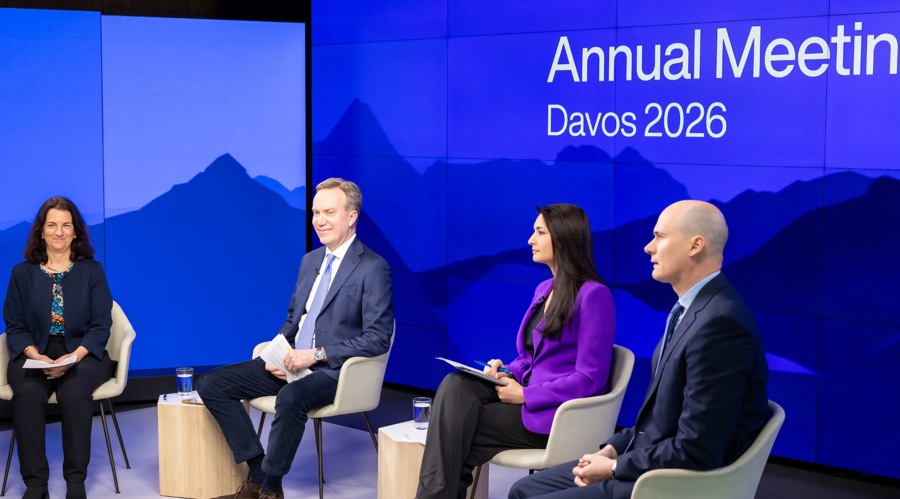
Davos 2026: Crypto Debate Shifts from ‘If’ to ‘How’ as Tokenization and Stablecoins Take Center Stage

Friday, 16/01/2026 | 13:32 GMT by Tanya Chepkova
  • Davos 2026 shows financial institutions moving from debating digital assets to testing where tokenization and stablecoins could fit within existing market infrastructure.
  • The agenda reflects a shift toward controlled experimentation with digital asset technologies under emerging regulatory frameworks.
Davos 2026
Davos 2026

The conversation around digital assets at the World Economic Forum’s Annual Meeting in Davos is becoming more concrete. Discussion is shifting from speculative debates on crypto’s long-term viability to practical questions, such as integration into traditional finance.

The shift is visible in this year’s official agenda, which reflects a growing focus on implementation rather than ideology. In 2025, the only official crypto-related session at Davos was titled “Crypto at a Crossroads,” a broad discussion centered on regulatory uncertainty and the sector’s future direction.

In 2026, that focus has sharpened. The agenda now includes two dedicated, high-level sessions: “Is Tokenization the Future?” and “Where Are We on Stablecoins?”

The speaker line-up underscores this change in tone. Crypto executives such as Coinbase CEO Brian Armstrong and Circle CEO Jeremy Allaire are appearing alongside senior public-sector and market-infrastructure figures, including the Governor of the Central Bank of France and the CEO of global settlement provider Euroclear.

Two Areas Drawing Institutional Attention

The Davos discussions point to two areas where financial institutions are now actively testing how digital assets could fit into existing systems.

First, tokenization is discussed less as a concept and more as an operational challenge. Panels are focused on how on-chain representations of real-world assets might be deployed at scale, with attention to governance, custody, and market infrastructure. The shift follows a year in which tokenized government bonds and money-market products gained traction among institutional users.

Second, stablecoins are increasingly framed as a payments and settlement tool rather than a trading instrument. Davos sessions are examining how stablecoins could be used in cross-border payments, treasury operations, and wholesale settlement, and how they intersect with existing banking and reserve-currency frameworks.

This more practical framing has been supported by regulatory developments in 2025. Frameworks such as the EU’s MiCA regime and the U.S. GENIUS Act have provided clearer parameters for stablecoin issuance and oversight, reducing uncertainty for institutions exploring limited use cases.

That clarity has coincided with initiatives from large financial and payments firms, including BlackRock and PayPal, which have begun experimenting with tokenized and stablecoin-based products.

From Debate to Experimentation

The Davos 2026 agenda does not suggest that digital asset integration is settled or uniform. Many operational, legal, and cross-border questions remain unresolved, particularly around interoperability, risk management, and supervisory coordination. What it does indicate is a change in emphasis.

For policymakers, market infrastructure providers, and large financial institutions, the discussion has shifted away from whether digital assets belong in the financial system and toward where — and under what constraints — they might be deployed.

For professional audience, the takeaway is less about declarations of victory and more about signal value. Davos 2026 reflects a phase in which tokenization and stablecoins are being treated as technologies to be tested within existing financial architecture, rather than as parallel systems. How far that experimentation goes will depend less on rhetoric and more on execution.

The conversation around digital assets at the World Economic Forum’s Annual Meeting in Davos is becoming more concrete. Discussion is shifting from speculative debates on crypto’s long-term viability to practical questions, such as integration into traditional finance.

The shift is visible in this year’s official agenda, which reflects a growing focus on implementation rather than ideology. In 2025, the only official crypto-related session at Davos was titled “Crypto at a Crossroads,” a broad discussion centered on regulatory uncertainty and the sector’s future direction.

In 2026, that focus has sharpened. The agenda now includes two dedicated, high-level sessions: “Is Tokenization the Future?” and “Where Are We on Stablecoins?”

The speaker line-up underscores this change in tone. Crypto executives such as Coinbase CEO Brian Armstrong and Circle CEO Jeremy Allaire are appearing alongside senior public-sector and market-infrastructure figures, including the Governor of the Central Bank of France and the CEO of global settlement provider Euroclear.

Two Areas Drawing Institutional Attention

The Davos discussions point to two areas where financial institutions are now actively testing how digital assets could fit into existing systems.

First, tokenization is discussed less as a concept and more as an operational challenge. Panels are focused on how on-chain representations of real-world assets might be deployed at scale, with attention to governance, custody, and market infrastructure. The shift follows a year in which tokenized government bonds and money-market products gained traction among institutional users.

Second, stablecoins are increasingly framed as a payments and settlement tool rather than a trading instrument. Davos sessions are examining how stablecoins could be used in cross-border payments, treasury operations, and wholesale settlement, and how they intersect with existing banking and reserve-currency frameworks.

This more practical framing has been supported by regulatory developments in 2025. Frameworks such as the EU’s MiCA regime and the U.S. GENIUS Act have provided clearer parameters for stablecoin issuance and oversight, reducing uncertainty for institutions exploring limited use cases.

That clarity has coincided with initiatives from large financial and payments firms, including BlackRock and PayPal, which have begun experimenting with tokenized and stablecoin-based products.

From Debate to Experimentation

The Davos 2026 agenda does not suggest that digital asset integration is settled or uniform. Many operational, legal, and cross-border questions remain unresolved, particularly around interoperability, risk management, and supervisory coordination. What it does indicate is a change in emphasis.

For policymakers, market infrastructure providers, and large financial institutions, the discussion has shifted away from whether digital assets belong in the financial system and toward where — and under what constraints — they might be deployed.

For professional audience, the takeaway is less about declarations of victory and more about signal value. Davos 2026 reflects a phase in which tokenization and stablecoins are being treated as technologies to be tested within existing financial architecture, rather than as parallel systems. How far that experimentation goes will depend less on rhetoric and more on execution.

About the Author: Tanya Chepkova
Tanya Chepkova
  • 68 Articles
About the Author: Tanya Chepkova
  • 68 Articles

More from the Author

CryptoCurrency

!"#$%&'()*+,-./0123456789:;<=>?@ABCDEFGHIJKLMNOPQRSTUVWXYZ[\]^_`abcdefghijklmnopqrstuvwxyz{|} !"#$%&'()*+,-./0123456789:;<=>?@ABCDEFGHIJKLMNOPQRSTUVWXYZ[\]^_`abcdefghijklmnopqrstuvwxyz{|}