Overall fees reached $96,100, including depreciation and stock compensation.
Miners are responding by diversifying into AI operations and securing strategic power contracts.
Publicly
listed Bitcoin (BTC) miners from Wall Street are grappling with escalating
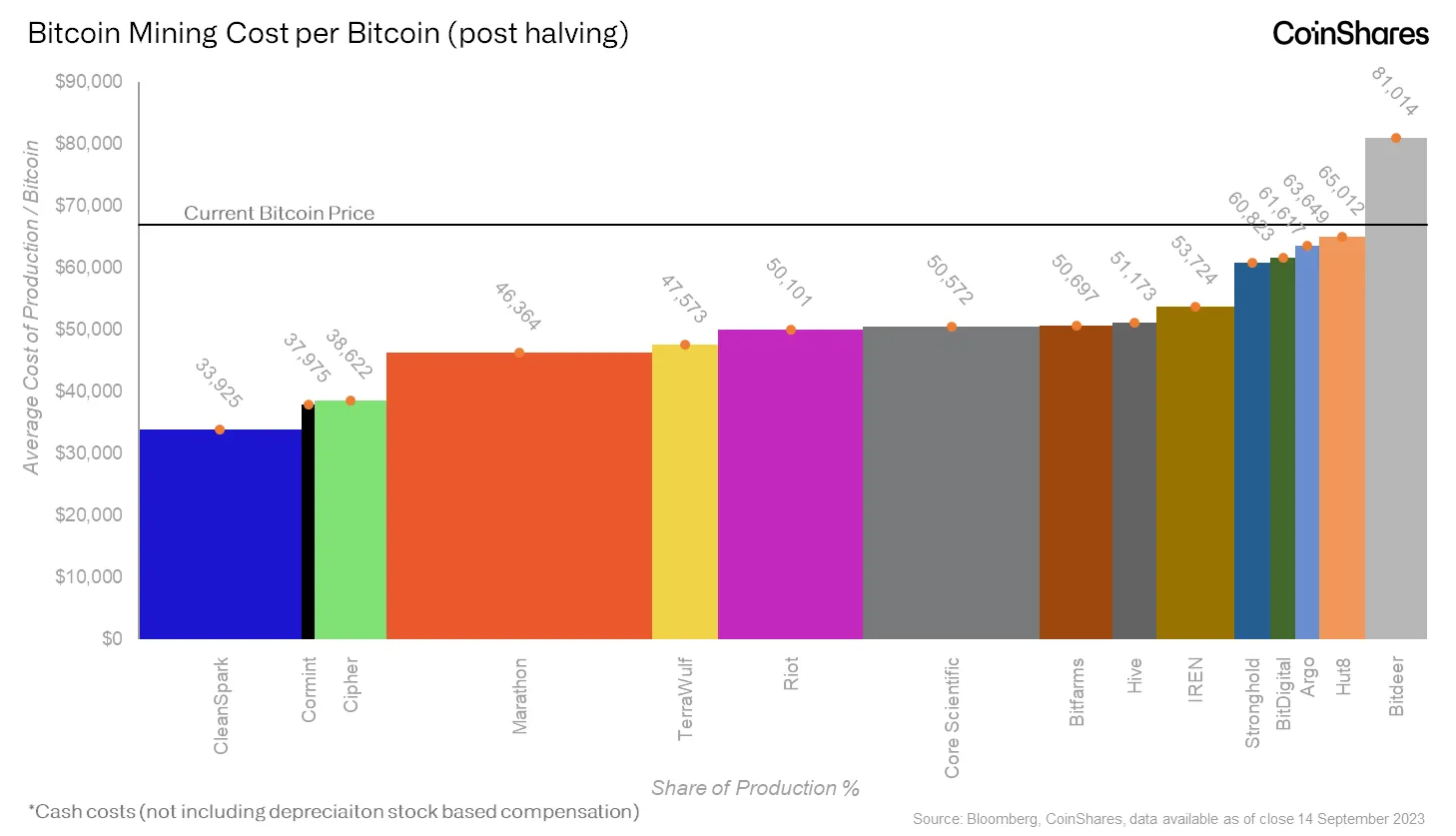
production costs, with the average expense to mine one token reaching $49,500
in the second quarter, highlighting the growing challenges in the
cryptocurrency mining sector.
Bitcoin Miners Face
Profitability Squeeze as Production Costs Soar
The
increasing costs, driven by rising electricity prices and record-high mining
difficulty levels, have forced many mining operations to pivot their business
strategies. When accounting for depreciation and stock-based compensation, the
total cost surges to $96,100 per bitcoin, putting significant pressure on
miners' profit margins.
“The
Bitcoin mining industry has faced significant challenges this year, with
revenues and hash prices declining,” CoinShares
commented in the newest report. Overall market activity “has pushed mining
difficulty levels to new highs, intensifying the issue of high production costs.”
Source: CoinShares
Mining
companies are implementing various approaches to combat these rising expenses.
For example, TeraWulf has positioned itself as an industry leader in cost
reduction, achieving production costs of $18,700 per Bitcoin through strategic
power contracts, including a fixed-rate agreement with a nuclear facility at
$0.02 per kilowatt-hour. Their success stems from a fixed-cost power agreement
with a nuclear facility at $0.02/kWh, valid until August 2027.
In response
to these challenges, mining companies are increasingly diversifying their
revenue streams, with several incorporating artificial intelligence (AI) operations
into their business models. Core Scientific has emerged as a pioneer in this
transition, securing a significant 12-year, $8.7 billion deal with Coreweave
for AI infrastructure.
In 2023, Finance
Magnates reported that following
a challenging 2022, cryptocurrency miners began turning to high-performance
computing (HPC) and AI: both highly energy-intensive sectors.
VanEck's head of digital assets research, Matthew Sigel
A
report from VanEck in August this year confirmed this shift, with Matthew
Sigel, VanEck’s head of digital assets research, noting that a pivot from BTC
mining to HPC and AI could potentially generate $38 billion in value for mining
companies by 2027.
“AI
companies need energy, and Bitcoin miners have it,” Sigel commented. “As the
market values the growing AI/HPC data center market, access to power—especially
in the near term—is commanding a premium.”
This
transition has been apparent since last year. For example, HIVE Blockchain
rebranded to HIVE
Digital to reflect its evolving business model, which now includes both BTC
mining and support for HPC and AI industries. The company anticipates that this
diversification will double
its revenue and has announced plans for a new hydroelectric data center to
support these operations.
Bitcoin HODL-ing Looks
More Profitable
A
comparative analysis of mining versus direct Bitcoin investment reveals
interesting dynamics (check the infographic above). A standard 1 MW mining project utilizing advanced equipment like the Canaan Avalon A1566 requires approximately $740,000 in initial investment. With Bitcoin projected to reach
$130,000 by late 2026, operators could achieve full capital recovery within 27
months, assuming stable electricity costs at $0.045 per kilowatt-hour.
However,
for mining operations to match the returns of direct Bitcoin investment, mining
fee revenue would need to increase dramatically to approximately 70% of total
daily issuance over the next four years. Given the historical average of 5%, this represents a significant challenge.
Industry Outlook
The mining
network's growth trajectory suggests significant expansion ahead. Current
modeling indicates the network hashrate will approach 765 EH/s by year-end
2024, representing a substantial increase from the present 684 EH/s.
Looking
further ahead, the industry faces an interesting inflection point regarding
energy utilization. The potential conversion of globally flared gas, estimated
at 150 billion cubic meters annually, could support sustained growth while
potentially reducing carbon emissions by 63% by 2050.
Publicly
listed Bitcoin (BTC) miners from Wall Street are grappling with escalating
production costs, with the average expense to mine one token reaching $49,500
in the second quarter, highlighting the growing challenges in the
cryptocurrency mining sector.
Bitcoin Miners Face
Profitability Squeeze as Production Costs Soar
The
increasing costs, driven by rising electricity prices and record-high mining
difficulty levels, have forced many mining operations to pivot their business
strategies. When accounting for depreciation and stock-based compensation, the
total cost surges to $96,100 per bitcoin, putting significant pressure on
miners' profit margins.
“The
Bitcoin mining industry has faced significant challenges this year, with
revenues and hash prices declining,” CoinShares
commented in the newest report. Overall market activity “has pushed mining
difficulty levels to new highs, intensifying the issue of high production costs.”
Source: CoinShares
Mining
companies are implementing various approaches to combat these rising expenses.
For example, TeraWulf has positioned itself as an industry leader in cost
reduction, achieving production costs of $18,700 per Bitcoin through strategic
power contracts, including a fixed-rate agreement with a nuclear facility at
$0.02 per kilowatt-hour. Their success stems from a fixed-cost power agreement
with a nuclear facility at $0.02/kWh, valid until August 2027.
In response
to these challenges, mining companies are increasingly diversifying their
revenue streams, with several incorporating artificial intelligence (AI) operations
into their business models. Core Scientific has emerged as a pioneer in this
transition, securing a significant 12-year, $8.7 billion deal with Coreweave
for AI infrastructure.
In 2023, Finance
Magnates reported that following
a challenging 2022, cryptocurrency miners began turning to high-performance
computing (HPC) and AI: both highly energy-intensive sectors.
VanEck's head of digital assets research, Matthew Sigel
A
report from VanEck in August this year confirmed this shift, with Matthew
Sigel, VanEck’s head of digital assets research, noting that a pivot from BTC
mining to HPC and AI could potentially generate $38 billion in value for mining
companies by 2027.
“AI
companies need energy, and Bitcoin miners have it,” Sigel commented. “As the
market values the growing AI/HPC data center market, access to power—especially
in the near term—is commanding a premium.”
This
transition has been apparent since last year. For example, HIVE Blockchain
rebranded to HIVE
Digital to reflect its evolving business model, which now includes both BTC
mining and support for HPC and AI industries. The company anticipates that this
diversification will double
its revenue and has announced plans for a new hydroelectric data center to
support these operations.
Bitcoin HODL-ing Looks
More Profitable
A
comparative analysis of mining versus direct Bitcoin investment reveals
interesting dynamics (check the infographic above). A standard 1 MW mining project utilizing advanced equipment like the Canaan Avalon A1566 requires approximately $740,000 in initial investment. With Bitcoin projected to reach
$130,000 by late 2026, operators could achieve full capital recovery within 27
months, assuming stable electricity costs at $0.045 per kilowatt-hour.
However,
for mining operations to match the returns of direct Bitcoin investment, mining
fee revenue would need to increase dramatically to approximately 70% of total
daily issuance over the next four years. Given the historical average of 5%, this represents a significant challenge.
Industry Outlook
The mining
network's growth trajectory suggests significant expansion ahead. Current
modeling indicates the network hashrate will approach 765 EH/s by year-end
2024, representing a substantial increase from the present 684 EH/s.
Looking
further ahead, the industry faces an interesting inflection point regarding
energy utilization. The potential conversion of globally flared gas, estimated
at 150 billion cubic meters annually, could support sustained growth while
potentially reducing carbon emissions by 63% by 2050.
Damian Chmiel is a Senior Analyst & Editor at Finance Magnates with more than 15 years of experience in the CFD and online trading industry. Active as both a trader and journalist since 2010, he focuses on broker coverage, fintech innovation, and regulatory developments across Europe, the Middle East, and Asia.
His work includes interviews with C-level leaders at major brokerages and fintech platforms, as well as co-authoring Finance Magnates’ quarterly industry benchmarking reports. Damian’s reporting is data-driven, market-aware, and grounded in direct industry engagement. His analysis and commentary have also been cited by external media outlets, including Investing.com, Binance, The Asset, Stockhead, and Dispatch.
Education:
MA in Finance and Accounting, Cracow University of Economics
Kraken Steps Up Speed Race with New Equinix Colocation Service for Crypto Traders
FP Markets Winner Spotlight 🏆 | Global Broker of the Year 2025 #Trading #Broker #Innovation #Shorts
FP Markets Winner Spotlight 🏆 | Global Broker of the Year 2025 #Trading #Broker #Innovation #Shorts
FP Markets takes the spotlight as Global Broker of the Year 2025 at the Finance Magnates Awards.
Martin Stoilov, Head of Client Experience, shares that trust, innovation, and people played a key role in the company’s success, supported by a strong foundation of integrity and client-centricity.
Following this milestone, FP Markets continues to focus on growth, technology investment, and its core values of transparency and excellence.
👉 Be part of FM Awards 2026: https://awards.financemagnates.com/#nominate
FP Markets takes the spotlight as Global Broker of the Year 2025 at the Finance Magnates Awards.
Martin Stoilov, Head of Client Experience, shares that trust, innovation, and people played a key role in the company’s success, supported by a strong foundation of integrity and client-centricity.
Following this milestone, FP Markets continues to focus on growth, technology investment, and its core values of transparency and excellence.
👉 Be part of FM Awards 2026: https://awards.financemagnates.com/#nominate
In this video, we review @HolaPrimeMarketsOfficial, a multi-asset forex and CFDs broker offering different account types, trading platforms, and flexible trading conditions.
We cover the broker’s overall offering, including account options, trading environment, platforms like MT4 and MT5, and additional services such as managed accounts and fast withdrawals.
Watch the full video to see if Hola Prime Markets fits your trading needs.
📣 Stay up to date with the latest in finance and trading. Follow Finance Magnates for industry news, insights, and global event coverage.
Connect with us:
🔗 LinkedIn: /financemagnates
👍 Facebook: /financemagnates
📸 Instagram: https://www.instagram.com/financemagnates
🐦 X: https://x.com/financemagnates
🎥 TikTok: https://www.tiktok.com/tag/financemagnates
▶️ YouTube: /@financemagnates_official
#HolaPrime #ForexBroker #CFDTrading #FinanceMagnates #Trading #Forex #BrokerReview
In this video, we review @HolaPrimeMarketsOfficial, a multi-asset forex and CFDs broker offering different account types, trading platforms, and flexible trading conditions.
We cover the broker’s overall offering, including account options, trading environment, platforms like MT4 and MT5, and additional services such as managed accounts and fast withdrawals.
Watch the full video to see if Hola Prime Markets fits your trading needs.
📣 Stay up to date with the latest in finance and trading. Follow Finance Magnates for industry news, insights, and global event coverage.
Connect with us:
🔗 LinkedIn: /financemagnates
👍 Facebook: /financemagnates
📸 Instagram: https://www.instagram.com/financemagnates
🐦 X: https://x.com/financemagnates
🎥 TikTok: https://www.tiktok.com/tag/financemagnates
▶️ YouTube: /@financemagnates_official
#HolaPrime #ForexBroker #CFDTrading #FinanceMagnates #Trading #Forex #BrokerReview
Hola Prime Review: What You Need to Know | Full Breakdown by Finance Magnates
Hola Prime Review: What You Need to Know | Full Breakdown by Finance Magnates
In this video, we review @HolaPrime_Global, a proprietary trading firm offering evaluation programs and performance-based payouts in simulated market environments.
We cover how the challenge model works, including account types, profit splits (up to 95%), trading rules, and what it takes to reach a funded account. You’ll also learn about available platforms like MT4, MT5, cTrader, and more, along with insights into payouts, support, and trading conditions.
Watch the full video to see if Hola Prime fits your trading style.
📣 Stay up to date with the latest in finance and trading. Follow Finance Magnates for industry news, insights, and global event coverage.
Connect with us:
🔗 LinkedIn: /financemagnates
👍 Facebook: /financemagnates
📸 Instagram: https://www.instagram.com/financemagnates
🐦 X: https://x.com/financemagnates
🎥 TikTok: https://www.tiktok.com/tag/financemagnates
▶️ YouTube: /@financemagnates_official
#HolaPrime #PropFirm #Trading #FinanceMagnates #Forex #FuturesTrading #TradingReview #PropFirmReview
In this video, we review @HolaPrime_Global, a proprietary trading firm offering evaluation programs and performance-based payouts in simulated market environments.
We cover how the challenge model works, including account types, profit splits (up to 95%), trading rules, and what it takes to reach a funded account. You’ll also learn about available platforms like MT4, MT5, cTrader, and more, along with insights into payouts, support, and trading conditions.
Watch the full video to see if Hola Prime fits your trading style.
📣 Stay up to date with the latest in finance and trading. Follow Finance Magnates for industry news, insights, and global event coverage.
Connect with us:
🔗 LinkedIn: /financemagnates
👍 Facebook: /financemagnates
📸 Instagram: https://www.instagram.com/financemagnates
🐦 X: https://x.com/financemagnates
🎥 TikTok: https://www.tiktok.com/tag/financemagnates
▶️ YouTube: /@financemagnates_official
#HolaPrime #PropFirm #Trading #FinanceMagnates #Forex #FuturesTrading #TradingReview #PropFirmReview
Axi Winner Spotlight 🏆 | Global Most Innovative Broker 2025 #Innovation #Trading #Fintech #Broker
Axi Winner Spotlight 🏆 | Global Most Innovative Broker 2025 #Innovation #Trading #Fintech #Broker
Axi takes the spotlight at the Finance Magnates Awards, winning Global Most Innovative Broker 2025.
Olivia Xenofontos and Ivanna Openko share how the team will feel: proud, motivated, and ready to keep delivering.
They also describe the night as well-organized, focused, and enjoyable for all.
👉 Be part of FM Awards 2026.
Axi takes the spotlight at the Finance Magnates Awards, winning Global Most Innovative Broker 2025.
Olivia Xenofontos and Ivanna Openko share how the team will feel: proud, motivated, and ready to keep delivering.
They also describe the night as well-organized, focused, and enjoyable for all.
👉 Be part of FM Awards 2026.
Recognition that matters.
Built on transparency.
Driven by the industry.
The Finance Magnates Awards 2026.
Nominations are now open.
🔗 https://awards.financemagnates.com/?utm_source=SM&utm_medium=social&utm_campaign=recognition-matters
Recognition that matters.
Built on transparency.
Driven by the industry.
The Finance Magnates Awards 2026.
Nominations are now open.
🔗 https://awards.financemagnates.com/?utm_source=SM&utm_medium=social&utm_campaign=recognition-matters